

Turn recordings into transcripts and summaries in minutes
Upload audio or video for multilingual transcription, AI notes, and action items
2026 Real-Time Recording Tools Compared: Which Can Transcribe While Recording?
Five Minutes Into the Meeting, You Realize No One Is Taking Notes
It's 2 PM on a Wednesday, and the online meeting starts on time. Your manager is on the third key point when they suddenly say, "We need to keep this conclusion."
Only then do you remember to start recording. By the time the meeting ends, the audio file is sitting on your computer, and you spend the next hour and a half with headphones on, rewinding over and over, typing out a transcript word by word.
Another scenario is an interview. You need to take notes on the spot, so you open your phone's built-in recorder. When you're done, all you have is a file with no name and no highlights. Three days later, when you want to find that one thing the client said, you have to listen from the beginning again.
Then there's the cross-language meeting. The other person speaks English, you speak Chinese, and after the meeting you have to translate first, then organize the key points.
What all these situations have in common is this: recording itself isn't hard—it's what comes after that's the challenge.
Before Choosing a Real-Time Recording Tool, Understand These 4 Key Points
First, do you want an audio file, or content you can actually use? Free online voice recorders almost all let you click to start recording in your browser, but the output is just an MP3 or WAV. If you still need to type up a transcript and pull out action items afterward, you've only done a third of the work.
Second, can it capture the sound from your computer? A microphone only picks up voices in the room; online meeting audio lives inside the system. If a tool can't capture system audio, you're stuck holding your phone up to the speaker. This makes a huge difference in real use.
Third, how well does it handle Chinese and mixed Chinese-English? Meetings in Taiwan are rarely pure Chinese or pure English—it's usually sentences like "Give me this deadline by next Wednesday." How a tool handles mixed Chinese-English directly affects whether the transcript is usable.
Fourth, where does the data end up? For personal use, as long as you can find it, that's fine. But for a team, whether meeting data should be stored centrally and whether it's still accessible after a member leaves is a whole different level of concern.
These four points are also what I cared about most during this hands-on test.
Tinrec: After Real-Time Recording Is Where It Really Works
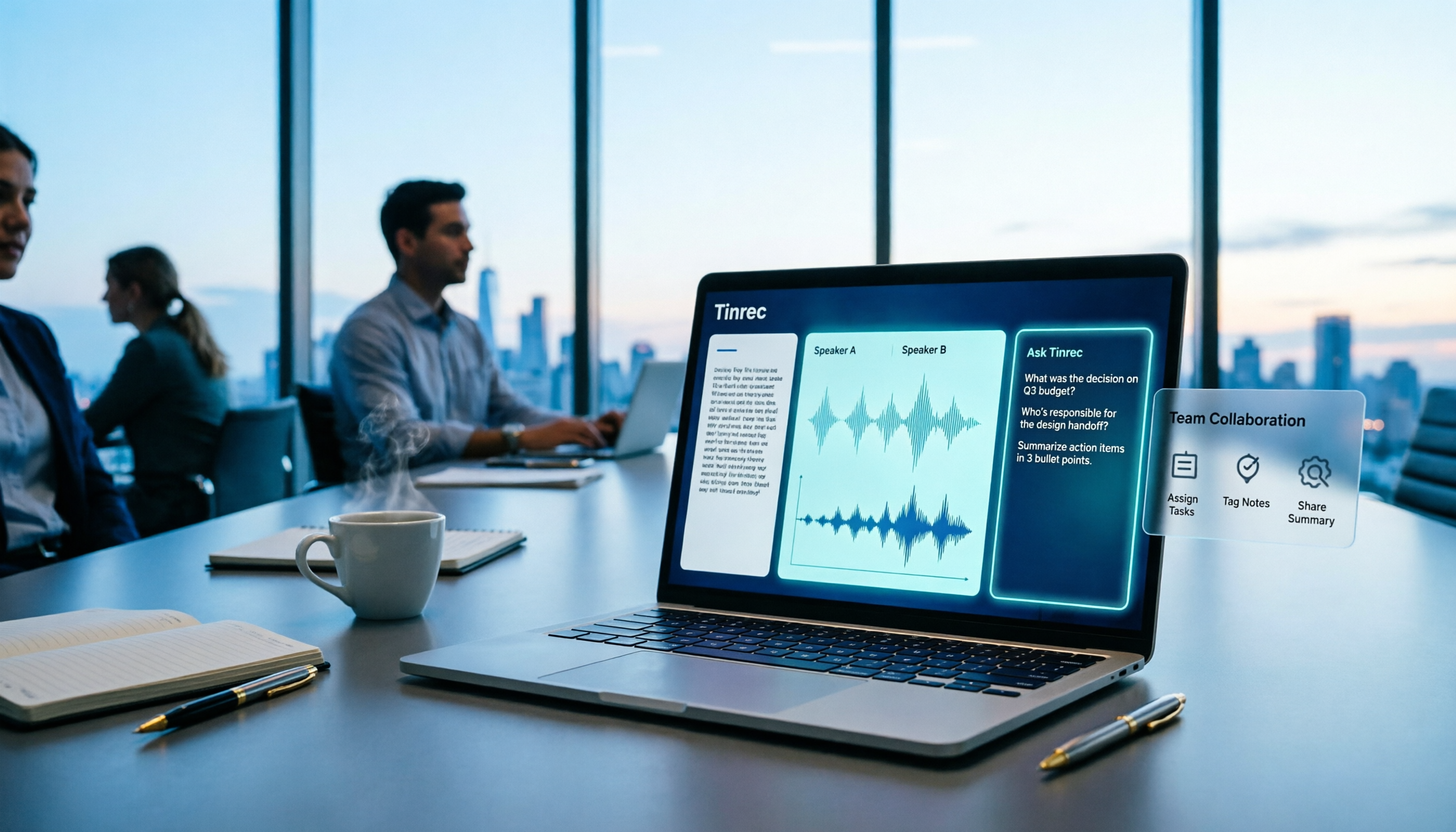
Tinrec is an AI meeting notes and collaboration tool for individuals and teams, supporting iOS, Android, and web, with a desktop version that handles system audio for online meetings.
I'm putting it first because when it comes to real-time recording, it doesn't just handle the "recording"—it handles what comes after.
No more summoning a meeting bot. The Tinrec desktop app directly captures your computer's system audio, so it works with Zoom, Google Meet, Microsoft Teams, and Webex meetings without needing a separate bot account to join as a participant. For external client meetings, this is very practical—you don't want the other side to see a stranger's account on the participant list.
Transcribes as you record, with real-time translation. Text starts appearing while you're recording, so you can follow along during the meeting. For cross-language meetings, you can switch between original text, translation, or bilingual view without waiting until the meeting ends.
After recording, AI pulls out the key points for you. When the meeting ends, it automatically generates a summary, chapters, and action items—who's responsible for what and when it's due, all listed out. Even better is AI Q&A: you can directly ask it "Who mentioned the budget in the last meeting?" and it will give you an answer based on meaning, not just a list of keyword search results.
The content can keep working for you. Transcripts can be exported to Notion, Google Docs, OneNote, Dropbox, and other tools, and you can also ask it to generate reports, tables, or meeting minutes.
Three Reasons I Think It's Worth It
- Real-time recording and online meetings use the same workflow. Record in-person meetings with your phone or the web version, record online meetings with the desktop version, and everything ends up in the same place—no need to manage two separate tools.
- Chinese meetings are its home turf. It handles Chinese, Traditional Chinese, and mixed Chinese-English content, and supports team hotwords so you can add internal company terms and product codes.
- The team version turns meetings into lasting data. Meeting data in team spaces belongs to the team, so new members can directly view past meetings; when a member leaves or loses their seat, the data doesn't disappear with their personal account. Admins can also view roles, seats, usage analytics, and activity logs.
Stop organizing recordings by hand
Upload audio or video and automatically get a transcript, summary, and action items
Things to Note
The free version offers a basic quota, good for trying it out; if you have several meetings to organize every week, you'll need to move to a paid plan.
Also, to be honest: transcription quality is affected by audio quality, background noise, accents, and people talking over each other. For important content, it's best to cross-check with the recording playback. Tinrec's strength is meetings and content organization—if you just want to "record a bit of audio and save it as MP3," a free online voice recorder is enough.
Plans and Pricing
The personal version is divided into Free, Weekly Pass, Pro Monthly, and Pro Annual, chosen by usage frequency: for occasional recording organization, start with the free version; for short-term intensive meetings, consider the weekly pass; for steady weekly needs, Pro is suitable; for long-term accumulation of recording data, look at the annual plan.
The team version is priced per paid seat: monthly is USD 29.80 per paid seat per month, annual is USD 199 per paid seat per year (about USD 16.58 per month). Eligible teams can try it for 7 days for the first time, with 1 free seat and 300 minutes of shared team import quota. Each paid seat provides 2,000 minutes of shared team import quota per month; under an active team plan and active seat, real-time recording currently does not deduct minutes—only file and web link imports use the shared team quota.
Who It's For
If you need to record Chinese or mixed Chinese-English meetings, don't want a meeting bot to join, want to use AI to find key points right after recording, or want team meeting data to accumulate centrally, Tinrec is currently the smoothest choice.
Besides Tinrec, What Other Options Are There?
Free Online Voice Recorders (FlexClip, Online Voice Recorder, piliapp online recorder) Open your browser, authorize the microphone, and you can record. Some tools even let you trim and merge directly on the web page, and some claim recordings aren't uploaded to a server for privacy, with output mostly in MP3 or WAV. Suitable for people who need a quick audio memo. But these tools only give you an audio file—no transcript, no summary, no action items, and no way to ask "What was that conclusion just now?"
Bandicam A veteran recording tool on Windows. Its audio mode can record both computer sound and microphone simultaneously, can start and stop automatically at set times, and has external noise suppression—great for people who regularly record broadcasts or online courses. Its positioning is recording software, with output in high-quality MP3 or WAV, and you still have to organize everything yourself afterward; Tinrec, on the other hand, does the transcript, summary, Q&A, and team archiving all in one.
Granola Also takes a bot-free approach, transcribing in real time through desktop system audio and combining it with the user's own handwritten notes. Basic is free, Business is USD 14 per user per month, Enterprise is USD 35 per user per month. Note that it doesn't support uploading pre-recorded audio files and doesn't retain meeting audio files; if you need to import existing recordings, need real-time Chinese translation, or want to keep audio files for later cross-checking, Tinrec is more suitable.
Pitfall Guide: The 3 Most Common Mistakes When Choosing a Real-Time Recording Tool
Pitfall 1: Only looking at "can it record," not "what happens after recording." Many tools' free versions can record, but the output is just a file. First figure out whether you need a transcript and action items after recording, then decide whether to pay for post-processing features.
Pitfall 2: Ignoring the system audio issue. Online meeting audio doesn't go into the microphone. If a tool can only record from the microphone, you'll capture the ambient sound in the room, and the content may be choppy. When choosing a tool, first confirm whether it can handle sound played from the computer.
Pitfall 3: Not paying attention to team data ownership. For personal use it doesn't matter, but if a team records all meetings on personal accounts, once someone leaves, the data goes with them. If you have team needs, choosing a tool with team spaces, seat management, and resource handover mechanisms will save you a lot of trouble.
Conclusion: Which One Should You Actually Choose?
Simply put, it depends on how much time you'll spend after recording.
- Need real-time transcription for Chinese or mixed Chinese-English meetings → Tinrec (Chinese experience is its home turf)
- Don't want a meeting bot to join online meetings → Tinrec (desktop version captures system audio)
- Want to ask AI directly after recording "Who mentioned the budget last time?" → Tinrec (AI Q&A)
- Team needs to share meeting data, manage members and seats → Tinrec team version
- Just need an audio memo, no transcript needed → a free online voice recorder is enough
- Mainly recording Windows system audio, need scheduled start/stop → Bandicam
- Pure English meetings, used to writing your own notes → Granola is worth considering
If this is your first time with this kind of tool, I suggest using Tinrec's free version to record a meeting first, see whether the transcript and summary help you, and then decide whether to move to a paid plan.
References
- Free Online Voice Recorder - Record Audio with Microphone | FlexClip
- Online Voice Recorder - Record via Microphone
- Bandicam Best Audio Recording Software | Free Recording Tool Supports System and Microphone (Windows)
- Online Voice Recorder
- Online Voice Recorder — Free Editing and Export to MP3/WAV/WebM
Turn every recording into actionable outcomes
Get 60 free transcription minutes when you sign in. No credit card required.
Related Reading
You might also like

What Is Real-Time Transcription in 2026: Definition, 4 Key Factors, and Tool Comparison
What is real-time transcription and how does it differ from transcribing recordings? This article explains the definition and how it works in plain language, outlines 4 key factors to consider, and compares Google Live Transcribe, Yating, Notta, and Tinrec in Chinese meetings, post-meeting organization, and team collaboration, with scenario-based recommendations.

4 Meeting Transcription Tools Tested: Which AI Saves the Most Time on Chinese Transcripts and Summaries?
After a meeting, do you spend another two hours organizing the audio recording? This article compares four meeting transcription tools—Tinrec, Notta, Otter.ai, and Granola—on Chinese transcription, AI summaries and action items, bot-free recording, team collaboration, and pricing to help you find the most time-saving solution.

3 iPhone Audio-to-Text Apps Tested in 2026: How Long Can You Record and Which Saves the Most Time After Meetings?
How long can an iPhone actually record? This article first breaks down the storage, battery, and file interruption risks of the built-in Voice Memos app, then compares 3 audio-to-text tools from a student's perspective—covering free quotas, single-recording limits, post-meeting organization, and AI Q&A capabilities—to help you decide whether the built-in recorder is enough or if you need an AI recording assistant that delivers key points right after recording.
Google Live Transcribe vs Tinrec in 2026: 5-Dimension Comparison — Which Is Better for Meeting Notes?
Google Live Transcribe & Sound Notifications is an Android accessibility tool known for being free, providing real-time transcripts, and sending environmental sound alerts. Tinrec focuses on meeting notes and team collaboration. This article compares them across 5 dimensions—transcription and organization, online meeting recording, AI Q&A, audio file import, and team management—to help you decide which one to use for meeting notes.

3 iPhone Call Recording Solutions Compared: iOS 18 Built-in vs Tinrec in 2026
iPhone call recording finally has a built-in solution with iOS 18, but regional restrictions, legal issues, and post-call organization are the real pain points. This article compares 3 solutions: iOS 18 built-in call recording, Tinrec, and PLAUD Note with Otter.ai, helping you understand how to record calls and quickly turn them into transcripts, summaries, and action items.

5 Meeting Recording Apps Compared in 2026: From Transcripts to Team Collaboration
Meeting recording apps aren't just about audio quality—they're about what happens after the meeting. This guide breaks down five common tool approaches, covering live transcription, AI summaries, action item extraction, AI Q&A, team spaces, and seat management. Using Tinrec as an example, we walk through bot-free online meeting recording, Chinese transcription, summaries, and exports, and compare the free, Pro, and Team plans to help you decide which solution fits your meeting needs.

What Is Instant Messaging in 2026? 5 Steps to Understand the Definition and Choose Tools
What does instant messaging (IM) mean? This article starts with the definition, history, and message storage methods to help you understand the essence of synchronous communication, 4 key points for choosing tools, and compares meeting and communication organization tools like Tinrec, Otter.ai, Notta, and Granola. Finally, a pitfall guide helps you choose the right tool.

Can You Share a Recording with Others in 2026? 5 Key Legal Points and How Tinrec Helps You Organize
Whether you can share a recording with others depends on your role, purpose, and content. This article summarizes key legal points on invasion of privacy and personal data protection, and explains how to use Tinrec to turn recordings into transcripts or summaries so you only share necessary information, reducing privacy and legal risks.

5 Best AI Meeting Notes Apps of 2026: Which Free Version Is Actually Enough?
There are countless AI meeting note takers, but buying one doesn't guarantee better notes. This article starts with the most common mistakes and inefficient habits, outlines 4 key factors for choosing a meeting transcription tool, tests Tinrec's bot-free recording, AI Q&A, and team workspace, and compares Otter.ai, Notta, and TurboScribe on positioning and pricing to help you find a solution that truly saves time.