
Turn recordings into transcripts and summaries in minutes
Upload audio or video for multilingual transcription, AI notes, and action items
As a student, have you ever faced these frustrating scenarios: the professor lectures like a machine gun, and handwritten notes can't keep up; or having to organize hours of interview or course recordings at the end of the semester, with manual transcription eating up your entire weekend? It's not your fault—according to a Stanford study, human speech speed (about 200-300 words per minute) is much faster than typing or handwriting (about 60-100 words per minute), so traditional note-taking can only capture 30-40% of the content.
The good news is that with the maturity of AI voice recognition technology, there are now many tools that can help you "understand" and "organize" course content. This article evaluates 10 mainstream tools from a student's budget and use-case perspective, and provides a detailed comparison table and practical guide.
Quick Navigation Conclusion:
- Completely free, just basic notes: Go with Google Docs or iOS 18 Voice Memos first.
- Need to process long recordings and value AI summaries: Consider LexiTranscript or Tinrec (秒聽錄音) for their AI understanding capabilities.
- Specific needs: For Taiwanese Hokkien recognition, choose Yating (雅婷逐字稿); for an all-English environment, pick Otter.ai.
Why Voice-to-Text Apps Are a Must-Have for Modern Students
Before diving into tool recommendations, let's clarify why the "recorder + manual transcription" method is outdated. Modern AI recording and note-taking tools do more than just "convert to text"; they solve these learning pain points:
- Information completeness: Eliminates the speed gap between speaking and typing, preserving 100% of the lecture content.
- Search efficiency: Traditional audio files are hard to search. Once converted to text, you can press
Ctrl+Fto find the professor's mention of "final exam key points." - Versatility: From classroom lectures, thesis interview transcripts, study group notes, to online courses without captions—everything can be turned into editable notes.
Top 10 Recording-to-Notes Apps of 2025: Full Comparison
Below, we categorize the tools into three groups based on features and target users.
Category 1: Built-in & Fully Free (Ideal for Light Users)
1. Google Docs Voice Typing
- Features: Works with any Chrome browser, completely free.
- Pros: Real-time transcription, supports multiple languages.
- Cons: Cannot upload existing recordings; you must have the computer's microphone on during recording. Punctuation requires manual adjustment, and unstable network or pauses can interrupt.
2. iPhone Voice Memos (iOS 18+)
- Features: Apple native feature; iOS 18 added built-in live transcription.
- Pros: Free, works offline, well integrated.
- Cons: Requires iPhone 12 or newer; only processes audio recorded with the app—cannot import external recorder files. Accuracy around 80%, requiring manual proofreading.
3. Google Live Transcribe
- Features: Designed for the hearing impaired, a great free tool for Android users.
- Pros: Real-time, almost no delay.
- Cons: Cannot save audio for later review (text is retained for only 3 days), and does not support file import.
Category 2: AI-Powered Notes & Long Recording Specialists (Ideal for Heavy Users)
4. LexiTranscript
- Features: Designed for students, with a daily reset free quota.
- Pros: No single-file time limit (even 3-hour files work), excellent Traditional Chinese recognition, and a daily free quota.
- Cons: Requires payment if daily limit is exceeded (though student pricing is relatively affordable).
5. Tinrec (秒聽錄音)
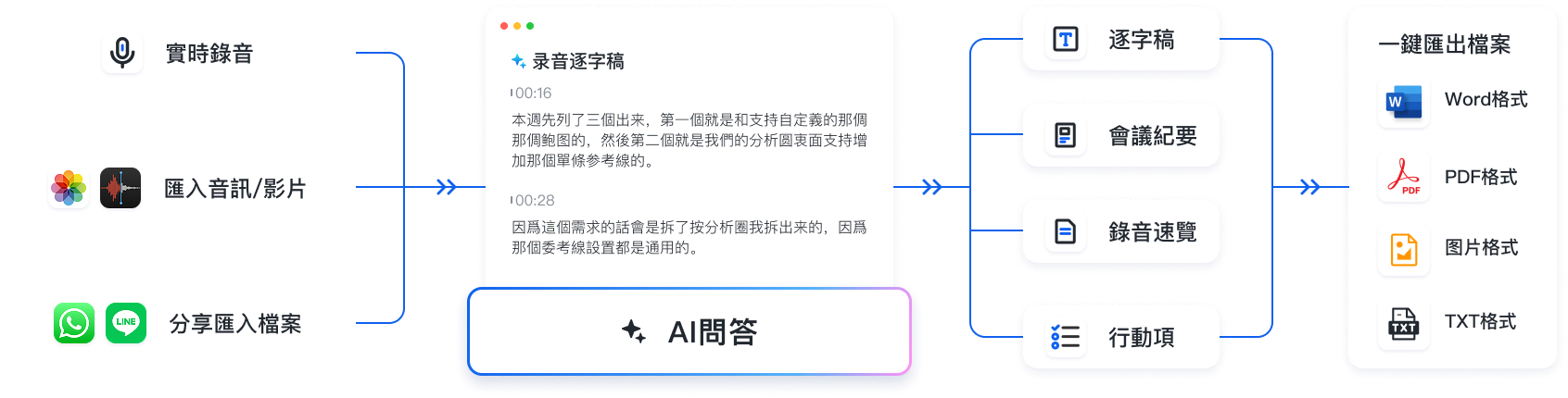
- Features: Focuses on a complete workflow of "Record → Understand → Act," providing not just transcripts but AI summaries and Q&A.
- Pros:
- Multi-platform support: Syncs across iOS, Android, and web—record on your phone in class, edit on your computer at the dorm.
- Multiple input modes: Supports live recording, audio file upload, and even YouTube/podcast links for transcription (great for online courses).
- AI chatbot: Unlike traditional tools that only show text, Tinrec lets you "ask questions about the recording" (e.g., "What did the professor say about the midterm?") to quickly extract key points.
Stop organizing recordings by hand
Upload audio or video and automatically get a transcript, summary, and action items
6. Notta.ai
- Features: Supports 104 languages and cross-platform sync.
- Pros: Can automatically join Zoom/Teams meeting recordings.
- Cons: Free quota is small (120 minutes/month), and live recording is limited to 3 minutes per session, inconvenient for long lectures.
Category 3: Niche & Tech-Savvy
7. Yating (雅婷逐字稿)
- Features: Developed by a Taiwanese team, excels in Taiwanese Hokkien and Mandarin with a Taiwanese accent.
- Use case: For qualitative research students whose interviewees often mix Taiwanese.
- Note: The free quota for file upload is very small (only 20 minutes); its strength is live recording.
8. Otter.ai
- Features: Top choice for international students in the US/Europe, excellent English recognition.
- Note: Does not support Chinese. Only suitable for fully English-taught environments.
9. Whisper (OpenAI)
- Features: Open-source model, extremely high accuracy.
- Note: Requires programming knowledge to set up, or use third-party wrappers (e.g., WhisperDesktop); technical barrier is high for non-STEM students.
10. MyEdit
- Features: Online tool, no installation needed.
- Note: Daily free quota is very limited (about 3 minutes), suitable only for testing or very short audio.
Key Spec Showdown: Feature & Free Quota Comparison
When choosing a tool, pay attention to "file upload capability" and "Chinese support." Here's a comparison of 5 representative tools:
| Dimension | Google Docs | iOS Voice Memos | Tinrec (秒聽錄音) | LexiTranscript | Otter.ai |
|---|---|---|---|---|---|
| Chinese Support | Good | Good | Excellent (incl. dialects) | Excellent | ❌ Not supported |
| Process Recordings | ❌ No | ❌ No (only internal recordings) | ✅ Yes (incl. video links) | ✅ Yes | ✅ Yes |
| Free Quota | Unlimited | Unlimited | 100 min/month | Daily reset quota | 300 min/month |
| AI Summary/Chat | None | None | ✅ Yes (Chat query) | ✅ Yes | ✅ Yes |
| Cross-Device Sync | Basic | Apple only | ✅ iOS/Android/Web | Web primarily | Multi-platform |
| Recommended Use | Short drafts | Quick notes | Key lectures/Online learning | Daily full lectures | English courses |
Practical Guide: How to Turn Lecture Recordings into Key Notes with AI
Once you have a tool, the workflow is key to efficiency. Using a well-rounded AI tool (like Tinrec or similar) as an example, here's how to turn a 2-hour lecture into a 10-minute read.
Step 1: Choose the Right Recording Mode
Most AI tools offer two entry points:
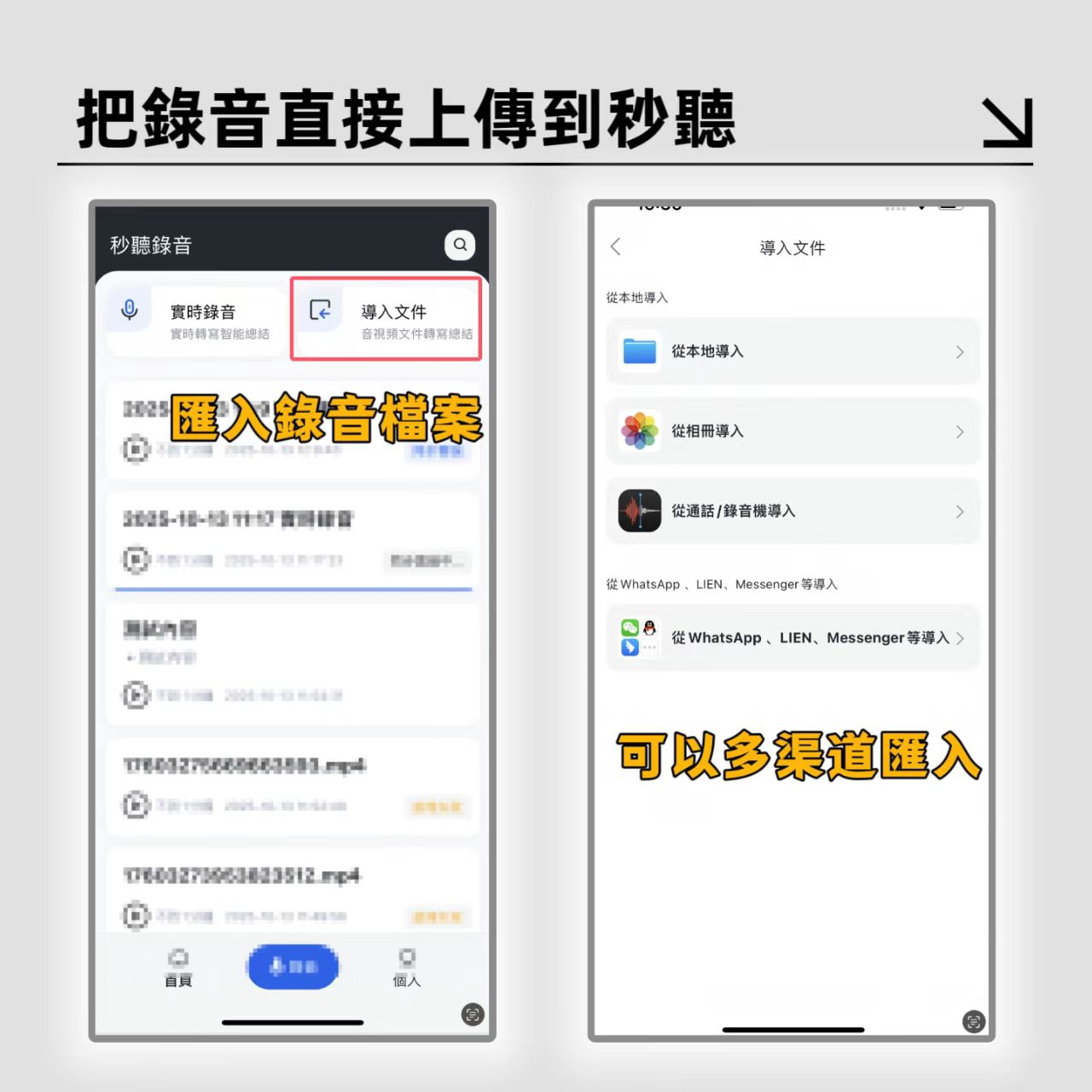
- Live recording: For in-class use. Sit close to the professor or use an external microphone. Activate the app's "live transcription" to see text in real time and confirm audio quality.
- File import: For organizing previous recordings or professor-provided online lecture videos. In Tinrec, you can paste a YouTube lecture link, and the system will automatically download the audio track and convert it to text, saving you the conversion hassle.
Step 2: Use AI for Speaker Diarization & Timeline
Long recordings are hard to navigate. After transcription, use the tool's "speaker identification" feature to separate the professor from student questions. If you spot an error, clicking the text usually jumps to the corresponding time code (timecode) for quick verification.
Step 3: AI Extraction & Chat Query (Core Technique)
This is the biggest difference between modern AI tools and traditional transcripts. Don't read from start to finish—try this instead:
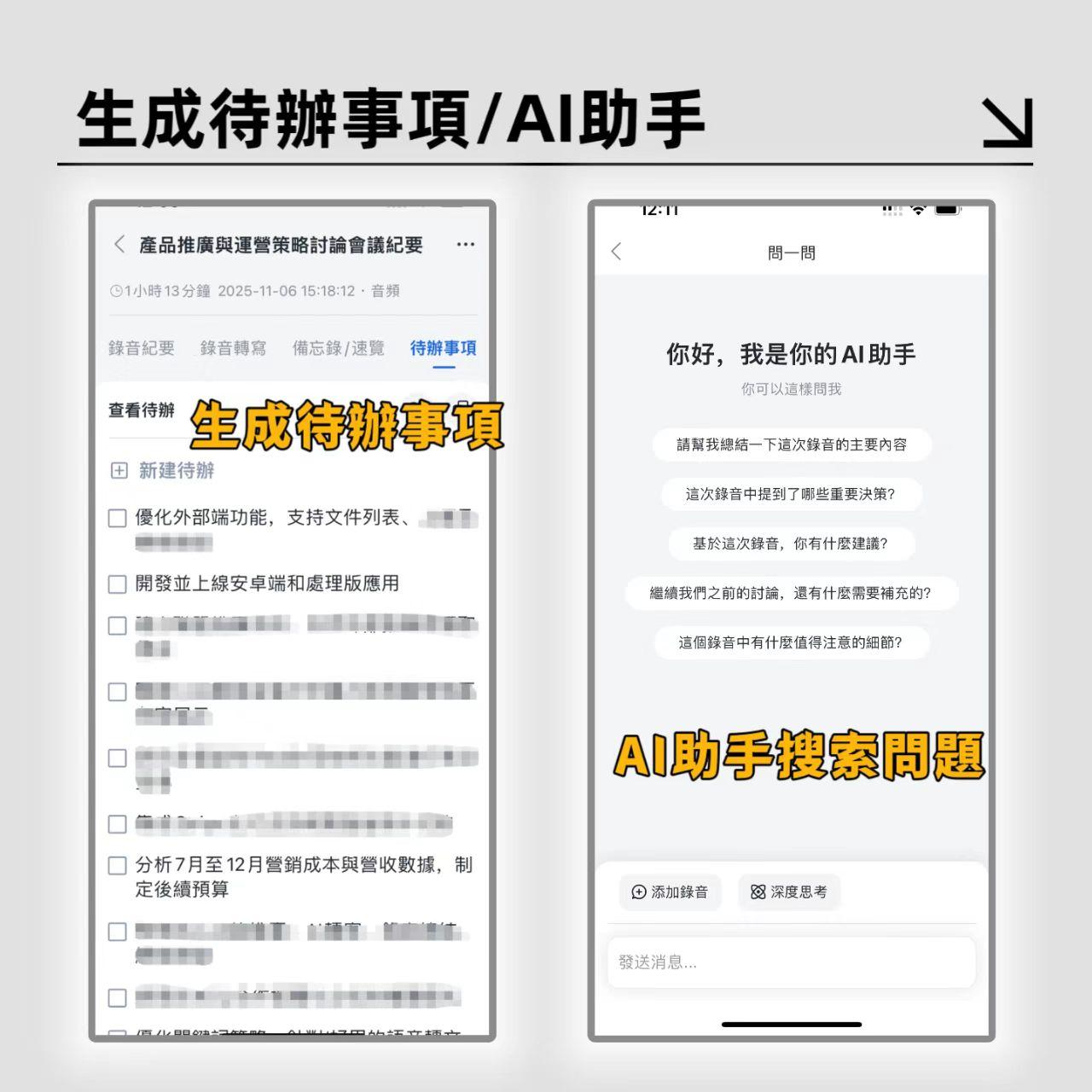
- Generate summary: Let AI automatically create a "lecture conclusion" or "action items" (e.g., next week's assignments).
- Chat query: Use the tool's AI chat function. For example, in Tinrec, you can type: "What are the exam topics mentioned in this lecture?" The AI will answer based on the recording content—much faster than searching yourself.
Frequently Asked Questions (FAQ)
Q1: What is the typical accuracy of speech-to-text?
A: In a quiet environment with good audio quality, modern AI (e.g., Whisper model or the engines used by Tinrec and LexiTranscript) can achieve over 95% accuracy. However, accuracy drops in noisy classrooms or with overlapping speakers; we recommend using a directional microphone.
Q2: Why can't I use the built-in transcription on my iPhone?
A: Make sure your iPhone is iPhone 12 or newer and updated to iOS 18.0 or later. Also, it currently only supports live recordings made with the Voice Memos app—not imported audio files.
Q3: Can I transcribe online course videos (YouTube/Coursera) into text?
A: Yes. The traditional method involved recording or downloading the video first, which is cumbersome. We recommend using a tool that supports "link parsing" (e.g., Tinrec)—just paste the video URL to get a transcript and summary.
Q4: What if my free quota runs out?
A: If you're on a budget, adopt a "hybrid strategy": use Google/iPhone built-in features for everyday notes; for final exam reviews, thesis interviews, or long online courses, use paid/freemium tools like Tinrec or LexiTranscript for high-quality AI organization.
Q5: Is my recording data secure?
A: When choosing a tool, review its privacy policy. Most paid SaaS services (like Tinrec, Otter) have strict data protection. For extremely sensitive data, consider fully offline solutions (like local Whisper).
Turn every recording into actionable outcomes
Get 60 free transcription minutes when you sign in. No credit card required.
Related Reading
You might also like

3 Speech-to-Text Tools Tested in 2026: Is the Free Version Enough? Tinrec Offers the Best Value
This tutorial reviews free speech-to-text tools, focusing on Tinrec, and shows how to use the free version to quickly convert meetings, interviews, and course recordings into transcripts and summaries. It also includes buying tips and FAQs.

2026 Tested: 4 Best Free Speech-to-Text Tools Compared – Which Free Plan Is Most Practical?
We tested 4 popular free speech-to-text tools, comparing free quotas, accuracy, and AI features to help you find the best option for meeting notes and transcripts.

2026 Hands-On Comparison of 4 Speech-to-Text Tools: Which AI Meeting Notes Really Save Time?
How do you choose a speech-to-text tool? This article tests Tinrec, Otter, Notta, and PLAUD, covering accuracy, AI summarization, cross-platform support, and team collaboration to help you find the best meeting notes solution.

4 iOS Voice-to-Text Apps Tested in 2026: Tinrec's AI Meeting Notes Save You Hours of Organizing
This article tests 4 iOS voice-to-text tools, comparing the built-in Voice Memos, Tinrec, PLAUD NotePin, and Yating Transcript, and tells you when to use the free built-in option and when to upgrade to Tinrec with AI meeting notes and team collaboration.

2026 Review: 4 Speech-to-Text Tools Compared – Which Is Best for Chinese Meetings and Team Collaboration?
We tested Tinrec, Otter.ai, Notta, and Granola for speech-to-text, focusing on Chinese meetings, bot-free recording, team collaboration, and file import. Get our recommendations.

2026 Free Speech-to-Text Tools Compared: Which Is Best for Meeting Notes?
We tested three free speech-to-text tools—Tinrec, Otter, and Notta—comparing free quotas, meeting organization, AI Q&A, and cross-platform support to help you pick the best option for meeting minutes.

3 iPhone Voice-to-Text Solutions Compared in 2026: Built-in Notes, Voice Memos, or Tinrec?
After updating to iOS 18.4 on iPhone 12 and later, the built-in Notes and Voice Memos apps can transcribe recordings into text. But if you need AI summaries, cross-platform export, or team collaboration, Tinrec is a more complete choice. This hands-on comparison helps you weigh the pros and cons of each option.
2026 Hands-On Comparison of 3 Recording-to-Text Apps: Which Is Best for Chinese Meeting Minutes and Team Collaboration?
Tired of transcribing meetings yourself? This hands-on test of Tinrec, Notta, and Otter.ai covers Chinese transcription, bot-free recording, AI summaries, and team spaces to reveal which tool truly saves you time on meeting minutes.

4 Best Speech-to-Text Platforms in 2026: Free Options for Meeting Notes
We tested 4 speech-to-text platforms in 2026, from Tinrec to MyEdit, cSubtitle, and Otter, to help you find free or entry-level solutions for meeting notes, transcripts, and AI summaries.