
Turn recordings into transcripts and summaries in minutes
Upload audio or video for multilingual transcription, AI notes, and action items
In a busy meeting room or lecture hall, when the speaker starts talking non-stop, are you still frantically taking notes, afraid of missing any key information? This traditional "stenographer" mode not only causes you to miss the golden opportunity for real-time thinking and asking questions, but also turns the aftermath—facing messy handwriting or hours-long recordings—into a major nightmare of organization. Especially in Hong Kong, we are accustomed to "code-switching" (mixing Chinese and English) and using a lot of colloquial expressions, which causes many mainstream AI tools (such as Siri or Google Voice Typing) to often "not understand" or produce garbled text.
This article takes stock of and reviews the AI voice-to-text tools optimized for Cantonese and supporting multiple languages on the market in 2026. We will analyze the pros and cons of tools like Subanana and Tinrec from dimensions such as "accuracy," "code-switching recognition," "AI summary features," and "value for money," and provide a quick navigation conclusion:

- If you need top-notch recognition of Cantonese street language and slang: Prioritize Subanana, optimized for the Hong Kong market.
- If you need multi-device syncing, AI chat queries, and full meeting action item management: Try the more feature-rich Tinrec (MiaoTing Voice Recorder).
- If you only need simple short sentences dictated: Use the built-in Apple Notes or Google Docs on your phone.
Why Is Cantonese AI Transcription a "Hellish" Challenge?
Before choosing a tool, we must understand why many internationally renowned tools "fail" when faced with Cantonese. According to related technical analysis and academic research, Cantonese transcription faces four core challenges:
- Tonal Complexity: Cantonese has nine tones and six tone contours; the same syllable (e.g., "si") can mean "try," "time," "city," or "matter" depending on the tone. If the AI cannot accurately capture pitch changes, the meaning will be completely wrong.
- Code-switching: This is a unique linguistic phenomenon in Hong Kong workplaces. For example: "I send an email to you confirm back." The AI must have both strong Chinese and English phonetic libraries and understand this hybrid grammar, otherwise it often misses English words.
- The Gap Between Spoken and Written Language: We say "搞掂" and "係唔係," but formal meeting notes need to be written as "complete" and "whether." A good AI needs the ability to polish spoken language into written language.
- Data Scarcity: Compared to Mandarin or English, high-quality annotated Cantonese data is scarce, leading to limited training effectiveness for general-purpose AI models.
2026 Popular Cantonese Transcription Tools Review and Comparison
To address the above pain points, we selected representative tools on the market for analysis:
1. Subanana: A Local Specialist Targeting the Hong Kong Market
Subanana is a tool developed by a Hong Kong team, designed specifically for "Cantonese colloquial speech" and "code-switching." According to practical tests and official data, it achieves extremely high accuracy when handling mixed languages (claimed 98%), and has a unique "spoken-to-written language" feature that directly converts "我哋" to "我們," greatly reducing post-editing time. It is a pure cloud-based service requiring no installation.
2. Tinrec (MiaoTing Voice Recorder): An All-in-One AI Meeting Assistant
Tinrec is a productivity tool that emphasizes "from recording to action." Although it serves global users, it supports automatic recognition of 10 languages including Cantonese. Tinrec's advantage lies in not just "transcribing," but also emphasizing the "use" after organization. It offers iOS/Android/Web multi-platform support and features an "AI Chat Query" function—you can chat with the AI like: "What was the conclusion about the budget in the last meeting?" and it will extract the answer directly from the recording, making it ideal for productivity-focused professionals.
3. Otter.ai / Google Docs
Otter.ai is a leader in the English market but offers weak Cantonese support. Google Docs and Apple Notes are suitable for "instant, short" dictation but perform poorly in accuracy and formatting when handling long meeting recordings or multi-speaker conversations.
Stop organizing recordings by hand
Upload audio or video and automatically get a transcript, summary, and action items
Comparison Table: See at a Glance
| Dimension | Subanana | Tinrec (MiaoTing Voice Recorder) | Google Docs / Apple Built-in |
|---|---|---|---|
| Cantonese Accuracy | Very High (specializes in colloquial/slang) | High (supports multilingual recognition) | Average (suitable for short phrases) |
| Code-Switching Handling | Excellent | Good | Prone to missing words |
| Core Features | Spoken-to-written conversion, subtitle creation | AI Chat Query, action item extraction, multi-device sync | Completely free, readily available |
| Platform Support | Web | iOS, Android, Web | Web / Mobile System |
| Output Content | Transcript, summary | Transcript, meeting minutes, mind maps | Plain text |
| Free Tier | Free trial available | 100 minutes free per month | Unlimited (but basic features) |
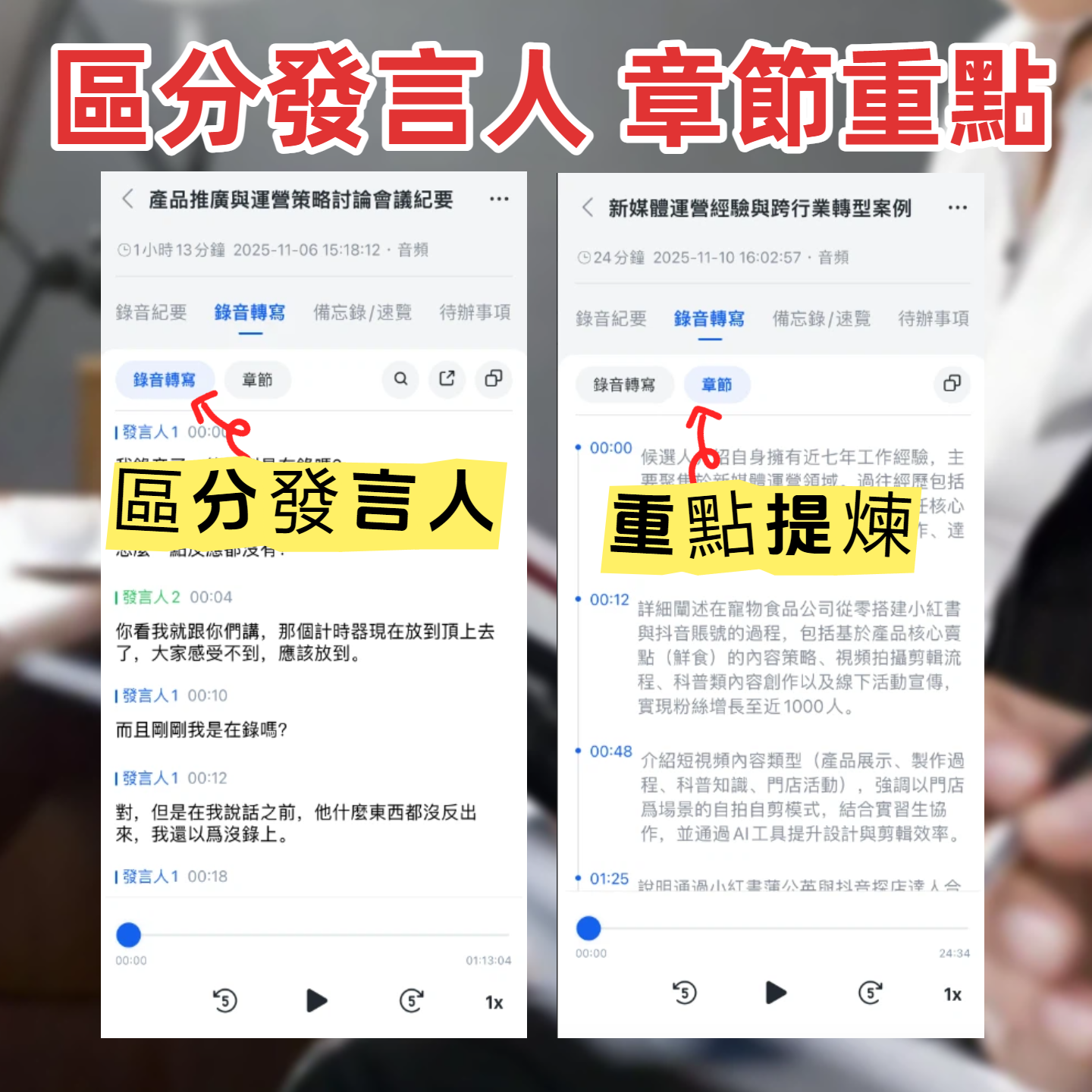
Deep Dive: How Tinrec Solves the "Post-Recording" Problem
While Subanana excels at processing vernacular language, if you want the tool to further help you "manage work," Tinrec offers a more complete Record → Understand → Act workflow.
1. Not Just a Transcript, but a "Second Brain"
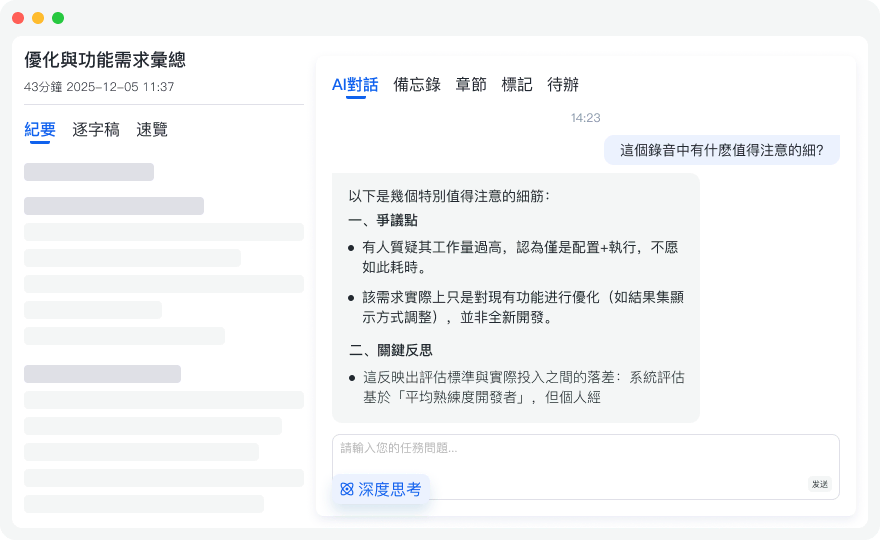
Traditional tools give you piles of text that you still have to read. Tinrec's AI Chat Query function allows you to interact directly with the recording content.
- Scenario: The meeting lasted two hours; you only want to know "What are the marketing department's tasks for next week."
- Solution: Simply type your question in Tinrec's AI Chat window; the AI will synthesize the entire meeting and answer you, which is more precise than Ctrl+F searching for keywords.
2. Automatic Action Item Extraction
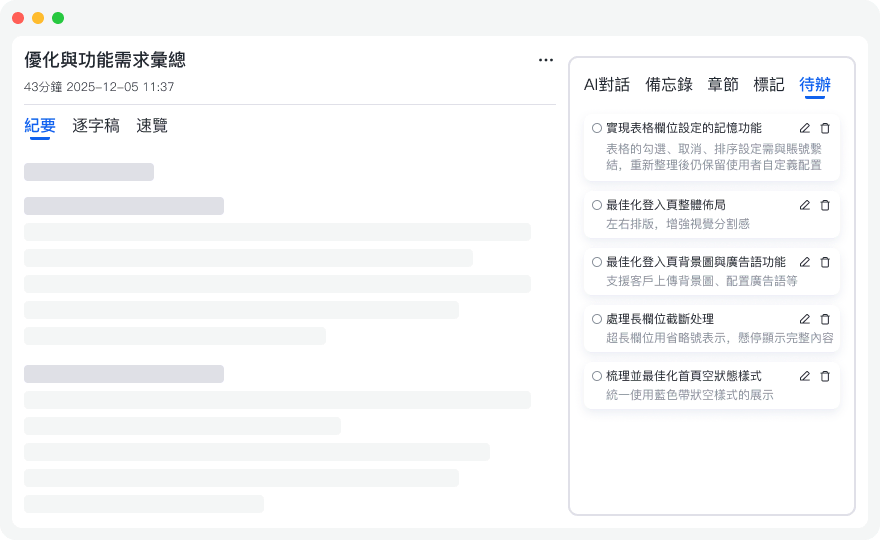
Tinrec automatically analyzes decision points in the conversation and generates a "to-do list." This is especially important for enterprise users, ensuring that after the meeting, everyone knows what they need to do, rather than leaving behind an unread transcript.
3. Supports Multiple Input Sources
In addition to live recording and file upload, Tinrec also supports YouTube link transcription. This is a great convenience for creators who want to organize Cantonese podcasts or instructional video content.
Hands-On Tutorial: How to Quickly Organize Cantonese Meeting Notes with AI
Using Tinrec as an example, here's how to turn a code-switching department meeting into actionable notes quickly:
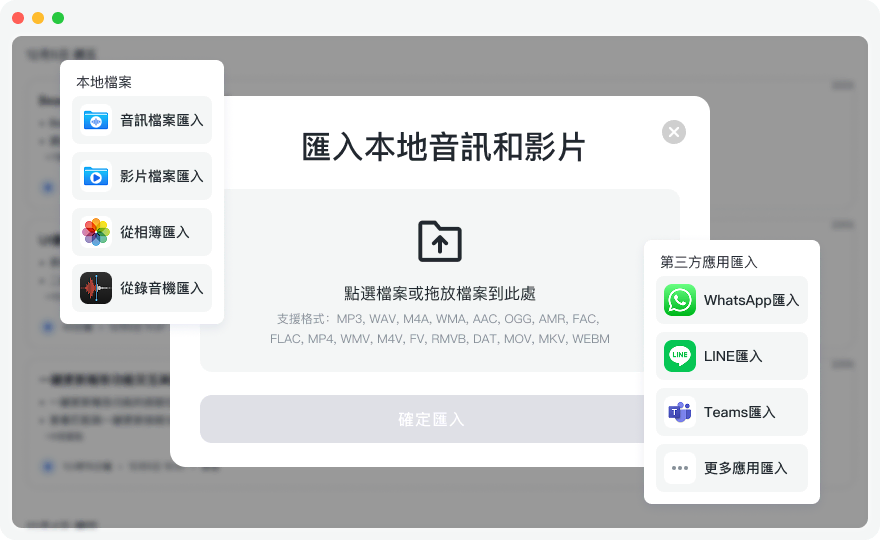
Step 1: Choose Recording or Import Mode
After signing up and logging in to Tinrec, you can choose:
- Real-time recording to text: Ideal for ongoing in-person meetings or classes.
- Audio file to text: If you already have a recorded mp3/m4a file, simply upload it.
- Video link: Paste a YouTube URL.
Step 2: Set Recognition Language
This is the most critical step. Make sure the language options include "Cantonese" or select auto-recognition to ensure the AI correctly handles tones and Chinese-English switching.
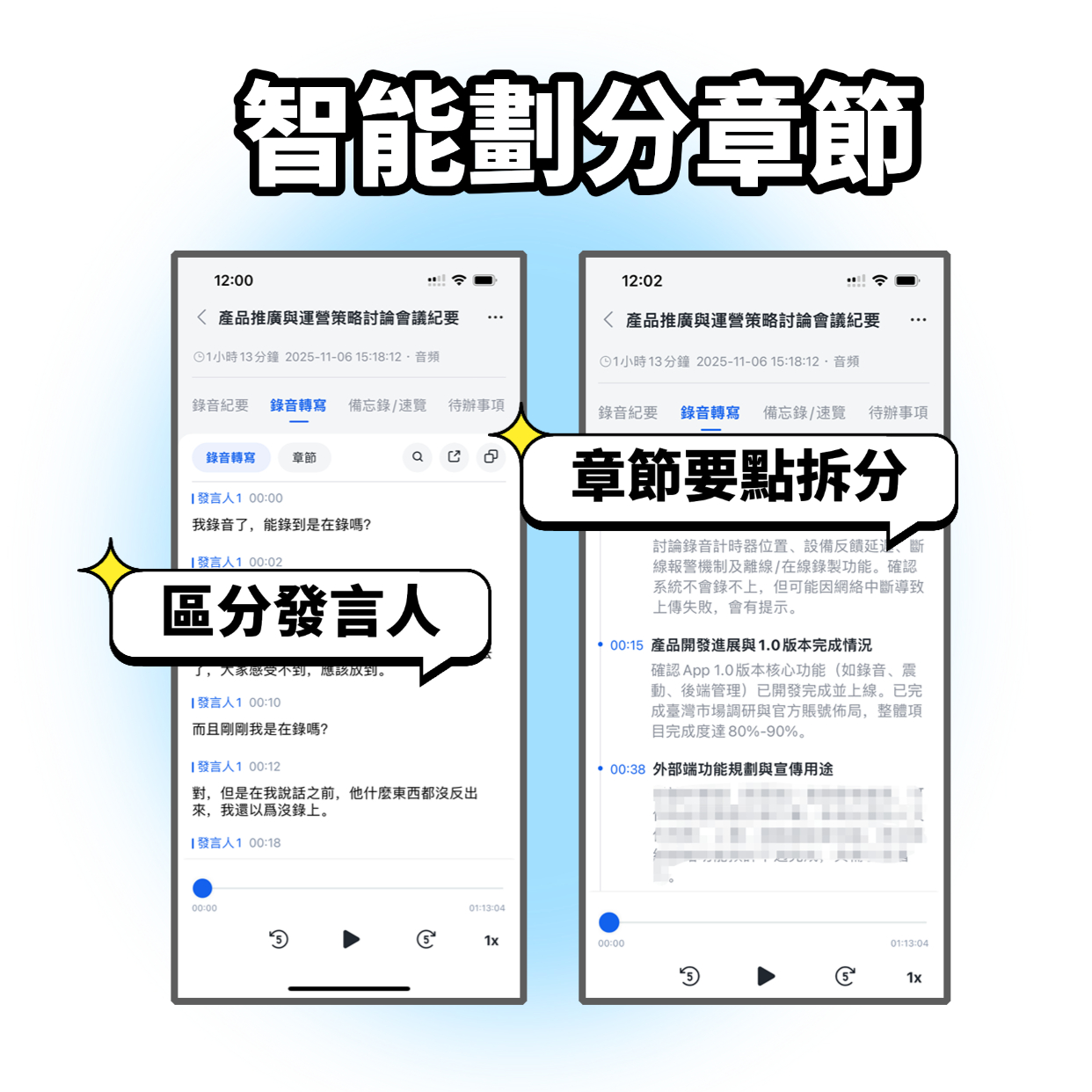
Step 3: Get Transcript & Speaker Diarization
After the recording ends or upload completes, the system will automatically transcribe. Tinrec attempts to differentiate speakers (Speaker Diarization); you can manually label them as "Boss," "Peter," "Mary" for clearer records.
Step 4: Use AI to Generate Summary and Action Items
Don't just stare at the transcript. Click "AI Summary" or "AI Chat" and ask the system to:
- "Generate a 300-word meeting summary"
- "List all Action Items that need follow-up"
- "Polish the colloquial content into a written report format"
Finally, you can export the organized content as Word, PDF, or Markdown and send it directly to meeting participants.
Frequently Asked Questions
Q1: Can these AI tools fully understand code-switching? Subanana performs best in this area, optimized for Hong Kong habits. Tinrec also supports multilingual recognition and can handle common workplace code-switching, but may be slightly weaker than local specialized tools regarding extremely colloquial slang.
Q2: Do Tinrec and Subanana have free versions? Subanana offers a trial plan; Tinrec provides 100 minutes of free transcription per month, which is sufficient for occasional meetings or students. Both have paid subscription plans if you exceed the limit.
Q3: Can long recordings (e.g., 3 hours) be transcribed? Yes. Tinrec's paid version (Pro) supports up to 1200 minutes per month and can handle long audio files. It is recommended to record in a clear environment for better accuracy.
Q4: Can I use it on my phone? Tinrec supports iOS and Android apps along with a web version, with automatic data sync. This means you can record on your phone and then edit on your computer. Subanana is currently mainly cloud web-based.
Q5: Can I transcribe Cantonese videos from YouTube? Tinrec supports inputting a YouTube link for direct transcription, which is very useful for studying, organizing interviews, or podcasts.
Q6: Are these tools secure? Most paid enterprise-grade tools (like Tinrec) use encrypted transmission and have clear privacy policies. For highly confidential business meetings, review each platform's privacy terms or use enterprise-grade plans.
Turn every recording into actionable outcomes
Get 60 free transcription minutes when you sign in. No credit card required.
Related Reading
You might also like

2026 Tested: 4 Meeting Recorder & Transcription Tools Compared—No Bot + AI Q&A, Which Saves More Time?
How to choose a meeting recording and transcription tool? This article tests and compares four mainstream tools—Tinrec, Otter.ai, Notta, and Granola—from the perspectives of bot-free recording, AI Q&A, and team collaboration, to help you find the best meeting notes solution.

How to Transcribe Meeting Recordings with Tinrec in 2026: No Bot Needed + AI Summaries & Action Items
This tutorial shows how to use Tinrec to turn meeting recordings into usable transcripts, automatically organizing them into summaries, action items, and chapters—ideal for individuals and teams who need to process meeting notes quickly.

5 Best Meeting Recording-to-Text Tools Tested in 2026: Which One Actually Saves You Time?
We tested 5 meeting recording-to-text tools, addressing common pain points from PTT users, comparing accuracy, AI summaries, bot-free recording, and more. Tinrec is our top recommendation, with a buying guide and tips to avoid common pitfalls.

4 Meeting Transcription Tools Tested in 2026: Which Is Best for Chinese Summaries and Team Collaboration?
We tested 4 meeting transcription tools, comparing Chinese accuracy, bot-free recording, AI summaries, and team collaboration to help you find the best solution for Taiwan's workplace.

2026 Test of 4 Meeting Transcription Tools: Which AI Meeting Notes Really Save Time?
When choosing a meeting transcription tool, first decide whether you need a verbatim transcript or a sustainable meeting notes workflow. This article compares Tinrec and Otter.ai from a methodological perspective across five key dimensions: Chinese transcription, bot-free recording, post-meeting organization, team space, and pricing, to help you make a time-saving decision.

4 Meeting Transcription Tools Compared in 2026: Which Is Best for No-Bot Recording and Chinese Summaries?
We tested Tinrec, Otter.ai, Notta, and Granola for meeting transcription, comparing no-bot recording, Chinese transcription, AI summaries, action items, and team spaces to help you find the best fit.

Tinrec vs Otter in 2026: A 5-Dimension Comparison for Chinese Meeting Transcription
A mid-level manager tests 5 meeting transcription tools: Tinrec, Otter, Notta, TurboScribe, and CLOVA Note. From Chinese transcription, AI Q&A, team collaboration to free plans, find the best meeting notes assistant for you.

How to Choose a Meeting Recording Transcription Tool in 2026: A 5-Step Guide
Struggling to keep up with meeting notes? This article uses Tinrec as an example to walk you through 5 key points for evaluating meeting recording transcription tools, including core features, practical use cases, buying considerations, and FAQs, helping you quickly find the right AI meeting minutes solution.

Tinrec vs Notta 2026: 5-Dimension Comparison for Chinese Meeting Notes
This article compares Tinrec and Notta across 5 key dimensions, covering bot-free recording, AI summaries, team collaboration, and Chinese language support, with practical tips and buying advice.