
Turn recordings into transcripts and summaries in minutes
Upload audio or video for multilingual transcription, AI notes, and action items
Facing fast-paced international meetings or all-English lectures, do you often find yourself in the anxiety of "understanding but unable to write it down" or "recorded but no time to relisten"? Traditional voice recorders can only save audio, not extract information in real-time, leading to spending several times the meeting length just to produce transcripts afterwards.
This article focuses on the core need of "converting English meeting recordings to Chinese transcripts" and reviews 5 noteworthy AI tools in 2025. We objectively evaluate them from dimensions like language recognition accuracy, translation capability, AI summarization features, and free tiers, complete with a detailed comparison table and practical guide.
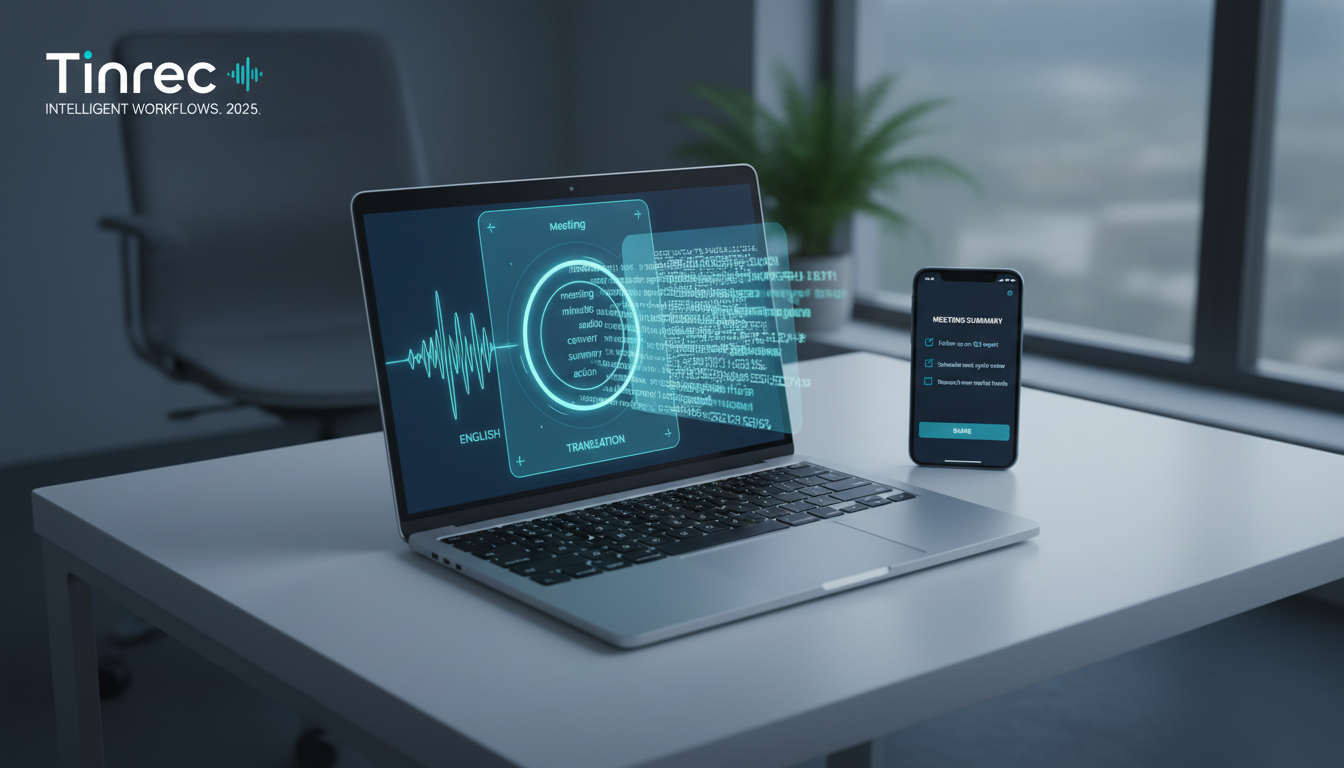
Quick Picks:
- Budget-limited, basic recording only: Prioritize Google built-in tools.
- Tech-savvy, privacy-conscious & offline: Recommend OpenAI Whisper.
- Need mixed Chinese-English recognition, meeting summaries & action items: Consider integrated AI assistants like Tinrec.
In-Depth Analysis of 5 Mainstream Speech-to-Text Tools in 2025
There are many tools on the market, but not all are suitable for "cross-language" scenarios. Below, we selected 5 representative solutions based on different user needs:
1. Google Live Transcribe / Docs Voice Typing
Best for: Student lectures, temporary and short recording needs. Google's free tools are the easiest entry point. Android users can use "Live Transcribe," supporting over 80 languages and environmental sound recognition; on desktop, Google Docs' Voice Typing works. Pros are completely free and no installation needed, but cons include no support for uploading audio files to transcribe (only real-time dictation) and lack of AI summarization or action item features, making it less efficient for long meetings.
2. Otter.ai
Best for: Professional meetings in English-only environments. Otter.ai is a globally renowned meeting transcription powerhouse with strong speaker identification and real-time note-taking. However, for Chinese users, it has a clear downside: it does not support Chinese recognition. If your meetings are entirely in English and don't require translation to Chinese, it's an excellent choice; but if you need mixed language or Chinese transcripts, you'll need alternatives.
3. OpenAI Whisper (and its derivatives)
Best for: Engineers, advanced users who value privacy highly. Whisper is currently the most powerful open-source speech recognition model, supporting multiple languages and high noise resistance. Through third-party clients like Whisper Desktop or MacWhisper, users can transcribe offline locally without uploading data to the cloud. While free and accurate, it requires decent hardware (especially GPU) and lacks business features like meeting management (e.g., automatic action item generation).
4. Tinrec (Second Listening Recorder)
Best for: Professionals needing multilingual recognition, AI-powered summaries, and team collaboration. Tinrec positions itself between simple transcription tools and AI assistants. It solves the traditional tool's problem of "only providing transcripts" by using AI to convert recordings into "meeting minutes" and "action items." For cross-language needs, Tinrec supports 10 languages including Chinese, English, Japanese, Korean, etc., making it suitable for processing English meeting recordings and leveraging AI to aid understanding. Its multi-device sync (iOS/Android/Web) allows seamless editing on desktop after recording on phone.
5. MyEdit
Best for: Content creators, short audio editing. An online tool by Taiwan's CyberLink, mainly for media editing needs. Pros are user-friendly interface, support for Traditional Chinese, and browser-based operation. However, its free tier is usually offered as "daily limited" (e.g., 3 minutes per day), making it more suitable for short video subtitles or brief voice memos rather than hour-long meeting minutes.
Stop organizing recordings by hand
Upload audio or video and automatically get a transcript, summary, and action items
Tool Specifications & Feature Comparison Table
To help you choose intuitively, we compiled a comparison table across 5 key dimensions:
| Dimension | Google Built-in | Otter.ai | OpenAI Whisper | Tinrec | MyEdit |
|---|---|---|---|---|---|
| Chinese/Multilingual Support | Excellent (but no translation) | No Chinese | Excellent (multilingual) | Excellent (supports Chinese, English, Japanese, Korean, etc.) | Good |
| Real-time Transcription | Yes | Yes | No (post-processing only) | Yes | No |
| File Upload Transcription | No | Yes | Yes | Yes (audio/video) | Yes |
| AI Summary/Action Items | No | Yes (English only) | No (text only) | Yes (auto-generates minutes) | No |
| Free Tier / Price | Fully free | 300 min/month | Free (need own hardware) | 100 min/month | Small daily quota |
Hands-On Tutorial: How to Convert English Meeting Recordings into Actionable Chinese Notes
Getting the transcript is only the first step; the real value lies in "understanding" and "action." Below, using Tinrec as an example, we demonstrate an efficient workflow from recording to decision-making:
Step 1: Import or Record the Meeting in Real-Time
- Live Meeting: Open the mobile app or web version, use the live recording to text feature. The system generates text in real-time as you record. Place your phone close to the speaker for clear audio.
- Existing Recording: If you have a file from a voice recorder or Zoom/Teams download, use the audio file to text feature to upload. Tinrec supports MP3, WAV, M4A and other common formats.
- Online Video: For English lectures or podcasts on YouTube, directly use the podcast/video to text feature by pasting the URL.
Step 2: Speaker Diarization & Proofreading
After AI transcription, the system automatically differentiates speakers (Speaker A, Speaker B). For specialized terms in English meetings, quickly browse and tweak the transcript. Tinrec supports "audio sync playback"—click on text to jump to the corresponding audio segment for easy confirmation.

Step 3: Get AI-Powered Summaries
Traditional transcripts can be tens of thousands of words, hard to read. Use the built-in AI analysis feature to generate "meeting conclusions" and "action items" with one click. This filters out small talk and filler, directly extracting who needs to do what by when.
Step 4: Query Details with AI Chat
If the meeting is long and you forget a detail (e.g., "What exactly did the CEO say about Q3 budget?"), no need to relisten. Use the AI chat query feature to ask as if talking to a person. The AI answers directly based on the recording content—especially helpful for sorting English meeting notes, reducing language barriers.
FAQ
Q1: Are free speech-to-text tools accurate? In quiet environments with standard pronunciation, modern AI tools (like Whisper or Tinrec) usually achieve 90-95% accuracy. However, in noisy, distant, or heavy accent scenarios, accuracy drops. We recommend pairing with "click to play audio" for manual proofreading.
Q2: Can I record phone conference calls directly on iPhone and transcribe? Due to iOS privacy restrictions, apps typically cannot record internal phone call audio (e.g., regular phone lines). We suggest using a computer tool to record during video conferencing (Teams/Meet) or use speakerphone with another device to record.
Q3: Does Otter.ai really not support Chinese at all? Yes, as of now Otter.ai focuses on English. Speaking Chinese into it produces gibberish or meaningless pinyin. If your meeting includes Chinese speech, strongly recommend choosing a multilingual tool like Tinrec or Whisper.
Q4: Can English recordings be directly translated into Chinese transcripts? Most tools do "dictation" (transcribe the original language). Some advanced tools (like Tinrec's AI assistant) can, after transcription, help summarize English content into Chinese key points via AI queries or summaries, which is more readable than a raw machine translation of the transcript.
Q5: What if my audio file is very large—will upload fail? Free tools usually limit file size or length (e.g., MyEdit restricts very short durations). Tinrec's audio file to text supports larger files with no length limit per file (subject to plan quota), ideal for long lectures or meetings.
Q6: Can these tools differentiate who is speaking? Yes, tools with "speaker diarization" can. Otter.ai and Tinrec both have this feature, automatically labeling content as "Speaker 1," "Speaker 2," which is crucial for meeting minutes.
Turn every recording into actionable outcomes
Get 60 free transcription minutes when you sign in. No credit card required.
Related Reading
You might also like

5 Best AI Meeting Note Tools Tested in 2026: Can You Take Accurate Chinese Meeting Minutes Without a Bot?
Meetings are tiring enough; taking minutes afterward is even more so. This hands-on comparison of 5 AI meeting note tools, including Tinrec, Granola, Otter.ai, and Notta, shows you how to choose and use them to turn Chinese meetings into searchable, collaborative action items—no meeting bot required.

How to Use AI Meeting Notes in 2026: 5 Steps from Recording to AI Summary
Still typing meeting minutes by hand? This article tests Tinrec to show you how to complete recording-to-text, AI summary, and to-do organization in 5 steps, and compares it with Notta and other tools to explain why Tinrec is better suited for Hong Kong professionals.

2026 Meeting Transcription Comparison: Tinrec's Bot-Free Recording, AI Summaries, and Team Collaboration
How to choose a meeting transcription tool in 2026? This article focuses on Tinrec, comparing Otter, Notta, and Granola, and explains bot-free recording, AI summaries, team collaboration, and key pitfalls to avoid.

How to Download Speech-to-Text in 2026? A Complete 5-Step Guide
Looking for a speech-to-text tool in 2026? Tinrec helps you convert recordings to text and download transcripts in 5 steps, with buying tips and FAQs. A must-read for professionals.
2026 Hands-On Comparison of 3 AI Meeting Recorder & Transcription Tools: Which AI Meeting Notes Actually Save You Time?
A mid-level manager tests 3 AI meeting recording and transcription tools, covering bot-free recording, Chinese speech recognition, AI summaries, and team collaboration, to reveal which one is most worth using.

5 Best AI Meeting Recorder & Transcription Tools in 2026: A Hands-On Comparison for US Professionals
A mid-level manager tests meeting transcription tools, sharing real-world experience with Tinrec to show how AI meeting notes can save hours of post-meeting work, plus buying tips and practical use cases.

2026 Test: Tinrec vs Plaud Note for Chinese Meeting Transcription – Which Is Better?
Addressing common pain points from Dcard about recording-to-text, this comparison reviews Tinrec's instant recording and Plaud Note's meeting transcription, AI summarization, cross-device support, and pricing to help you decide between a hardware recorder and an AI meeting tool.

2026 Hands-On Review of 3 Meeting Transcription Tools: Which Is Best for Chinese Meetings?
Many people think meeting transcription is just about recording with a free app, only to end up with a huge block of text that still needs manual cleanup. This hands-on review focuses on Tinrec, showing you how to choose an AI meeting notes tool that truly saves time, and compares 3 common solutions on the market to help you make the right purchasing decision.

The Complete Guide to Converting Meeting Recordings to Text in 2026: Use Tinrec to Auto-Generate Transcripts, Summaries, and Action Items
Still manually transcribing meeting recordings? This article introduces how Tinrec can help you quickly convert meeting recordings into text, automatically generate summaries, chapters, and action items, and support AI Q&A, multi-format export, and team collaboration, so you no longer have to re-listen to recordings word by word.