
Turn recordings into transcripts and summaries in minutes
Upload audio or video for multilingual transcription, AI notes, and action items
Facing a two-hour meeting recording or lecture, have you ever experienced the agony of "recorded but no time to listen" or "spent half an hour replaying just to find one sentence"? Traditional recording saves sound but fails to save "information."
This article evaluates 5 notable voice-to-text solutions in 2026 across dimensions like accuracy for English (and other languages), real-time transcription speed, AI summarization, and free allowances. We'll also show you how to turn audio into actionable checklists using AI tools.

Quick Navigation Summary:
- For simple memos: Use your phone's built-in voice memos (iOS/Android).
- For online meetings on a computer: Use Teams/Google Meet's native captions (but post-meeting organization is weak).
- For complete meeting minutes and action items: Choose an AI-powered recording app (like Tinrec) that drastically reduces organization time.
1. Why You Need "AI Real-Time Transcription": Solve Three Pain Points
Before diving into tool recommendations, let's clarify why traditional voice recorders or simple recording apps are no longer sufficient. For professionals and students, audio files have three major drawbacks:
- Low information density, high replay cost: You can scan 500 words per minute of text, but only listen to 180 words per minute of audio. Re-listening takes about 1:1 time vs. recording length—extremely inefficient.
- Lack of structure, hard to extract key points: In hours-long audio, decisions and action items are scattered across different segments; manual extraction often misses things.
- Cannot be searched, knowledge doesn't stick: Traditional audio is like a black box—you can't Ctrl+F to find content, so recordings end up as "digital junk" taking up storage.
Thus, the modern need has evolved from "preserving sound" to "extracting information."
2. 2026 Hot Transcription Tools Comparison
The market is flooded with options. We've compared the most representative solutions: native phone features, cloud meeting software, and professional AI recording tools (using Tinrec as an example).
| Dimension | Built-in Recorder (iOS/Android) | Online Meeting (Teams/Meet) | AI Recording Tool (e.g., Tinrec) | Traditional Human Transcription | English-Focused Tools (e.g., Otter) |
|---|---|---|---|---|---|
| Core Purpose | Quick voice memo | Online meeting captions | Full-scenario recording & knowledge management | High-accuracy publishing | English meetings |
| English Recognition | Good/Decent | Good | Excellent (supports EN/CN/JP/KO mixed) | Human proofread (highest) | Excellent |
| Real-Time Transcription | Partial (model-dependent) | Yes (online only) | Yes (output during recording) | No (takes days) | Yes |
| AI Summary/Conclusions | No | Basic | Auto generates meeting minutes & action items | No | Yes |
| Post-Recording Search | No | Hard to search | AI Chat Query (ask your recording) | Text search | Text search |
| Cost | Free | Included in enterprise plan | Free trial / subscription | Very expensive (per minute) | Subscription |
Recommendations:
- If you're an iPhone user, iOS built-in notes are convenient but weak on "summary" for long recordings.
- If you need to handle multilingual environments (e.g., mixed Chinese/English meetings) or speaker diarization, professional tools like Tinrec offer better value.
Stop organizing recordings by hand
Upload audio or video and automatically get a transcript, summary, and action items
3. Deep Dive: How Tinrec Turns Recordings into Actions
Among many tools, Tinrec (秒聽錄音) has a unique design philosophy. It's not just about speech-to-text but emphasizes a complete workflow: "Record → Understand → Act." Here are key differences from traditional tools:
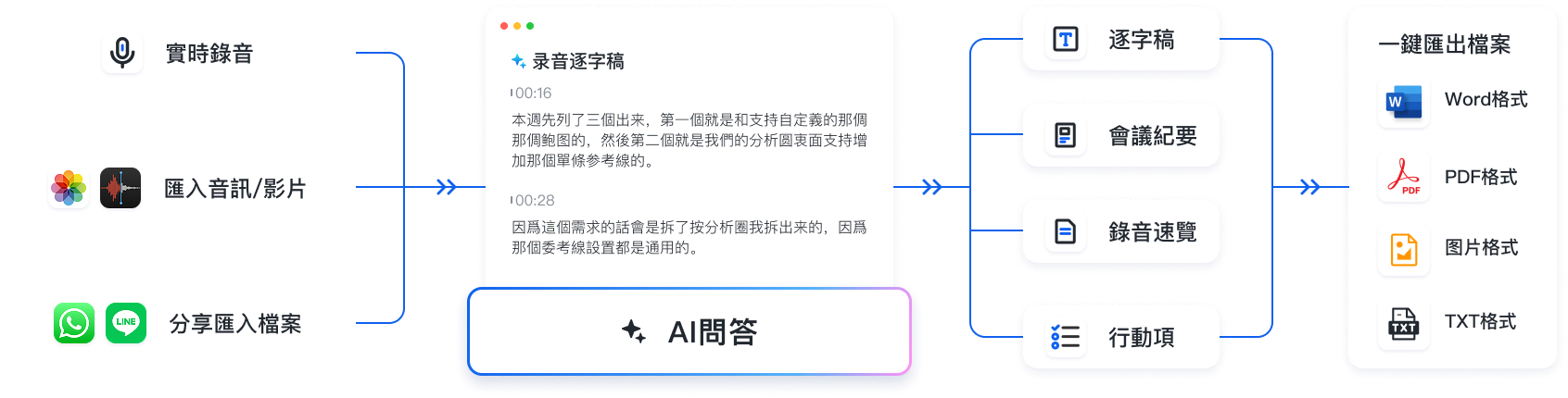
3.1 Multilingual Mixed Recognition & Real-Time Transcription
Unlike many tools that only support a single language, Tinrec supports Chinese, English, Japanese, Korean, Cantonese, Taiwanese, and more—10 languages total. This is very useful in cross-border meetings or language learning, enabling real-time transcripts and reducing language barriers.
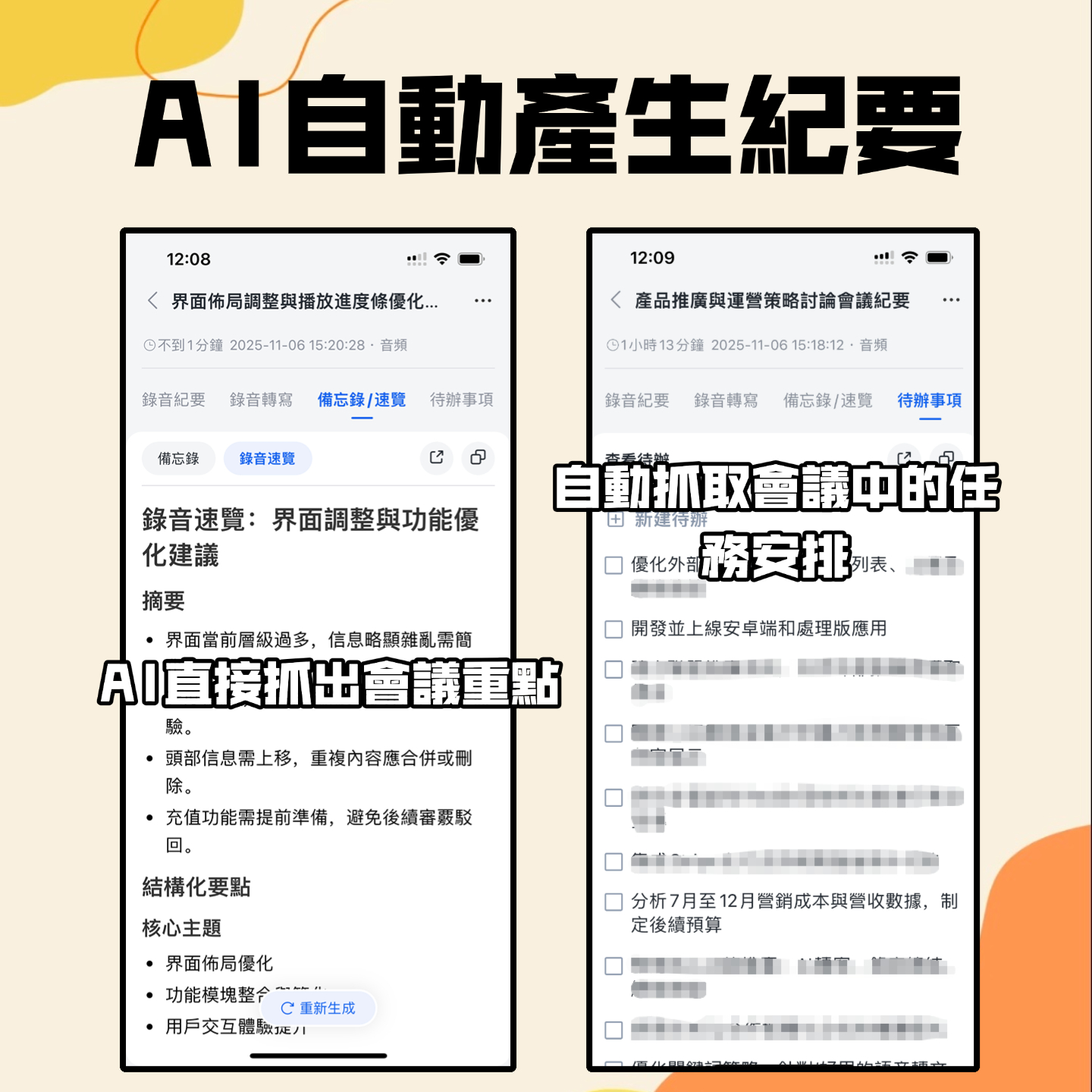
3.2 Not Just a Transcript, but a "Decision List"
This is the feature most valued by professionals. Tinrec uses AI to analyze the entire recording and automatically extracts:
- Meeting Minutes: Quick summary of discussion points.
- Action Items: Lists who needs to do what by when.
This saves 30 minutes of post-meeting note-taking.
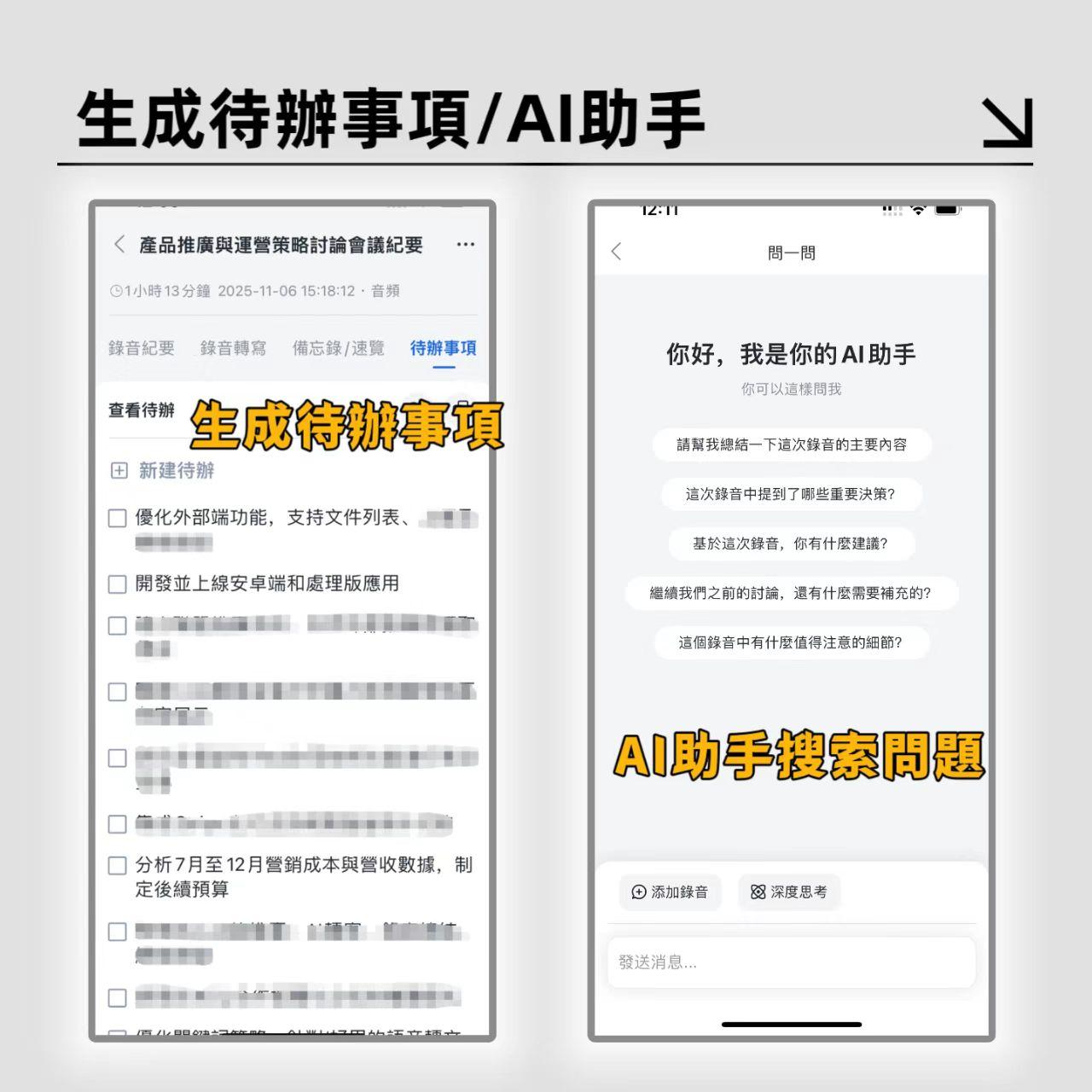
3.3 AI Chat Query: Ask Your Recording Like a Person
For a one-hour interview recording, you don't need to read from start to end. Tinrec's built-in "AI Chat Query" lets you ask direct questions like "What was the conclusion about the marketing budget?" The AI answers based on the recording content, changing the way we retrieve information.

4. Tutorial: How to Quickly Produce Meeting Notes with the App
Below is a demo using Tinrec to efficiently process recordings for meetings, classes, or interviews.
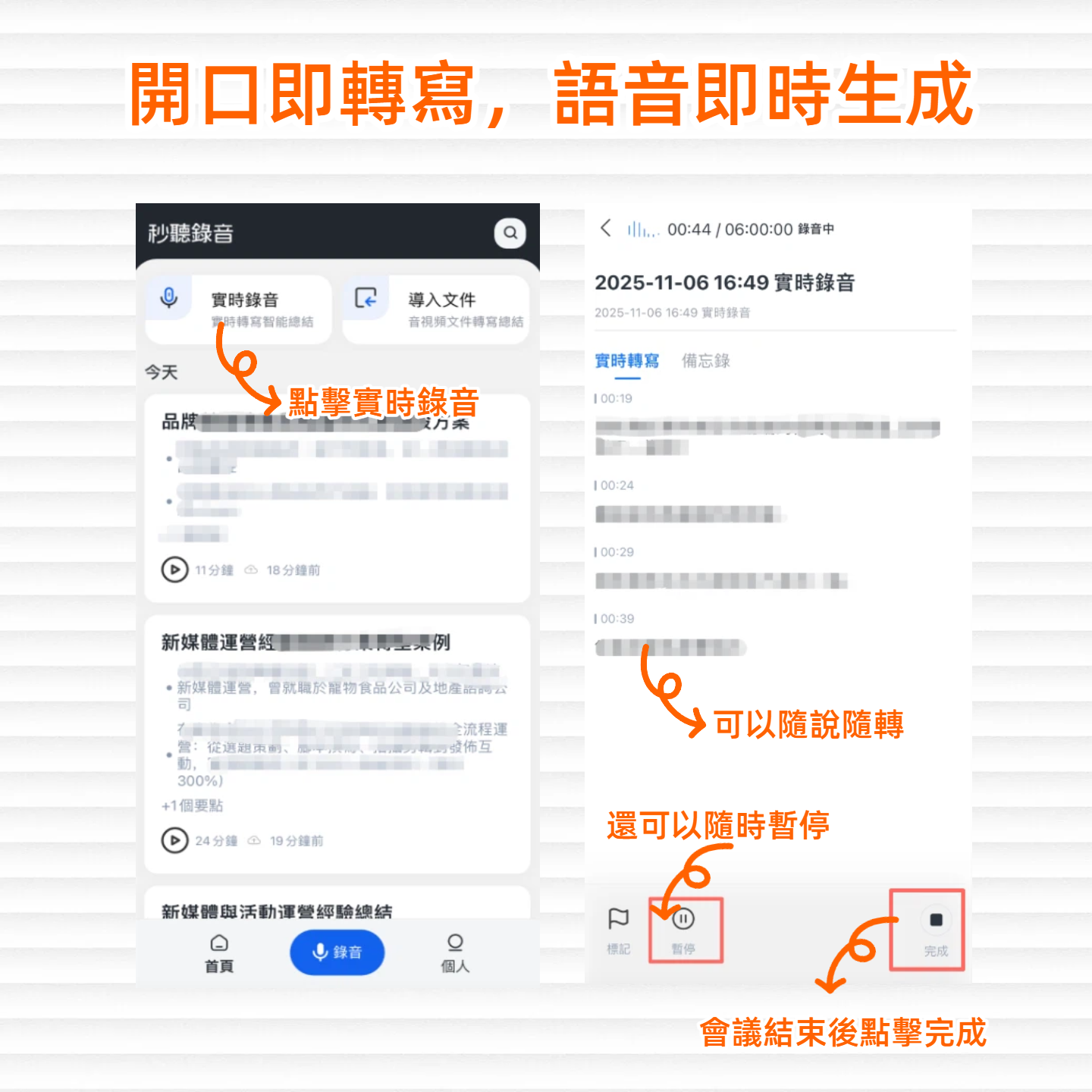
Step 1: Start Real-Time Recording
Open the Tinrec app or web version and tap "Start Recording."
- Tip: Place the phone near the speaker(s) for best results. The app displays live transcription so you can track progress.
- Feature link: Real-time Voice to Text
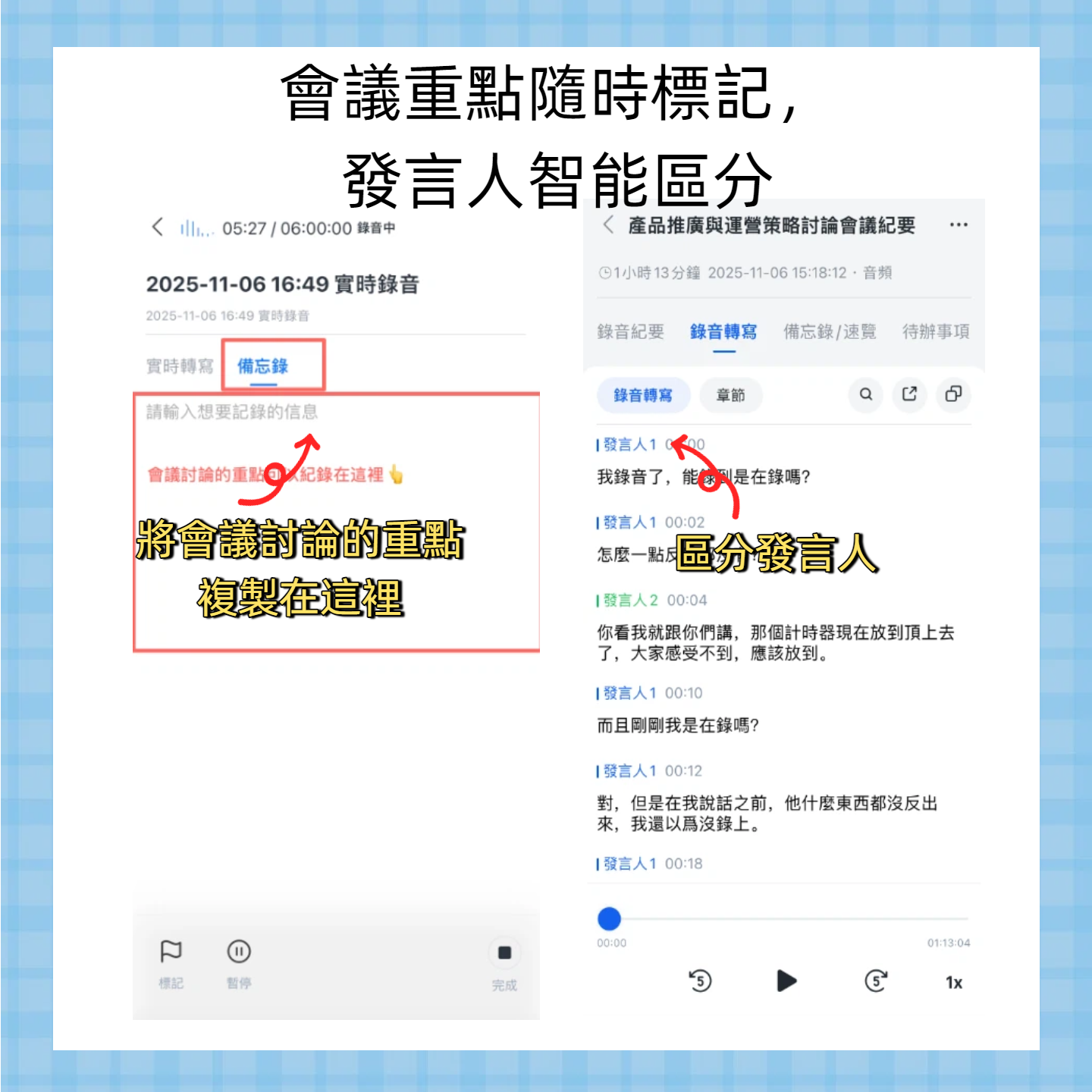
Step 2: Bookmark Key Points & Speaker Diarization
During recording, tap the bookmark button for important parts. After recording, the system automatically tries to distinguish speakers (Speaker A, Speaker B), and you can manually rename them (e.g., PM, Designer) for a clearer transcript.
Step 3: Import External Files or Video Links (Optional)
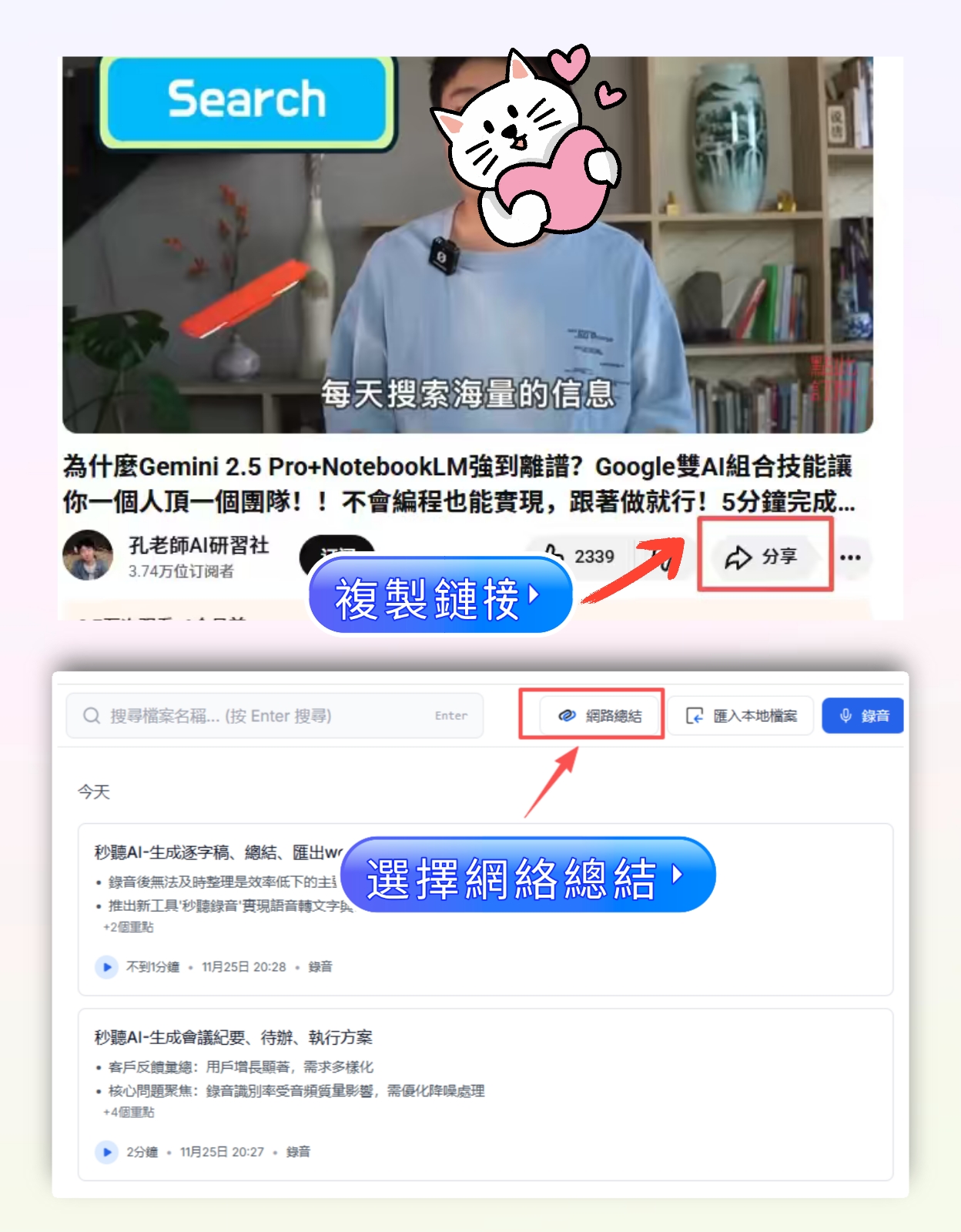
If you already have an audio file or want to process YouTube/Podcast content, you don't need to re-record on the phone.
- Audio files: Directly upload mp3/m4a etc.
- Video links: Paste a YouTube or TikTok link; Tinrec can analyze and generate a summary.
- Feature links: Audio File to Text | Video Link to Text
Step 4: Generate Summary & Export
After recording, tap the AI analysis button. The system generates a structured note. Finally, you can export as Word, PDF, or Markdown and paste into your work report.
5. FAQ
Q1: Is Tinrec's free tier enough?
Tinrec offers 100 free minutes per month for recording transcription. This is typically sufficient for students or individuals who occasionally need to record classes or short meetings. For high-frequency business needs, consider Basic or Pro plans.
Q2: iPhone has call recording restrictions—can this app work?
Due to iOS privacy policies, most apps cannot directly record phone calls. Use speakerphone mode and open Tinrec to record, or import call recordings (if obtained via other means) into the app for transcription.
Q3: What affects transcription accuracy?
Background noise and microphone distance are the biggest factors. Use in a quiet environment and keep the phone close to the speaker. Tinrec's AI includes semantic correction to auto-fix some grammatical errors, but clear audio is still key.
Q4: What languages are supported for transcription?
Besides English and other major languages, Tinrec supports Japanese, Korean, German, Cantonese, Taiwanese, and more—10 languages total, suitable for multilingual learning or international business.
Q5: Is my recording data secure?
Tinrec uses encrypted transmission to protect your audio data. For enterprise or sensitive content, you can manage cloud storage as needed after transcription and export.
Q6: Can I transcribe YouTube videos directly?
Yes. Use Tinrec's "Podcast/Online Video to Text" feature; just paste the URL without downloading the video, and you get a transcript and AI summary. Great for content creators.
Turn every recording into actionable outcomes
Get 60 free transcription minutes when you sign in. No credit card required.
Related Reading
You might also like

2026 Comparison of 4 AI Meeting Note-Takers for Chinese: Which Saves the Most Time on Chinese Transcription and Post-Meeting Organization?
How to choose an AI meeting note-taker for Chinese? This article compares Tinrec, Notta, Otter.ai, and Granola on Chinese recognition performance, recording methods, and post-meeting organization capabilities. It covers free tiers, team collaboration, and common pitfalls to help you find the most time-saving Chinese meeting note-taking tool.
2026 Comparison of 4 Web Recording Tools: Which One Can Record Both Microphone and System Audio?
The most common reason web recording fails isn't the tool—it's setting the wrong audio source and not organizing the recording afterward. This article first highlights three common pitfalls, then uses Tinrec as an example to explain the core capabilities of web recording, practical use cases, 5 key factors to consider when choosing a tool, and the differences and costs between personal and team plans, ending with an FAQ.
How to Use AI for Meeting Recordings in 2026: A Complete 5-Step Tutorial
Struggling to organize long meeting recordings? This tutorial uses Tinrec as an example to guide you through 5 steps: recording, transcription, proofreading, generating meeting minutes, and exporting/sharing. It also includes troubleshooting FAQs and 3 efficiency-boosting tips to turn your meeting recordings into searchable, collaborative team resources with AI.

2026 AI Meeting Notes Tools Comparison: Tinrec vs Notta — Which Is Better for Chinese-Speaking Teams Across 5 Key Areas?
Starting from common misconceptions, this hands-on comparison of Tinrec and Notta examines 5 key areas: Chinese meeting recording, post-meeting organization, team governance, pricing and quotas, and export workflows. It also answers 6 common questions to help you decide which AI meeting notes workflow best fits your work style.

2026 AI Meeting Recorder Showdown: Tinrec vs PLAUD Note — Which Is Better for Chinese Meetings?
Tinrec or PLAUD Note? We tested both across meeting capture, Chinese transcription, post-meeting AI organization, team collaboration, and pricing to help you decide whether software or recording hardware fits your meeting workflow.

4 Best English Transcription Tools in 2026: Free vs Paid Comparison
Looking for an English transcription tool? This article compares 4 popular options: Tinrec, Otter.ai, Notta, and TurboScribe. From free tiers to mixed Chinese-English recognition, post-meeting organization to team collaboration, we break it down to help you find the best English transcription solution.

Tinrec vs Notta 2026: 5-Dimension Comparison for Chinese Meeting Notes
How to choose a meeting transcription tool? This article compares Tinrec and Notta across five dimensions: meeting capture methods, Chinese and mixed-language transcription, post-meeting AI organization and Q&A, team data ownership, and pricing. It also provides practical selection criteria and four common pitfalls to help you find the right AI meeting notes tool for your team.

2026 Free Transcription App Plans Compared: 4 Top Picks
Compare free plans for Tinrec, Otter.ai, Notta, and Yating in 2026. See free minutes, language support, and post-meeting features to choose the right audio-to-text tool and save time on transcript cleanup.

5 Best Meeting Recording Tools in 2026: From Transcripts to Meeting Minutes
Recording a meeting isn't just about placing your phone on the table—the real pain points are the transcript, summary, and action items that follow. This article breaks down the 6 key factors for choosing a meeting recording tool, from recording legality and online meeting capture methods to team permissions and pricing, and demonstrates the complete workflow from recording to action items using Tinrec.