

Turn recordings into transcripts and summaries in minutes
Upload audio or video for multilingual transcription, AI notes, and action items
The Chaotic Reality of Group Discussions – What You Need Isn't Faster Note-Taking, But a Real Solution
Last semester, during my senior project, I had weekly meetings with my group. Everyone was talking over each other, sometimes mixing Chinese and English with technical terms. I tried typing notes during the meeting, but when I looked at them afterward, I couldn’t understand what I’d written. A few times I even mixed up who was responsible for what and missed deadlines, nearly getting hunted down by my teammates.
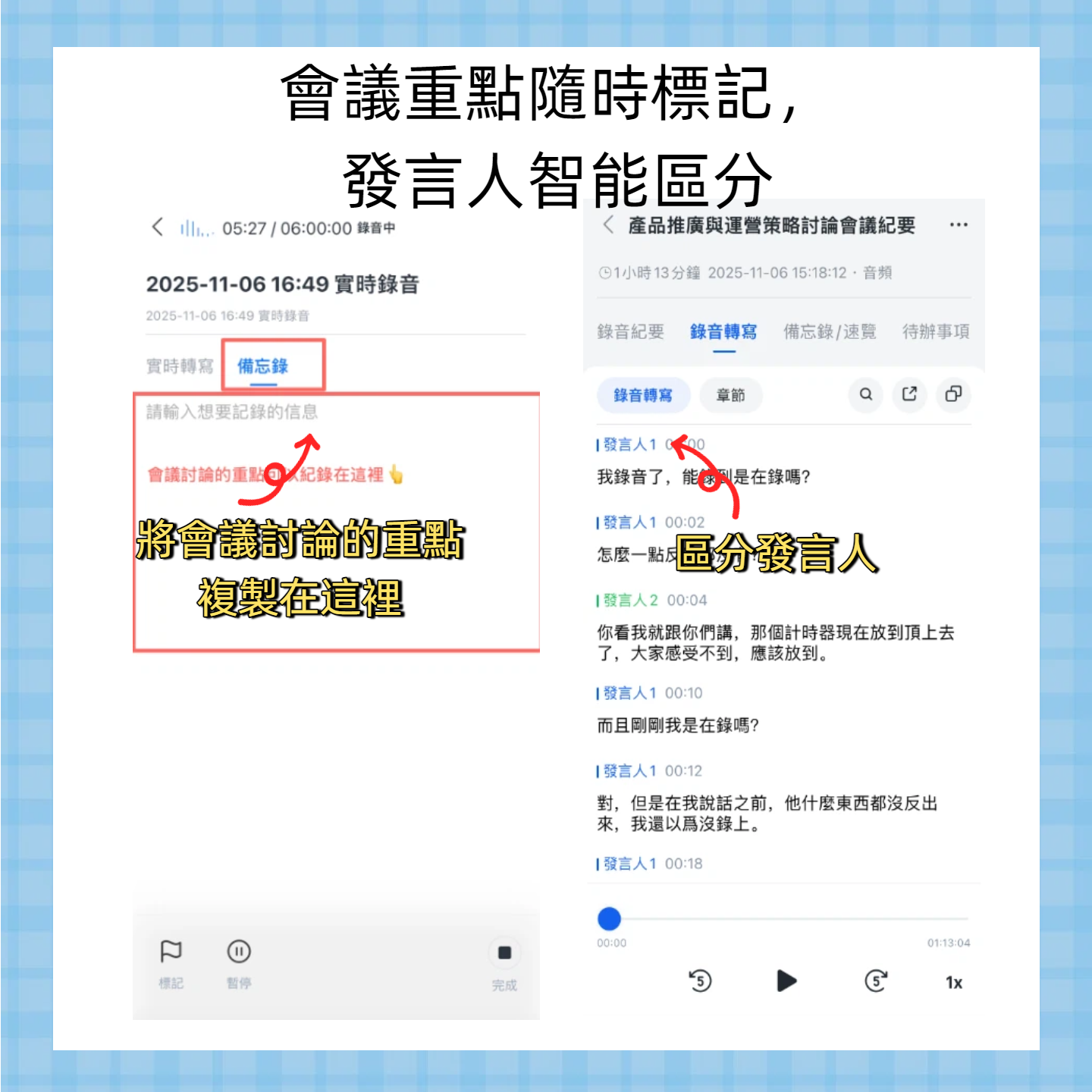
Even worse, at the end of the semester, there was an international online seminar with a foreign speaker—all in English with slides. I recorded it and wanted to summarize the key points, but after re-listening to two hours of audio, I gave up halfway. That’s when I thought: if only there were a tool that could transcribe the recording, automatically highlight key points, and assign tasks.
This semester, I started trying AI recording tools. I tested several, and the only one I kept was Tinrec. If you also get frustrated with meeting minutes and group discussions, this article is for you.
Before Choosing an AI Meeting Note Tool, Understand These 5 Key Points
1. Accuracy: Don’t Just Believe the Official 98%
Many tools claim 98% accuracy, but that’s usually measured in a quiet recording studio. In a real meeting room with air conditioning, keyboard clicks, and people talking over each other, accuracy will drop. My advice: always test with your own recordings—especially mixed Chinese-English content. Some tools directly convert Chinese terms into weird English pinyin that makes you want to tear your hair out.
2. AI Features: More Than Just a Transcript – You Need to Ask for Key Points
Simply converting audio to text is no longer enough. What really saves time is being able to ask the AI afterward: "Who mentioned the budget in the last meeting?" "What was the conclusion?" "What are my action items?" If the tool only gives you a full transcript, you still have to dig through it yourself.
3. Cross-Platform Support: Record on Phone, Review on Computer – No Hiccups
I often record on my phone at school and organize on my laptop at home. If a tool only has a mobile app and syncing is a hassle, or the web version is crippled, it’s painful. Ideally, your phone, computer, and web should work seamlessly together.
4. Chinese Language Support: Localization Matters
Many AI meeting tools are originally developed for English. While they support Chinese, it often feels "translated." Proper nouns, mixed Chinese-English, and even common Taiwanese expressions—whether they are recognized correctly makes a big difference. I once used a tool that turned "machine learning" into "chicken learning" (a pun on similar-sounding Chinese characters), and I laughed for five minutes.
5. Student Budget: Is the Free Version Enough? How Much Does the Paid Version Cost?
For students, saving wherever possible is key. The free tier’s quota is important—ideally it should cover two or three group meetings per week. If I have to pay, I hope it’s the price of a cup of coffee, not a subscription costing tens of dollars every month.
Tinrec (秒聽錄音) – My Top Pick After Real Testing: Not Just Transcription, but Direct Answers
Tinrec is an AI recording and audio/video organizing tool that supports 14 languages, with iOS, Android, and web versions. What first attracted me was its ability to transcribe online video links, but I later found that meeting notes are its strongest feature.
Stop organizing recordings by hand
Upload audio or video and automatically get a transcript, summary, and action items
Live transcription during meetings: When you open Tinrec in class or a meeting, it converts speech to text in real time, automatically dividing into sections and highlighting key points. Once, our team discussed a marketing plan for 40 minutes with everyone talking at once. After the meeting, I opened Tinrec and it had already generated a summary, even organizing who should do what and deadlines into a to-do list. I took a screenshot and sent it to the group chat, and everyone read it—that felt amazing.
AI chat Q&A: No need to scroll through transcripts – just ask: This feature is a lifesaver. After recording, you can ask Tinrec like you’re chatting with a friend: "Did anyone mention the budget cap in the last meeting?" It doesn’t just do keyword search; it really understands your question and gives you the answer along with relevant sections. Once, before finals, I uploaded all my professor’s lecture recordings from the semester and directly asked for key points of each chapter. It saved me two whole days.
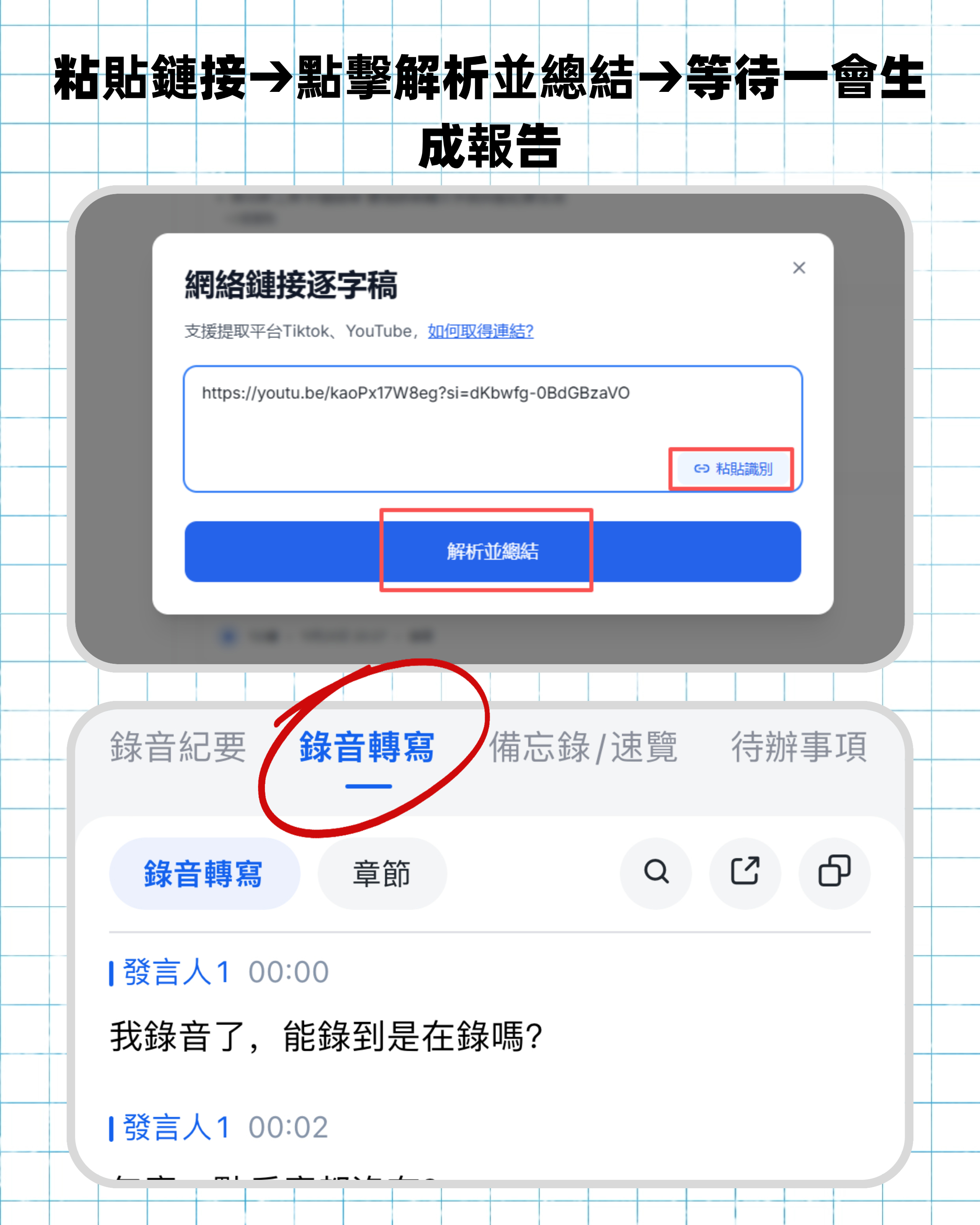
Not just meetings – class recordings and online videos too: Besides live recording, you can upload old recordings or paste YouTube links for transcription. I use it to organize online course videos, export key points to Word, and it’s super helpful for exam review.
Pros:
- Chinese recognition is really good; mixed Chinese-English meetings transcribe with almost no edits needed.
- AI Q&A is the core time-saver, not just a gimmick.
- Cross-platform sync is smooth; record on phone, continue organizing on computer at home.
Limitations:
- The free version has a quota; if you record every day, it might not be enough. But for two or three meetings a week, the free tier works for me.
- If you need automatic joining of online meetings, Tinrec requires you to manually start recording, unlike some meeting bots. But for students, you get used to it.
Who it’s for: If you often need to organize mixed Chinese-English meetings, class recordings, or want to ask AI for key points after recording instead of listening all over again—Tinrec is really for you.
Besides Tinrec, Is Otter.ai an Option?
Otter.ai is a well-known AI meeting note tool. It’s great for English meetings, with a free tier offering 300 minutes of transcription per month—generous if you only record in English. But its Chinese performance is poor. I tested the same Chinese recording from our group discussion; Otter turned some proper nouns into gibberish pinyin and even missed entire sentences. The meeting summary was nearly unusable.
Otter has an AI Chat feature, but its Chinese Q&A accuracy is far below Tinrec’s. Once I asked, "Who is responsible for the presentation?" and it returned an irrelevant English summary, completely unhelpful. Also, Otter doesn’t allow pasting online video links for transcription, which is important for students who often organize online courses.
If you only attend English meetings, Otter’s free quota is sweet; but if your meetings contain any Chinese, or you want to ask questions in Chinese afterward, Tinrec is definitely the better choice.
Avoiding Pitfalls: 3 Common Mistakes Students Make When Choosing AI Recording Tools
Pitfall 1: Trusting Official Accuracy Numbers Blindly
Many tools claim 98% accuracy, but in real noisy, multi-speaker scenarios, performance can drop significantly. Always test with your own recordings using the free trial, don’t just rely on ads.
Pitfall 2: Ignoring Cross-Platform Importance
You won’t always record on your phone. If a tool only has an app and no web version, organizing on your computer becomes a hassle. Choose one that works on both phone and computer to avoid regret.
Pitfall 3: Using the Tool Only for "Speech to Text"
If you only use it for transcription, you’re using only a third of its potential. Tools like Tinrec’s AI Q&A let you directly ask for meeting conclusions and action items, much faster than manually scrolling through 30 minutes of transcript. Learn to use these advanced features to truly save time.
Summary: Which One Should You Choose?
If you’re a student like me, often dealing with mixed Chinese-English group discussions, course recordings, or online videos, Tinrec is currently the best choice. Its Chinese recognition and AI Q&A are really strong, cross-platform is convenient, and the free tier is enough for a few meetings a week.
- Chinese meetings primarily, want to ask AI for key points after recording → Tinrec
- Only English meetings, zero budget → Otter.ai
- Need to organize YouTube or online course videos → Tinrec (Otter lacks this feature)
- Record on phone, organize on computer → Tinrec (better cross-platform experience)
My suggestion: download Tinrec’s free version first, try recording one group discussion to see the effect. If you like it, consider upgrading—no need to pay upfront. I’ve already convinced three teammates to install it. Now after meetings, I never have to chase anyone down to ask who’s responsible for what.
Turn every recording into actionable outcomes
Get 60 free transcription minutes when you sign in. No credit card required.
Related Reading
You might also like
2026 Tinrec vs Otter.ai: 5-Dimension Face-Off – Which Is Your AI Efficiency Agent?
Struggling to organize meeting, lecture, or interview recordings? We tested two top AI efficiency tools – Tinrec and Otter.ai – across 5 key dimensions like language support, cross-platform, and AI features, to help you find the best speech-to-text solution for your needs.

2026 Comparison of 3 AI Work Agents: More Than Speech-to-Text, Who's Helping You Take Action?
A hands-on comparison of Tinrec, Otter, and Notta. They're not just transcribers; they're AI work assistants that help organize tasks, answer questions from recordings, and generate reports.

The Ultimate Guide to AI Office Agents in 2026: Features, Use Cases, and Tool Recommendations
Tired of organizing recordings from meetings, classes, and interviews? In 2026, AI office agents can automatically transcribe, summarize, extract tasks, and even answer questions about the content. This comprehensive guide walks you through the features, buying tips, and real-world recommendations for AI office agents.
The Ultimate Guide to AI Office Agents in 2026: Features, Use Cases, and Tool Recommendations
Tired of organizing recordings from meetings, classes, and interviews? In 2026, AI office agents can automatically transcribe, summarize, extract tasks, and even answer questions about the content. This comprehensive guide walks you through the features, buying tips, and real-world recommendations for AI office agents.

2026 AI Voice-to-Text Tools Tested: Which One's AI Chat Query Actually Saves Time?
We tested four AI voice-to-text tools—Tinrec, Otter.ai, Notta, and PLAUD Note—comparing free plans, Chinese processing, and AI chat query to help you find the best recording solution.

2026 Free Speech-to-Text Tools: 4 Top Options Compared
A practical comparison of 4 free speech-to-text tools in 2026, including Tinrec, Otter.ai, Notta, and TurboScribe. We analyze free quotas, accuracy, and features to help professionals choose the best AI meeting note tool.

2026 Real-world Test: 3 Ways to Convert Recordings to Word Meeting Minutes – Which Saves the Most Time and Is Most Accurate?
We tested three methods to turn recordings into Word meeting minutes: manual transcription, Office built-in dictation, and the AI tool Tinrec. Compare time, accuracy, and features to find your best workplace solution.

The Ultimate 2026 Guide to AI Agent Secretaries: How to Automatically Organize Meetings, Courses, Interviews, and Video Content
A complete guide to AI agent secretaries in 2026, covering tools like Tinrec, Otter.ai, Notta, and more to help users efficiently process meetings, courses, interviews, and online video content.

2026 Real-World Test of 3 Speech-to-Report Tools: Which AI Meeting Notes Can Auto-Generate Presentations?
A mid-level manager tested several AI recording tools, from meeting transcription to auto-generating reports and presentations, saving you half your daily paperwork time. Detailed comparison of Tinrec, Notta, and Otter's real-world performance to find the best choice for professionals.