
Turn recordings into transcripts and summaries in minutes
Upload audio or video for multilingual transcription, AI notes, and action items
How to Use Dialect Speech Recognition in 2026? A Complete 5-Step Guide
Have you ever conducted fieldwork, interviewed elders who only speak a dialect, or attended a Taiwanese class, ending up with a two-hour recording that feels like deciphering a code when you try to organize it? This isn't just your pain point—it's the daily reality for many workers, students, and creators who need to process dialect content.
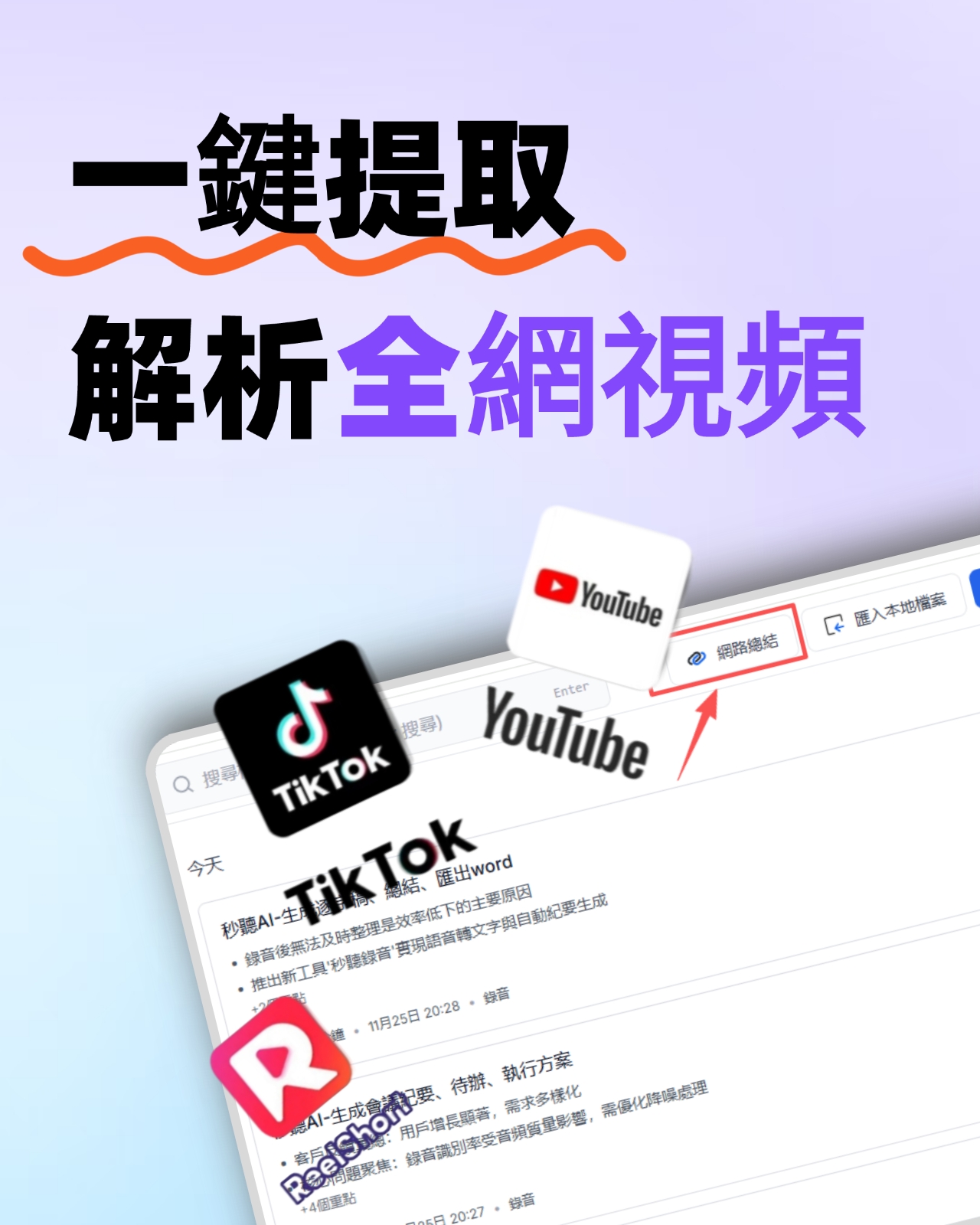
In the past, the only option was to manually listen repeatedly, which was time-consuming and prone to missing key points. But with advances in AI speech recognition, there are now tools that can transcribe your recordings into text, and even automatically highlight key points, summarize, and export to documents. This article will teach you how to use them, starting from choosing a tool and walking you through each step, so dialect recordings no longer become a black hole.
3 Things to Look for When Choosing a Dialect Speech Recognition Tool
Choosing a tool is like choosing a teammate—the wrong one can make you want to quit. Before you try one, consider these three dimensions.
Language Coverage and Dialect Support List
First, check if the tool supports the language variants you need. Some tools claim multilingual support but only cover official languages; others specifically list Cantonese, Taiwanese, etc. Be sure to read the official specs, or better yet, test with a real recording using a trial version.Recognition Performance in Real-World Scenarios
Lab results may look impressive, but real-world performance is what matters. Noisy conference rooms, café chatter, outdoor wind—these are real environments. Look for a tool that can handle background noise, multiple speakers, and mixed foreign terms to save yourself a lot of regret.What Can You Do After Transcription?
Getting a transcript is just the beginning. The ability to organize, highlight key points, export in various formats, or even generate reports directly determines your workflow efficiency. Find a solution that lets you be 'almost done organizing right after recording.'
Stop organizing recordings by hand
Upload audio or video and automatically get a transcript, summary, and action items
Looking at the current market, Tinrec 秒听录音 is one of the few options that meets all three criteria while especially enhancing the Chinese and multilingual experience. It supports over 14 languages and variants, including Cantonese, Taiwanese, and Hakka. Beyond transcripts, it offers AI summaries, action item extraction, and the ability to ask questions about the recording. Below, we'll use Tinrec to demonstrate turning a dialect recording into usable data.
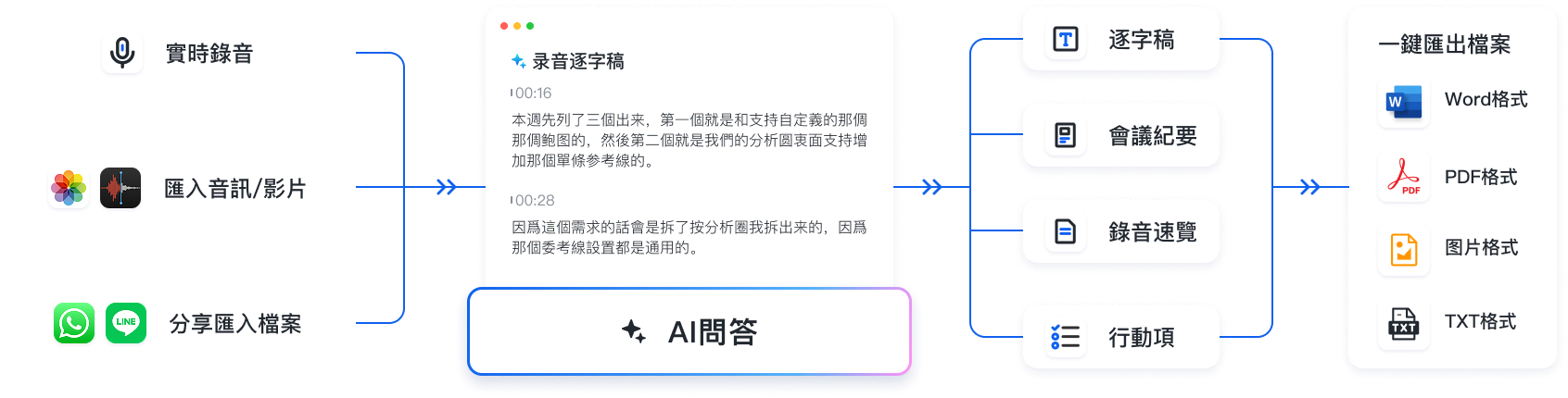
5-Step Implementation: From Recording to Action List
Step 1: Download and Register Tinrec
First, go to the official website or download "Tinrec 秒听录音" from the App Store or Google Play. After registration, you can immediately use the free version, which includes 100 minutes of transcription per month—enough to test a few dialect recordings.
Step 2: Record or Import a Dialect Audio File
You can open Tinrec and press record to capture interviews or meetings on the spot. If you have existing audio files (supported formats: MP3, M4A, WAV, etc.), you can also upload them from your phone or computer.
Step 3: Select Language and Start Transcription
After recording or uploading, select the corresponding language in the transcription settings (e.g., 'Cantonese' or 'Taiwanese Hokkien'). Tinrec will automatically recognize and transcribe into Traditional Chinese text. Accuracy varies based on audio quality, but generally clear recordings achieve over 90%. Transcription is fast—a 1-hour recording takes about 3 minutes.
Step 4: Ask AI to Highlight Key Points
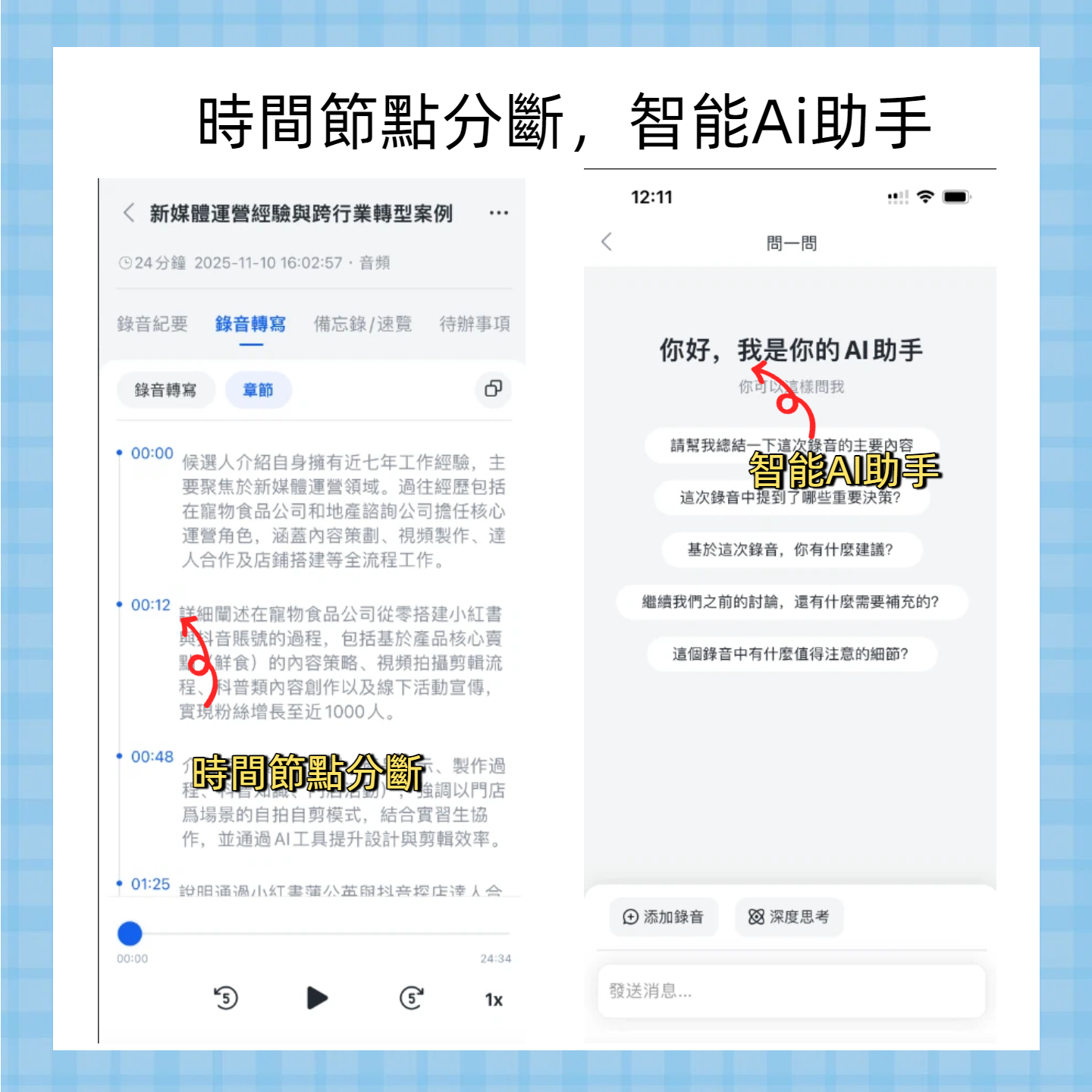
This is Tinrec's most useful feature. After transcription, you don't need to read from start to finish. Simply tap the AI chat below and ask: 'What budget items were discussed?' or 'Is there anything I need to follow up on?' It will find answers based on the recording content and highlight timestamps so you can cross-reference with the original audio.
Additionally, Tinrec automatically generates summaries, chapter divisions, and action items. You can quickly scan them to see what needs priority.
Step 5: Export and Next Steps
After organizing, you can export the transcript, summary, and to-do list as PDF or TXT, or sync directly to tools like Notion, Google Docs, or Dropbox. This way, you can turn dialect interview content into meeting documents, research materials, or class notes.
Conclusion: Make Dialect Recordings More Than Just Space-Consuming Files
The biggest fear with dialect speech recognition is tools that can't recognize or are hard to organize. Tinrec, with its support for multiple language variants and post-transcription AI querying, automatic summaries, and chapter splitting, is especially suitable for those who need to process large volumes of dialect audio—such as cultural historians, graduate students, language teachers, or families wanting to preserve elders' oral histories.
If you're still unsure if it's right for you, just use the free version to upload a dialect recording you commonly encounter and run through the 5 steps above. Experiencing it firsthand will be more meaningful than any review.
Note: AI recognition may still be affected by background noise, accents, or multiple people speaking simultaneously. For important content, please double-check against the original recording.
Turn every recording into actionable outcomes
Get 60 free transcription minutes when you sign in. No credit card required.
Related Reading
You might also like

2026 Complete Guide to Speech-to-Text: Features, Use Cases, and Tool Selection
As a senior college student, I used speech-to-text tools for an entire semester to organize lecture notes, group discussions, and YouTube study videos. This guide introduces you to Tinrec, from core features to real student scenarios, showing how AI turns audio and video into actionable knowledge.

2026 Free Speech-to-Text Solutions: 2 Tools Compared
A mid-level manager puts two popular free speech-to-text tools—Tinrec and Otter.ai—to the test, comparing Chinese accuracy, free tiers, AI features, and cross-platform support to help you pick the best one for workplace productivity.

2026 Tinrec Voice-to-Text Tutorial: No Hardware Needed, AI Organizes from Multiple Sources
How to choose voice-to-text software? This article compares Tinrec and Plaud Note, from hardware requirements, input sources, AI features to pricing, and tells you why you don't need to buy a voice recorder — your phone can handle meetings, lectures, and online video transcription.

2026 Hands-On Comparison of 5 Cross-Border Meeting Note Apps: Which AI Summary Saves the Most Time?
Dealing with cross-border meetings daily, mixing English, Mandarin, and Cantonese? Still transcribing recordings after meetings? We test 5 transcription apps to see which one can quickly organize multilingual meetings, saving you time and overtime.

2026 Free Chinese-English Real-Time Translation Solutions: 3 Tools Compared
A must-read for professionals: hands-on testing of Chinese-English real-time translation tools. From cross-border meetings to self-study, Tinrec not only translates in real time but also transcribes audio and generates AI summaries, truly solving the pain points of middle managers.

2026 Tinrec vs Otter.ai: 5-Dimension PK – Which Is Better for Chinese Transcription?
Looking for a great speech-to-text app? This article compares Tinrec and Otter.ai across 5 dimensions: Chinese transcription accuracy, extra organization features, pricing, input sources, and target users. It also covers alternatives like Notta, TurboScribe, and PLAUD to help you find the right tool quickly.

How to Choose a Multilingual Speech-to-Text Tool in 2026: A 5-Step Guide
Cross-border team meetings often mix English and Chinese, and a simple English transcription tool fails when it hits Chinese. After using Otter.ai for two years and switching to Tinrec, here's a 5-step guide to choosing the best multilingual speech-to-text solution, covering accuracy, translation, input sources, AI post-processing, and pricing.

2026 Comparison: 3 Transcription Apps Tested – Which AI Summary Actually Saves Time?
We tested three popular voice-to-text apps—Tinrec, Otter.ai, and Notta—comparing language support, cross-platform capabilities, AI summaries, and free plans to help you find the best time-saving tool for Chinese users.

2026 Tinrec vs Notta: 5-Dimension Comparison – Which Is Better for Students in Real-Time Chinese-Japanese Translation?
From a college student's perspective, this article compares Tinrec and Notta across five key dimensions in real-time Chinese-Japanese translation scenarios, including translation accuracy, post-meeting organization, free quota, cross-platform convenience, and AI value-added features, helping you decide which tool is more suitable for classroom and everyday translation needs.