

Turn recordings into transcripts and summaries in minutes
Upload audio or video for multilingual transcription, AI notes, and action items
I recently took on a Korean client and have weekly overseas meetings. The biggest headache isn't the time difference—it's the language. I only know "안녕하세요" in Korean. During meetings, when the other side goes on a long speech, I rely on a colleague to translate. But if that colleague isn't around, the meeting practically stalls. Later, I tried real-time translation apps, but they only translate one sentence at a time, and there's no record after the meeting. I also tried recording and then feeding it to translation software, but the processing was slow and I only got translated text without organized key points. It wasn't until I moved the entire workflow to Tinrec that I realized Chinese-Korean real-time translation could be much simpler.
This article is based on my three months of hands-on experience, walking you through 3 steps on how to use Tinrec for Chinese-Korean meetings, while also comparing it with traditional translation tools like Papago.
Why Are People Looking for Alternatives to Papago?
Papago is a Chinese-Korean translation app that many people have installed on their phones. It's convenient for looking up words and translating short phrases. But in a professional setting, its limitations gradually emerge: during meetings, it only allows sentence-by-sentence input or voice input, and cannot instantly turn entire conversations into bilingual records; the translated content lacks structured organization, so finding a conclusion later requires scrolling from beginning to end; and it doesn't support directly processing meeting recordings or Korean videos online—all common workplace needs.
If you share similar frustrations—needing more than just "translation," but a full conversation record, key point summaries, and follow-up tracking—then Tinrec, a tool centered on audio/video organization, is actually more suitable.
Tinrec vs Papago: What's the Difference in Core Experience?
I'll compare them directly from several key dimensions so you can see the differences at a glance.
Real-time Capability and Completeness
The most important thing in a meeting isn't translating sentence by sentence, but the context of the entire conversation. Tinrec's simultaneous interpretation feature displays bilingual text while recording, with less than 1 second lag, and a bilingual transcript is ready as soon as the conversation ends. Papago's voice translation mode has real-time capability too, but it can only handle one sentence at a time, making it impossible to keep up in multi-person meetings.
Scenario Coverage
Papago is a pure translation tool, suitable for queries or short conversations. Tinrec, besides real-time translation, can handle meeting recordings, uploaded Korean videos, Korean content from YouTube, and even turn the entire database into a searchable knowledge base. For example, after a meeting, I can simply ask the AI chat, "What was the conclusion of the last meeting?" and the system finds the answer from the Chinese-Korean records—something Papago can't do at all.
Output Results
Papago only gives you translated text. Tinrec not only provides bilingual transcripts but also automatically generates summaries, action items, chapters, and can even help you write meeting reports or tables. For someone like me who needs to report upward, the time saved isn't just translation time—it's the entire post-meeting organization effort.
Cross-platform and Collaboration
Papago is mainly a mobile app, with occasional web version use. Tinrec syncs across iOS, Android, and web, with all Chinese-Korean records stored in the cloud. Record on your phone, review on your computer—seamless cross-device integration. For team collaboration, you can share links directly without sending a bunch of screenshots.
Stop organizing recordings by hand
Upload audio or video and automatically get a transcript, summary, and action items
Tinrec's Core Features at a Glance
These are the features I find particularly useful for Chinese-Korean scenarios, explained one by one.
Simultaneous Interpretation
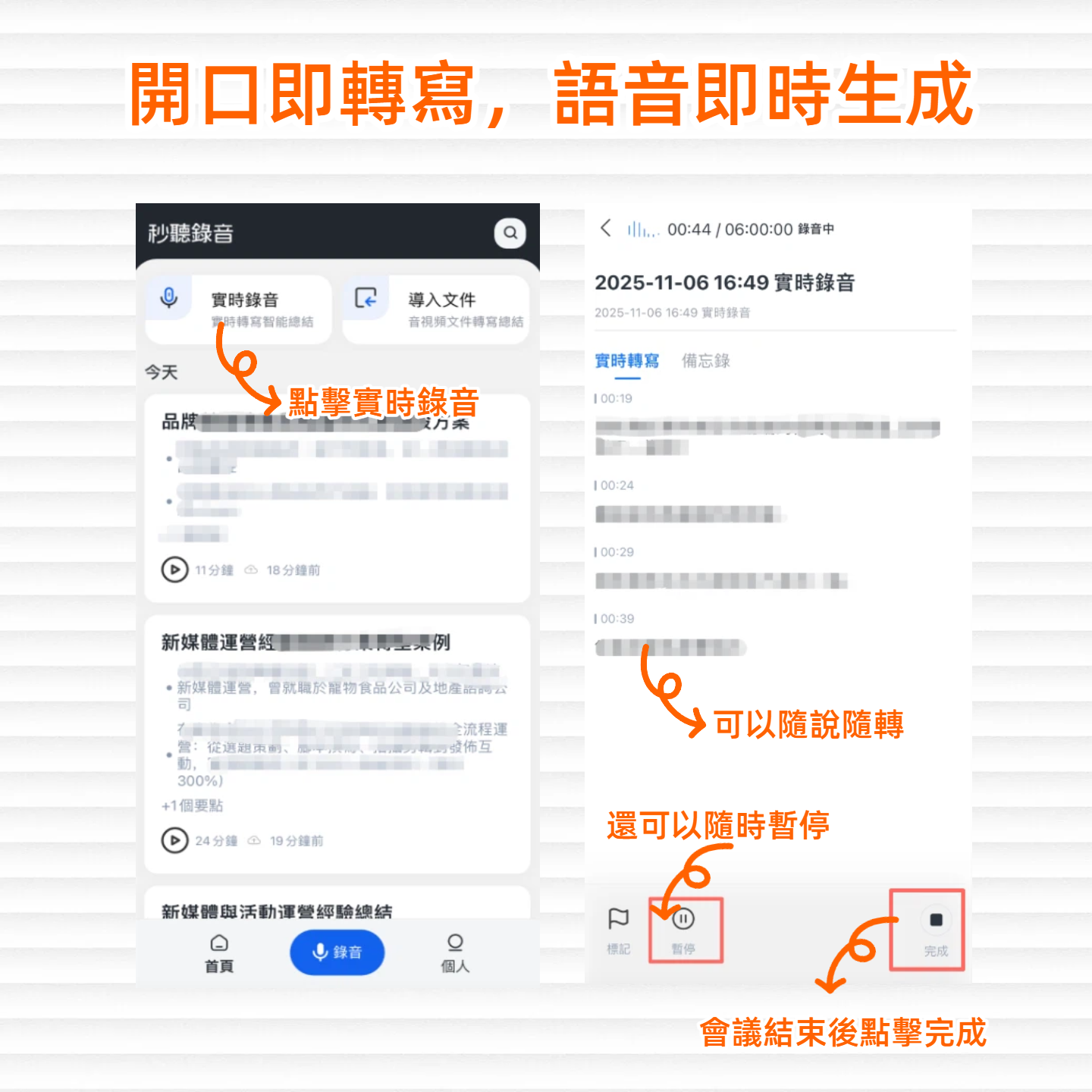
It's like having an instant interpreter. While recording, the screen shows both the original text and translation, working both ways between Chinese and Korean. Last week, when discussing specs with a Korean vendor, I could talk and glance at the screen at the same time without waiting for them to finish before reacting—communication flow improved dramatically.
AI Summary and Action Item Extraction
After recording a one-hour Chinese-Korean meeting, Tinrec automatically generates a summary and action items. Previously, I had to spend half an hour re-listening and organizing. Now, I can paste the key points to my boss and team within five minutes.
Web Video Parsing
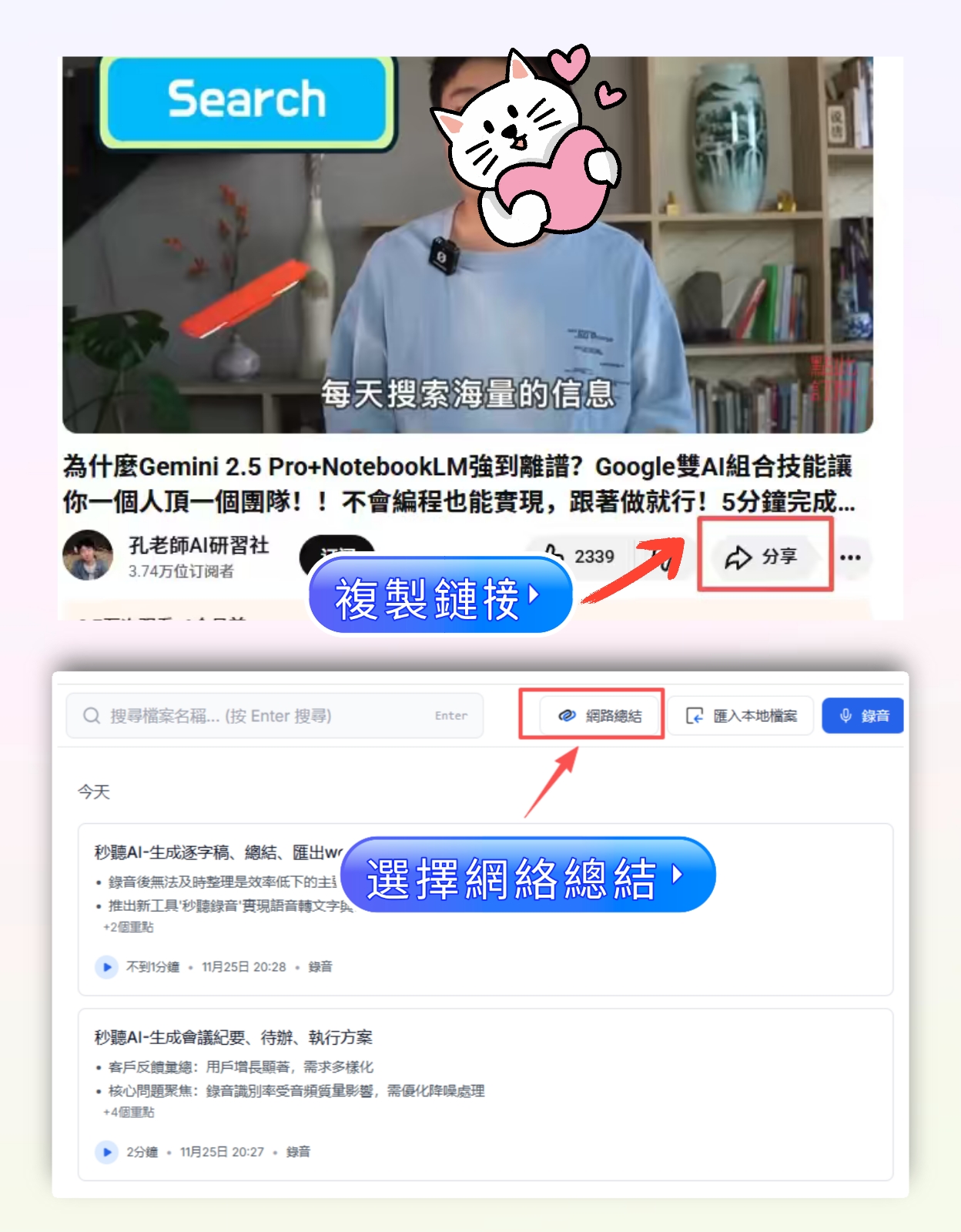
I need to research competitor dynamics in the Korean market and often watch their YouTube videos. Just paste the link into Tinrec, and it converts them into bilingual Chinese-Korean text, with key sections highlighted. This feature has saved me countless nights.
AI Chat Query
All recorded Chinese-Korean content can be queried by asking questions. For example, I ask, "When did the client ask to change the delivery date in the last meeting?" Tinrec finds the answer from past recordings, along with the original text and translation. For managers who frequently need to look back at information, it's like finding treasure.
Actual Use Cases
Below are three scenarios I encounter most often in my work and find most practical.
Scenario 1: Chinese-Korean Online Meetings
Every Tuesday morning regular meeting with Korean clients and the Taiwan team. Previously, it was colleague interpreting plus my handwritten notes. Now, I open Tinrec, enable simultaneous interpretation, and by the end of the meeting, the bilingual transcript and summary are already on my phone. Sharing with attendees saves a lot of back-and-forth communication.
Scenario 2: Korean Language Courses and Self-Study
To build rapport with clients, I signed up for an online Korean course. The teacher's pace was too fast for me to take notes. After recording, I use Tinrec to convert it into bilingual Chinese-Korean text with automatic chapter division, making review much more efficient.
Scenario 3: Researching Korean Content
From Korean news to YouTube unboxing videos, I throw everything into Tinrec for parsing. Not only for language learning, but also when I need to cite data for market reports, I can just copy and paste from the transcript instead of transcribing manually.
Key Points to Consider When Choosing a Chinese-Korean Real-Time Translation Tool
1. Don't Just Look at Translation—Look at "Post-Processing"
Pure translation tools can handle short conversations, but the real time sink in a professional setting is post-meeting organization. Choose a tool that can automatically generate summaries, action items, and even export to Notion or Google Docs. That's real time-saving. Tinrec does this very comprehensively.
2. Cross-Device Sync is Important
You might record on your phone during meetings but review on your computer later. If data is locked to one device, it becomes another form of rework. Tinrec's cloud sync lets me switch seamlessly.
3. Translation Quality and Speed
The fluency of Chinese-Korean translation directly affects meeting pace. Tinrec's simultaneous interpretation has almost no lag in a typical office environment, and the translation results are suitable for business language. Of course, background noise or too many technical terms may cause errors—that's the same for all tools.
4. Can It Handle Content from Different Sources?
Your Chinese-Korean needs might not be limited to meetings; you might have videos, files, or even old recordings. Make sure the tool supports multiple input types so you're not locked in later. One of Tinrec's strengths is that it accepts almost any format.
5. The Generosity of Free Plans
Papago is basically free, but its features are also basic. Tinrec's free plan offers 100 minutes of transcription per month, enough to test with one or two meetings. If you have high usage like me, the Pro plan costs less than a Starbucks coffee per month—very cost-effective.
Conclusion: Is Tinrec Worth a Try?
If you only occasionally look up a few Korean words, Papago is still convenient. But if you're a professional, student, or someone who frequently deals with Chinese-Korean voice content, Tinrec's end-to-end workflow—"Recording → Translation → Organization → Query"—truly helps turn language barriers into usable knowledge.
I recommend downloading the free version of Tinrec and testing it with your existing Chinese-Korean recordings or meetings to experience the complete process from transcript to AI summary. Rather than reading more comparisons, try it yourself—that's the most straightforward way for us managers to decide.
Turn every recording into actionable outcomes
Get 60 free transcription minutes when you sign in. No credit card required.
Related Reading
You might also like

2026 Complete Guide to Speech-to-Text: Features, Use Cases, and Tool Selection
As a senior college student, I used speech-to-text tools for an entire semester to organize lecture notes, group discussions, and YouTube study videos. This guide introduces you to Tinrec, from core features to real student scenarios, showing how AI turns audio and video into actionable knowledge.

2026 Free Speech-to-Text Solutions: 2 Tools Compared
A mid-level manager puts two popular free speech-to-text tools—Tinrec and Otter.ai—to the test, comparing Chinese accuracy, free tiers, AI features, and cross-platform support to help you pick the best one for workplace productivity.

2026 Tinrec Voice-to-Text Tutorial: No Hardware Needed, AI Organizes from Multiple Sources
How to choose voice-to-text software? This article compares Tinrec and Plaud Note, from hardware requirements, input sources, AI features to pricing, and tells you why you don't need to buy a voice recorder — your phone can handle meetings, lectures, and online video transcription.

2026 Hands-On Comparison of 5 Cross-Border Meeting Note Apps: Which AI Summary Saves the Most Time?
Dealing with cross-border meetings daily, mixing English, Mandarin, and Cantonese? Still transcribing recordings after meetings? We test 5 transcription apps to see which one can quickly organize multilingual meetings, saving you time and overtime.
2026 Free Chinese-English Real-Time Translation Solutions: 3 Tools Compared
A must-read for professionals: hands-on testing of Chinese-English real-time translation tools. From cross-border meetings to self-study, Tinrec not only translates in real time but also transcribes audio and generates AI summaries, truly solving the pain points of middle managers.

2026 Tinrec vs Otter.ai: 5-Dimension PK – Which Is Better for Chinese Transcription?
Looking for a great speech-to-text app? This article compares Tinrec and Otter.ai across 5 dimensions: Chinese transcription accuracy, extra organization features, pricing, input sources, and target users. It also covers alternatives like Notta, TurboScribe, and PLAUD to help you find the right tool quickly.

How to Choose a Multilingual Speech-to-Text Tool in 2026: A 5-Step Guide
Cross-border team meetings often mix English and Chinese, and a simple English transcription tool fails when it hits Chinese. After using Otter.ai for two years and switching to Tinrec, here's a 5-step guide to choosing the best multilingual speech-to-text solution, covering accuracy, translation, input sources, AI post-processing, and pricing.

2026 Comparison: 3 Transcription Apps Tested – Which AI Summary Actually Saves Time?
We tested three popular voice-to-text apps—Tinrec, Otter.ai, and Notta—comparing language support, cross-platform capabilities, AI summaries, and free plans to help you find the best time-saving tool for Chinese users.

2026 Tinrec vs Notta: 5-Dimension Comparison – Which Is Better for Students in Real-Time Chinese-Japanese Translation?
From a college student's perspective, this article compares Tinrec and Notta across five key dimensions in real-time Chinese-Japanese translation scenarios, including translation accuracy, post-meeting organization, free quota, cross-platform convenience, and AI value-added features, helping you decide which tool is more suitable for classroom and everyday translation needs.