

Turn recordings into transcripts and summaries in minutes
Upload audio or video for multilingual transcription, AI notes, and action items
2026 Local Speech-to-Text Buying Guide: Hands-on Test of Tinrec and Recommendations
I have about 15 meetings a week—weekly meetings, project progress meetings, one-on-ones, cross-departmental coordination. What used to annoy me wasn't the meetings themselves, but what came after—because every meeting had a bunch of decisions and to-do items to organize. My phone was filled with dozens of recordings, but I never had time to listen to them. I tried handwritten notes (too slow), tried listening back to recordings (too time-consuming), tried asking subordinates to help (they were also busy). Until I started using Tinrec. It didn't solve all my management problems, but at least it turned those local recordings piling up on my phone into searchable, readable, usable text in minutes. This article is my hands-on review, a reference for those who are also chased by meetings.
What Can Local Speech-to-Text Do for You?
"Local" doesn't mean you need to buy an offline transcription machine; it means the recordings of meetings, interviews, and classes already on your phone or computer no longer require you to manually transcribe them. Take Tinrec for example: it lets you directly import audio or video files from your device, start transcribing, and get a transcript within minutes. It can even help you organize key points.
Scenario 1: Get Meeting Minutes 5 Minutes After the Meeting
After a two-hour meeting, my boss used to ask "What's the conclusion?" and I'd dread it. I'd have to scroll through the phone recording from the start, listen again, then type a summary—at least 30 minutes. Now, before a meeting, I open Tinrec's live recording (just set the phone aside), or after the meeting, I upload the recording file. The AI automatically transcribes it into text and pulls out the meeting topic, conclusions, and action items—who needs to do what and deadlines are all listed. I copy and paste it directly into a report or Slack, and my boss thinks I've gotten faster at typing.
Scenario 2: Turn Course Recordings into Study Notes
Last month, I attended a project management class. The instructor spoke quickly and covered a lot, so I used to record it and listen again at home. This time, I fed the recording directly into Tinrec. It generated a transcript, and the AI automatically broke it into sections with titles. I just skimmed through, highlighted key concepts, and reduced my review time from 2 hours to 20 minutes.
Scenario 3: Never Miss a Detail in Interviews or Cross-Department Communication
After talking with clients or partners, verbal promises are often forgotten. I've developed the habit of recording important calls or face-to-face conversations with my phone. Afterward, I import them into Tinrec for transcription, ask the AI to extract action items, and share them with relevant colleagues. Even if the other party didn't take notes, I have a clear record to follow up on progress.
Core Capabilities of Local Speech-to-Text Tools
I've tried several tools and settled on Tinrec because it doesn't just transcribe; it helps me get things done afterward. Here are the four capabilities I find truly useful:
Real-time Transcription, Words as You Speak
Tinrec's live recording feature has less than a second delay. During a meeting, you can watch the text on screen to ensure no key points are missed. If the network is unstable, it also supports offline recording saved on your phone for later upload. This is very convenient for situations where you need to see the transcript in real time, such as interviews or foreign language classes.
Not Just Transcripts, But AI Summaries and Chapters
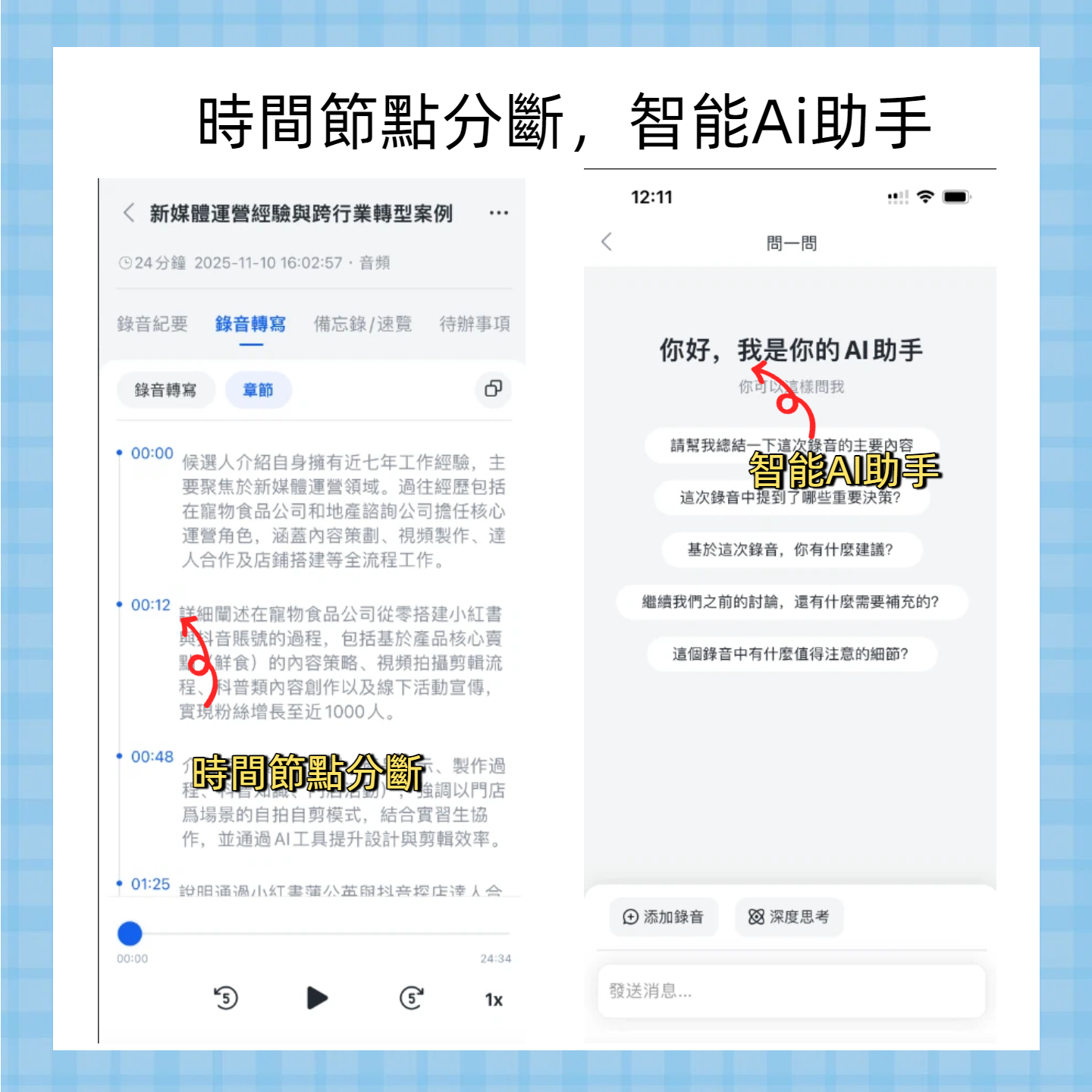
Just giving me a block of text still requires reading. Tinrec automatically generates structured summaries: meeting topic, discussion conclusions, and action items listed separately. Long recordings can also be split into chapters with titles, like an e-book table of contents—click to jump to that section.
Stop organizing recordings by hand
Upload audio or video and automatically get a transcript, summary, and action items
AI Chat Query, Faster to Find Key Points
After transcription, I can directly ask the AI: "Who mentioned the budget in the meeting?" "What was the client's feedback on the timeline?" It pulls the answers from the entire content. This is probably my most-used feature—no more scrolling through the screen searching for keywords.
Multi-Format Export, Seamless Workflow Integration
Summaries, action items, transcripts—Tinrec can export as TXT, Word, PDF, or sync directly to Notion, Google Docs, OneNote. I usually paste action items into my team's Trello and store meeting minutes in Notion for archiving, without having to copy and paste twice.
Real-World Use Cases with Tinrec
Case 1: Department Weekly Meeting, Quick Meeting Minutes
Now, for the weekly department meeting I host, I use Tinrec to record. After the meeting, I ask the AI to generate a summary and action items, check for misunderstandings, make corrections, and then email it to the whole team. Previously, it took at least 40 minutes to organize; now it takes under 10 minutes.
Case 2: Online Courses or Lectures, Turned into Personal Notes
When attending external training or listening to TED talks, I use the screen recording feature to capture audio, then import it into Tinrec. The AI automatically segments and titles sections. I read the text while highlighting key points—much more efficient than listening and writing at the same time.

Case 3: One-on-One Meetings, Record Employee Development Points
For regular check-ins with team members, I simply record them (with consent). After Tinrec transcribes them, I can refer back to the goals and improvement plans from previous meetings as a basis for the next one. This accumulation of data is more accurate than relying on memory.
Case 4: Media Interviews or Podcast Organization
I once helped a friend organize a 1-hour interview recording. Using Tinrec, I got a transcript and then had the AI extract highlight quotes and section outlines. Without listening from start to finish, I produced a blog post in half an hour.
4 Points to Consider When Buying a Local Speech-to-Text Tool
1. Supported File Formats and Sources
Some tools only accept specific formats or can't handle large files. Tinrec supports common formats like MP3, WAV, M4A, MP4, and can even transcribe from online video links like YouTube and Bilibili—very handy for those who often organize online resources.
2. Post-Transcription Organization Ability, Not Just Transcripts
If you just need dictation, free online services suffice. But to save time, focus on summaries, chapters, action item extraction, and Q&A after transcription. Tinrec does this very well, especially for Chinese content summaries, with rarely awkward sentence breaks.
3. Performance in Chinese and Mixed-Language Scenarios
Many tools are strong in English but weaker in Chinese. For Chinese, Traditional Chinese, and even Chinese-English mixed meetings or courses, Tinrec's accuracy is over 90% in my tests (quiet environment, clear speech). Background noise or overlapping speakers still reduces accuracy, but compared to manual re-listening, the difference is significant.
4. Security and Privacy Considerations
If you have confidential company meetings, you may be concerned about uploading recordings to the cloud. Tinrec encrypts the recording and transcription process during transmission, and you can delete cloud files afterward. However, if you have strict offline requirements, these tools currently still need internet connectivity—a limitation to be aware of before purchasing.
Frequently Asked Questions
Q1: Is the free version of Tinrec sufficient?
If you only have 3-4 meetings per week or occasionally organize course recordings, the free version offers a basic monthly transcription allowance (based on the product page) that's enough to experience key features. But if you have meetings every day like I do, going straight for the Pro monthly plan is less restrictive—it costs less than two Starbucks drinks a month.
Q2: Will my uploaded recordings be used to train the AI?
Tinrec's policy is not to use your content for model training. Check the official privacy policy for details. If you're still concerned, you can use live recording only (no file saved) for sensitive meetings, or pause recording during important parts.
Q3: Can it distinguish between different speakers?
Yes, Tinrec's transcription results label speakers as "Speaker 1," "Speaker 2," but works best when audio quality is clear and voices are distinct. Overlapping or noisy backgrounds can still cause confusion.
Q4: What languages are supported?
Currently supports 14 languages, including Traditional Chinese, Simplified Chinese, English, Japanese, Cantonese, etc., very friendly for users in Taiwan.
Q5: Can I use it on both phone and computer?
Tinrec has iOS and Android apps and a web version, with data synced across all three. I use it on my computer at work and on my phone during commute—no gaps in accessing data.
Conclusion
Looking back, my phone used to be full of dozens of meeting recordings that I never had time to re-listen to. Now with Tinrec, recordings are no longer a data black hole but a searchable, queryable knowledge base that can be turned into action. If you're like me, chased by meetings every week and don't want to spend a lot of time organizing documents, I suggest starting with the free version to experience what it's like to get a meeting summary within 5 minutes after recording. Especially if you already have a bunch of local recordings, import them for transcription—you'll see how much time these tools can save you.
Turn every recording into actionable outcomes
Get 60 free transcription minutes when you sign in. No credit card required.
Related Reading
You might also like
Tinrec vs Notta 2026: A 5-Dimension Showdown – Which Is Better for Chinese Content Organization?
Choosing a speech-to-text tool? This article compares Tinrec and Notta across five aspects including transcription accuracy, AI post-processing, and multi-source input to help you find the best solution for organizing Chinese content.

2026 5 Real-Time Translation Apps Compared: Are Free Plans Good Enough?
Looking for a great real-time translation app? This article compares 5 popular tools in real-time translation, AI summarization, free quotas, and Chinese recognition to help you choose.

2026 Comparison of 3 Meeting Note Tools in Real Tests: Which AI Minutes Really Save You Time?
How to take meeting notes quickly and accurately? This article tests 3 tools, showing you how to use AI to automatically generate summaries and to-dos, from recording to organizing in one go. Using Tinrec as an example, we demonstrate the full meeting note process and summarize 4 key purchase points to help you find the best solution.

2026 Speech-to-Text Tool Buying Guide: 3 Tools Tested and Recommendations
A student's real-world test of speech-to-text tools, comparing online and offline solutions, sharing genuine experiences in class and meeting scenarios to help you choose the best learning tool.
2026 Speech-to-Text Tool Comparison: Which One Handles Multilingual Accuracy Best?
For multilingual meetings, Cantonese interviews, and mixed Chinese-English recordings, which speech-to-text tool can you really count on? This hands-on test compares Tinrec and 3 other leading tools across Cantonese accuracy, AI Q&A, cross-platform support, and free tiers to help you find the best fit.

Tinrec 2026 Tutorial: Real-Time Transcription & AI Summary for Meetings
Still scribbling notes during meetings? Tinrec instantly transcribes conversations, generates summaries and action items, and the free plan is easy to use. This complete guide takes you from recording to organized notes.

How to Choose a Real-Time Translation Online Tool in 2026? A 5-Step In-Depth Comparison Guide
With so many real-time translation online tools available, how do you choose? This article compares Tinrec and Notta across 5 dimensions including language support, translation accuracy, use cases, and pricing plans to help you find the best free real-time translation tool.

Tinrec vs Otter.ai 2026: A 4-Dimensional Showdown – Which is Better for Chinese Real-Time Translation?
Who is the real-time translation savior for Hong Kong office workers, Tinrec or Otter.ai? We tested them across 4 dimensions: Cantonese recognition, translation support, multi-platform, and AI query, to help you pick the best tool.

2026 Free Simultaneous Interpretation Solutions: One Look at All
How to choose the best free online simultaneous interpretation tool? This article recommends Tinrec Instant Recording, which supports real-time recording translation, meeting interpretation, and document translation, along with buying tips to help you save budget and improve cross-language communication efficiency.