

Turn recordings into transcripts and summaries in minutes
Upload audio or video for multilingual transcription, AI notes, and action items
Why Are People Looking for Alternatives to Basic Offline Transcription Tools?
I used to think that for transcription, a simple offline app was enough. I would record lectures on my phone, listen to them later at home, and manually type out the key points—sounded reasonable. But when midterms and finals came, I realized that the "record now, organize later" plan simply didn't work. Several times, after recording a two-hour class, I would open the audio file late at night and have absolutely no desire to listen from start to finish, let alone pick out the important parts and take notes.
Some of my classmates use built-in phone features or free offline transcription tools—accuracy is average, and they only provide verbatim transcripts with no summaries, no categories, and no way to ask "What are the exam focus points from this class?" If you're starting to feel that simply turning audio into text isn't enough and you want a tool that can truly turn your audio files into "review-ready materials," then Tinrec is definitely worth a look.
Tinrec vs. Basic Offline Transcription Tools: What's the Core Difference?
Many people ask: Isn't offline transcription more convenient? You can use it without internet. That's true—if you frequently record in places with no internet, offline capability is essential. But for most students—classrooms, libraries, cafés—there's usually internet. In these cases, the "AI post-processing" that online tools offer becomes much more critical. Below, I'll compare Tinrec and typical offline tools from several angles.
Post-transcription Understanding and Organization
Basic offline tools usually just give you a verbatim transcript. After reading it, you still have to manually highlight key points. Tinrec, on the other hand, automatically generates summaries, breaks the text into chapters, and even extracts to-do items the teacher mentioned. Last semester, in one class, the professor casually mentioned the final report format in the last ten minutes—Tinrec flagged that sentence as important and turned it into a to-do. My roommate, using her phone's built-in recorder, completely missed it.
Multiple Input Sources
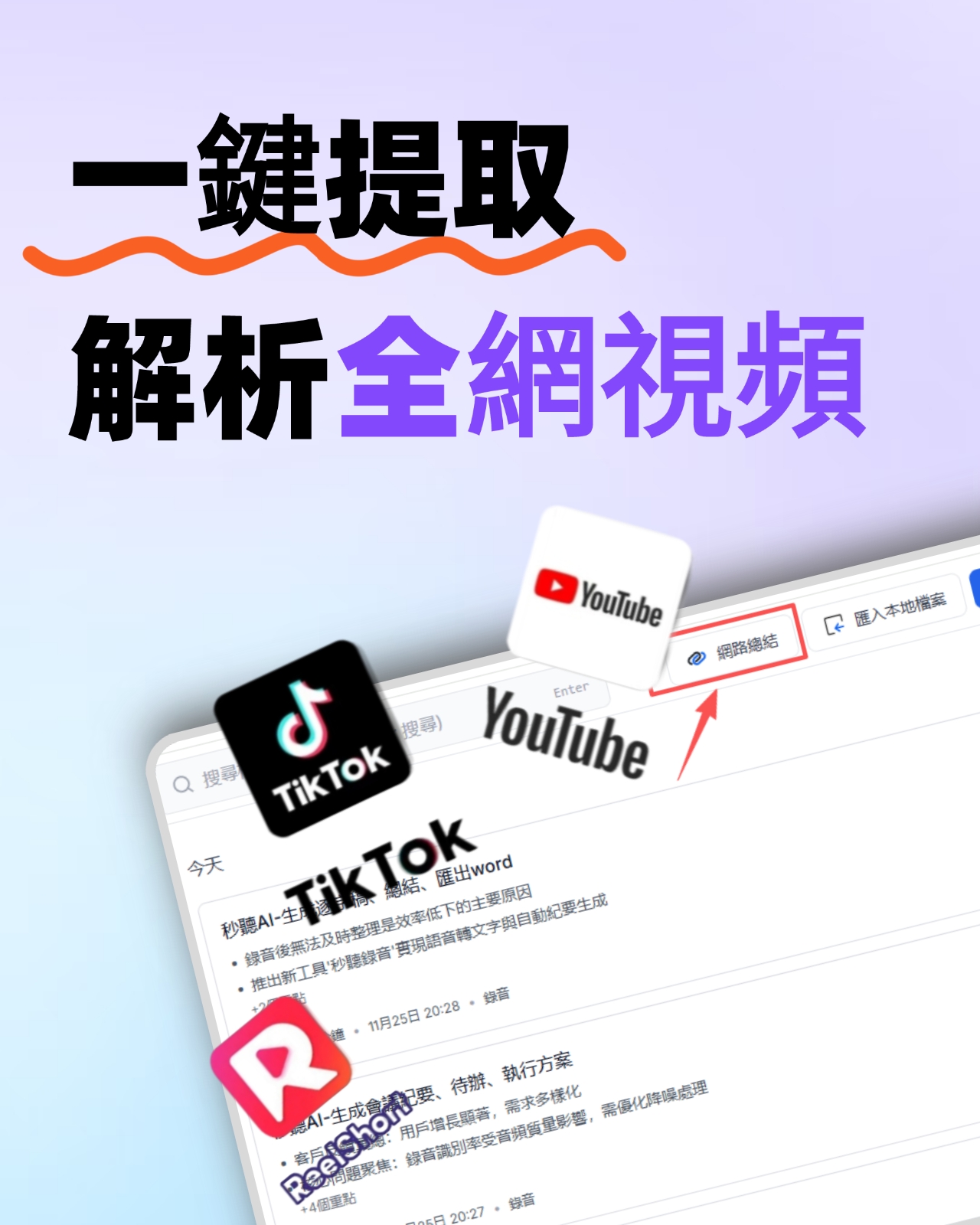
Offline tools can mostly only handle recordings made on the phone at that moment. Tinrec not only records in real time but also allows you to upload previous audio files, paste YouTube or Bilibili video links, and directly convert online videos into text and summaries. This is super practical for students like us who often supplement with online courses or foreign videos.
AI Conversation Queries
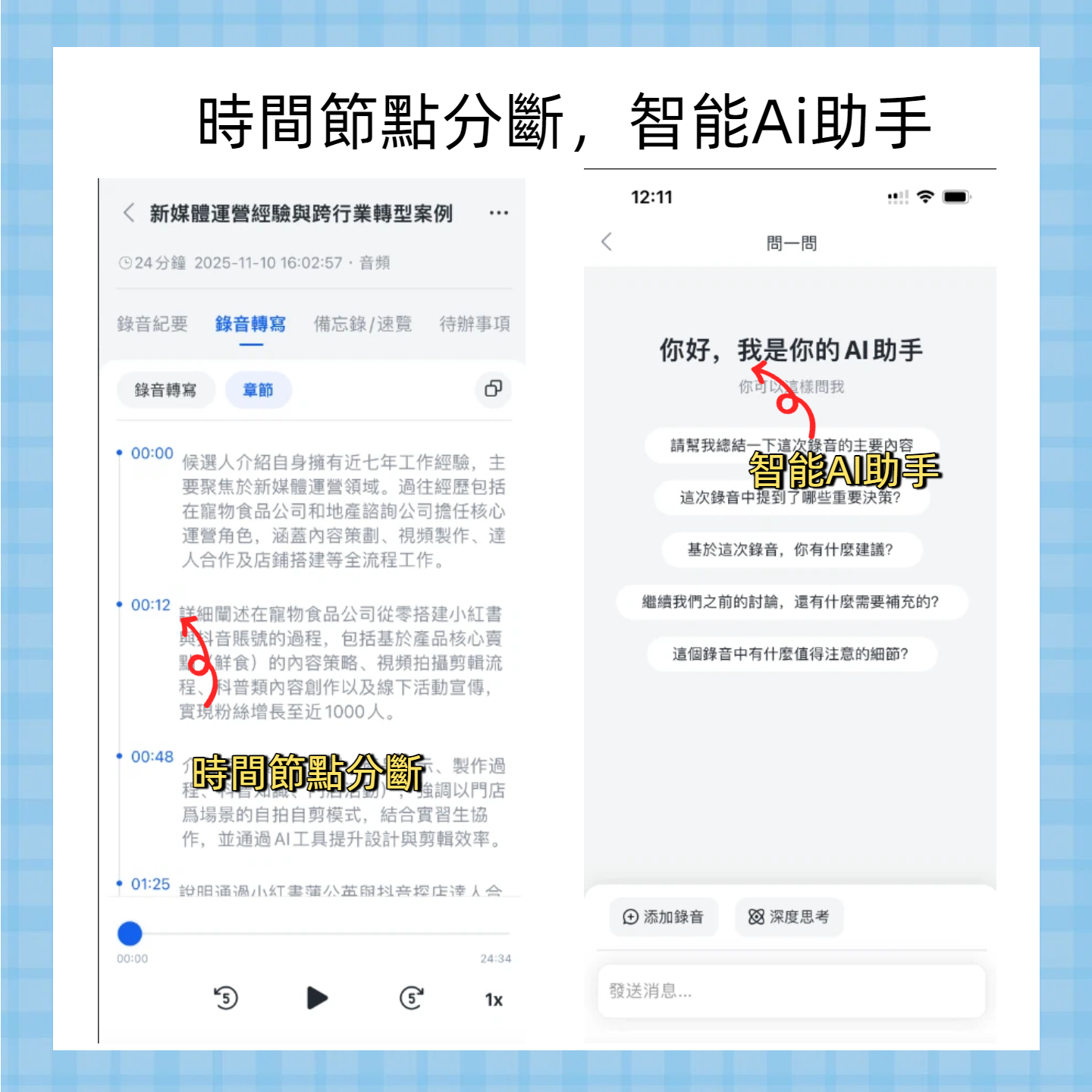
This is my most-used feature. After recording a class or a group discussion, I can just ask Tinrec: "What was the conclusion of this discussion?" or "Who is responsible for which part?" It answers based on the content, saving me from flipping through dozens of pages of transcript. Offline tools can't do this at all, which is ultimately why I chose to pay—the time saved is better spent sleeping.
Cross-Platform Sync
Tinrec works on phone, computer, and web. Recordings are automatically saved to the cloud, so I can open and organize them on my computer when I get home. With offline tools, you have to manually transfer files to your computer—one extra step means one more excuse not to organize.
Stop organizing recordings by hand
Upload audio or video and automatically get a transcript, summary, and action items
Price and Free Tier
This is what students care about most. Tinrec's free version offers a basic monthly quota (about 100 minutes), which is just enough for my key classes. If you want to record every class fully, the Pro plan costs about the price of a bubble tea and a chicken cutlet each month—still affordable for students. While many offline tools are free, they lack AI organization features, so you might end up spending more time digesting the content yourself, which isn't necessarily a better deal.
Tinrec's Core Features at a Glance
Real-Time Speech-to-Text
Open Tinrec, and as you record, the text appears—latency less than a second. During class, I let it run, and during the 10-minute break I can skim the key points and mark important sentences.
Audio/Video File and Online Video Transcription
Not just recording—you can also upload previously saved audio files or paste links to online instructional videos and get them transcribed directly. When compiling references for finals, I paste all relevant YouTube links into Tinrec and generate all text notes at once.
AI Summaries and Conversational Queries
After the transcript is ready, tap "Generate Summary" and within seconds you get a condensed overview of the class. If something is unclear, just ask, "What is the concept of ×× that the teacher just mentioned?" and it will find relevant passages from the recording to answer you.
Multiple Export Formats
Organized notes can be exported directly as PDF, Word, Markdown, or sent to Notion or Google Docs. During finals review, I exported all subjects to Notion, saving the hassle of manual organization.
Real-World Use Cases
Classroom Recording
In large lectures or when the professor talks fast, I just open Tinrec and record while reading the text in real time. After class, I use the summary feature to confirm key points, then query anything unclear via the AI chat. Compared to listening to audio files, my review efficiency is at least doubled.
Group Discussions
Group projects often suffer from "forgetting conclusions after the meeting." Now I start Tinrec before each discussion. Afterward, I share the summary and to-do list directly to the group—everyone sees it clearly, no more exchanging notes.
Online Courses
When taking supplementary or audit online courses, if it's a video, I just drop the link; if it's a live stream, I use the desktop version to record. Tinrec turns the entire session into chapter-organized notes with timestamps, making it super easy to find a specific part later.
Personal Notes
Sometimes inspiration strikes—I use Tinrec to record a voice memo, convert it to text, tag keywords, and later search my note library. Speaking is faster than typing, and AI summaries ensure I don't forget what I was thinking.
What to Look for When Buying a Speech-to-Text Tool
Post-Transcription Organization
If a tool only provides verbatim text, you'll still need to digest it yourself. Prioritize tools with AI summaries, chapter segmentation, and to-do extraction—that's where you really save time. Tinrec excels here; the notes it generates are almost ready to use.
Input Source Support
Does it only handle real-time recording, or can it also process existing files and online videos? For students, the ability to handle YouTube or open course links is especially useful. Tinrec's online video transcription is a major reason people switch.
Cross-Platform and Sync
Ideally, it should work on both phone and computer with automatic syncing. That way, you record on the go and continue organizing at home on your computer. Tinrec's cloud sync is smooth, no manual file transfer needed.
Free Tier Adequacy
First assess how much you record per week. If it's less than 100 minutes, the free plan is usually enough. If you need more, check whether the paid plan fits your budget. Tinrec's Pro plan is under $10 a month, which isn't too stressful for students.
Offline Needs
If you frequently record in unstable network environments (e.g., field research in remote areas), offline transcription is a must. Currently, Tinrec requires an internet connection for transcription and AI processing—this is an honest point. However, most campus and daily environments have internet, so pure offline capability isn't that critical for most students.
Conclusion: Is Tinrec Worth a Try?
If you're like me—wanting a tool that doesn't just convert speech to text but truly turns recordings into "organized notes"—Tinrec is currently a great choice for students. Its free version is more than enough for core subjects, and the paid plan is within a student's part-time job budget. In particular, the online video transcription and AI query features save me a ton of review time.
Of course, if you strongly require offline use, Tinrec can't meet that need for now. But if most of your scenarios have internet, I recommend downloading the free version to try it out with your own class recordings. Experience the AI organization effect firsthand—it's more convincing than reading any review.
Turn every recording into actionable outcomes
Get 60 free transcription minutes when you sign in. No credit card required.
Related Reading
You might also like

2026 Best 5 Real-Time Translation AI Tools Compared: Which Can Handle Transcription and Live Translation Simultaneously?
This article reviews 5 AI tools with real-time translation capabilities, from speech-to-text to multilingual comparison, analyzing free plans and paid features to help you find the best choice for meetings, courses, video content, and more.

2026 Tinrec vs Otter.ai: 5-Dimensional Comparison – Which Is Better for Online Meeting Notes?
Based on hands-on experience as a mid-level manager, this article compares Tinrec and Otter.ai across five dimensions: Chinese meeting transcription, input source diversity, post-transcription organization, free plans, and cross-platform convenience. It helps you find the best tool for online meeting notes and everyday audio/video content processing.

2026 Comparison of 4 Real-Time Translation Tools: Which One Do Free Users Recommend Most?
How to choose the best real-time translation software in 2026? We tested and compared 4 tools, from voice translation and meeting conversations to video subtitles, fully analyzing features and use cases. Want to know which free version is the most capable? This article helps you find the best real-time translation solution.

2026 Comparison of 3 Meeting Recording Tools: Never Miss Key Points Even if Google Meet Has No Sound
How to fix Google Meet audio issues? This article tests 3 meeting recording tools, from audio/video transcription, AI summaries to cross-platform use, giving you the most reliable backup solution.

2026 Comparison of 3 Simultaneous Interpretation Software: Which Free Plan is Most Worth It?
We tested three popular simultaneous interpretation tools on the market, analyzing real-time translation accuracy, supported languages, free plan limits, and actual user experience. This article focuses on Tinrec as a key example to help you choose the best real-time voice translation software for meetings, classes, and interviews.

Tinrec vs Notta 2026: A 5-Dimension Showdown – Which Is Better for Chinese Content Organization?
Choosing a speech-to-text tool? This article compares Tinrec and Notta across five aspects including transcription accuracy, AI post-processing, and multi-source input to help you find the best solution for organizing Chinese content.

2026 5 Real-Time Translation Apps Compared: Are Free Plans Good Enough?
Looking for a great real-time translation app? This article compares 5 popular tools in real-time translation, AI summarization, free quotas, and Chinese recognition to help you choose.

2026 Comparison of 3 Meeting Note Tools in Real Tests: Which AI Minutes Really Save You Time?
How to take meeting notes quickly and accurately? This article tests 3 tools, showing you how to use AI to automatically generate summaries and to-dos, from recording to organizing in one go. Using Tinrec as an example, we demonstrate the full meeting note process and summarize 4 key purchase points to help you find the best solution.
2026 Speech-to-Text Tool Comparison: Which One Handles Multilingual Accuracy Best?
For multilingual meetings, Cantonese interviews, and mixed Chinese-English recordings, which speech-to-text tool can you really count on? This hands-on test compares Tinrec and 3 other leading tools across Cantonese accuracy, AI Q&A, cross-platform support, and free tiers to help you find the best fit.