
Turn recordings into transcripts and summaries in minutes
Upload audio or video for multilingual transcription, AI notes, and action items
Tinrec vs Notta 2026: A 5-Dimension Showdown – Which Is Better for Chinese Content Organization?
Recently, while organizing interview recordings from the past three years, I realized those audio files had been sitting on my hard drive—I never actually went back to use them.
Not because I didn't want to organize—I just had no idea how to do it efficiently.
Each recording is easily one or two hours long. Just generating a transcript takes half a day, let alone summarizing key points afterward.
So I started looking for speech-to-text tools.
I tried Notta first. The transcription was fast—it generated a transcript in minutes.
But when I threw a file in, I found an even bigger problem: the transcript was there, but I still had to read through everything, highlight the key points, and draw conclusions myself.
As a productivity consultant, that felt like only half the job was done.
Then I switched to Tinrec, and I found it doesn't just turn speech into text—it turns text into "ready-to-use material."
That difference in experience is what drove me to write this comparison.
What Can Speech-to-Text Do for You?
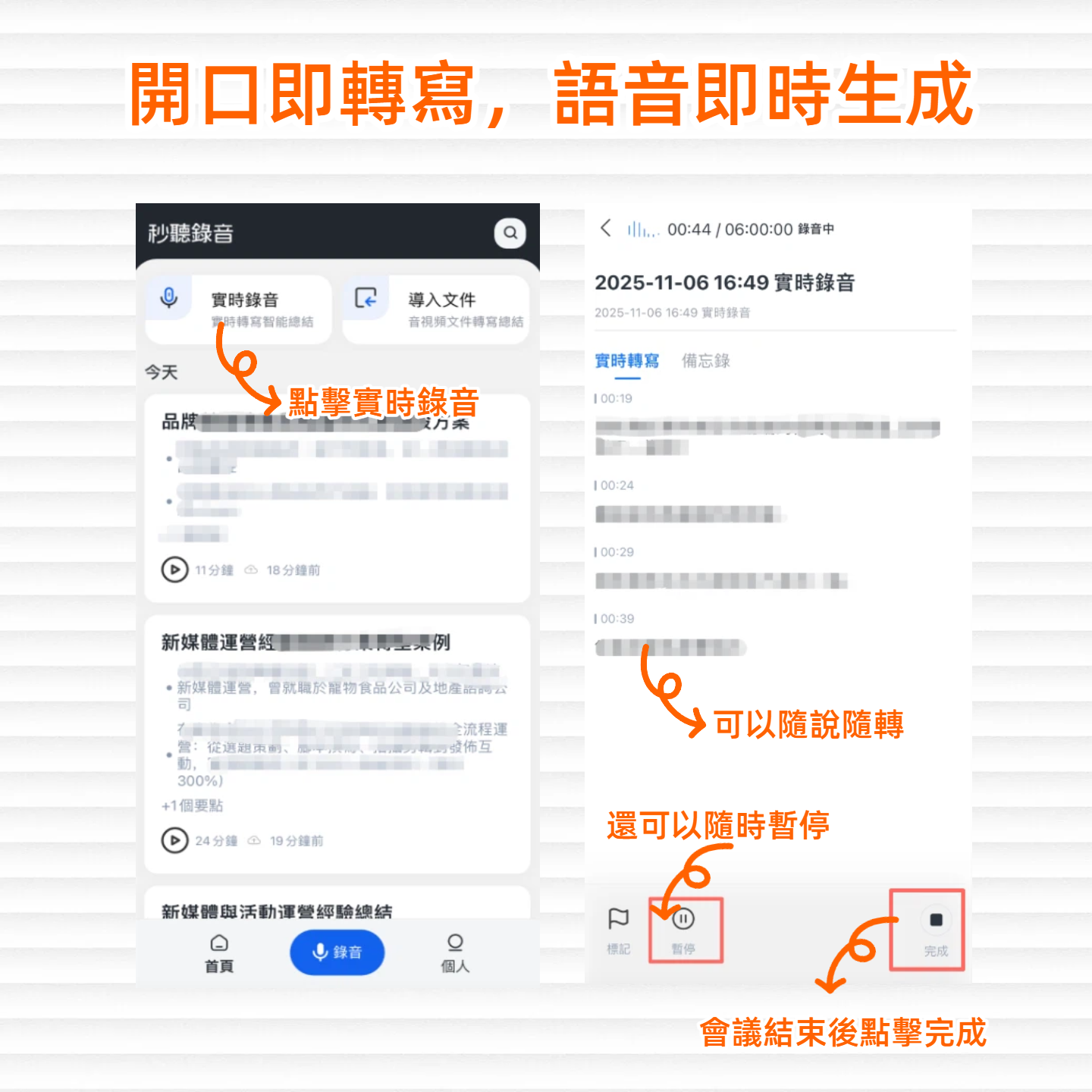
(Screenshot: Real-time transcription 1, arrow pointing to the live transcript)
Many people think speech-to-text is just "turning spoken words into written words," but its real value is transforming scattered audio content into searchable, organizable, reusable data.
Scenario 1: Generate meeting minutes immediately after a meeting
In the past, after a two-hour project meeting, you'd spend another hour jotting down notes from memory. Now, just toss the recording into Tinrec; by the time the meeting ends, the AI summary has already organized discussion conclusions, decisions, and to-do lists—who is responsible for what and the deadline are all clear at a glance.
Scenario 2: Turn long courses into review notes
Online courses can be three hours long—you forget the first part by the time you finish the last. With Tinrec, it automatically splits the content into chapters, highlights key points, and you can even ask the AI: "What three time management tips did this course mention?" It pulls the answers directly from the transcript, saving you the time of re-listening.
Scenario 3: Turn interview recordings into citable material
When I conduct interviews, the hardest part is finding that one key quote among thousands of words. Now, after recording, I upload it to Tinrec. Not only do I get a transcript, but I can also use the AI chat feature to query: "What are the interviewee's views on remote work?" It then lists the relevant paragraphs with timestamps, making it easy to cite and verify.
What Core Capabilities Matter?
(Screenshot: AI chat query 1, arrow pointing to the query box and answer)
If a speech-to-text tool only does "transcription," it will quickly hit a ceiling. The real differentiator is the "understanding" and "usage" after transcription.
Real-time transcription: text appears as you speak, not after recording
Tinrec's real-time transcription has almost zero latency. During meetings, you can watch the text appear to confirm you haven't missed any key points. Notta does this too, and both perform well in basic transcription—but the differences that follow are critical.
AI semantic summary: structured organization, not just a condensed paragraph
Many tools condense an entire recording into a few sentences of summary, but Tinrec produces a structured summary—meeting topic, discussion conclusions, action items, assignees, listed separately. Notta also has a summary feature, but it leans more toward extracting key paragraphs directly, lacking that "organized-for-you" context.
Action item extraction: turn discussions into a to-do list
(Screenshot: Action item extraction 1, arrow pointing to the extracted to-do list)
The worst meetings are those where people discuss but never decide. Tinrec automatically identifies who needs to do what and by when, organizing it into a to-do list. I tried Notta, and it requires manual tagging or predefined templates, which makes it easier to miss action items in free-flowing discussions.
AI chat query: interrogate your recordings like a database
This is the feature that made me switch to Tinrec. After transcription, you can type questions like: "Who mentioned the budget adjustment in the meeting?" "What was the client's feedback on this proposal?" It answers directly using semantic understanding. Notta mainly relies on keyword search within the transcript, so for questions that require comprehensive understanding, its responses aren't as thorough.
Stop organizing recordings by hand
Upload audio or video and automatically get a transcript, summary, and action items
Multi-source input: not just recording—handles files and online videos too
(Screenshot: Online video link parsing, arrow pointing to the pasted link interface)
Tinrec supports not only real-time recording and file uploads but also direct YouTube or Bilibili video links, turning public courses and talks into text notes. Notta is more focused on meetings and file transcription, making it less convenient for organizing online video content.
Practical Application Scenarios
Meeting scenario: from recording to to-do list in one go
For our weekly team meetings, I put my phone in the middle of the table and start Tinrec for real-time recording. By the time the meeting ends, the summary, decisions, and action items are already organized. I just copy them to the Slack channel for my colleagues—no need to format meeting minutes from scratch.
Classroom scenario: turn lectures into searchable review materials
After a full-day seminar, instead of taking a bunch of slide photos, record the whole thing. Later, use Tinrec to convert it to text. The AI splits the content into chapters, so when reviewing, you can jump directly to the parts you're less familiar with and even ask questions to extract key points.
Interview scenario: quickly locate key quotes
When interviewing experts, the worst thing is not being able to find exactly where a certain sentence was said after writing the article. Now I upload the recording immediately after the interview, and once the transcript is ready, I use the Q&A feature to search. For example, search for "views on second-generation succession challenges"—the system lists relevant paragraphs with timestamps, making it very convenient for fact-checking.
Content creation scenario: turn YouTube videos into article material
(Screenshot: YouTube online video parsing and summarization, arrow pointing to the generated summary)
As a content creator, I often need to organize points made by others. When I come across a good interview video, I just paste the link into Tinrec, and it generates a transcript and summary. I can extract material from it and develop my own opinion pieces without having to type everything from scratch.
5 Things to Consider When Choosing a Speech-to-Text Tool
If you're also hesitating on which tool to pick, these five points are what I've prioritized after trying several tools.
1. Post-transcription organization matters more than transcription itself
Unless your only need is to "turn audio files into text" and then read through them yourself, focus on what the tool gives you after transcription. Notta's transcripts are complete, but Tinrec goes a step further—providing structured summaries, action items, and Q&A, saving you a lot more follow-up time.
2. Accuracy and contextual understanding for Chinese content
Both tools transcribe accurately in quiet environments, but when it comes to mixed Chinese-English terms, proper nouns, or multiple speakers, Tinrec's corrections and contextual grasp are clearly more suited for Chinese users. Especially for scenarios requiring Traditional Chinese or Cantonese, Tinrec's support is more comprehensive.
3. Multi-source input capability: shouldn't be limited to recordings
Notta focuses on meetings and file transcription, and it does that well. But if your scenarios also include online videos, social media clips, etc., Tinrec's ability to parse pasted links gives you a much broader range of material to organize.
4. Language and output format flexibility
Both support major languages, but Tinrec's Traditional Chinese interface, multi-format export (TXT, DOCX, SRT, etc.), and third-party integrations (Notion, Google Docs) make it smoother to bring results into your existing workflow.
5. Pricing plan should match your actual usage frequency
If you only transcribe a couple of recordings occasionally, both have free tiers to start. But if you have meetings, courses, or interviews every week, Tinrec's Pro plan is reasonably priced on an annual basis, and the AI post-processing features it offers can significantly improve overall work quality compared to a pure transcription plan.
Frequently Asked Questions
Can speech-to-text accuracy reach 100%?
It's hard to be 100%—especially with multiple speakers, background noise, or heavy accents. But tools like Tinrec deliver highly reliable transcription quality with clear audio. For important occasions, it's still advisable to cross-check with the original or listen back.
Can I use Tinrec to organize YouTube videos? Do I need extra setup?
Yes, just copy the video link and paste it into Tinrec's "Online Video" feature—it parses it without any extra plugins. But please remember to comply with the platform's terms of service and copyright rules.
Notta's transcripts are also very complete, so why choose Tinrec?
If you only need a transcript, Notta is indeed a great choice. But if you want automatic summary generation, action items, and even Q&A review after transcription, Tinrec's post-processing capabilities make content organization much easier.
How long are uploaded recordings stored? Is it secure?
Tinrec stores your recordings and text in the cloud; you can replay, query, or export them anytime. Data transmission is encrypted. If you still have concerns, you can delete files from the dashboard.
What languages are supported? Can it handle mixed Chinese and English?
Tinrec supports over a dozen languages, including Traditional Chinese, Cantonese, English, and Japanese. It correctly interprets mixed Chinese-English conversations, which makes it more practical than tools that only support a single language model.
Conclusion
Speech-to-text is not a new technology, but a tool that can turn audio data into "actionable knowledge" is the real key to boosting productivity.
If you're like I used to be—with piles of recordings you never organized, or finding key points in transcripts until your eyes hurt—perhaps try Tinrec and see the difference.
Start with the free plan for a few meetings or a class, and feel the seamless flow from "recording" to "organizing" to "taking action."
You'll realize that those recordings scattered on your hard drive can indeed become your best knowledge base.
Turn every recording into actionable outcomes
Get 60 free transcription minutes when you sign in. No credit card required.
Related Reading
You might also like

2026 Best 5 Real-Time Translation AI Tools Compared: Which Can Handle Transcription and Live Translation Simultaneously?
This article reviews 5 AI tools with real-time translation capabilities, from speech-to-text to multilingual comparison, analyzing free plans and paid features to help you find the best choice for meetings, courses, video content, and more.

2026 Tinrec vs Otter.ai: 5-Dimensional Comparison – Which Is Better for Online Meeting Notes?
Based on hands-on experience as a mid-level manager, this article compares Tinrec and Otter.ai across five dimensions: Chinese meeting transcription, input source diversity, post-transcription organization, free plans, and cross-platform convenience. It helps you find the best tool for online meeting notes and everyday audio/video content processing.

2026 Comparison of 4 Real-Time Translation Tools: Which One Do Free Users Recommend Most?
How to choose the best real-time translation software in 2026? We tested and compared 4 tools, from voice translation and meeting conversations to video subtitles, fully analyzing features and use cases. Want to know which free version is the most capable? This article helps you find the best real-time translation solution.
2026 Comparison of 3 Meeting Recording Tools: Never Miss Key Points Even if Google Meet Has No Sound
How to fix Google Meet audio issues? This article tests 3 meeting recording tools, from audio/video transcription, AI summaries to cross-platform use, giving you the most reliable backup solution.
2026 Comparison of 3 Simultaneous Interpretation Software: Which Free Plan is Most Worth It?
We tested three popular simultaneous interpretation tools on the market, analyzing real-time translation accuracy, supported languages, free plan limits, and actual user experience. This article focuses on Tinrec as a key example to help you choose the best real-time voice translation software for meetings, classes, and interviews.

2026 5 Real-Time Translation Apps Compared: Are Free Plans Good Enough?
Looking for a great real-time translation app? This article compares 5 popular tools in real-time translation, AI summarization, free quotas, and Chinese recognition to help you choose.

2026 Comparison of 3 Meeting Note Tools in Real Tests: Which AI Minutes Really Save You Time?
How to take meeting notes quickly and accurately? This article tests 3 tools, showing you how to use AI to automatically generate summaries and to-dos, from recording to organizing in one go. Using Tinrec as an example, we demonstrate the full meeting note process and summarize 4 key purchase points to help you find the best solution.

2026 Speech-to-Text Tool Buying Guide: 3 Tools Tested and Recommendations
A student's real-world test of speech-to-text tools, comparing online and offline solutions, sharing genuine experiences in class and meeting scenarios to help you choose the best learning tool.
2026 Speech-to-Text Tool Comparison: Which One Handles Multilingual Accuracy Best?
For multilingual meetings, Cantonese interviews, and mixed Chinese-English recordings, which speech-to-text tool can you really count on? This hands-on test compares Tinrec and 3 other leading tools across Cantonese accuracy, AI Q&A, cross-platform support, and free tiers to help you find the best fit.