

Turn recordings into transcripts and summaries in minutes
Upload audio or video for multilingual transcription, AI notes, and action items
What Can AI Meeting Recording Do for You?
You've probably been in this situation: you start a Google Meet meeting with recording on, but then you have to leave early—does the recording stop? In fact, Google Meet's built-in recording stops immediately when the host leaves or the meeting ends. Plus, the file is saved as a full video, forcing you to replay it manually and type out the transcript.
Stability isn't the only issue. The bigger headache is what happens after the recording—a two-hour meeting might take another hour to turn into usable notes. That's why you need a smarter AI meeting recording tool like Tinrec. It's not just a recorder; it's a workspace that automatically transcribes, summarizes, and extracts action items from meetings, lectures, interviews, and even online videos.
For example, with Tinrec's live recording feature, it displays the transcript on your phone or computer in real time with less than 1 second delay. As soon as the meeting ends, AI generates a summary and to-do list, clearly stating who is responsible for what and the deadline.
Core Capabilities of AI Meeting Recording
To truly solve the pain point of meeting notes, simply "recording" isn't enough. You need a complete workflow from recording, transcription, to organization and action. Here are Tinrec's core capabilities, each addressing a real work challenge.
Real-Time Transcript: Text as You Speak
Unlike Google Meet, where you have to wait until after the meeting to replay, Tinrec displays text as you speak with less than 1 second delay. You can check if you missed key points, or even mark important sections directly on the text. By the time the meeting ends, half your notes are already done.
AI Structured Summary, Not Just a Paragraph
Tinrec's summary automatically breaks down the meeting into "Meeting Topic," "Discussion Conclusions," "Action Items," and "Assignees," providing a ready-made framework for your meeting notes. You don't need to listen to the recording from scratch—you can grasp the entire meeting's conclusions in 5 minutes.
AI Dialogue Search: Find Key Points by Asking
After transcription, you can directly ask Tinrec: "Who mentioned the budget?" or "What feedback did the client give?" It uses semantic understanding to answer instantly, like a meeting assistant on standby. Even with hundreds of past meetings, you can pull out key information in seconds.
Action Item Extraction
The worst outcome of a meeting is that no one follows up. Tinrec automatically extracts "action items" from the conversation, identifying who is responsible and when it's due. You can export this list directly to Notion or Google Docs, seamlessly integrating with your team's workflow.
Cross-Platform and Multi-Source Input
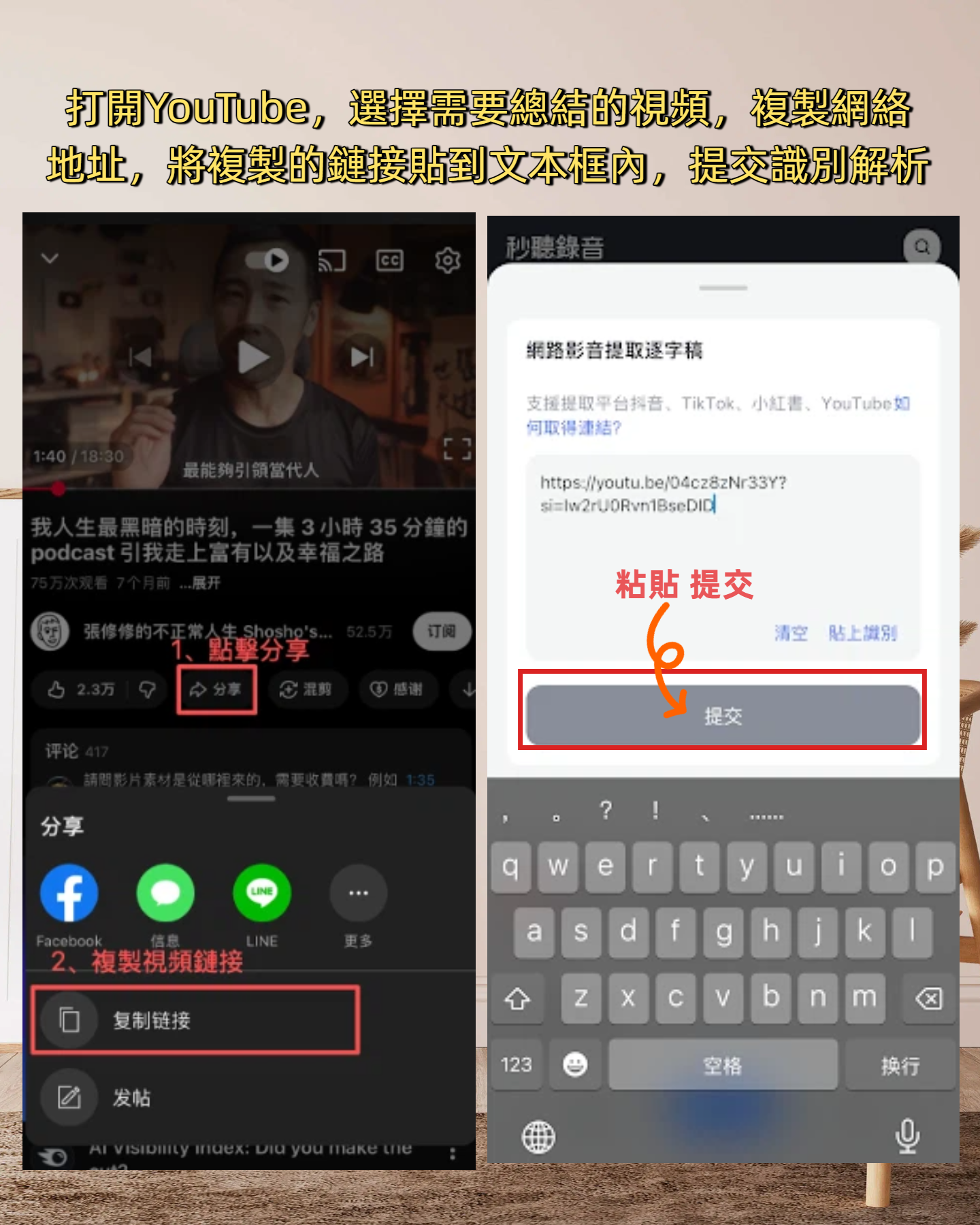
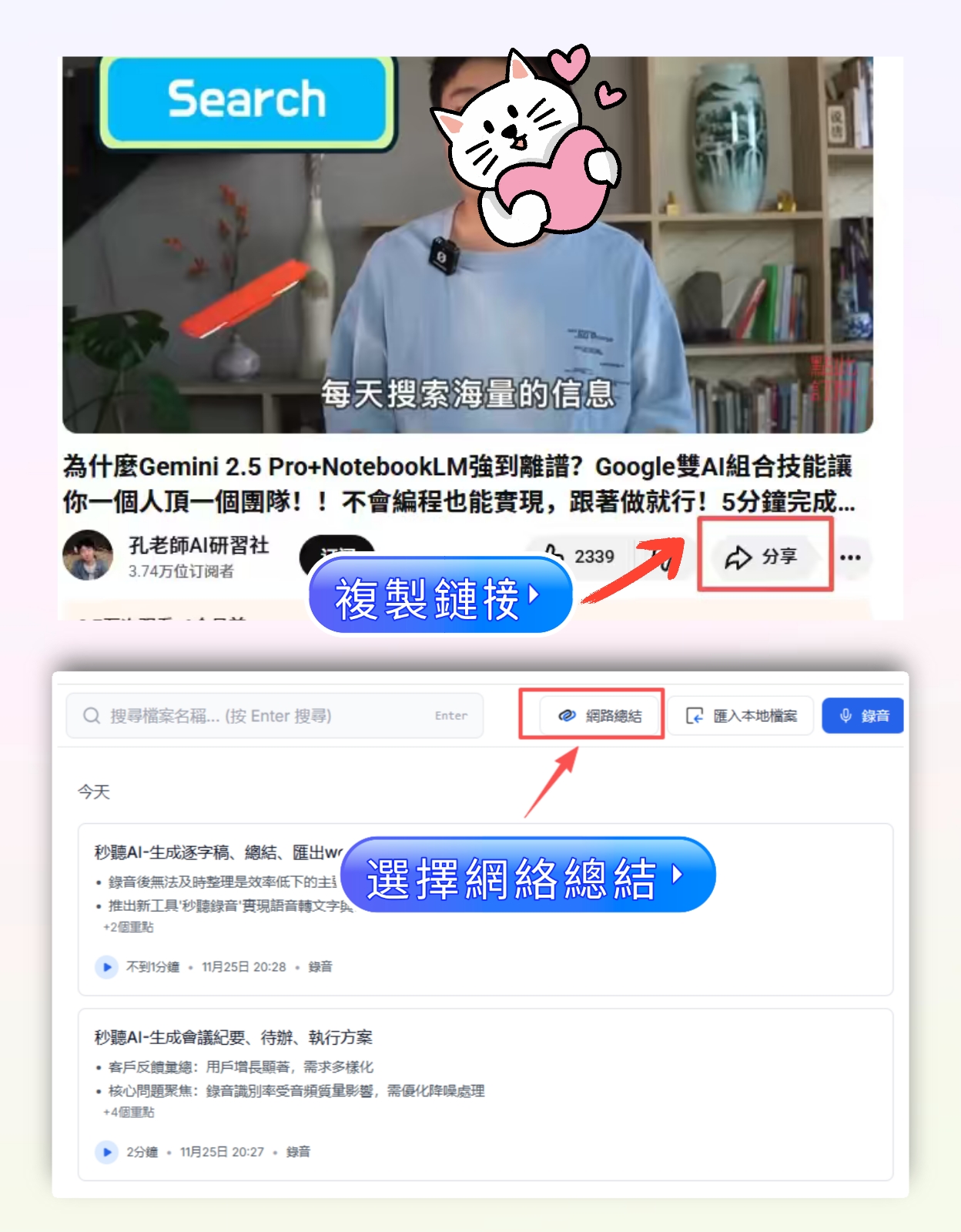
Tinrec has iOS, Android, and web versions. Whether you record an in-person meeting with your phone or an online meeting with your computer, all recordings sync under the same account. Even better, it can directly import Google Meet audio (via system audio) for real-time transcription, or you can upload a pre-recorded Google Meet video for Tinrec to process. Additionally, by pasting a link from YouTube, Bilibili, or other public videos, it can directly produce text and summaries.
Practical Use Cases
Tinrec isn't designed for just one type of meeting—it covers every moment you need to process audio. Here are the most common scenarios and how Tinrec makes work easier.
Scenario 1: Online Meeting → Automated To-Do List
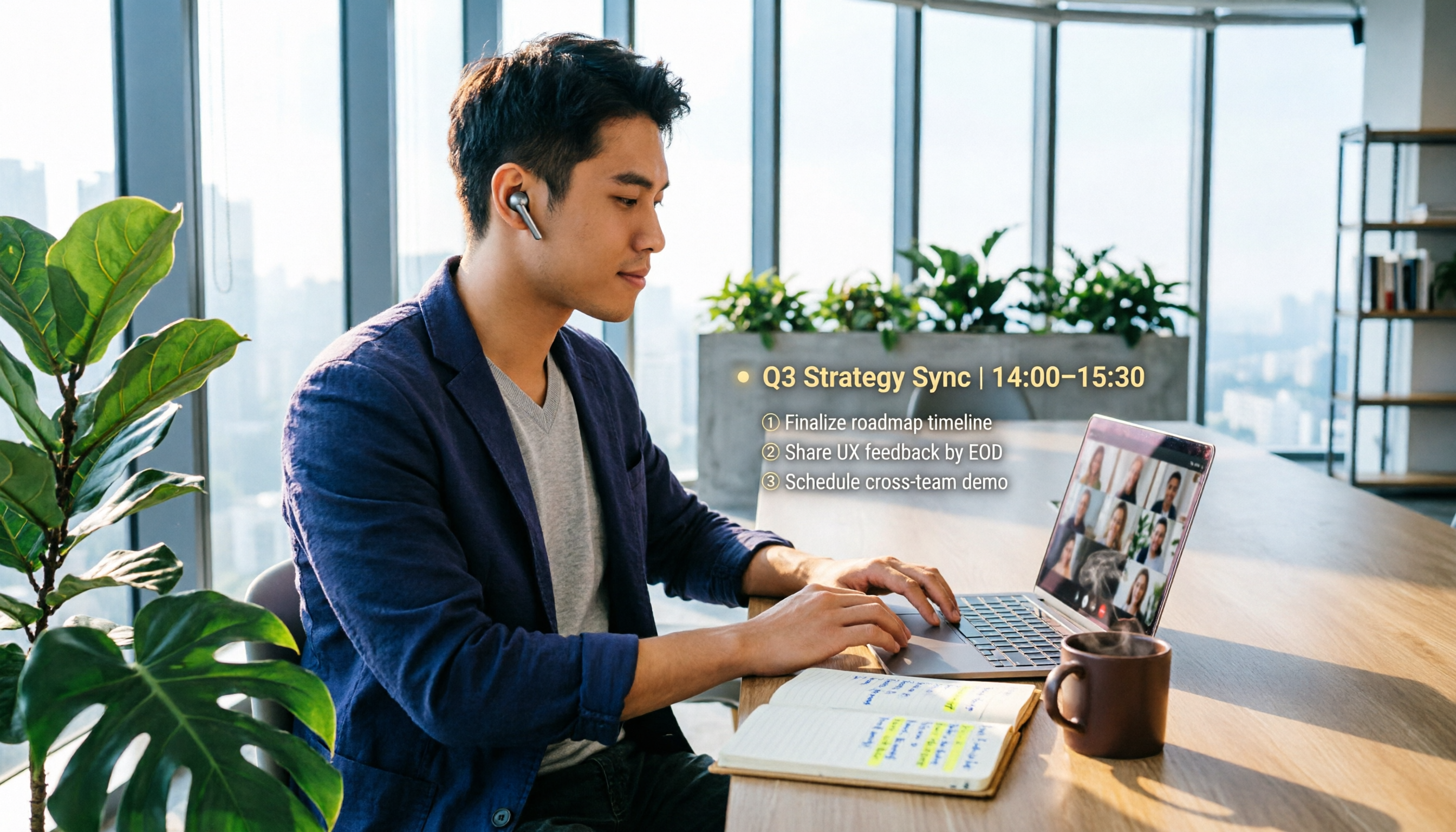
Start a project meeting via Google Meet while running Tinrec on your computer, selecting "System Audio" to record. All discussions are transcribed in real time, AI summary extracts decisions, and the to-do list shows each person's next steps. After the meeting, paste the record into your team chat—saving 30 minutes of organizing time.
Scenario 2: In-Person Interview → Phone Recording with Real-Time Transcript
Meet a client or interviewee in person; open the Tinrec app and start recording. Text appears on screen as you speak, allowing you to instantly confirm key figures or quotes. When the interview ends, a full transcript and key summary are already on your phone, ready for report writing back at the office.
Stop organizing recordings by hand
Upload audio or video and automatically get a transcript, summary, and action items
Scenario 3: Online Course or Lecture → Structured Notes
Attend a two-hour online course on your laptop; Tinrec records and transcribes simultaneously. AI automatically divides the content into chapters, highlights key points, and even generates a mind map. When reviewing, you don't need to listen from the start—just read the summary and notes, doubling your efficiency.
Scenario 4: Content Creation → Extracting Material from Videos
Find a competitor's YouTube video worth analyzing? Drop the link into Tinrec, and it will produce a transcript, auto-summary, and even organize key arguments into a table. You can directly use these materials for articles or presentations without manually transcribing.
4 Things to Consider When Choosing a Meeting Recording Tool
There are many meeting note solutions on the market, from platform-built-in free features to professional AI tools. Based on our experience, these four points are often overlooked and are where Google Meet and Tinrec differ the most.
1. Is recording stable when you leave the meeting?
Google Meet's recording heavily depends on the meeting host. If the host leaves or ends the meeting, the recording stops. In practice, this means you can't step away mid-meeting, and a sudden disconnection could ruin the entire record. Tinrec is an independent recorder; it won't stop unless you manually pause or stop. You can even record only the first half and have a colleague record the second half, merging them later—offering much more flexibility.
2. Transcription accuracy and language support
Google Meet's live captions mainly support English, with limited Chinese accuracy and fluency, and they don't produce an editable transcript. Tinrec performs well across 14 languages, including English and Chinese (including Cantonese). In tests with clear audio, the character error rate is around 8%. More importantly, it provides editable, searchable transcripts for easier post-processing.
3. Not just transcription, but also organization
Getting only a video or audio file after recording solves just 10% of the problem. What you really need are summaries, to-do lists, key highlights, and export capabilities. Tinrec's AI not only summarizes but also answers questions about the content and can generate a full structured meeting report. Google Meet's recording file can only be replayed—all subsequent processing is manual.
4. Friendliness to Chinese meeting scenarios
If your meetings are primarily in Chinese, Tinrec is a better fit. Its speech engine is deeply optimized for Chinese, handling proper nouns and mixed Chinese-English conversations well. Google Meet's captions are still immature for Chinese, and without post-processing features, practicality is limited.
Here's a table summarizing the key differences:
| Dimension | Google Meet Built-in Recording | Tinrec |
|---|---|---|
| Recording Stability | Depends on host; stops if host leaves or disconnects | Independent tool; won't stop until manually paused |
| Real-Time Transcription | Only provides live captions (no editable transcript retained) | Generates editable transcript in real time with <1s delay |
| AI Organization | None | Auto-summary, action item extraction, AI Q&A, mind maps |
| Language Support | Primarily English; weak for Chinese | Supports 14 languages; excellent for Chinese (incl. Cantonese) |
| Post-Meeting Actions | Only saves video file; manual processing required | Export transcript, summary, to-do list to Notion and other tools |
| Price | Included in Google Workspace subscription | Free plan with monthly basic quota; Pro monthly/annual based on usage |
Frequently Asked Questions
Q: If I use Google Meet and record with Tinrec simultaneously, will Tinrec stop when I leave the meeting?
A: No. Tinrec is an independent app running on your phone or computer. As long as you don't manually pause or stop it, it will continue recording your system audio (or microphone). Even if you leave the Google Meet, Tinrec's recording continues until you end that session.
Q: How long can I use Tinrec for free?
A: The free plan provides a monthly quota of transcription minutes (see product page for exact amount), enough to try out a few medium-sized meetings. The free version gives you access to AI summaries and to-do features for testing.
Q: Does Tinrec guarantee accuracy?
A: With clear audio (no heavy noise, echo, or overlapping speech), Tinrec's Chinese character error rate is around 8%, sufficient for meeting notes. However, in noisy environments or with heavy accents, a small amount of manual proofreading is recommended.
Q: Besides meetings, what else can Tinrec be used for?
A: Many things. You can use it to process online courses, interviews, podcasts, YouTube videos, or simply upload audio files for transcription. It's not just a meeting tool—it's your personal audio/video knowledge base.
Conclusion
Google Meet's built-in recording is a "passable" feature, suitable for ad-hoc, simple meeting backups. But for scenarios that require post-processing, team collaboration, or Chinese language support, it clearly falls short.
If you have more than 3 meetings a week, or often need to turn meetings, courses, and interviews into usable documents, we recommend trying Tinrec. It connects the entire workflow—recording, transcription, organization, and action—across platforms, supports Chinese, and offers a free plan to start. Next time before a meeting, download Tinrec and see how much time AI can save you in organizing meeting notes.
Turn every recording into actionable outcomes
Get 60 free transcription minutes when you sign in. No credit card required.
Related Reading
You might also like

2026 Free Google Meet Meeting Minutes Solutions: 5 Tools at a Glance
No more handwritten meeting minutes! This article rounds up 5 free Google Meet meeting minutes solutions, led by Tinrec Instant Recording, which automatically transcribes, generates summaries and to-dos, saving you overtime.

Top 3 Free Google Meet Recording Tools in 2026: A Comprehensive Comparison
A hands-on comparison of 3 Google Meet recording tools, covering free quotas, transcription accuracy, and AI features, to help you pick the best meeting notes solution.

The Ultimate Guide to Google Meet Meeting Notes in 2026: Why Tinrec Captures Your Meeting Highlights Better Than Built-in Recording
Missed a Google Meet notification because your phone died, and forgot to record? This guide tackles real pain points for managers, showing how Tinrec automatically records, summarizes, and Q&As every meeting, turning them into searchable, actionable data.

2026 Comparison of 5 Zoom and Google Meet Alternatives: Turn Meetings into Searchable Knowledge Bases
Struggling with Zoom and Google Meet's basic built-in recording and time-consuming post-meeting organization? This comparison of 5 tools—from real-time transcription and AI summaries to cross-platform Q&A—helps you find alternatives that turn meeting content into actionable knowledge.
2026 Zoom vs Google Meet Free Plans: 5 Tools Compared
Looking for the best online meeting and transcription tools? This article compares 5 free plans including Zoom, Google Meet, and more, and recommends Tinrec, which goes beyond simple meeting notes to turn your meetings, classes, and interviews into searchable, actionable knowledge.

2026 Hands-On Comparison of 3 Google Meet Transcription Tools: Why Tinrec is the More Comprehensive Choice?
While the free version of Google Meet offers basic meeting features, its built-in transcription cannot be exported and lacks summaries and to-do lists. This article compares Google Meet's built-in captions with tools like Tinrec, analyzes whether the free plan is sufficient, and shows you how to use Tinrec to easily turn meeting recordings into a searchable knowledge base.
How to Record a Google Meet Meeting in 2026? 5-Step Complete Guide (with AI Tips)
Recording Google Meet calls is easy, but just recording isn't enough—you need to organize the content. This article shows you how to convert recordings to text in 5 steps, using AI to automatically generate meeting minutes and to-do lists, saving you overtime. We compare built-in recording, Otter.ai, and Tinrec to find the best for office workers.

2026 Google Meet AI Meeting Notes Tools Buying Guide: 2 Tools Tested and Recommendations
Struggling with incomplete Google Meet notes? This article provides an in-depth comparison of Tinrec and Otter.ai across 5 key dimensions—transcription accuracy, multi-source processing, post-meeting organization, cross-platform support, and pricing—to help you find the best AI note-taking tool for boosting meeting productivity.

2026 Google Meet AI Meeting Note-Taking Tools Comparison: Which One Suits Hong Kong Office Workers Best?
Tired of writing meeting minutes after Google Meet calls? We tested three AI tools — Tinrec, Otter.ai, and Fireflies.ai — on accuracy, AI features, and pricing to help you pick the best one.