

Turn recordings into transcripts and summaries in minutes
Upload audio or video for multilingual transcription, AI notes, and action items
I have about 15 meetings a week, and half of them are cross-department or client-facing online meetings using Google Meet.
Once, I was on a business trip and my phone ran out of battery—I completely missed the Google Meet notifications. After that meeting, I had no record at all, and the built-in recording didn't start because I was using my phone for the meeting. When my boss later asked for the meeting conclusions, I spent 3 minutes flipping through my notes and found nothing. That feeling was terrible.
Later, I realized the problem wasn't missing notifications—it was that "recording can't rely on luck." Google Meet's built-in recording is convenient, but it has many limitations: the mobile app may not always record, it only gives you a link afterward, no summary, and if you need to find key points, you still have to listen through the whole thing.
If you've had similar experiences, this article is for you. Based on my team's hands-on testing, I'll explain why after switching to Tinrec (Instant Recording Transcription), even if my phone dies and I miss notifications, I can still organize meeting content clearly—and it's not just for meetings: it also works for class recordings, interviews, and online videos.
What Can AI Meeting Notes Do for You?
When people mention AI meeting notes, many immediately think of "turning audio into text." But what really saves you time is what happens after the transcription.
Take Tinrec for example. It doesn't just transcribe; it automatically turns a recording into actionable data—that's the real value. Let me illustrate with three real scenarios:
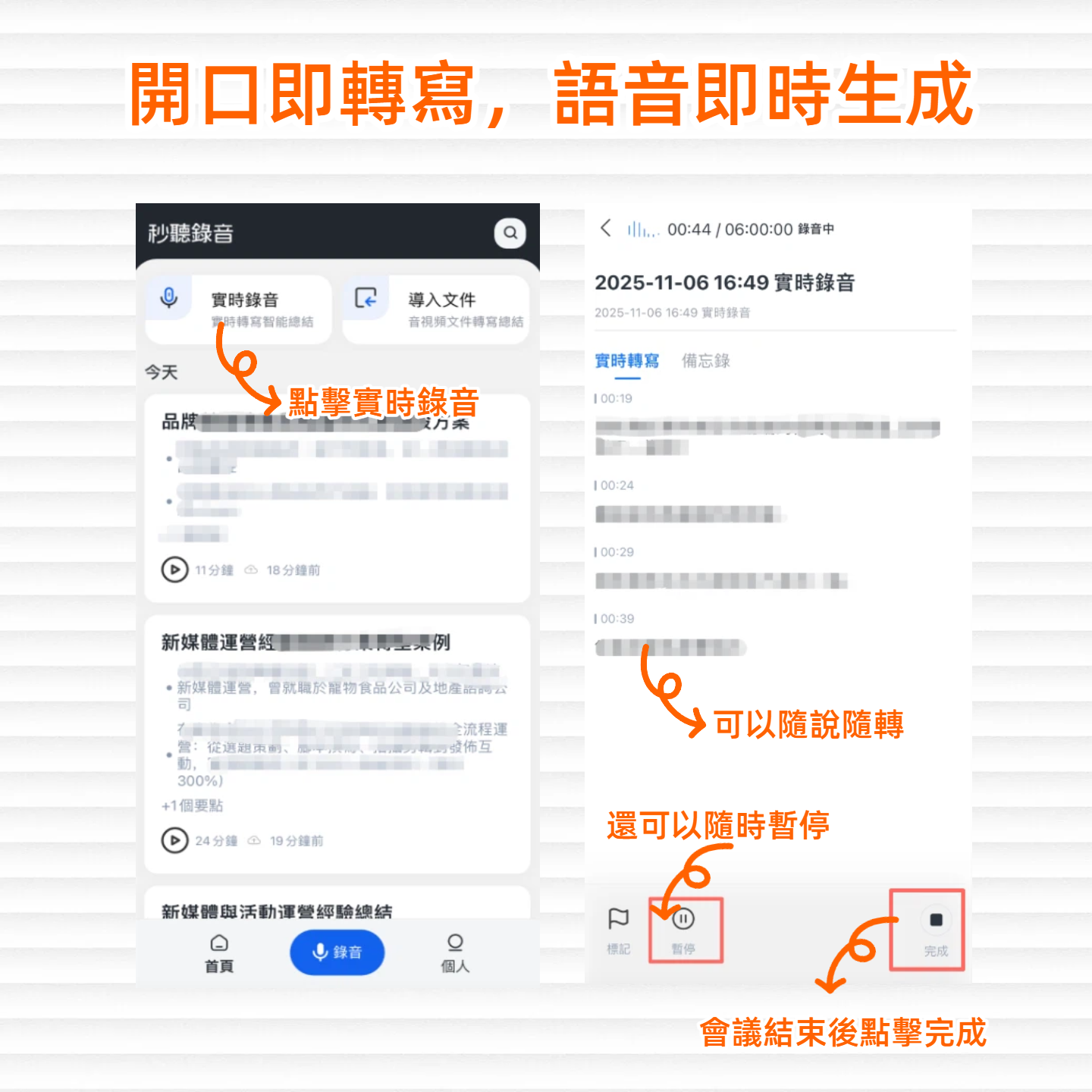
Scenario 1: Missed notification, dead phone—still get meeting highlights My habit: Before a Google Meet, I open Tinrec on my laptop and select "Real-time Audio Transcription." Even if my phone is completely dead, as long as my laptop picks up the audio, the full transcript, AI summary, and action items are generated the moment the meeting ends. I never rely on notifications to decide whether a meeting gets recorded.
Scenario 2: No more spending an hour after meetings organizing notes Before, after a two-hour meeting, I'd spend at least 40 minutes filling in notes, extracting key points, and listing action items. Now, Tinrec's "AI Summary" lays out the meeting topic, conclusions, action items, and responsible persons separately. I just give it a quick review and can paste it directly to my boss or share it in the team chat.
Scenario 3: Historical meetings become a searchable, queryable database Last week, my boss suddenly asked, "In that client meeting two months ago, what was their attitude toward pricing?" I opened Tinrec, used "AI Chat Query," and asked: "What was the client's feedback on pricing?" It answered directly based on that recording, without me having to fish through five recordings.
What Core Capabilities Does AI Meeting Notes Need?
To make meeting notes go from "just done" to "truly useful," I think there are a few essential capabilities. Tinrec has them all, and our team's real-world experience is that it treats your recordings like a conversational database, not just giving you a string of text.
1. Real-time Transcript: Outputs while recording, not after Tinrec's real-time transcription delay is under one second. While you're in a Google Meet, the text appears on screen almost simultaneously, letting you check for missed technical terms or names. This is far more useful than built-in recording, which only gives you a blurry audio file.
2. AI Summary: Not condensation, but structured organization Many tools condense a one-hour meeting into three paragraphs, but Tinrec gives you a list broken down into "Meeting Topic," "Conclusions," "Action Items," and "Responsible Persons." For a mid-level manager, what you need isn't just a rough idea of what was said—you need material you can directly report or assign work with.
Stop organizing recordings by hand
Upload audio or video and automatically get a transcript, summary, and action items
3. AI Chat Query: Ask your recordings like you'd ask a colleague After transcription, you can ask Tinrec: "Who mentioned the budget during the meeting?" "What was the client's reaction to the delivery timeline last time?" It answers based on semantic understanding and even provides timestamps. This feature saves me from Ctrl+F ing through long transcripts.
4. Automatic Action Item Extraction: Turns discussions into to-do lists Tinrec extracts action-oriented phrases like "You do A" or "Submit B by this Friday" and automatically lists them as tasks. After a one-on-one meeting, I can immediately share this list with my colleague—both sides know the next steps.
5. Multiple Format Export: Seamlessly integrates into your existing workflow You can export the organized content as TXT, PDF, or even sync directly to Notion or Google Docs. This is extremely useful for managers who need to write weekly reports or archive documents—no more manual copy-pasting.
Practical Application Scenarios
Tinrec's strength is that it's "agnostic to audio source"—it handles not only meetings but any situation where you need to turn audio into usable data.
Scenario 1: Online Meetings (Google Meet)
As mentioned, simply open Tinrec on your laptop or phone and start recording—it will capture both system audio and your microphone. Google Meet's built-in recording is often limited by account type and requires significant post-meeting effort; Tinrec, on the other hand, works regardless of your account type—as long as audio comes through, it transcribes and organizes it for you.
Scenario 2: Classes and Lectures
A new member of my team is taking external training courses. He uses Tinrec for real-time audio transcription and then reviews key points with the AI summary after class, saving a lot of study time.
Scenario 3: Interviews and Research
A colleague in charge of user interviews imports recordings into Tinrec and uses "AI Q&A" to quickly extract key insights, then exports the document to share with relevant departments. Compared to manual transcription, it's at least three times faster.
Scenario 4: Content Creation
I'm into listening to podcasts, so I drop the episode link into Tinrec's "Online Video Link Analysis." It converts the entire episode into text and a summary, letting me grasp key points in five minutes—and it's easy to reference later.
4 Things to Consider When Choosing an AI Meeting Notes Tool
There are many tools out there, but for managers like us who have many meetings and need quick output, here are key points to look for.
1. Accuracy: Don't just look at numbers—test in your environment In our office's multi-person meeting tests, Tinrec's error rate for general dialogue was under 10%; however, if there's heavy background noise or strong accents, the error rate increases. It supports Cantonese and mixed Chinese-English, which is friendly for Asian workplaces, but I recommend testing it with your actual meeting recordings—it's more meaningful than a claimed 99% accuracy.
2. AI Features: Transcription is just the start; organization is key Some tools only give you a text file and leave the rest to you. Tinrec, after transcription, automatically summarizes, lists action items, answers questions, and exports structured documents. If you have over ten meetings a week, this "post-transcription processing" capability directly determines how much time you save.
3. Language Support: If you need Traditional Chinese or Cantonese, pay special attention Google Meet's built-in live captions have limited support for Traditional Chinese, and not all third-party tools handle Chinese well. Tinrec clearly supports 14 languages, and its handling of Chinese content is particularly good—make sure to check this when comparing.
4. Cross-platform and Offline Needs Make sure the tool works on the devices you use—Tinrec has iOS, Android, and web versions, so you can use it on both laptop and phone, and recordings are accessible across devices. If you frequently switch between different devices, this is very practical.
Frequently Asked Questions
Q: Doesn't Google Meet have built-in recording? Why would I need Tinrec? A: Google Meet's built-in recording only provides an audio file link, with no transcript, summary, or action items, and the mobile app may not always record. Tinrec turns every meeting into searchable, organized data, especially useful for managers who need to quickly find key points.
Q: Does a dead phone really not affect Tinrec recording? A: As long as you open Tinrec on another device (like a laptop) and start recording, a dead phone has no impact. It captures system audio and microphone, not phone notifications.
Q: Is the free version enough? A: Tinrec's free version provides a basic monthly transcription allowance. If you only have a few meetings per week, you can start with the free version. I personally upgraded to Pro because I have meetings every day—it costs less than two Starbucks drinks a month.
Q: Is the recorded content private and secure? A: Tinrec has a complete explanation of personal data protection. Recordings and transcriptions are stored under your account, and you can manage and delete them. It's recommended to read the terms of service before use.
Summary
Google Meet is a great tool for meetings, but meeting notes shouldn't rely on luck with built-in features. Phone dying, notification not showing, recording not started—these are small accidents we often encounter at work.
Since using Tinrec, the biggest change for me is: I no longer worry about "whether that meeting was recorded." It quietly works in the background, turning audio into text, and then text into actionable to-dos, summaries, and reports. If you're a mid-level manager buried in meetings every week, give it a try—start with the free version and experience how AI can help you organize meeting notes.
Turn every recording into actionable outcomes
Get 60 free transcription minutes when you sign in. No credit card required.
Related Reading
You might also like

A Side-by-Side Comparison of 4 Google Meet Note-Taking Tools in 2026: Which One Saves Students the Most Time?
As a senior, I spent a whole semester testing multiple Google Meet note-taking tools, from free built-in features to paid AI note-takers. This post shares my real experience and tells you which one is best for classes, group discussions, and final exam review.

2026 Comparison of 3 Google Meet Alternatives: Which One Makes Chinese Meeting Notes Easiest?
Google Meet offers high-quality video calls, but post-meeting note-taking often consumes a lot of time. This article tests 3 AI meeting recording and organizing tools, focusing on which one truly saves you time, and uses Tinrec as an example to demonstrate the automated workflow from recording to summaries and to-do lists.

2026 Mac Google Meet Meeting Recorder Tools Comparison: Which AI Auto-Minutes Saves the Most Time?
Tired of missing key points in Google Meet? This real-world test shows which AI meeting recorder truly helps Mac users auto-summarize and extract to-dos, saving hours after meetings.

2026 Google Meet Attendance Tools Compared: Which Auto-Generates Meeting Minutes Fastest?
Struggling to capture key points in Google Meet meetings? We tested three popular Google Meet attendance recording tools, covering transcription, AI summaries, action item extraction, and cross-platform support, to help you find the best meeting minutes solution for your workflow.
2026 5 Interview Transcription Software Comparison: Which One is Best for Hong Kong Workers?
Tired of spending hours transcribing interview recordings? We tested 5 popular voice-to-text tools, from free to paid, to help you find the best one so you can stop working overtime on transcripts.

2026 Free Google Meet Meeting Minutes Solutions: 5 Tools at a Glance
No more handwritten meeting minutes! This article rounds up 5 free Google Meet meeting minutes solutions, led by Tinrec Instant Recording, which automatically transcribes, generates summaries and to-dos, saving you overtime.

Top 3 Free Google Meet Recording Tools in 2026: A Comprehensive Comparison
A hands-on comparison of 3 Google Meet recording tools, covering free quotas, transcription accuracy, and AI features, to help you pick the best meeting notes solution.

2026 Comparison of 5 Zoom and Google Meet Alternatives: Turn Meetings into Searchable Knowledge Bases
Struggling with Zoom and Google Meet's basic built-in recording and time-consuming post-meeting organization? This comparison of 5 tools—from real-time transcription and AI summaries to cross-platform Q&A—helps you find alternatives that turn meeting content into actionable knowledge.
2026 Zoom vs Google Meet Free Plans: 5 Tools Compared
Looking for the best online meeting and transcription tools? This article compares 5 free plans including Zoom, Google Meet, and more, and recommends Tinrec, which goes beyond simple meeting notes to turn your meetings, classes, and interviews into searchable, actionable knowledge.