

Turn recordings into transcripts and summaries in minutes
Upload audio or video for multilingual transcription, AI notes, and action items
What Can Meeting Recording and Organizing Do for You?
After a Google Meet video call, do you often run into these situations?
Scenario 1: Chaotic post-meeting follow-up
A two-hour meeting covers tons of key points, but by the time you get around to organizing your notes, you've forgotten who said what. With AI meeting recording and organizing—using Tinrec as an example—as soon as the meeting ends, AI has already generated a structured summary, conclusions, and action items. Who is responsible for what and deadlines are crystal clear, allowing you to instantly send meeting notes to your team.Scenario 2: Searching through past meetings like finding a needle in a haystack
In last month's project meeting, a client mentioned a key requirement, but you just can't find that discussion. Tinrec not only transcribes recordings to text, but you can also ask it like a database: "What was the client's feedback on the design proposal last time?" AI will directly find the answer from past recordings, saving you the agony of listening to two hours again.Scenario 3: Cross-department collaboration out of sync
After marketing, engineering, and sales meet, each team's notes highlight different things. With Tinrec recording uniformly, the generated to-do list can be synced to Notion or Google Docs, giving everyone the same organized meeting output, reducing communication gaps.
Core Capabilities of Meeting Recording and Organizing
There are many tools on the market, but the ones that truly save you post-meeting time usually have these core capabilities. Let's see how Tinrec does it.
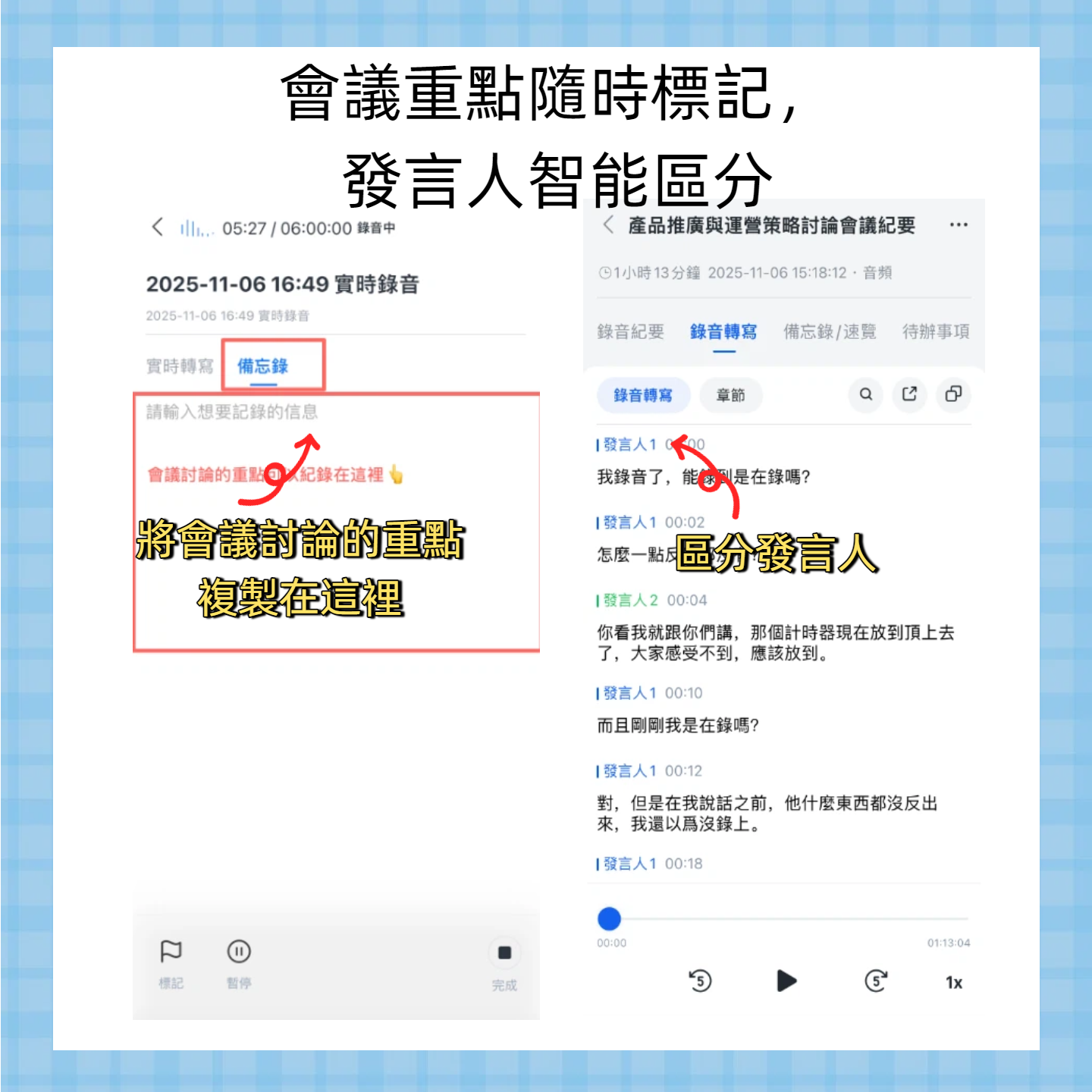
- Real-time speech to text: Transcribes while recording, not after. Tinrec's real-time transcription has low latency. During the meeting, you can watch the text sync to check if any key points are missed, and even mark important sections directly.
- AI semantic summarization: Not just condensing transcripts into a paragraph, but structured organization—meeting topic, discussion conclusions, action items, and responsible persons listed separately. Tinrec's summary is clear enough to be directly pasted into a meeting notes template.
- Speaker differentiation: In multi-person meetings, the biggest fear is mixing up who said what. Tinrec automatically tags different speakers, making it easy to review later and ask questions about specific people's remarks.
- Automatic action item extraction: Pulls out "what needs to be done" from conversations, lists action items, and even marks estimated times. No more manual note-taking.
- AI conversational queries: After transcription, you can directly ask Tinrec questions—"Who mentioned the budget during the meeting?" "What was the client's feedback?"—it answers based on semantic understanding, no need to search through everything.
Practical Use Cases
Don't overthink it—Tinrec can fit into almost any scenario where you need to turn audio into action.
Internal Project Meetings
After weekly progress meetings, Tinrec automatically generates summaries and action items, then forwards them to the team's Slack. No more "I didn't know I had this task."
Client Communication Meetings
Record and transcribe online meetings with clients—all key requirements and commitments are put into text, avoiding future disputes and making it easy to hand over to colleagues.
Stop organizing recordings by hand
Upload audio or video and automatically get a transcript, summary, and action items
Online Lectures or Seminars
During online courses on Google Meet, instructors speak fast with heavy information. Use Tinrec to transcribe while learning; review AI summaries and chapter breakdowns after class for double the review efficiency.
One-on-One Interviews or User Research
No more furiously scribbling notes during recruitment interviews or user interviews. Tinrec captures every response, and post-meeting you can use AI Q&A to quickly compare different interviewees' perspectives.
5 Things to Consider When Choosing a Meeting Recording Tool
After comparing several tools, we found the key is not who offers more transcription minutes, but "what you can do after transcription." Here are 5 aspects to confirm before purchasing, along with Tinrec's performance.
Recording source compatibility
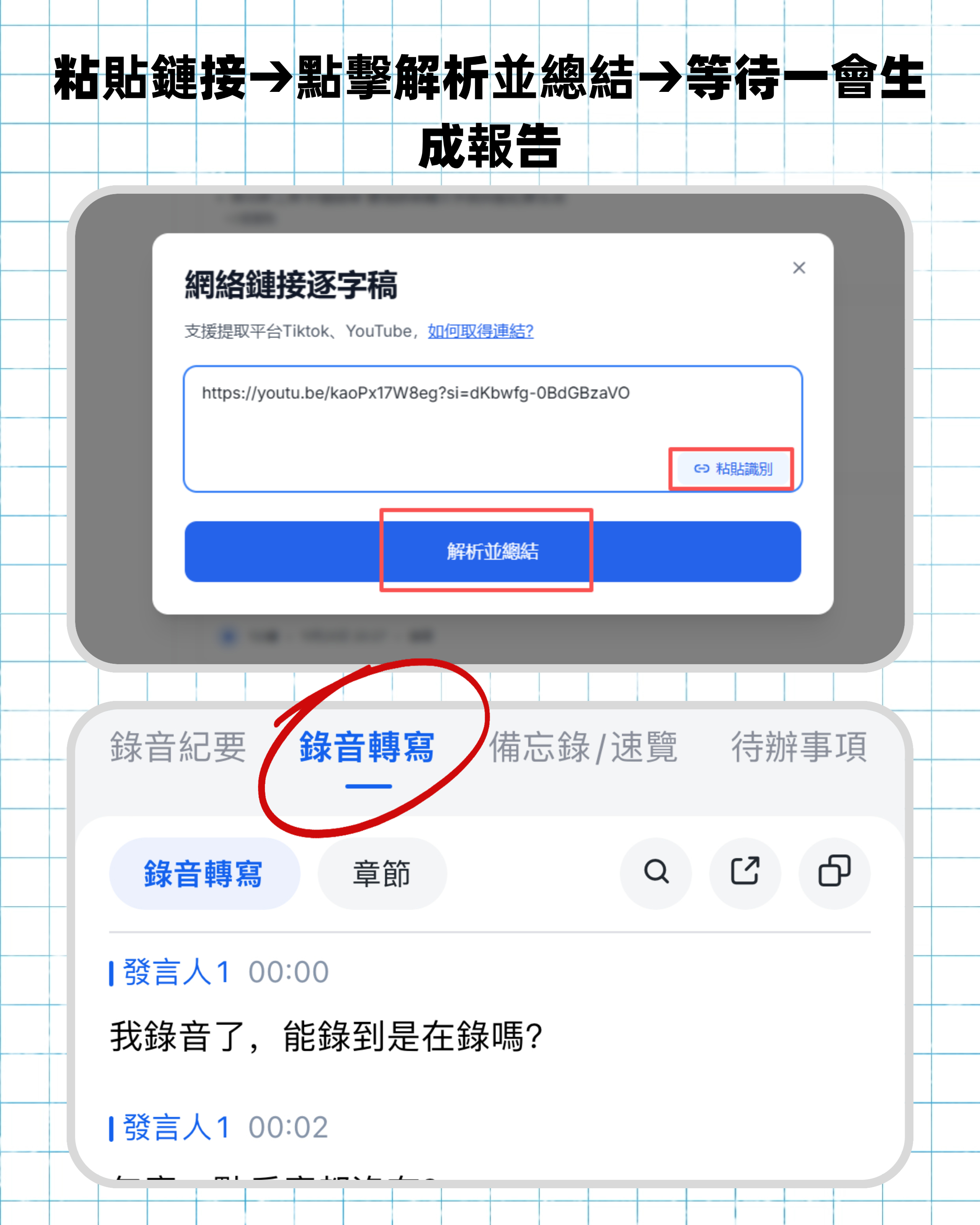
What you can record determines tool flexibility. Some tools only record their own app calls and can't handle external audio. Tinrec supports system audio recording, covering Google Meet, Zoom, Teams, and can also import local audio/video files or paste YouTube links for parsing—far broader than just meeting bots.Chinese transcription accuracy
Don't just look at official claims. In our tests, under normal network call quality, Tinrec's Chinese transcription word error rate is about 8-10%, sufficient for general meetings; accuracy drops in noisy environments or with multiple people talking over each other. We recommend testing with your typical meeting scenarios.AI organization depth
Transcription is just the first step; subsequent summaries, action items, and Q&A are where time is saved. Some tools only give you a plain text transcript, while Tinrec classifies and organizes directly, and even allows questioning. This is the most overlooked but most valuable difference when choosing.Where results can go
If organized data can't be exported, it becomes another data silo. Tinrec supports export to TXT, PDF, Word, or direct sync to Notion, Google Docs, and other external tools, integrating meeting notes into your existing workflow.Is the free tier enough for you?
If you're just testing the waters, a free tier that meets basic needs is ideal. Tinrec's free plan offers 100 minutes of transcription per month, enough for 2-3 one-hour meetings, suitable for trying before deciding to upgrade.
Frequently Asked Questions
Google Meet already has live captions—why do I need Tinrec?
Live captions only help you understand dialogue during the meeting; they cannot be saved as structured records. Tinrec's value is "post-meeting"—preserving full transcripts, auto-summarizing, extracting action items, and even letting you search for meeting content from six months ago. These are things built-in captions cannot do.
How does Tinrec record Google Meet audio?
On a computer, simply select "System Audio" to record the audio played by the computer, including the other party's speech; you can also record your own microphone input simultaneously. On mobile devices, use the microphone or speaker recording. No meeting plugin installation is needed.
Is the Chinese transcription accuracy really good enough?
In tests with clear voice environments, the word error rate is below 10%, more than adequate for general meeting notes. However, accuracy may be affected by heavy accents, background noise, or multiple people speaking at once. We recommend cross-referencing with the original audio for important decisions.
What happens when the free 100 minutes run out?
The free plan resets 100 minutes monthly, suitable for light users. If you have many meetings in the near future, consider purchasing a weekly card or Pro monthly card for higher monthly limits with great flexibility.
Can I use it on mobile?
Yes, Tinrec has iOS and Android apps and a web version. You can also use it directly on Chrome on your computer. It's convenient to take out your phone and record during meetings.
Conclusion
Google Meet solves the problem of "meeting face to face," but post-meeting organization and follow-up are the hidden costs that eat into team productivity. AI meeting recording and organizing tools are no longer a future trend—they are time-saving tools you can use today.
Among the three mainstream alternatives we tested, Tinrec is especially suitable for those who need complete Chinese meeting notes and want to turn meeting content into reusable data. It's not just recording-to-text, but a complete workflow from recording, understanding, to action.
If you have more than 3 meetings a week, we recommend downloading Tinrec's free version to try—100 minutes per month is enough to experience two or three meetings and see what AI-organized meeting notes feel like. The time saved might just let you leave work on time.
Turn every recording into actionable outcomes
Get 60 free transcription minutes when you sign in. No credit card required.
Related Reading
You might also like

2026 Comparison of 4 Google Meet Meeting Recording Solutions: Audio-to-Text is Key
Still looking for the best Google Meet headset? Actually, meeting note-taking is where the time really goes. This article compares 4 solutions and explains why using Tinrec 秒听录音 for direct audio-to-text and automatic summary generation saves more effort.

2026 Comparison: 4 Google Meet Meeting Tools Tested – Beyond Headphones, You Need This AI Recording Assistant
A good headset isn't enough for Google Meet. This article tests 4 meeting recording tools, from transcription to AI summaries and cross-platform organization, and explains why Tinrec is the top choice for Chinese meetings. The free plan offers 100 minutes per month, enough for most office workers.

How to Record Google Meet Calls with Tinrec in 2026: Auto-Generate Minutes & AI Q&A for Key Points
Spending hours transcribing and summarizing Google Meet calls? Learn how Tinrec can record, transcribe, auto-generate summaries and action items, and let you use AI Q&A to find key points instantly—turning meeting recordings into actionable knowledge.

2026 Hands-On Comparison of 3 Meeting Transcription Tools: Zoom/Google Meet Built-in vs Tinrec – Which Saves You Time?
Are Zoom and Google Meet's built-in transcription features any good? We tested two major video conferencing platforms and Tinrec, and found that post-meeting organization is the real pain point. This comparison helps you choose the right tool to save precious post-meeting time.

2026 Comparison of 2 Podcast-to-Transcript Tools: Which Performs Better for Cantonese Accuracy and AI Summarization?
Want to transcribe Apple Podcasts into text but Cantonese recognition often fails? We tested two popular tools, Tinrec and Notta, comparing Cantonese accuracy, AI summarization, free plan adequacy, and cross-platform support to find the best podcast-to-text solution for Hong Kong users.

A Side-by-Side Comparison of 4 Google Meet Note-Taking Tools in 2026: Which One Saves Students the Most Time?
As a senior, I spent a whole semester testing multiple Google Meet note-taking tools, from free built-in features to paid AI note-takers. This post shares my real experience and tells you which one is best for classes, group discussions, and final exam review.
2026 Mac Google Meet Meeting Recorder Tools Comparison: Which AI Auto-Minutes Saves the Most Time?
Tired of missing key points in Google Meet? This real-world test shows which AI meeting recorder truly helps Mac users auto-summarize and extract to-dos, saving hours after meetings.

2026 Google Meet Attendance Tools Compared: Which Auto-Generates Meeting Minutes Fastest?
Struggling to capture key points in Google Meet meetings? We tested three popular Google Meet attendance recording tools, covering transcription, AI summaries, action item extraction, and cross-platform support, to help you find the best meeting minutes solution for your workflow.
2026 5 Interview Transcription Software Comparison: Which One is Best for Hong Kong Workers?
Tired of spending hours transcribing interview recordings? We tested 5 popular voice-to-text tools, from free to paid, to help you find the best one so you can stop working overtime on transcripts.