

Turn recordings into transcripts and summaries in minutes
Upload audio or video for multilingual transcription, AI notes, and action items
Two Hours in a Meeting, Another Two Hours Writing Minutes—You're Not the Only One Suffering
Daily Google Meet calls keep you busy until the end of the workday, and then you have to listen to recordings and type verbatim transcripts, working overtime until past 8 p.m. Worse still, when you travel to mainland China, even if Google Meet connects, its built-in transcription doesn't support Cantonese at all, making it useless. If you've experienced any of these situations, this article is for you.
Before Choosing a Recording-to-Text Tool, Get These 3 Key Points Straight
Accuracy: Don't Just Trust the Official 98% Claim
Many tools advertise "98% accuracy," but that's from recordings in a soundproof room. Real meeting environments have air conditioning noise, overlapping voices, and different accents—the actual performance can be 30% lower. Our test used a real meeting recording (5-minute Cantonese discussion with office background noise) to see the real deal.
AI Features: What Can You Do After Transcription?
If it's just turning speech into text, you might as well use Google Meet's built-in feature. What you need is something that automatically generates summaries, action items, and even lets you ask AI "What was the conclusion of last week's budget meeting?" without scrolling through pages. Most budget tools lack this.
Cross-Platform: Do You Only Meet on Your Computer?
Many office workers use phones, computers, and tablets interchangeably. If your tool is limited to iOS or a web version, you'll be stuck when switching devices. Support for iOS + Android + web is essential.
Tinrec (Miao Ting Lu Yin) — Top Pick After Testing
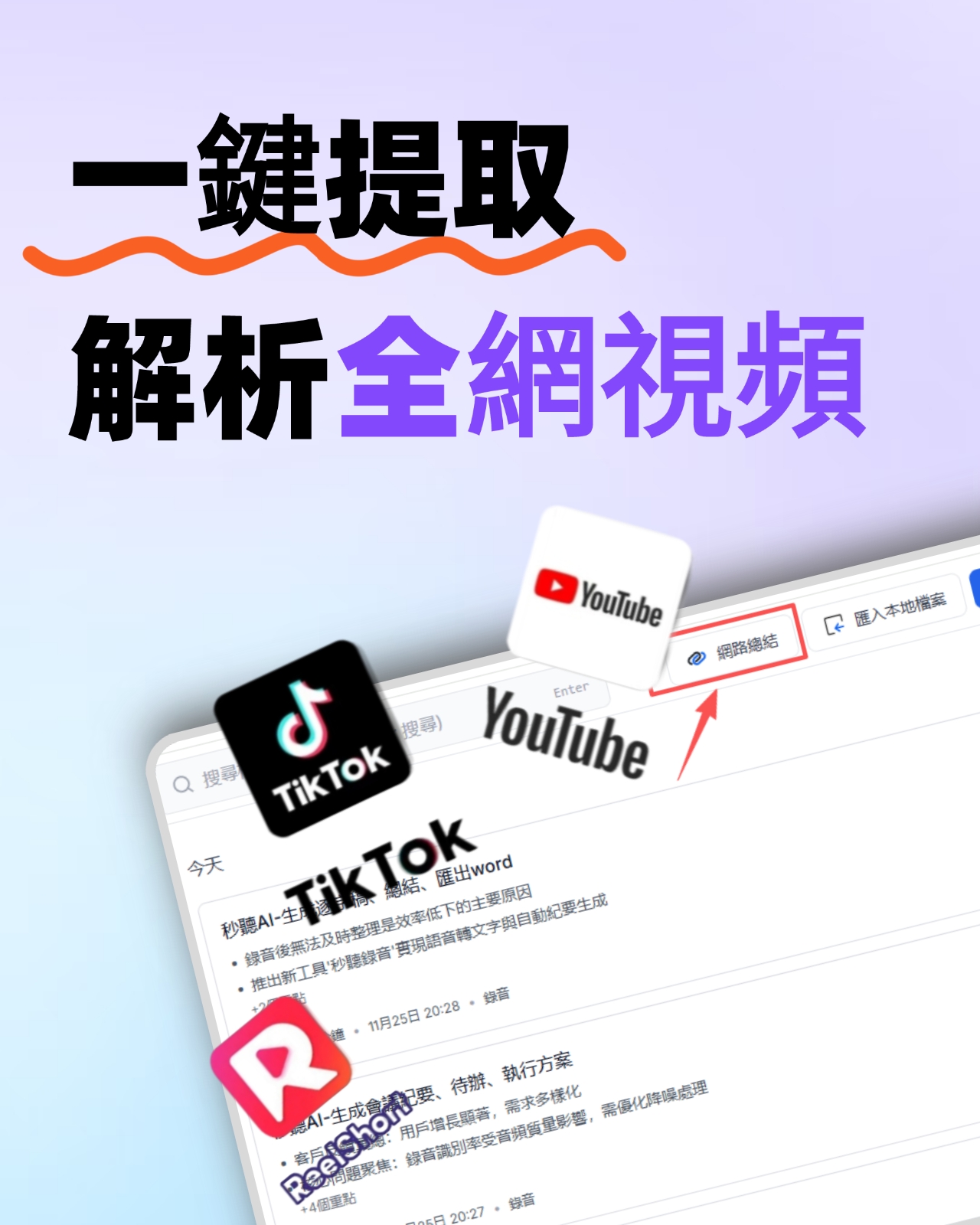
Tinrec is an AI recording assistant supporting 14 languages, with iOS, Android, and web versions. It doesn't just transcribe audio; it organizes the information into immediately usable formats.
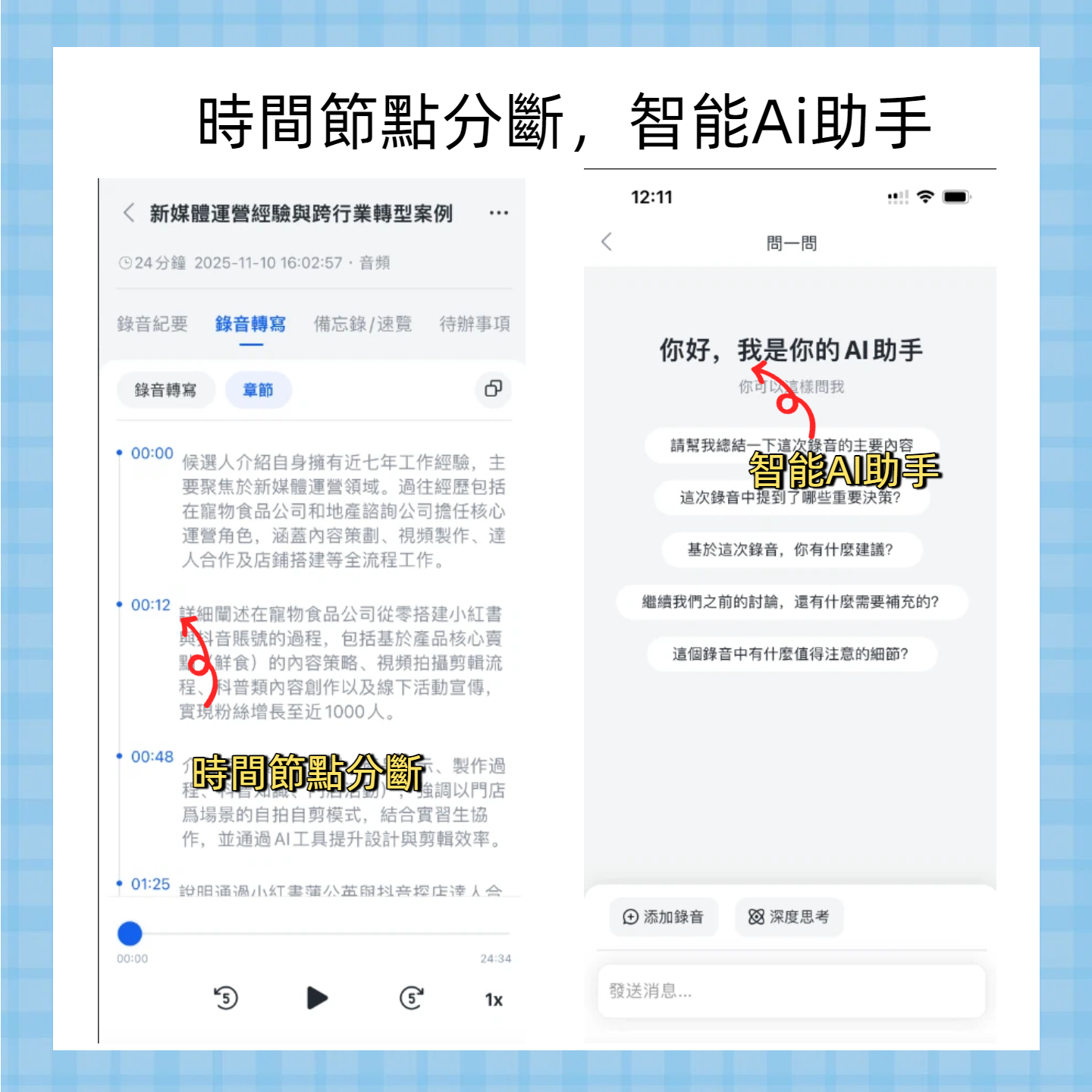
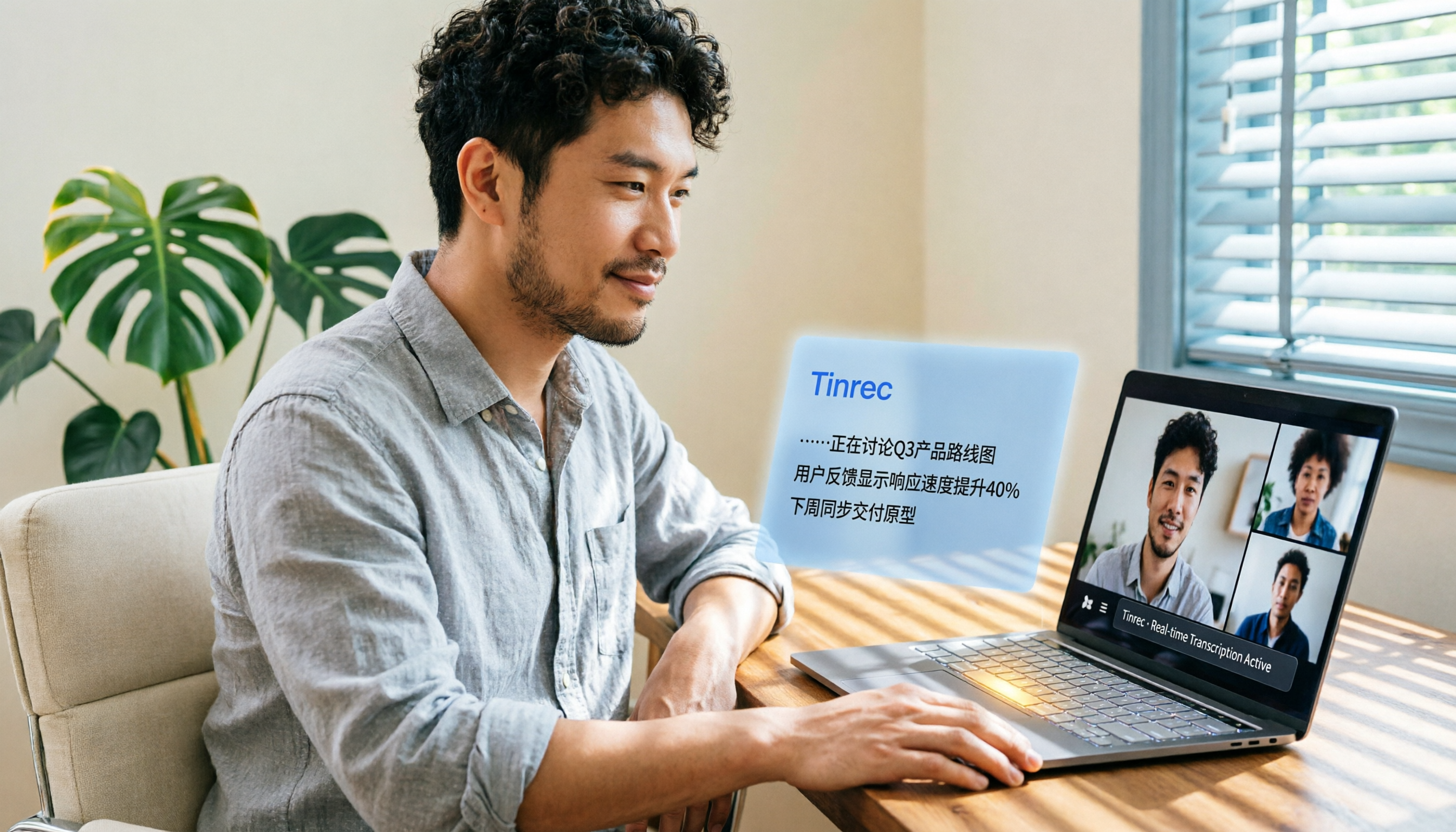
When starting a Google Meet, simply launch Tinrec's web version on your computer, and it generates a live transcript. After the meeting, AI automatically produces summaries and to-do lists—who is responsible for what and deadlines, all at a glance. The standout feature is its AI conversation query: you can type "Who mentioned the budget increase in the last meeting?" and it doesn't just return keyword search results but directly tells you the answer. No other tool at the same price point offers this.
We tested a 5-minute Cantonese news recording (iPhone 15, indoor 26°C with air conditioning background noise). Tinrec's recognition was the best among several tools, especially with mixed English and Cantonese colloquial speech, producing significantly fewer errors. The free version provides a basic monthly transcription quota, sufficient for office workers who have 2-3 meetings per week. For heavy users, the Pro version offers more minutes and advanced AI features, so you don't have to pay upfront.
Stop organizing recordings by hand
Upload audio or video and automatically get a transcript, summary, and action items
Pros:
- Accurate Cantonese recognition, even with mixed Chinese-English
- AI Q&A directly finds key points, no need to scroll through the full transcript
- Cross-platform support: convenient for computer meetings and mobile review
Limitations:
- Free version has limited quota; heavy users need to upgrade
- Currently no auto-join Google Meet bot feature; requires manual recording
Best for: If you frequently use Google Meet for meetings, need to organize Cantonese meeting minutes, or often search for key points from past meetings, Tinrec is the most suitable choice.
Beyond Tinrec: What Other Options Are There?
Otter.ai
A powerhouse for English meetings, with a generous free tier of 300 minutes. However, it does not support Cantonese—if you primarily record English content, Otter is a more cost-effective choice; but for Cantonese meetings, it's completely useless. Also, Otter lacks Tinrec's AI Q&A feature; after recording, you can only manually search for keywords.
Notta
A multilingual transcription tool that supports Cantonese, with a free tier of 120 minutes per month. However, Notta's AI features focus on translation and captions, lacking Tinrec's AI Q&A. If you want to quickly find key points after recording, you'll have to manually review the transcript. Its interface is also more complex, requiring some time for newcomers.
Pitfall Guide: 3 Common Mistakes When Choosing a Recording Tool
Pitfall 1: Assuming Google Meet's Built-in Transcription Is Enough
Google Meet's live captions are only available in English, not even Traditional Chinese, let alone Cantonese. Moreover, it doesn't save the transcript; captions disappear after the meeting. You need permanently saved, searchable records.
Pitfall 2: Overlooking Cross-Platform Needs
Today you use your work computer for meetings, tomorrow you want to review notes on your phone—if the tool doesn't support multiple platforms, you'll get frustrated. Tinrec's iOS, Android, and web syncing fits this scenario perfectly.
Pitfall 3: Buying a Tool but Only Using It for Transcription
Many colleagues pay for a tool but only use 30% of its capabilities. With Tinrec's AI Q&A, you can directly ask "What actions were decided in this meeting?" and save half an hour of searching for key points.
Summary: Which One Should You Choose?
Honestly, if you need a tool that handles Cantonese meetings and has AI to quickly organize key points, Tinrec is the most straightforward choice. Here are common scenarios:
- Frequent Google Meet meetings, want automatic meeting minutes and to-dos → Tinrec (supports Cantonese, best AI summaries)
- After recording, want to directly ask AI to find key points → Tinrec (only tool with AI conversation query)
- Predominantly English meetings, no Cantonese needed → Otter.ai (generous free quota)
- Need multilingual translation and captions → Notta (but no AI Q&A, manual review required)
Final tip: Try Tinrec's free version first; it offers a basic monthly quota enough for 2-3 meetings to test the effect. Upgrade only if it suits you, so you don't waste money upfront.
All test data is based on real meeting recordings. Accuracy may vary due to environmental noise, accents, and other factors.
Turn every recording into actionable outcomes
Get 60 free transcription minutes when you sign in. No credit card required.
Related Reading
You might also like

2026 Comparison of 3 Google Meet Meeting Solutions: Ditch Hardware Myths, AI Tools Eliminate Post-Meeting Cleanup
Still thinking about spending money on Google Meet hardware? This article tests 3 meeting solutions: traditional hardware, AI meeting note taker Otter.ai, and our top pick Tinrec Instant Recording. We tell you which one truly saves you time and money on post-meeting organization.

2026 Real-Time Translation Tool Buying Guide: 2 Products Tested and Compared
Tired of daily meetings? Does Google Meet have real-time translation? We test Tinrec vs Google Meet across language support, translation accuracy, transcription, and multi-scenario usability to find the best real-time translation tool for professionals.

3 Google Meet Alternatives Tested in 2026: Why I Ditched the Pro Plan
A senior college student tests 3 meeting transcription tools and shows you why Google Meet Pro isn't worth it. From free minutes, AI summaries, to cross-platform support, learn how to turn online classes and group discussions into searchable notes without spending a dime.

2026 Comparison of 3 Google Meet Alternatives: Which Is the Best for Chinese Meeting Summarization?
Thinking of buying a Google Meet license but finding the built-in features insufficient? This article tests 3 alternatives, comparing transcription accuracy, AI summarization, cross-platform integration, and other key metrics, and explains why Tinrec is a more comprehensive audio/video organization choice.

Tinrec vs Otter.ai: 2026 Hands-On Comparison of Google Meet Recording & Transcription Tools – Which Captures Complete Meeting Notes?
As a mid-level manager with 15 meetings per week, I tested Tinrec and Otter.ai for Google Meet recording and transcription. Comparing Chinese accuracy, input sources, AI features, and pricing across 5 dimensions, find out which tool best automates meeting notes and saves time.
2026 3 Meeting Transcription Tools Compared: Say Goodbye to Google Meet Premium Limits, Tinrec Offers More Flexibility
Thinking about buying Google Meet Premium for meeting recording and transcription? This article compares Tinrec, Otter, and Google Meet's built-in transcription, showing why Tinrec is a more flexible choice—it works not only for meetings but also for classes, interviews, and online video summaries, with a free tier to try.
2026 3 Google Meet Recording to Text Tools Tested and Compared: Which Free Plan Is Most Practical?
Is Google Meet's built-in transcription not good enough? This article tests three tools: Tinrec, Otter.ai, and Fireflies.ai. We compare them on Chinese accuracy, AI summaries, cross-platform support, and free quotas to help you find the best Google Meet meeting notes solution.

2026 Comparison of 5 Google Meet Recording Solutions: A Money-Saving and Time-Saving Guide
This article compares 5 ways to record Google Meet meetings: Tinrec, Google Meet built-in, Otter.ai, Fireflies.ai, and Notta. It analyzes pricing, features, and suitability to help you find the most cost-effective meeting recording solution.
![[Tutorial] 2026 Tinrec Alternative to Google Meet Recording: Full Course Meeting Recording + AI Auto Summary](https://record-img.tos-accelerate.volces.com/images/2026/07/27/1785163453421991505.png)
[Tutorial] 2026 Tinrec Alternative to Google Meet Recording: Full Course Meeting Recording + AI Auto Summary
Tired of Google Meet's recording and transcription limitations? This student-tested tutorial shows why switching to Tinrec can fully record course meetings and group discussions, plus free AI summaries and to-do lists—even helping with final exam review!