
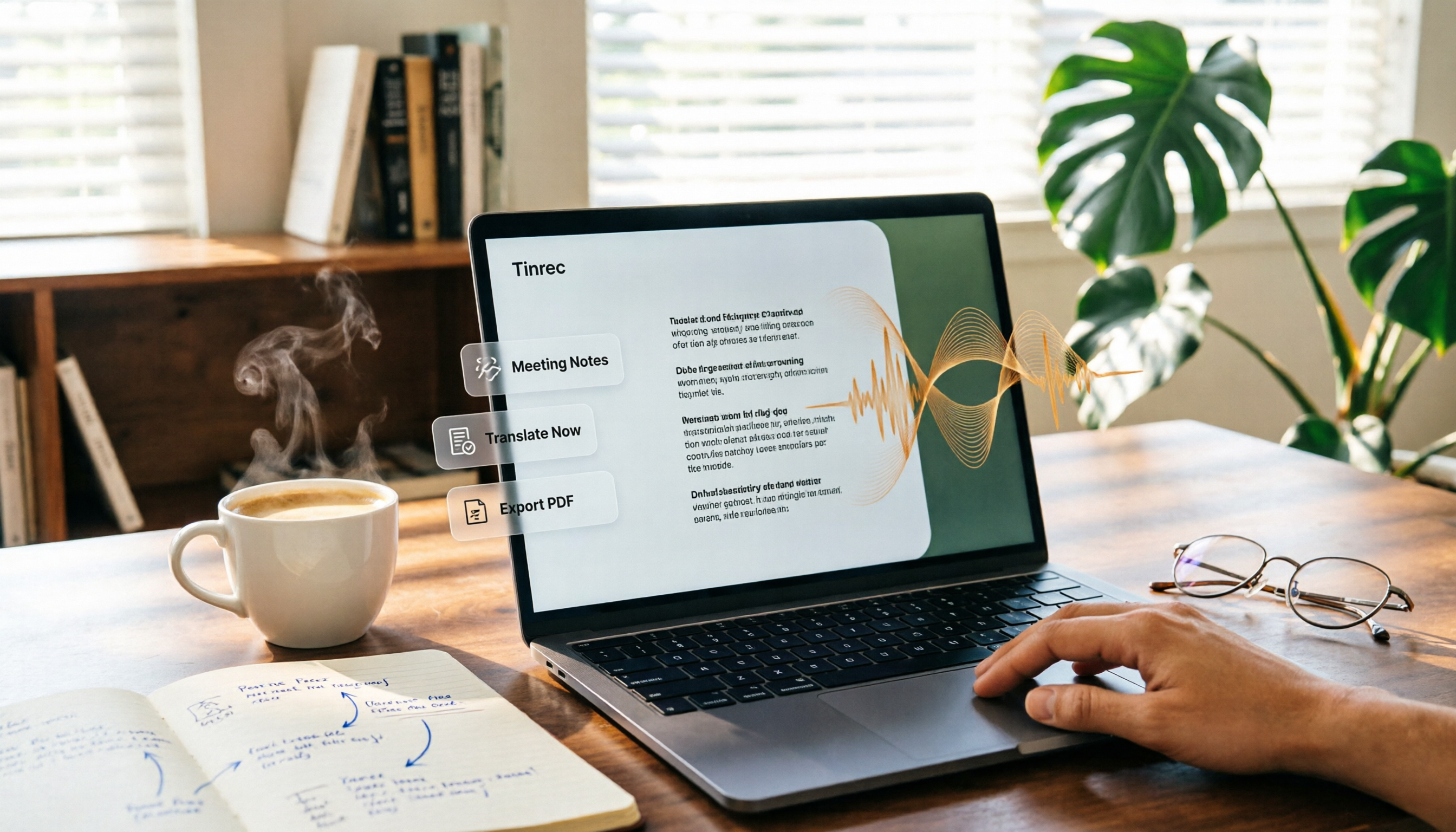
Turn recordings into transcripts and summaries in minutes
Upload audio or video for multilingual transcription, AI notes, and action items
If you frequently hold Google Meet meetings and spend hours afterward re-listening to recordings, typing transcripts, and organizing key points—Tinrec can be a game-changer for your workflow. It’s an AI-powered recording and audio/video organization tool that supports live recording, file imports, web link parsing, and automatically generates summaries, chapters, action items, and even lets you ask questions about the content. The free plan provides a monthly transcription allowance, and it works on mobile, desktop, and web—perfect for meetings, classes, interviews, and content creation.
Why Are People Looking for Google Meet Alternatives?
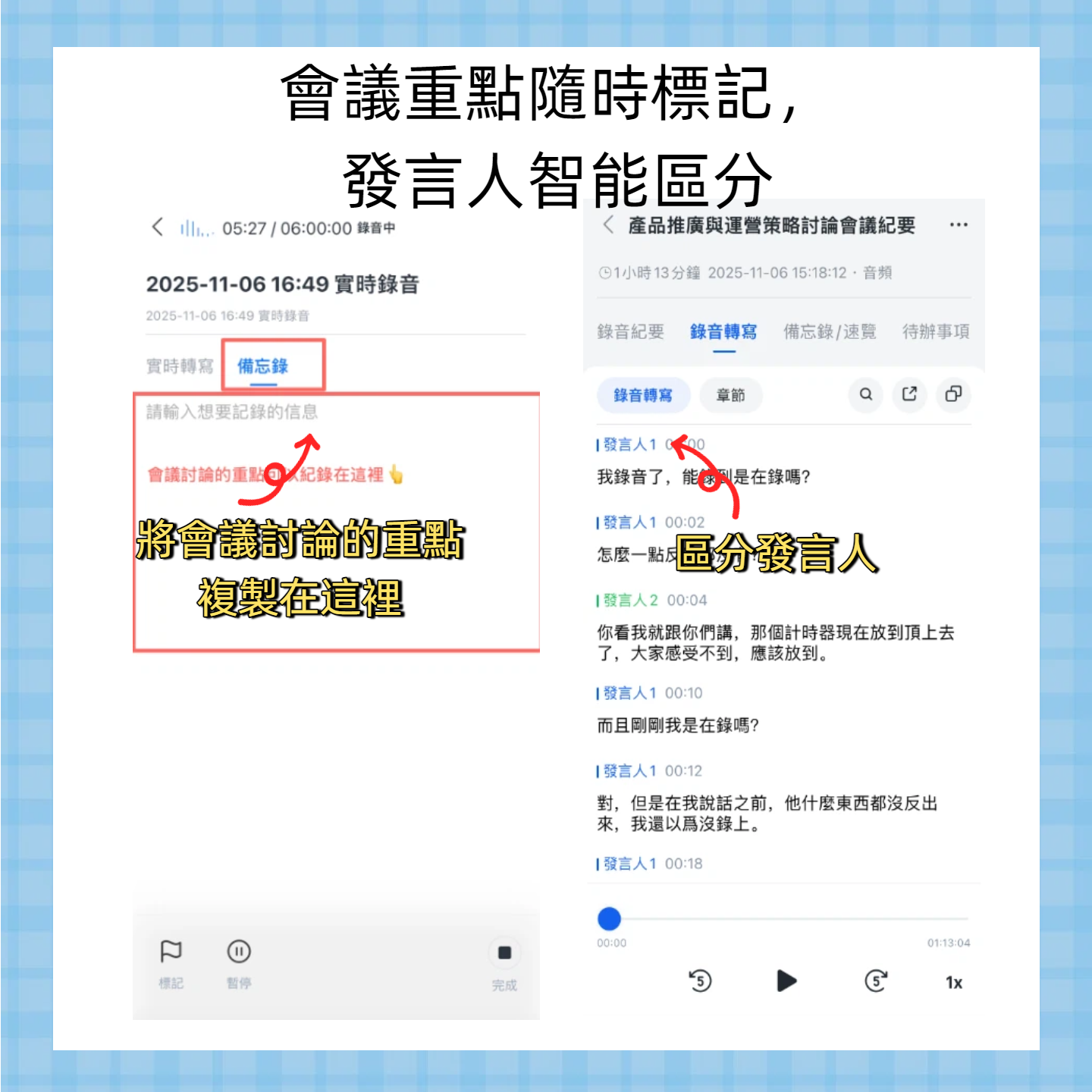
Google Meet’s built-in recording and transcription are certainly convenient—one click during the meeting and you’re set. But if you’ve used them, you’ve probably encountered these issues: transcription only supports a limited set of languages, with Chinese recognition being less accurate; after the meeting ends, you’re left with just a video file that you have to scrub through manually to find important parts; the transcript can’t be edited or searched, let alone auto-summarized or exported to other tools for further processing.
If you want your meeting recordings to become immediately usable data rather than just archived files—Tinrec is designed exactly for that.
Tinrec vs Google Meet: What’s Different in Core Experience?
Meetings Are Just the Starting Point
Google Meet’s transcription is confined to that specific meeting and is hard to reuse outside the platform. Tinrec centralizes your meeting recordings and other audio data (classes, interviews, videos), allowing you to search and ask questions across platforms and time.
The "Next Step" After Transcription Is Key
Built-in transcription usually gives you plain text, maybe with bold highlights. Tinrec automatically generates summaries, chapters, and action items, and you can also ask AI questions like: "What decisions were made in this meeting?" or "Who is responsible for what?"—much faster than reading through the entire transcript.
Chinese Content Nuance
Google Meet’s transcription excels in English, but with Chinese, Cantonese, or mixed language scenarios, it often misses or misrecognizes words. Tinrec is specifically optimized for Chinese meetings, classes, and interviews, delivering noticeably better recognition quality in clear recordings—you’ll feel the difference in real use.
Export and Integrate with Your Workflow
Google Meet meeting notes can only be edited within the Google ecosystem. Tinrec supports export to Word, PDF, TXT, subtitle files, and can sync to tools like Notion, Google Docs, OneNote, and Dropbox, letting your data flow directly into your existing workflow.
Tinrec Core Features at a Glance
Live Recording to Text: Open Tinrec, and text appears as you record with almost no delay. By the time the meeting ends, the transcript is ready, and you can start organizing highlights immediately.
Audio/Video File Transcription: Import last month’s course recording or interview file into Tinrec, and within minutes you’ll get a transcript, summary, and chapters. No more manual transcription.
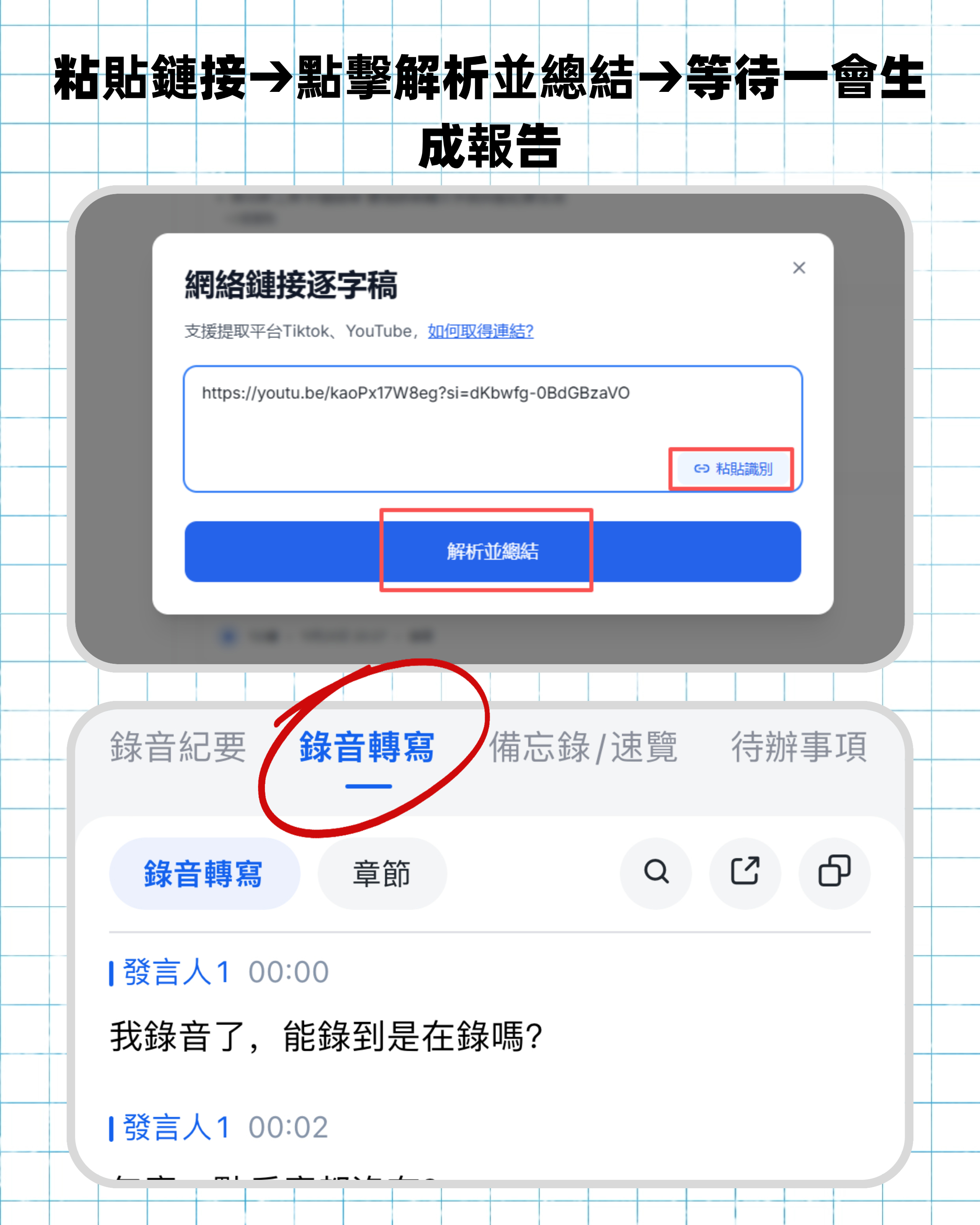
Web Video Link Parsing: Paste a public video link from YouTube, Bilibili, or TikTok, and Tinrec automatically extracts the audio, transcribes it, and generates a summary. Great for research or video note-taking.
AI Q&A: This is my most-used feature. After recording a one-hour meeting, just type a question like: "What’s the conclusion?" or "What are each department’s action items?" Tinrec acts like an assistant that has watched the entire meeting and can answer based on the content.
Stop organizing recordings by hand
Upload audio or video and automatically get a transcript, summary, and action items
Real-World Use Cases
Weekly Meeting Notes and Action Item Tracking
I use Tinrec to record every weekly meeting. After the meeting, I open the AI summary to quickly review key points and export action items to Notion with one click. When following up with colleagues, instead of flipping through meeting notes, I just ask Tinrec what was discussed last time.
Online Courses and Lecture Notes
After a two-hour online class, I upload the recording file to Tinrec. It automatically splits into chapters, highlights key points, and I can even ask AI to explain a concept. Much more efficient than listening to the whole thing again.
User Interviews and Research Data Organization
When doing user research, I record interviews with Tinrec, get them transcribed, mark important sections, and ask AI to summarize common pain points. It saves at least half the time compared to manual processing.
How to Use Tinrec to Record Google Meet Meetings: 5-Step Tutorial
Step 1: Download and Install Tinrec
Search for "Tinrec" in the App Store or Google Play, or use the web version directly on the official website. Log in and you’re ready to start. (See Figure 1)
Step 2: Start Recording
Tap the "Record" button on the main screen, and Tinrec will start capturing audio immediately. You can leave it running in the background while you continue your Google Meet meeting. (See Figure 2)
Step 3: Record Google Meet Audio
If you’re using a phone or tablet, you can simply play the meeting through the device speaker, and Tinrec will clearly capture all speech. If you’re on a computer, it’s recommended to use the Tinrec app on your phone placed near the computer speakers for the most stable results. When the meeting ends, press stop, and the recording is automatically saved. (See Figure 3)
Step 4: Use AI Summary and Q&A
Go back to the Tinrec main page and tap the recording you just made. The system will automatically generate a summary, chapters, and action items. If you need to quickly find a specific decision, tap "AI Q&A" at the bottom and type your question. For example: "Summarize the three conclusions of this meeting." It will provide an answer instantly. (See Figure 4)
Step 5: Export and Share
After organizing, tap "Export" to choose Word, PDF, TXT, or even subtitle files. You can also sync directly to Notion, Google Docs, and other tools. Share the meeting notes with your team, and the whole process is complete. (See Figure 5)
What to Consider When Choosing a Transcription Tool
Post-Transcription Organization: Don’t just look at transcription speed or per-minute rates. The ability to auto-summarize, extract action items, and use AI Q&A is what saves you time. Tinrec excels in this area.
Cross-Platform and Export Options: Does the tool work on all your devices? Can you export results to your daily work software? Tinrec supports iOS, Android, and web, and offers multiple export formats, so your data isn’t locked into a single app.
Chinese and Mixed-Language Performance: If your meetings often involve Chinese or mixed English-Chinese content, test the recognition quality first. Tinrec has been specifically tuned for Chinese content and performs better than generic engines.
Free Plan Value: Some tools have very restrictive free plans that barely let you test the experience. Tinrec’s free plan provides a monthly transcription allowance, letting you run a few meetings end-to-end before deciding to upgrade.
Final Verdict: Is Tinrec Worth Trying?
If you want to turn your Google Meet meeting notes from passive archives into actionable data, Tinrec is a strong contender. It doesn’t just convert speech to text—it helps you extract key points, action items, and a searchable knowledge base. Plus, it’s cross-platform and supports exports, making it ideal for users who don’t want to be tied to a single ecosystem. Try the free plan with a few meetings to see the difference—that’s more effective than any review.
Frequently Asked Questions
How long can I use the free version of Tinrec?
The free version has no time limit. It provides a fixed amount of transcription minutes each month (see the product page for the latest number). Once used up, you can wait for a reset next month or upgrade your plan.
Do I need others' consent to record a Google Meet meeting?
Please obtain consent from participants in accordance with local laws and meeting etiquette. Tinrec is a recording tool and cannot automatically join meetings.
How accurate is the transcription?
Under clear recording conditions (standard accent, quiet background), Chinese transcription quality is quite good. If multiple people talk simultaneously, there is background noise, or accents are strong, it’s advisable to review key points after the meeting.
Can I record both phone and computer audio simultaneously?
Currently, Tinrec records ambient sound around the device. To capture computer audio, place the phone near the computer speakers or use a wired earpiece.
How long are files stored?
Both free and paid plans allow continuous access to recordings and transcripts as long as your account remains active. Data will not be deleted.
What’s the difference between Tinrec and Otter or Notta?
Otter focuses on English meetings and team collaboration; Notta excels in transcription and translation. Tinrec is more dedicated to turning all audio/video content into usable knowledge, particularly with Chinese accuracy and post-processing (summaries, Q&A, exports) being more comprehensive.
Turn every recording into actionable outcomes
Get 60 free transcription minutes when you sign in. No credit card required.
Related Reading
You might also like

2026 Tinrec vs Google Meet Live Transcription: 4-Dimension Showdown – Which Is Better for Meeting Notes?
Attending 15 meetings a week and spending half the time on notes? This article compares Tinrec and Google Meet's built-in transcription across 4 key dimensions to help you choose the best meeting recording tool.

2026 Test of 3 Google Meet Recording Tools: Which One Nails Cantonese Transcription?
Spend hours in Google Meet meetings and then more hours on meeting notes? We tested 3 recording-to-text apps to see which one saves you the most time. All in one read.
2026 Test of 3 Google Meet Recording Tools: Which One Nails Cantonese Transcription?
Spend hours in Google Meet meetings and then more hours on meeting notes? We tested 3 recording-to-text apps to see which one saves you the most time. All in one read.

2026 Real-World Comparison of 4 Speech-to-Text Apps: Which Saves Time with AI Summaries and Cantonese Recognition?
We tested 4 speech-to-text apps on Cantonese accuracy, AI summaries, free credits, and cross-platform experience to find the best for Hong Kong office workers.

2026 Comparison of Two AI Meeting Recording & Transcription Tools: Solving Google Meet's Missing Recent Calls Issue
Google Meet not showing recent calls? Can't find meeting recordings? This article tests two AI recording tools, Tinrec and Otter.ai, comparing them across five dimensions: recording sources, Chinese transcription quality, AI summarization, pricing, and cross-platform support. Find out which tool can truly help you save, organize, and utilize meeting recordings so you never miss important content.

2026 Comparison of 3 Google Meet Meeting Note Alternatives: Why Tinrec Is More Comprehensive?
Google Meet's built-in transcription is convenient, but for professionals handling diverse audio/video content, it has limitations. We tested Tinrec, Notta, and Google Meet's transcription to see which tool saves you the most time on meeting notes.

2026 Real-World Comparison of 4 AI Meeting Note Tools: Is Google Meet's Built-in Transcription Good Enough?
Google Meet is convenient for meetings, but is its built-in transcription really enough? We tested 4 AI meeting note tools, including Tinrec, Otter.ai, and more, to see which one saves you the most time!

Which Google Meet Recording-to-Text Tool is Best? 2026 Review of 3 Tools – This Cross-Platform Option is Most Practical
We tested Tinrec, Otter.ai, and Notta for Google Meet transcription and post-meeting organization. Tinrec stands out with high accuracy for Chinese, cross-platform sync, and AI chat query, making it the best choice for Chinese-speaking users.

After Google Meet Integrates Gemini in 2026, 3 AI Meeting Note Tools Compared: Which Free Version Is Best?
Google Meet now has the power of Gemini, but is its AI meeting notes really good? We tested Google Meet, Tinrec, and Otter to help you find the best solution for office workers.