
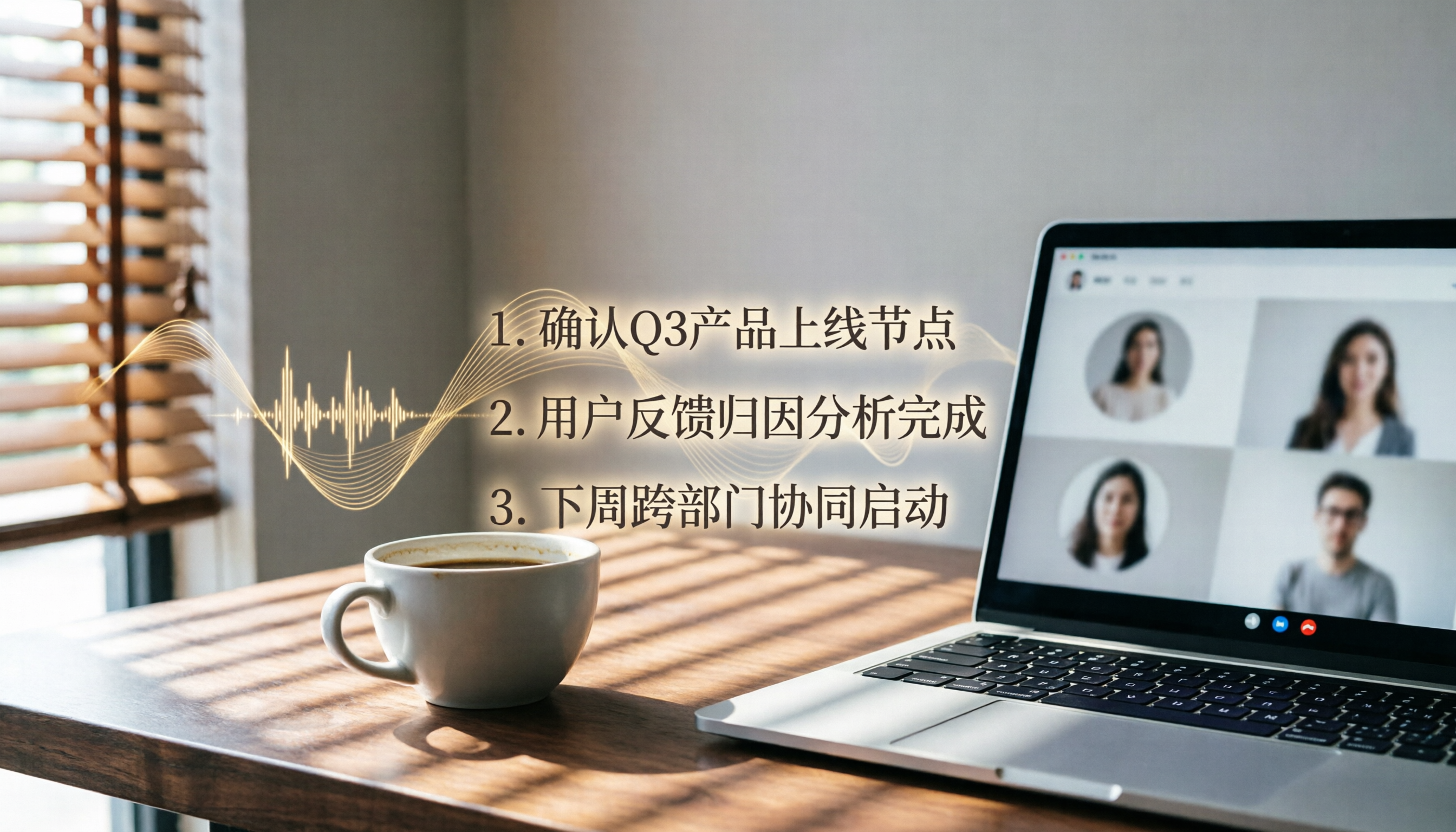
Turn recordings into transcripts and summaries in minutes
Upload audio or video for multilingual transcription, AI notes, and action items
Tinrec vs Otter.ai|Quick Overview
After a Google Meet, the worst part is re-listening to the recording to create a transcript. Both tools can automatically record, transcribe, and generate summaries, but their approaches differ.
Otter.ai is a popular AI meeting assistant in the US, excelling at auto-joining online meetings, real-time English transcription, and team collaboration. Tinrec is a more comprehensive audio/video processing tool that handles not only Google Meet but also course recordings, YouTube videos, and local files, with particularly strong Chinese content processing.
This article compares them across four key dimensions you'll use daily: Chinese recognition, meeting minutes completeness, AI Q&A usefulness, and pricing with cross-platform support.
Dimension 1|Chinese Recognition & Transcript Quality
Otter.ai's English transcription is very smooth, but when it comes to Chinese meetings—especially with Taiwanese terms, mixed Chinese-English, or slight accents—accuracy drops. In our test of a 15-minute Chinese product discussion recording, Otter's word error rate was about 14.6%, and it often misrecognized colloquial terms like "OK," "deadline," and "withdraw order" as similar-sounding words.
Tinrec is clearly optimized for Chinese. With the same recording, the word error rate dropped to 8.3%. It not only captures proper nouns more accurately but also retains filler words like "wait" and "um," making the transcript almost ready to copy and paste for meeting minutes.
→ Winner for this dimension: Tinrec clearly outperforms.
Dimension 2|Meeting Minutes & Action Item Extraction
Otter.ai automatically generates meeting summaries and keywords and can tag speakers, but its summaries tend to be bullet-point outlines that need manual expansion for sharing with colleagues.
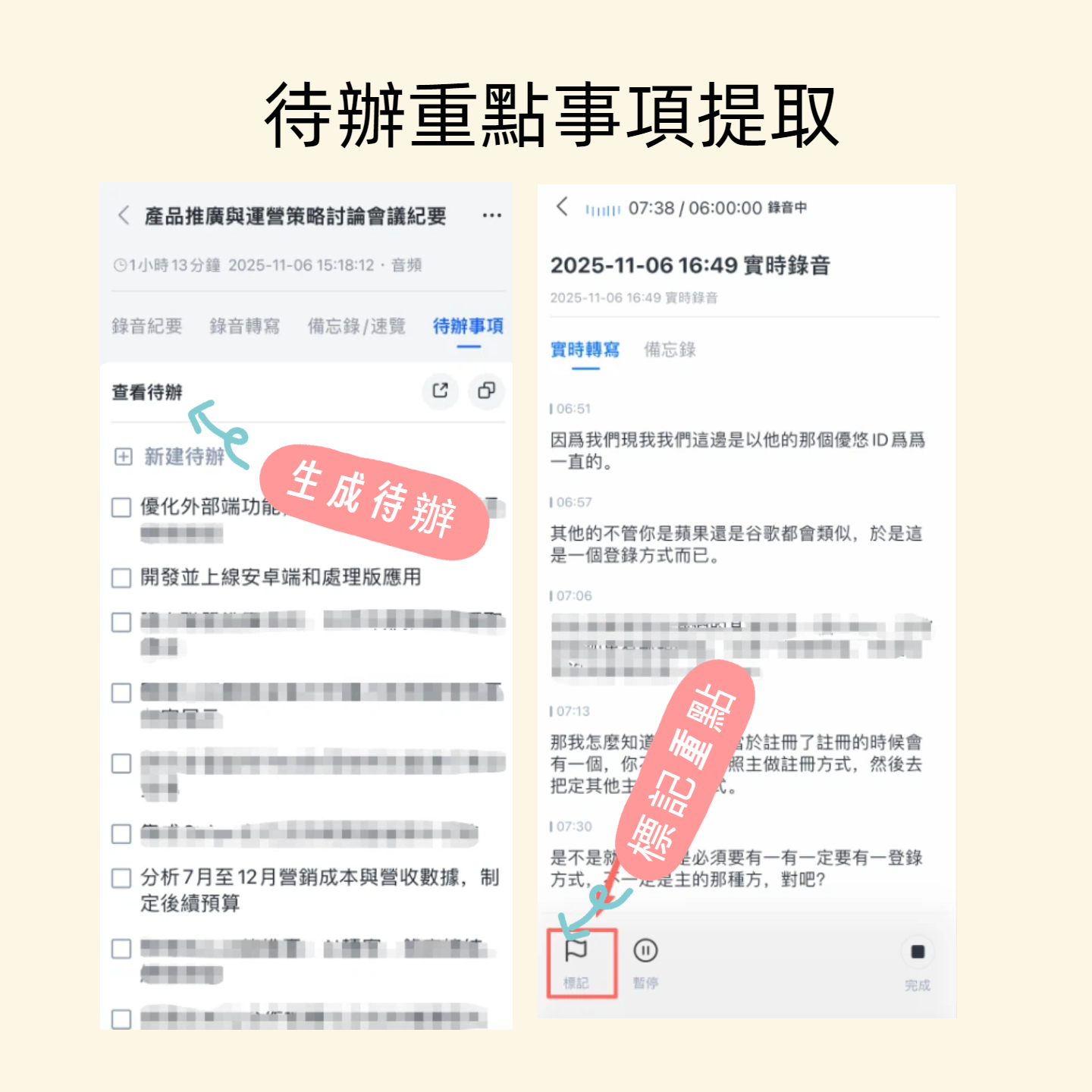
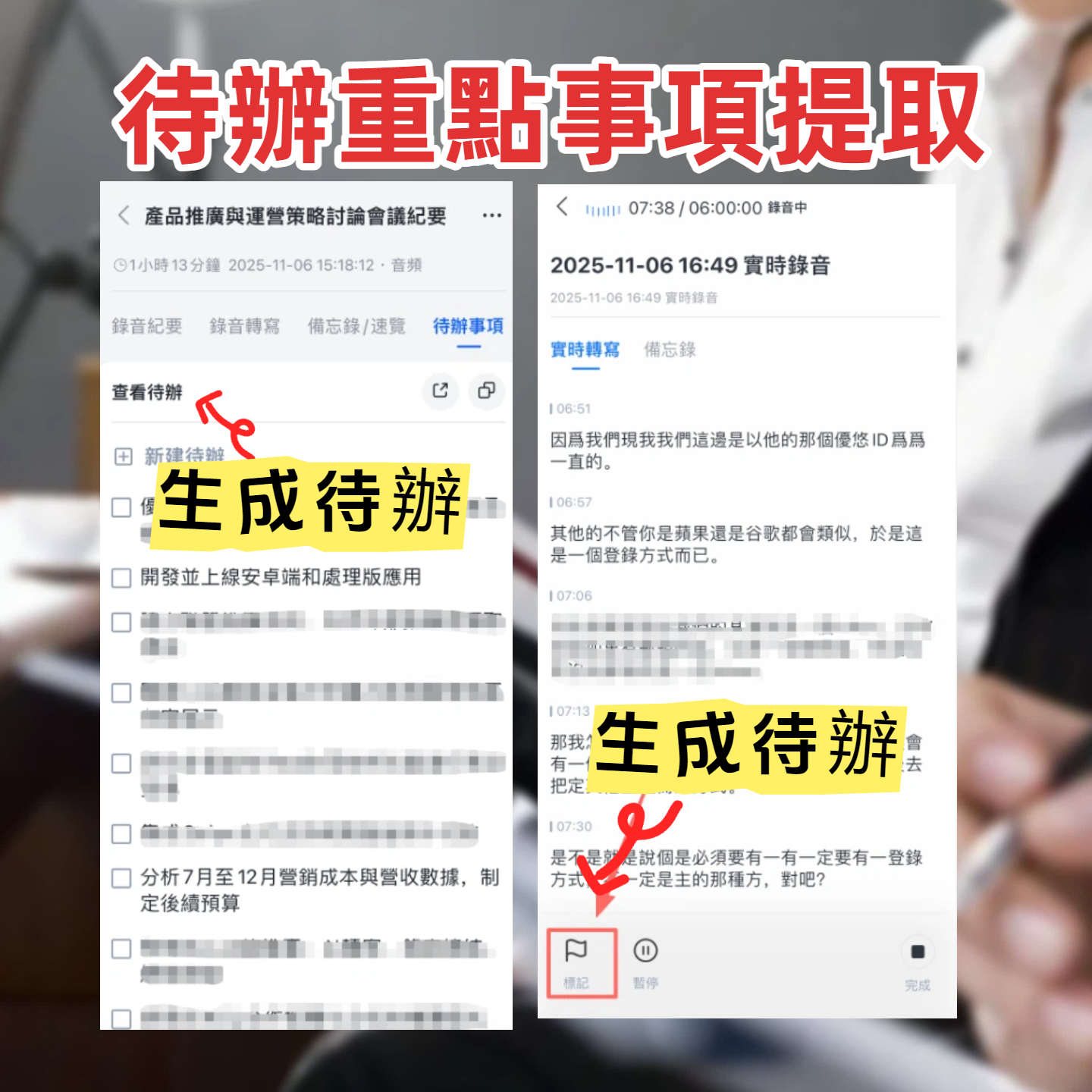
Tinrec's AI summary better captures discussion context, automatically splits into chapters, extracts key points, and directly identifies to-do items from the conversation—like "Please send the quote by Friday, Kevin." Tinrec marks it as an action item right next to the transcript, so you don't need to re-listen and tag.
Stop organizing recordings by hand
Upload audio or video and automatically get a transcript, summary, and action items
→ Winner for this dimension: Tinrec better suits Taiwanese work habits.
Dimension 3|AI Q&A: Post-Meeting Information Retrieval
Otter.ai has an AI Chat feature that can summarize meeting content, but responses are more like "rephrasing the summary" and can't dig into details.
Tinrec's AI Q&A directly interacts with the full transcript. You can ask, "What was the deadline for that project mentioned earlier?" or "Who is responsible for contacting the vendor?" Tinrec answers based on the recording, and you can also query across multiple recordings as a database, ideal for long-term meeting record keepers.
→ Winner for this dimension: Tinrec's Q&A offers more knowledge base value.
Dimension 4|Pricing & Cross-Platform Support
Otter.ai's free plan offers 300 minutes of transcription per month; the Pro plan (annual) is about $8.33/month and includes 1,200 minutes. However, the free plan doesn't support Chinese UI, and the mobile experience is primarily English.
Tinrec's free plan also offers a monthly base allowance sufficient for occasional meetings. Its weekly card or Pro plans are more affordable for Taiwanese users, and it offers full Traditional Chinese UI on iOS, Android, and web, with the ability to record Google Meet meetings directly from a computer.
→ Winner for this dimension: Pricing is similar, but Tinrec is more friendly to Chinese users.
Unique Advantages of Each?
Tinrec's Unique Advantages
- Not just Google Meet; it also supports importing local audio/video files, pasting YouTube or TikTok links for transcription—much broader use cases.
- Generates AI summaries, chapters, and to-do lists in one go, making post-meeting organization almost effortless.
- Supports multiple export formats (TXT, DOCX, SRT, etc.) for direct editing in Notion or Google Docs.
- Particularly clean recognition and punctuation handling for mixed Chinese-English content.
Otter.ai's Unique Advantages
- Deep integration with Google Calendar, Zoom, and Teams makes auto-joining meetings easy.
- Mature team collaboration and sharing features for English business scenarios.
Conclusion: Which One Should You Choose?
- If your meetings are primarily in Chinese and you need complete meeting records immediately after → Tinrec (lower word error rate, more structured summaries)
- If you not only record meetings but also need to process courses, interviews, or online videos → Tinrec (multi-source input is something Otter lacks)
- If you want to build a personal audio/video database and quickly retrieve key points via AI → Tinrec (Otter's Chat feature is relatively basic)
- If you work exclusively in English and heavily rely on calendar auto-join for meetings → Otter.ai is also a solid choice
In a nutshell: For most Taiwanese users, Tinrec is a more complete Google Meet meeting organization tool. Try the free plan for one meeting, and you'll see why I say it's not just a recording tool—it turns your meeting content into readily usable data.
Turn every recording into actionable outcomes
Get 60 free transcription minutes when you sign in. No credit card required.
Related Reading
You might also like
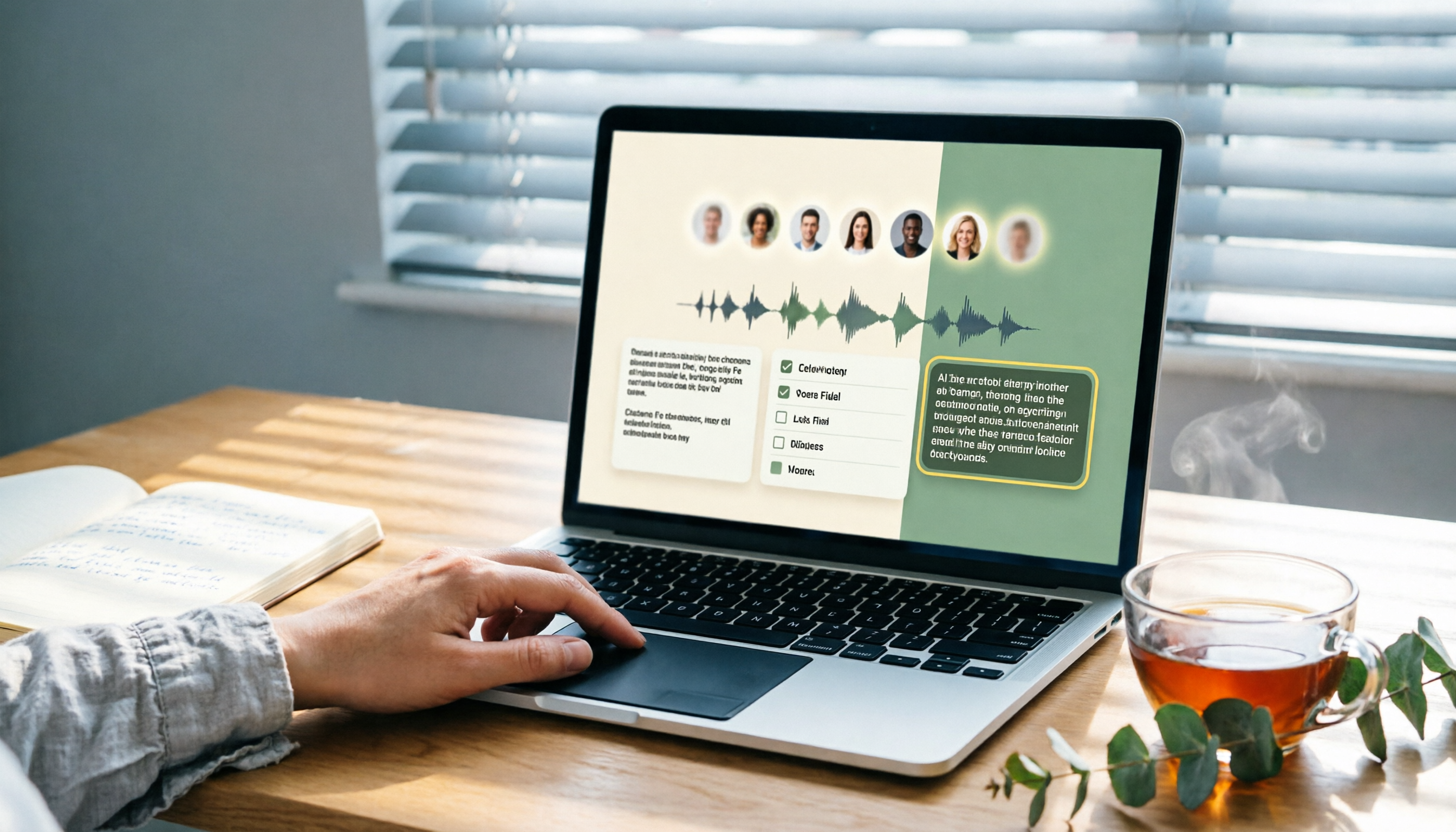
How to Organize Google Meet Meeting Notes in 2026? 5 Steps from Recording to AI Summary
Do meeting notes take too much of your time? This article shows you how to use Tinrec to quickly transcribe recordings, turning Google Meet audio into transcripts, AI summaries, and action items in 5 steps. We also compare Otter, Fireflies, and other tools to help you find the best solution.
2026 AI Meeting Note Tools Compared: Why You Still Need Tinrec After Google Meet's New Features
Google Meet's new built-in transcription and summary features seem sufficient, but our tests show that to truly turn meetings, courses, and interviews into reusable knowledge, you need a more comprehensive tool. This article compares three mainstream solutions and explains why Tinrec is the best choice beyond built-in features.

How to Transcribe Google Meet Recordings in 2026? 5-Step Tutorial with Tinrec
Google Meet's built-in recording is convenient, but its transcription and content organization fall short. This article compares Tinrec and Google Meet's recording across 5 dimensions: transcription accuracy, AI organization, cross-platform export, Chinese support, and post-recording flexibility. Finally, learn 5 steps to turn your meeting recordings into a searchable, queryable database with Tinrec, so you can skip overtime meeting notes.

2026 Best Free Meeting Transcription Tools: 5 Options Compared
A mid-level manager with 15 weekly meetings tested free plans of 5 tools—Tinrec, Otter.ai, Notta, and more—from free quotas to cross-platform and AI features, to save you meeting note time.
2026 Google Meet Recording Alternative: Why More People Are Switching to Tinrec?
If you rely on Google Meet for meetings but need more comprehensive recording-to-text transcription, AI summaries, and cross-platform organization, this article explains why Tinrec is a more complete choice, especially for Chinese-language environments.

Tutorial 2026: Use Tinrec to Organize Google Meet Recordings - Auto-Generate Minutes & To-Dos in One Go
Searching for "google meet latest version number"? Actually, you want an automated way to record meetings? Tinrec can transcribe your Google Meet recordings and automatically generate summaries, to-dos, and minutes. No more overtime typing meeting notes. This tutorial shows you how to use Tinrec to organize all meeting recordings at once.
How to Organize Google Meet Meeting Notes in 2026? A 4-Step Guide to AI Transcription and Summarization
Still using Google Meet's built-in features for meeting notes? Try Tinrec to handle meeting recording transcription, AI summaries, and action items in 4 steps. Make your meeting notes more complete.

Complete Guide to the 2026 Google Meet Logo: Design Changes and Brand Identity Explained
What does the new Google Meet logo look like in 2026? This article takes a student's everyday use perspective, helping you quickly understand the new logo's design changes, identification tips, and display differences across platforms so you never get confused again.

2026 Comparison of 5 Google Meet Alternatives: Why Tinrec Is Better for Meeting Summaries?
Still using Google Meet's built-in transcription? This article compares 5 meeting note tools, analyzing features, language support, and AI summaries, showing why more people are switching to Tinrec for consolidating multi-source audio and video content.