

Turn recordings into transcripts and summaries in minutes
Upload audio or video for multilingual transcription, AI notes, and action items
Tinrec vs Google Meet 2026: A 5-Dimension Showdown for Better Meeting Minutes
Stuck in Google Meet until quitting time? The worst part isn't the meeting itself, it's having to write up the minutes afterward. On Reddit, many office workers complain that Google Meet's built-in recording and transcription features are underwhelming, especially for Chinese and Cantonese, where errors are so frequent you have to replay the recording and type it out. This time, we'll walk you through a real-world workflow using Tinrec (Miao Ting Lu Yin) to handle Google Meet recordings, and compare it side-by-side with the built-in features in a 5-dimension showdown to see which one truly saves you overtime.
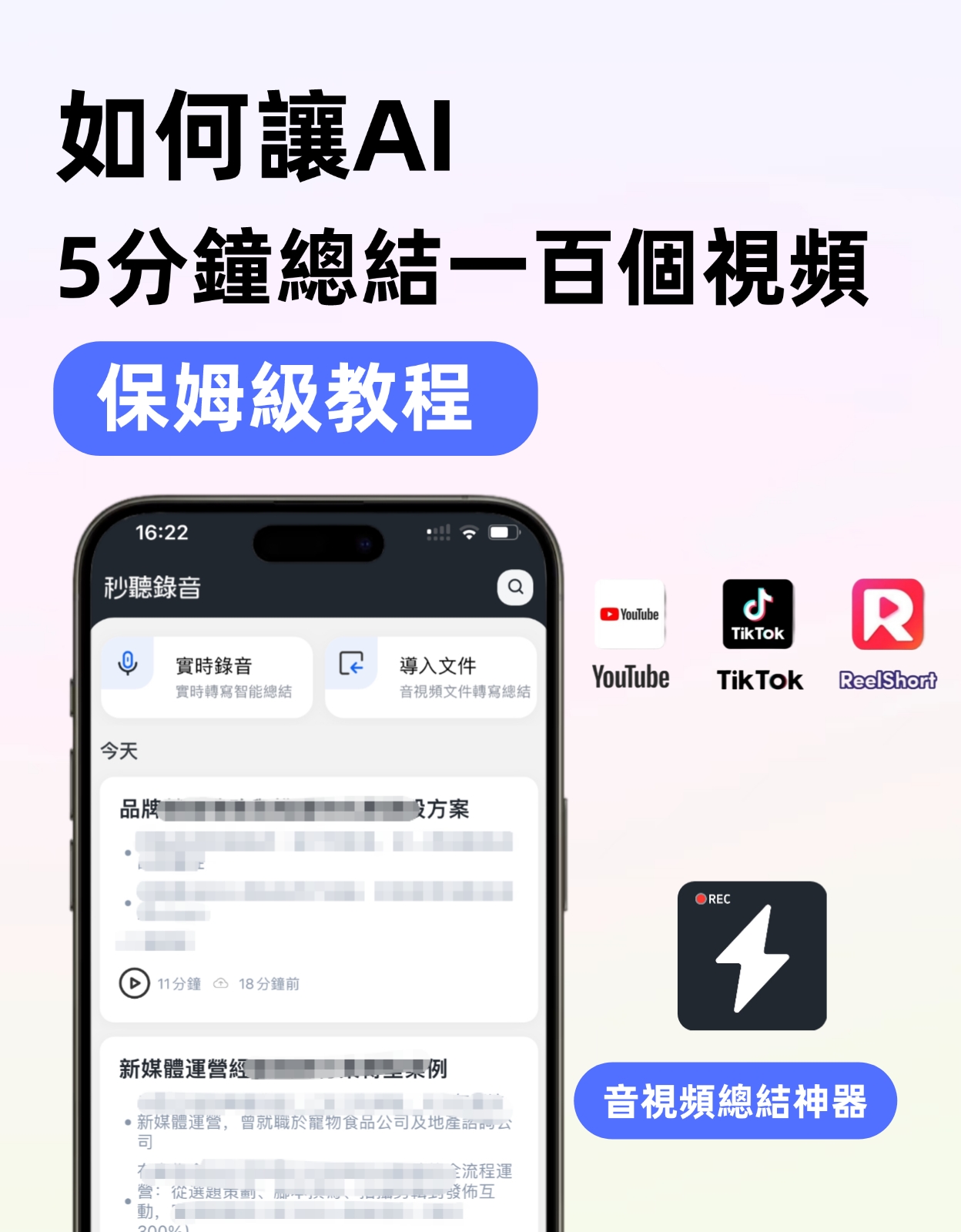
Before You Start | What You'll Need
This test is conducted in a typical Hong Kong office environment. You'll need:
- A computer or phone to host a Google Meet meeting (no plugin required)
- Download the Tinrec App (free on App Store / Google Play, log in with Google or Apple ID)
- A recording of a Google Meet meeting (you can record it yourself, or use Tinrec on desktop to capture Google Meet audio)
- A stable internet connection (transcription requires internet; for offline use, download the Cantonese language pack in advance)
Image: Tinrec supports iOS, Android, and web versions — recording during meetings is seamless.
Step 1 | Record Your Google Meet Meeting
The goal here is to get a clear audio file — the foundation for everything that follows.
During a Google Meet call, open the Tinrec app or web version and tap the record button to start recording in real time. For audio quality, if you're on a computer, we recommend using Tinrec's web version on the same machine; it yields much better sound than recording from a phone speaker. If you must use your phone, place it close to the speaker and minimize background noise.
Why emphasize recording quality? AI transcription accuracy heavily depends on audio clarity. Google Meet's built-in recording often requires setup beforehand and only captures meeting room audio, not manually added files or screen share sounds. Tinrec has no such limitations — it records whatever you need, supports system audio capture, and even records the sound of videos you play.
When finished, you'll see the recording on Tinrec's main screen, showing duration and file size.
Image: One person in an office using Google Meet on a computer while Tinrec records simultaneously.
Step 2 | AI Transcribes to Verbatim Text
Once recorded, it's time for the main event: turning audio into text.
Tap "Transcribe" in Tinrec, and the AI will automatically process it. Wait time depends on recording length, usually a few minutes. The resulting verbatim transcript is auto-paragraphed with timestamps.
Google Meet's built-in transcription exists, but it's primarily for English — not great for Chinese. Even if you select Chinese, it often outputs gibberish. Tinrec supports Cantonese and multiple Chinese variants, even handling mixed Chinese-English, putting it miles ahead.
When done, you'll have a full verbatim transcript with time markers.
Image: Phone screen showing the verbatim transcript generated from the recording.
Stop organizing recordings by hand
Upload audio or video and automatically get a transcript, summary, and action items
Step 3 | Quick Proofreading of the Transcript
Even the best AI makes occasional errors, so proofreading is essential.
Tinrec's proofreading interface is intuitive: you can listen to the recording while editing text. Tap a timestamp, and the recording jumps to that point. For names or technical terms, you can manually add them, and the AI will learn for next time.
Google Meet transcription only allows viewing, not convenient listen-and-edit; any errors cannot be corrected. Tinrec's proofreading workflow saves significant time, especially for long meetings.
Image: Listening to the recording while proofreading the transcript; the phone screen displays a synchronized timeline.
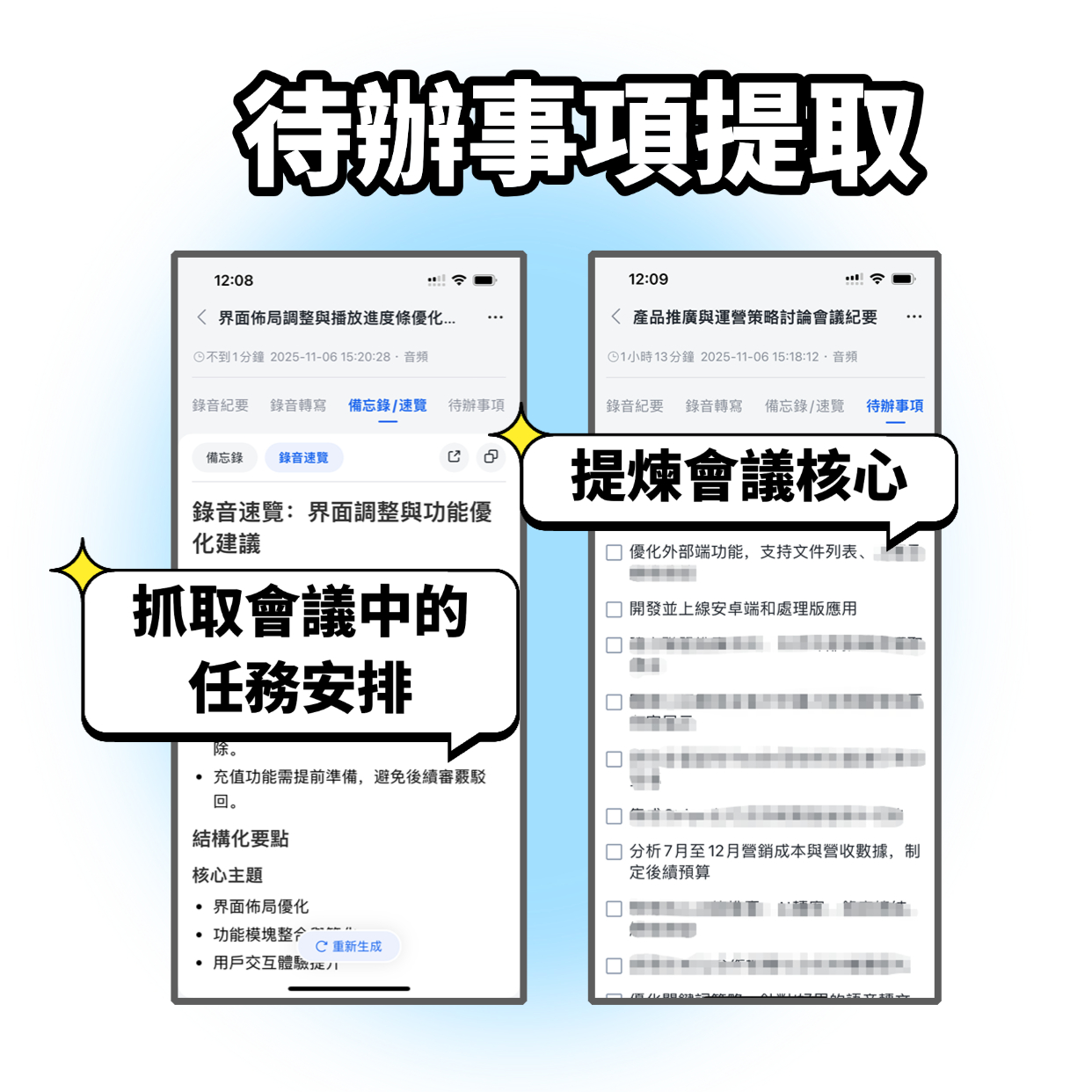
Step 4 | AI Automatically Generates Meeting Minutes
Verbatim transcripts are too long; your boss wants the key points. That's where Tinrec's AI summary and meeting minutes features come in.
From the recording page, select "AI Summary" to automatically generate a summary, chapters, and action items. You can also tap "Generate Meeting Minutes" for a format ready to submit. With Google Meet, you'd have to read through the transcript and type it out manually — at least an extra hour wasted.
More importantly, Tinrec's minutes identify speakers, marking who said what, so you don't end up with a mess of unlabeled sentences.
Image: Automatically generated meeting minutes, showing speakers and action items.
Step 5 | Export and Share
Once your meeting minutes are ready, you'll want to send them to your colleagues.
Tinrec allows exporting verbatim transcripts, summaries, and minutes in PDF, Word, and TXT formats, and can sync to Notion and Google Docs. Google Meet's transcription is only accessible in Google Drive, with limited format options, making editing difficult.
A few taps, and it's sent — no more overtime typing up records.
Image: Multi-format export options; phone screen shows sharing pathways.
FAQ & Troubleshooting
Q: Google Meet already has transcription, why use Tinrec? Google Meet transcription is just raw text output; it's poor for Chinese and lacks summaries, action items, and speaker identification. Tinrec transforms recordings into truly useful meeting minutes, not an error-ridden text file.
Q: Long recordings produce many errors — what to do? This is usually an audio quality issue. Tinrec has built-in smart noise reduction; enable it in settings before recording. If you're importing an existing file, you can manually select the "High Noise Environment" mode — Google Meet doesn't have that.
Q: Multiple people speaking at once — can't tell who said what? Tinrec distinguishes speakers as long as voices aren't completely overlapping; it labels Speaker 1, Speaker 2, etc. Google Meet transcription just outputs a wall of text with no speaker differentiation.
Advanced Tips: 3 Ways to Double Tinrec's Efficiency
1. AI Chat Query: Ask questions about the recording Tinrec has an AI Q&A feature — you can ask "What was the budget mentioned in last week's meeting?" and it will find the exact segment and text. Google Meet can't do that; you're forced to listen from start to finish.
2. Convert Online Videos Client sent you a YouTube video? Paste the link into Tinrec, and it will convert it to text and summary. Google Meet has no such capability; it only works within meetings.
3. Cross-Platform Sync Record on your phone, view the transcript on your computer instantly. Start a meeting on a company computer, continue editing on your iPad at home. Google Meet has cloud sync, but only within meetings.
Alternatives If You Don't Use Tinrec
Honestly, if you only need very simple, non-edited English meeting transcription, Google Meet's built-in feature suffices. But once you need Chinese, summaries, or time savings, it's a different story. Otter.ai is also popular, but it costs money and its Chinese support is mediocre. In the end, Tinrec is the go-to, especially for Hong Kong office workers.
Conclusion
After this head-to-head test, Google Meet's built-in transcription is just not cutting it for Chinese users. Tinrec handles recording, transcription, editing, and exporting all in one, plus it supports Cantonese — saving enough time to leave work half an hour early. Next step: download the free version of Tinrec, try it on one of your Google Meet recordings. There's a free monthly quota good for two or three meetings.
Turn every recording into actionable outcomes
Get 60 free transcription minutes when you sign in. No credit card required.
Related Reading
You might also like

How to Transcribe Google Meet Recordings for New Accounts in 2026: 5-Step Complete Guide
Taking classes or holding meetings with a new Google Meet account? Learn how to quickly transcribe recordings into text. This article covers 5 useful tools, from free to paid, to help you easily extract key points. Student plans and use cases included.

How to Organize Google Meet Meeting Notes in 2026? 3 Steps to Auto-Generate Transcripts and Tasks with Tinrec
Tired of spending time organizing meeting notes after a Google Meet call? Tinrec instantly transcribes your recordings, generates AI summaries and to-dos, and even lets you ask questions to find key points, so you can wrap up in just 5 minutes after the meeting.

The Complete Guide to Google Meet Meeting Notes in 2026: Auto-transcribe, Summarize, and Extract Tasks with Tinrec
This article introduces how to use Tinrec to record recent Google Meet calls, covering recording, transcription, AI summaries, and task extraction, and compares other options to help you find the best meeting notes solution.

2026 Google Meet Meeting Notes Free Tools: 5 Options Compared
Spending hours after Google Meet calls in India transcribing notes? We tested 5 free AI voice-to-text tools. Tinrec stands out with AI问答 and multi-source support, along with alternatives like Otter.ai and Fireflies.

2026 Real-World Test: 4 Best Free Apps for Recording & Transcribing Online Meetings
After a full semester of recording online classes (Google Meet, Zoom, Teams), I found the best free tools that actually work. Tinrec not only transcribes but also generates AI summaries and answers questions—perfect for students.

2026 Google Meet vs Tinrec: A 5-Dimensional Comparison — Which Is Better for Meeting Notes?
Have 15 meetings a week and still spend two hours after each one taking notes? This article compares Google Meet's built-in transcription with Tinrec from a mid-level manager's perspective, covering accuracy, AI summaries, cross-platform support, and pricing to help you choose the real time-saver.
Complete Guide to Google Meet Recording Transcription in 2026: Tinrec Automatically Organizes Meeting Highlights and Action Items
Meetings every day until closing time, and still have to work overtime for meeting minutes? This guide breaks down why more and more people are switching from Google Meet's built-in transcription to AI recording tools like Tinrec. From core features, real-world scenarios to buying tips, see at a glance how to save time and stop staying late at the office.

2026 Comparison of 4 Google Meet Note-Taking Solutions: Save Time Without Paying for an Expensive Plan with Tinrec
Office workers in Central use Google Meet all day, and the worst part is writing meeting minutes afterward. We tested 4 solutions and found that using Tinrec for audio-to-text plus AI organization means no overtime, no expensive plan, and it even handles Cantonese well. Get summaries and action items in 5 minutes. See which one suits you best.

Tinrec vs Otter.ai 2026: 5-Dimension Comparison for Google Meet New Link Meeting Notes
After creating a new Google Meet link, how do you automatically record meeting content? Compare Tinrec and Otter.ai across 5 dimensions: transcription accuracy, AI summaries, Chinese support, multi-platform integration, and pricing. Plus, 4 other tools to help you choose the best meeting note solution.