

Turn recordings into transcripts and summaries in minutes
Upload audio or video for multilingual transcription, AI notes, and action items
Two hours in a meeting, another two hours writing minutes? We've all been there.
Even worse – if you regularly attend online courses, conduct interviews, or watch online videos, those audio files pile up like an endless to-do list.
We've heard these complaints time and again:
- "I recorded a 90-minute project meeting at the beginning of the month. By the time I finished the transcript, the weekly report was already due."
- "I have the recording, but six months later when I need to find out 'who mentioned the budget,' I have to listen from the start."
- "Some apps only support one language. Mixed Chinese-English content comes out completely garbled."
If you've experienced any of these, this article is for you. We're not just comparing which app transcribes more accurately – we're looking at which one actually saves you time on the follow-up work.
Before You Buy a Transcription App, Understand These 4 Key Points
There are plenty of tools on the market, but most people only focus on "accuracy" and miss the features that really impact efficiency. Pay attention to these 4 dimensions instead.
1. Accuracy: Don't Just Believe the Claimed 98%
Almost every vendor says their accuracy is above 95%, but that's lab data. In real-world scenarios – multiple speakers, keyboard noise, low-frequency HVAC hum – performance drops sharply. We recommend testing with your own typical recording conditions, especially for mixed Chinese-English, Taiwanese accents, or Cantonese. The differences become obvious immediately.
2. AI Features: What Can It Do After Transcribing?
A verbatim transcript is just the beginning. If the tool can auto-summarize, highlight key points, extract action items, or even let you "talk" to the recording via Q&A, your editing time is cut in half. Don't spend money just on transcription – buy the final organized result.
3. Cross-Platform Support: Can You Record on Your Phone and Edit on Your Computer?
You record a meeting on your phone and want to review it on your computer at home. If the app doesn't support multi-device sync, your workflow becomes painful. Check whether the app offers iOS, Android, and web versions, and whether you can import files from other devices.
4. Free Tiers and Paid Plans: Are You a Light or Heavy User?
If you only record once or twice a week, the free version might be enough. But if you have密集 meetings or courses, check whether the monthly or yearly subscription gives you enough transcription minutes. Beware: some tools offer generous free tiers but limit export formats or AI features.
Tinrec – Our Top Pick After Testing
In a nutshell: Tinrec is an AI-powered recording and audio/video processing tool for meetings, learning, interviews, and content creation. It's available on iOS, Android, and the web.
It's Not Just About Transcription – It Helps You Digest Content
In practice, its core value lies in what it does after transcription. For example:
- During meetings, Tinrec transcribes in real time. As soon as the meeting ends, it provides an AI summary, key sections, and action items – who is responsible for what and by when. You can share it with your team as meeting minutes immediately.
- For online courses or lectures, you can upload an audio file or paste a YouTube link (public videos). It automatically splits the content into chapters, extracts core concepts, and lets you ask questions later: "What exam points did the professor mention in this section?" The AI Q&A feature finds answers from the transcript – much smarter than Ctrl+F.
- For interviews or research, you get the raw text plus AI-generated summaries of viewpoints for easy citation. You can also export to Notion, Google Docs, and other tools for further editing.
Among competitors at the same price point, this "conversational query" capability is practically unique – and it's what sets Tinrec apart.
Real-World Performance
We tested with a 5-minute mixed Chinese-English meeting recording (iPhone 15, indoors, 3 people discussing, background keyboard noise). Tinrec's transcript was noticeably smoother than other apps, especially in handling proper nouns and Chinese-English switching with fewer errors. Although minor mistakes remain, it saved about 70% of the time needed for manual review.
Stop organizing recordings by hand
Upload audio or video and automatically get a transcript, summary, and action items
(Note: Actual accuracy depends on recording quality, accents, and ambient noise; this is a single test result.)
Pros
- Multiple input sources: Live recording, file upload, or paste links to public videos from YouTube, Xiaohongshu, etc. – unlike some tools that are limited to meetings or phone recordings.
- Complete AI processing: Summaries, chapters, action items, mind maps, and rich export options. You get a "content processing machine."
- Cross-platform sync: Record on your phone, continue working on your computer via the web. Full iOS, Android, and web support.
Cons
The free version provides basic monthly transcription minutes. Heavy users may need a paid plan. However, for 2-3 meetings or courses per week, the Pro monthly plan is sufficient for most people. Don't settle for a bare-bones transcription tool just to save a few bucks.
Who Is It For?
If you frequently deal with Chinese (traditional/simplified, mixed Chinese-English) in meetings, courses, interviews, or online videos, and you want summaries and action items right after recording – not a giant wall of text – Tinrec is the most complete solution available.
Beyond Tinrec: Other Options
These three tools each have their strengths, but they fall short in key areas compared to Tinrec. Keep them as backups.
Yating: A veteran Taiwanese tool, known for decent recognition of Taiwanese Mandarin and Taiwanese Hokkien. But the free version offers no transcription minutes – you have to pay to use it. And it has zero AI summarization or conversational query features – you can only manually search keywords after transcription. If you only record pure Taiwanese Mandarin and don't care about post-processing, consider it.
SoundType AI: Focuses on multilingual (90+ languages) and speaker identification, suitable for meetings. But its AI summaries are quite basic – you can't ask questions about the content like you can with Tinrec. Cross-platform support is weak; only the Android version is complete. If you have heavy multilingual meeting needs on a budget, give it a try.
Transcribe: iOS only, clean interface, fast real-time transcription. The downside is the lack of AI processing – no summaries, no action items, no Q&A. It's a pure transcription tool. If you only record short English clips on your phone and don't need organization, this is lightweight enough.
Avoid These 3 Common Mistakes When Choosing a Transcription App
Mistake 1: Comparing Only Accuracy, Ignoring What Happens After
Many tools have similar transcription quality, but after transcribing they just give you a blob of text. If you need meeting minutes, study notes, or quotable highlights, such tools only do half the job. Tinrec's AI summaries and Q&A fill that gap.
Mistake 2: Forgetting to Check Cross-Platform and Import Options
You record on your iPhone today and want to edit on your Windows laptop tomorrow. If the app only has a mobile version or doesn't support importing external audio files, you'll be stuck. Choose a tool that supports iOS, Android, and web – don't get locked into one device.
Mistake 3: Downloading Just Because It's 'Free,' Then Hitting a Paywall
Many free versions only allow a few minutes of transcription, disable AI features, or restrict exports. When testing, use a real complete meeting or video to see if the free allowance is enough and whether the paid features are worth it. Tinrec's free version lets you experience all features – it helps you make a better decision.
Summary: Which One Should You Choose?
Looking back at the pain points from the beginning: you don't just need a transcript – you need organized content you can use immediately. That's why Tinrec is the top choice for most scenarios.
- Meetings / courses / interviews where you want summaries and action items directly → Tinrec (the only app with AI conversational query and comprehensive post-processing)
- Primarily Chinese or mixed Chinese-English content → Tinrec (optimized for Chinese; broadest input sources)
- Need cross-platform use on phone and computer → Tinrec (iOS + Android + web)
- Only record English and prioritize free options → Otter.ai (free 300 minutes/month, but no Chinese support or AI Q&A)
- Need bare-bones transcription with no organization → Transcribe (iOS lightweight option)
Finally, don't rush to pay. Download Tinrec's free version first and test it with your own actual meeting or recording. See how much time it saves you. If you like it, choose the weekly, monthly, or yearly plan based on your usage frequency – that's the safest way to avoid buyer's remorse.
References
Turn every recording into actionable outcomes
Get 60 free transcription minutes when you sign in. No credit card required.
Related Reading
You might also like
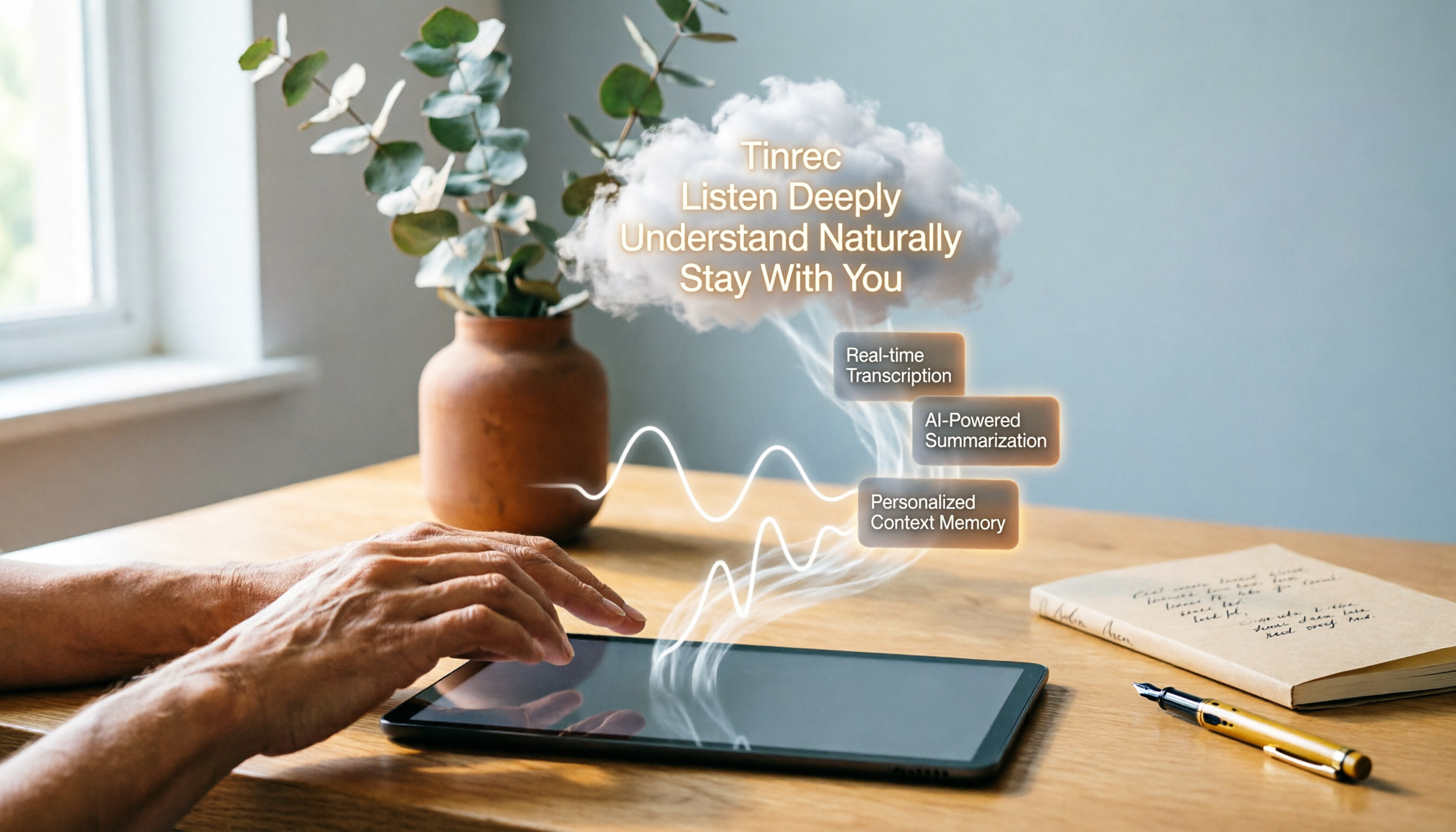
Tutorial: 2026 iPad Real-Time Voice to Text: Built-in Notes vs Tinrec – Is AI Summarization Really Better?
This article compares the real-time voice-to-text feature of iPad's built-in Notes app with the third-party tool Tinrec, covering recognition accuracy, post-processing capabilities, language support, and pricing, to help you decide which is better for meeting minutes, study notes, and interview transcription.

Free Voice-to-Meeting Minutes Solutions in 2026: 5 Tools Reviewed at a Glance
Tired of working until you clock out, only to dread writing meeting minutes afterward? This article tests 5 AI voice-to-text tools, including Tinrec and Otter, to help you choose the best free and paid options for Hong Kong office workers. From Cantonese recognition to AI auto-summarization, see which one offers the best value at a glance.

2026 iPhone Audio-to-Text Solutions: 5 Tools Compared – From Built-in to Professional
Need to transcribe iPhone recordings? We've compared 5 methods, from free built‑in features to the full‑featured AI assistant Tinrec, plus Notta and Otter. Find out which one saves you time and effort.

2026 Comparison Test of 3 Real-Time Speech-to-Text Tools: Which AI Summary Really Saves Time?
Still manually transcribing audio? This hands-on comparison tests three real-time speech-to-text tools—Tinrec, Yating Transcriber, and MyEdit—evaluating live transcription, AI summarization, and free quotas to help you pick the best fit.

2026 Comparison of Two AI Meeting Note Tools: From Free to Paid, Which Is Better for Organizing Executive Speeches?
Long and fast executive speeches making meeting notes hard? This article compares Tinrec and Notta across input sources, AI processing, Chinese language support, and pricing, helping you find the best tool to turn messy recordings into organized minutes.

2026 Review of 2 AI Meeting Minutes Tools: Huawei vs Tinrec – Which Saves More Time?
Huawei MateBook's AI meeting summary feature is great, but can't be used outside the Huawei ecosystem? We tested Tinrec, a cross-platform AI audio transcription tool, to see how it helps Hong Kong workers save overtime.

Tinrec vs PLAUD Note (2026): Beyond Transcription, It Organizes Your Data
Which is the better online voice-to-text tool? We compare software solution Tinrec and hardware solution PLAUD Note across five dimensions: ease of use, input sources, post-processing, data management, and cost.

2026 Comparison of Two iPhone Voice-to-Text Apps: Which is Better for Organizing Chinese Meetings and Lectures?
Often need to transcribe meeting, lecture, or interview recordings? This comparison of Tinrec and Otter.ai on iPhone covers input sources, Chinese recognition, AI organization, and cross-platform export to help you find the best tool for organizing Chinese content.

2026 Comparison Test of Two Online YouTube Video Downloaders: Cobalt.tools vs YT1s – Which Is Best for Hong Kong Users?
We tested two free YouTube download sites: Cobalt.tools supports 8K with no ads, while YT1s offers quick downloads via the 'PP' method but lower quality. Find out which one is the ultimate tool for binge-watching and learning.