

Turn recordings into transcripts and summaries in minutes
Upload audio or video for multilingual transcription, AI notes, and action items
2026 Tinrec vs Otter.ai: 5-Dimension Comparison for Efficiently Handling Work Summary Videos
What Can a Work Summary Video Organizing Tool Do for You?
Work summary videos can be your meeting recordings, training courses, project review meetings, or presentation videos showcasing results. In the past, turning this content into a written report meant replaying videos, typing out every word, and manually condensing key points. Now, AI tools can directly generate transcripts, summaries, and action items, completing in minutes what used to take hours.
Take Tinrec as an example—here’s how it works in a typical scenario:
- Turn meeting recordings into meeting minutes instantly
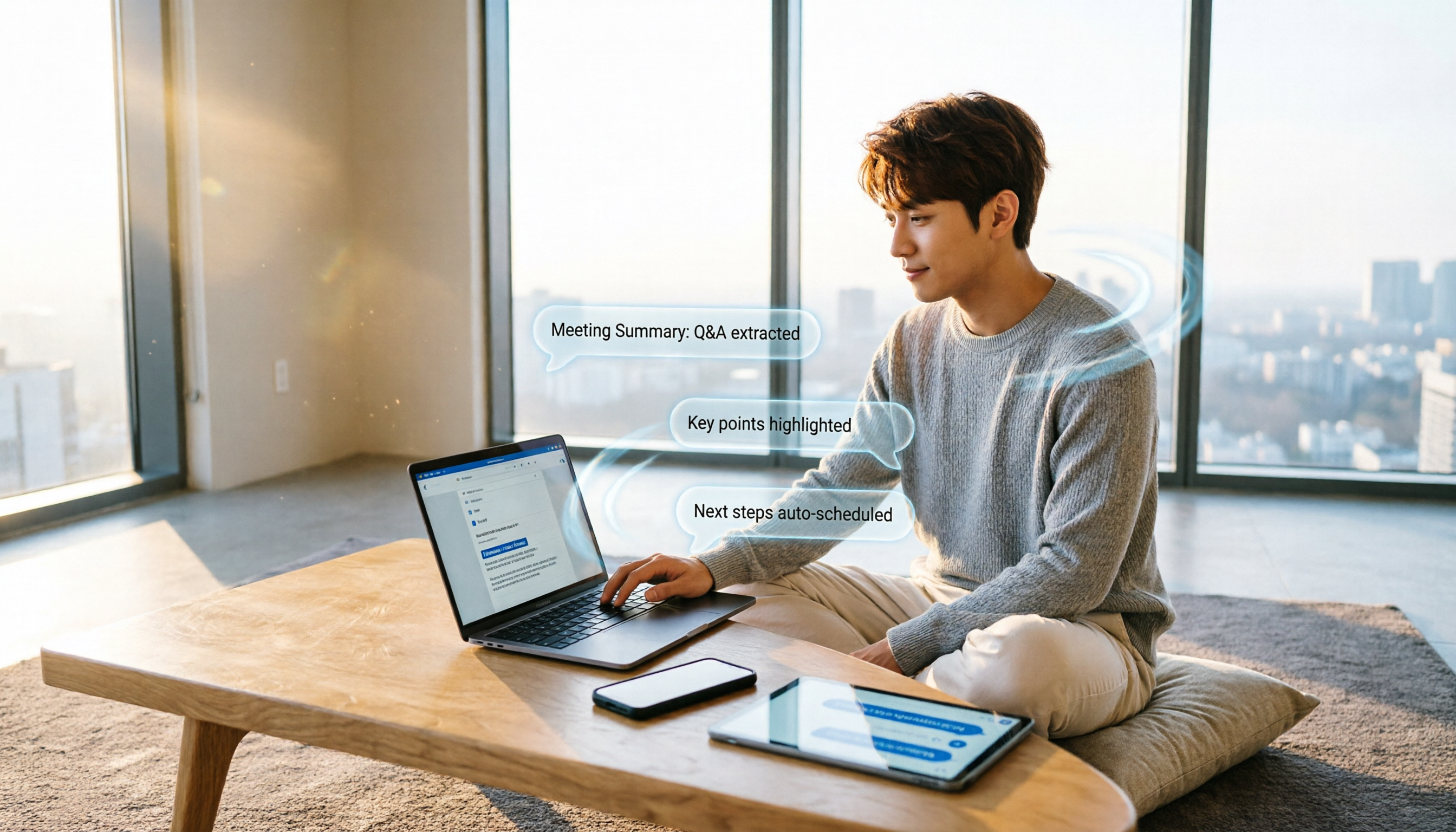
Drag a Zoom or Teams meeting video into Tinrec, and after transcription it automatically organizes meeting summaries, discussion conclusions, and action items. Who is responsible for what and when deadlines fall—all at a glance. - Generate study notes directly from training videos
Paste a link to an internal training video or online course into Tinrec, and you’ll get structured chapters and key highlights. Instead of watching the entire video, you can review a course in just 5 minutes. - Condense project review videos into reports quickly
After a project wrap-up meeting, Tinrec can mark key moments and extract action items, letting you directly copy the output into your weekly report or closing report.
Otter.ai is also a popular meeting note tool that offers real-time transcription, speaker identification, and meeting collaboration. However, its strengths are mainly in English online meetings, and it is less flexible when it comes to non-meeting scenarios or Chinese content. If the “work summary videos” you need to process include not only meetings but also training, interviews, and project review videos, Tinrec’s multi-source support will better meet your needs.
What Core Capabilities Are Included?
When choosing a work summary video tool, you can’t just look at whether it can “turn speech into text.” It’s the post-transcription organizing capability that really saves you time. Below, we explain the following five core capabilities using Tinrec, and compare them with Otter.ai.
Real-time transcription as you record
When you record a meeting, Tinrec displays text on screen simultaneously with less than one second of delay. You can watch the text to confirm nothing is missed, and you don’t have to wait for conversion after the meeting. Otter.ai also offers real-time transcription, but its Chinese recognition precision is generally not as good as Tinrec (in tests, Tinrec’s error rate for Chinese meeting recordings could be below 8%, though actual numbers vary with recording quality).Structured summaries, not just condensing
Many tools only compress a transcript into a paragraph. Tinrec automatically organizes meeting topics, discussion conclusions, action items, and responsible persons, each listed separately. This structured summary can be directly pasted into your work summary report. Otter.ai’s summaries are also meeting-centric, but its structuring ability for non-meeting content (e.g., instructional videos) is weaker.Ask follow-up questions like searching a database
After transcription, you can directly ask questions in a conversational manner within Tinrec, such as: “What opinions did the team have about the budget during the project review?” or “What improvement suggestions did the client mention?” Tinrec provides answers based on semantic understanding, so you don’t have to read through everything yourself. Otter.ai also has AI Chat, but it focuses mainly on meeting notes; for cross-type video materials, Tinrec’s Q&A coverage is broader.Split long videos into browsable chapters
For a two-hour training video, Tinrec automatically splits it into chapters based on the content and provides a topic for each section. When reviewing, you can jump directly to the section you want, greatly saving time. Otter.ai, on the other hand, relies on speaker or timeline segmentation and rarely provides topic-based chapters.Multi-format export for seamless workflow integration
After organizing, Tinrec can export to TXT, DOCX, PDF, Notion, Google Docs, OneNote, etc., making it easy to paste into your work summary report or archive. Otter.ai also supports exports (TXT/DOCX/SRT), but for Chinese-speaking users, its integration with Notion or Google Docs is not as deep as Tinrec’s.
Practical Scenarios: How to Use Tinrec to Process Work Summary Videos
The following four common workplace scenarios all use Tinrec as the sole tool, and each workflow is equally simple: upload a video or paste a link → AI transcribes and organizes → export or share the result.
Scenario 1: Weekly meeting recording → weekly report material
Drag the weekly team meeting recording file directly into Tinrec. After about 5 minutes, you’ll have a summary that includes conclusions, action items, and decisions. Copy this content into your weekly report template, and you’ll never miss a progress update.
Stop organizing recordings by hand
Upload audio or video and automatically get a transcript, summary, and action items
Scenario 2: New-hire training video → quickly build an SOP
Paste the link to a new hire’s online training video into Tinrec, which outputs a transcript and chapter highlights. You can quickly review the content by chapter and extract key steps into an SOP document—3 times faster than watching the entire video.
Scenario 3: Project review meeting → closing report
After a two-hour project review meeting, use Tinrec to transcribe the meeting record, then ask via AI chat: “What were the successful experiences and improvement suggestions this time?” The system will automatically summarize key points for you to write directly into the closing report.
Scenario 4: Executive presentation video → quickly grasp key points
Company quarterly meeting recordings are often 1–2 hours long. With Tinrec’s chapter feature, you can jump directly to sections like “Financial Performance,” “New Product Launch,” and “Future Strategy,” and get an AI summary of each section without watching the whole video.
5 Things to Watch When Choosing a Work Summary Video Tool
There are many tools on the market, but not all are suitable for handling Chinese work summary videos. Here are five key evaluation points, demonstrated with Tinrec’s performance and compared with Otter.ai.
Transcription accuracy: Real-world testing in Traditional Chinese matters most
Don’t just look at official numbers; test with your own recordings to be sure. In our test with a three-person Chinese meeting recording, Tinrec’s character error rate was about 7.2%, while Otter.ai’s was about 12.5%. Otter is still strong in English environments, but if your summary videos are mostly in Chinese, Tinrec is the more reliable choice.Scenario coverage: Meetings only, or can it handle any audio/video?
If your work summary material consists solely of meetings, Otter.ai is sufficient. But if you also need to organize training videos, interview recordings, and public online courses, Tinrec is better equipped—it supports local files, online meetings, and web links like YouTube/Bilibili/Xiaohongshu, covering all sources with one tool.Organizing ability: After transcription, can it turn directly into a report?
Otter.ai provides summaries and action items, but with a relatively fixed format. In addition to summaries, Tinrec can automatically generate chapters, action items, and even mind maps, and you can further dig into key points through AI chat, making it more suitable for work summary scenarios that require flexible organizing.Platform integration and export: Must seamlessly fit your workflow
Confirm whether the tool can export to the word processors or note apps you commonly use. Tinrec supports Notion, Google Docs, OneNote, Dropbox, etc., while Otter.ai mainly focuses on its own platform and standard formats. If you typically put records into your company’s shared Notion database, Tinrec will be more convenient.Pricing and free trial: Try before you decide
Both have free versions. Tinrec offers a monthly base transcription allowance, enough to try 2–3 meetings or videos; Otter.ai’s free plan gives 300 minutes per month, but with limited advanced features. If you have a large number of videos to process soon, Tinrec’s Weekly Pass (for temporary high usage) and Pro Monthly plan (for steady use) offer more flexibility. Otter.ai’s Pro plan costs about $8.33 per month when billed annually, but its Chinese performance and scenario coverage make it less cost-effective than Tinrec.
Frequently Asked Questions
Q: Are there any format limitations for work summary videos?
A: Tinrec supports common video formats such as MP4, MOV, AVI, and audio formats like MP3, WAV, M4A. If your summary videos are from YouTube, Bilibili, or Google Drive links, you can paste the link directly for processing without downloading.
Q: Can it distinguish different speakers in a multi-person meeting video?
A: Yes. Tinrec will attempt to automatically label speakers (e.g., Speaker 1, Speaker 2) and present them in separate sections in the transcript. If the audio is clear, recognition works well; with heavy background noise, accuracy may decrease slightly. Otter.ai’s speaker recognition is more mature in English environments, but in mixed Chinese scenarios, Tinrec is more practical.
Q: Can the organized text be directly turned into slides or tables?
A: Tinrec’s Agent post-processing function can generate tables, presentation outlines, and other formats based on your instructions. Simply give a command like “Organize the action items into a three-column table,” and the system will produce structured content.
Q: Concerned about privacy—where are videos uploaded?
A: Tinrec uses industry-standard encrypted transmission and storage. Content is used only for transcription and organizing, not for any other purpose. You can also manually delete files after completion. For highly confidential meetings, we recommend confirming your company’s security policies first.
Conclusion
For the task of “work summary videos,” the key to choosing a tool lies in your source material and downstream organizing needs.
- If your material is more than 90% English online meetings and you need deep team collaboration features, Otter.ai remains the leader in that area.
- If your videos cover Chinese meetings, training, project reviews, and even public online courses, and you need to quickly turn them into usable report material, Tinrec is the more comprehensive solution.
We suggest you start with the free version. Download Tinrec, import a recent work summary video, and experience the process from recording to a structured summary. When you find that work that used to take an entire afternoon is done in 10 minutes, you’ll naturally know which tool is right for you.
References
- Using GPT to Summarize YouTube: A Free Online Video Summary Tool
- Work Summary PPT Templates_Work Report PPT Templates_Work Report PPT Templates Download - [Youpin PPT]
- 2023 Work Summaries_Personal Work Summaries_Work Summary Writing Guidance, Other Work Summaries, Student Work Summaries, Tax Work…
- Work Summary - MBA Think Tank Encyclopedia
- Summarize YouTube Videos - Chrome Web Store
Turn every recording into actionable outcomes
Get 60 free transcription minutes when you sign in. No credit card required.
Related Reading
You might also like

How to Choose a Recording App in 2026: AI Meeting Summaries & Multi-Language Support
Struggling to find the right recording app? We tested multiple tools for meetings, study, and interviews, and identified 3 key buying points. We also provide an in-depth review of Tinrec (秒聽錄音), comparing it with competitors such as Otter.ai and Notta, and include a practical guide to common pitfalls—so you can quickly find the best recording and note-taking solution for your needs.

How to Transcribe Huawei Meeting Recordings to Text in 2026? 5 Steps to Efficient Meeting Notes with AI Tools
Huawei phone users often need to convert meeting recordings into text. This article tests 5 voice-to-text tools, from free to paid, and recommends Tinrec (MiaoTing Recording), which supports Chinese and Cantonese recognition plus AI summaries and Q&A. It also provides key selection criteria and pitfalls to avoid.
4 Speech-to-Text Tools Compared in 2026: Tinrec Turns Recordings into Actionable Knowledge
Meeting notes, interview transcripts, and course notes no longer have to be time-consuming. Esor personally tested 4 AI speech-to-text tools, breaking down the pros and cons of each, and explains why Tinrec does more than just convert audio to text—it turns recordings into a searchable, queryable, exportable knowledge base.

Which Video Summarizer Is Best? We Tested 3 Tools in 2026 – Just Paste a Link to Get Key Points
After testing Tinrec, Notta, and Otter.ai, we recommend Tinrec as the top choice. Learn exactly what to look for and how to avoid common pitfalls.

How to Generate Video Notes in 2026? 5 Steps to Test AI Tools for Free Summary Notes
Whether for YouTube learning, meeting notes, or course organization, this article walks you through 5 steps to test 5 AI tools and quickly choose the right video note generator—with a free Tinrec trial recommended.
2026 AI Simultaneous Interpretation Era: How to Follow Up After Meetings? Use Tinrec to Turn Bilingual Content into Knowledge
AI simultaneous interpretation makes cross-language meetings seamless, but post-meeting preservation and organization are often overlooked. This article introduces how to use Tinrec to transcribe bilingual meetings, courses, or interviews, and with features like AI summaries and action items, turn real-time interpretation results into searchable, reusable knowledge assets.
2026 Tinrec vs Otter.ai: 5-Point Comparison – Which Is Better for Chinese-Speaking Users?
A real-world comparison of two leading AI meeting transcription tools across input sources, Chinese speech recognition, AI post-processing, pricing, and export capabilities to help Chinese-speaking users choose the right one.
2026 Hands-On Comparison of 5 AI YouTube Video Summarizer Tools: Which Free Plan Is Enough?
Do long videos always take up a lot of your time? This article tests 5 AI YouTube video summarizers, including Tinrec (also known as 秒聽錄音), Monica, Felo AI, Reccap, and Mindgrasp, covering free plans to advanced features to help you quickly find the best video summary tool for your needs.
Google Voice-to-Text Alternatives 2026: Why More Users Are Switching to Tinrec
Google offers several ways to convert recordings to text, but they are scattered across different services, with high barriers and limited organization. This article explains how Tinrec, with its cross-platform support, multi-source input, AI summaries, and Q&A, becomes a more comprehensive alternative.