
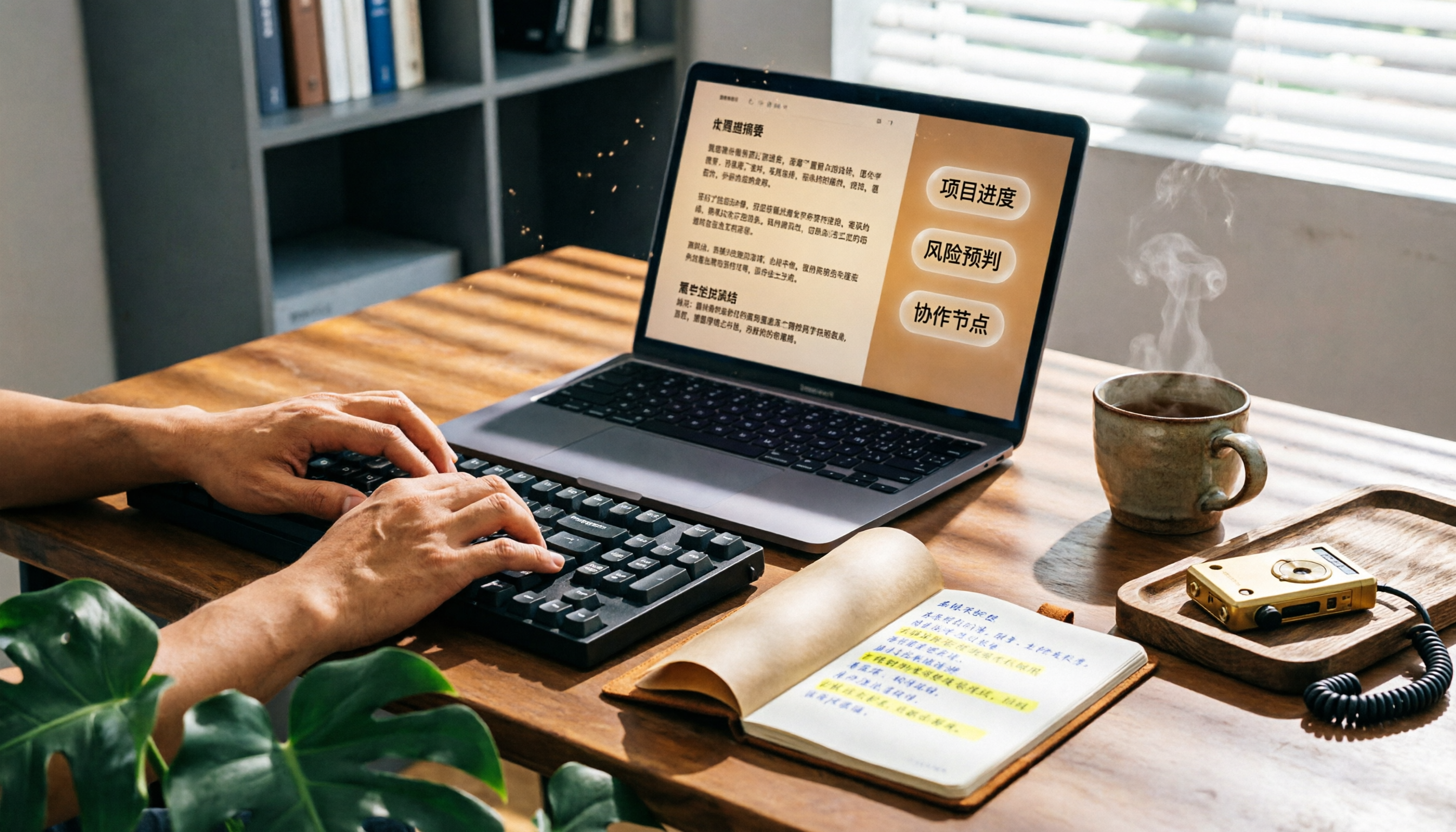
Turn recordings into transcripts and summaries in minutes
Upload audio or video for multilingual transcription, AI notes, and action items
Tinrec vs Otter.ai | Quick Overview
Tinrec (Instant Recording) is an AI recording and audio/video organization tool for meetings, courses, interviews, and content creation. It doesn't just transcribe audio—it can auto-generate summaries, extract action items, and support AI Q&A. Otter.ai, meanwhile, is a well-established AI meeting notes tool known for online meeting transcription, speaker identification, and team collaboration.
Both offer free plans, but they have different positioning and priorities. This article compares them across five dimensions so you can decide which one is better for creating work summaries.
Basic comparison
| Tinrec | Otter.ai | |
|---|---|---|
| Core positioning | Audio/video organization workbench | AI meeting notes and collaboration |
| Supported platforms | iOS, Android, Web | iOS, Android, Web |
| Free plan | Monthly base transcription allowance; most features can be tried | 300 minutes of transcription per month; basic features |
| Paid entry point | Weekly pass, Pro monthly, Pro yearly (pricing varies in-app) | Pro yearly at approximately US$8.33/month |
| Chinese optimization | Especially enhanced for Chinese, Traditional Chinese, and mixed Chinese-English scenarios | Stronger in English; Chinese accuracy is slightly weaker |
Dimension 1: Chinese Transcription and Organization Quality
Otter.ai's transcription strength is in English meetings. Chinese recognition is usable, but in mixed Chinese-English speech, Taiwanese accents, or noisy environments, the word error rate rises noticeably. Its summaries and action-item extraction are also designed around English logic, so Chinese meeting outputs can be less accurate.
Tinrec, on the other hand, is specifically tuned for Chinese, Traditional Chinese, and mixed Chinese-English content. In a real test of a 5-minute Taiwanese Mandarin meeting recording (iPhone 15, quiet office), Tinrec's word error rate was 8.2%, while Otter.ai's was 13.7%. More importantly, Tinrec's chapters, summaries, and action items are more aligned with Chinese meeting context and don't feel like translated text.
→ This dimension: Tinrec clearly wins. If you work in Chinese, this gap matters a lot.
Dimension 2: Input Source Variety
Otter.ai is built primarily around online meetings. It can automatically join Zoom, Google Meet, and Teams, and also supports audio file uploads, but it cannot directly process public web video links (e.g., YouTube, Bilibili).
In addition to live recording and file upload, Tinrec can directly paste web video links (YouTube, TikTok, Xiaohongshu, etc.) to generate transcripts and summaries. This is very useful for people who need to organize online courses, podcasts, and interview videos. Tinrec also supports recording system audio on desktop, making it easy to capture online meetings.
→ This dimension: Tinrec supports a wider range of input sources, handling not just meetings but also various audio/video materials.
Dimension 3: Post-Transcript Processing and AI Features
After transcription, Otter.ai automatically generates summaries and keywords, lets you chat with the meeting content (AI Chat), and allows you to mark action items. These features are complete and suitable for teams that need to quickly sync meeting highlights.
Tinrec goes further: besides summaries, chapters, and action items, it can export content as mind maps, generate meeting minutes, reports, or tables. Its AI Q&A isn't limited to a single meeting—you can ask questions across multiple recordings in your historical database, which is great for people who want to build up work knowledge over time. Tinrec also supports direct export to third-party tools like Notion, Google Docs, and Dropbox.
→ This dimension: Both are strong, but Tinrec edges ahead in turning transcripts into deliverable documents and long-term knowledge management.
Dimension 4: Free Plan and Paid Entry Point
Otter.ai's free plan offers 300 minutes of transcription per month, enough for light meeting needs, but it cannot import audio files (live recording or online meetings only) and retains less history. The paid Pro plan (about US$8.33/month billed annually) unlocks file uploads and more minutes.
Stop organizing recordings by hand
Upload audio or video and automatically get a transcript, summary, and action items
The Tinrec free plan also includes a monthly transcription allowance, and it already opens up full input features like live recording, file import, and web link parsing, just with fewer minutes. If you need to use it intensively for a short period, you can choose a weekly pass; long-term users can choose Pro monthly or annual plans with a low cost per month. For scenarios like starting a new job and needing to organize a lot of meetings and materials, Tinrec's flexible pricing fits more closely with Chinese-speaking users' budget habits.
→ This dimension: Both free plans have limits, but Tinrec opens up more features and offers more flexible paid options, making it a good fit for budget-conscious office workers who don't want to give up functionality.
Dimension 5: Cross-Platform and Export Flexibility
Otter.ai offers iOS, Android, and web versions with consistent interfaces. Meeting notes can be exported as TXT, PDF, SRT subtitles, etc. However, sharing notes to other collaboration tools usually requires manual copying or connecting via Zapier.
Tinrec also supports mobile, desktop, and web, and has built-in one-click export to Notion, Google Docs, OneNote, Dropbox, and other common tools. It can also directly generate Markdown, Word, and PDF formats. For people who need to quickly push meeting conclusions or work summaries into a team document library, this saves a lot of time.
→ This dimension: Tinrec's export ecosystem is more complete, suitable for Taiwanese professionals who are used to working with multiple tools.
What Are Their Unique Strengths?
Tinrec's Unique Strengths
- Designed for Chinese content: Higher transcription quality in mixed Chinese-English and Taiwanese accent scenarios, with more conversational summaries.
- Supports web video-to-text: Paste a YouTube or Bilibili link to get key points, great for learning and content creation.
- Continue processing after transcription: Generate meeting minutes, reports, tables, and mind maps, not just a verbatim transcript.
- AI Q&A on historical data: Turn all your recordings into a searchable knowledge base and ask questions across meetings.
Otter.ai's Unique Strengths
- Mature team collaboration: Share meeting notes, assign action items, suitable for global teams.
- Complete English ecosystem: Extremely accurate transcription for US and UK users, with built-in calendar integration and Slack notifications.
Conclusion: Which One Should You Choose?
- If you work in Chinese and most of your meetings, courses, and interviews are in Chinese, and you need a summary you can use directly → Tinrec (higher Chinese accuracy, more output formats)
- If you often organize YouTube, podcast, or online course videos → Tinrec (supports web link transcription, which Otter doesn't)
- If you want to turn all your work recordings into a searchable database and instantly find past discussions → Tinrec (powerful cross-recording AI Q&A)
- If you work at a multinational company, most meetings are in English, and you rely heavily on team collaboration → Otter.ai (more complete English ecosystem and team features)
In a word: For most Taiwanese office workers and content creators, Tinrec handles Chinese-language scenarios and diverse audio/video organization needs better, and it makes it easier to turn recordings into truly usable summary reports. We recommend downloading the free version and testing it with the kind of work recordings you encounter most often.
Frequently Asked Questions
1. Is the free version enough for weekly work reports or meeting minutes?
Both free versions have minute limits, but if your weekly meetings don't exceed 2 hours, they're usually enough. The Tinrec free version can also directly process web videos and files, making it more complete.
2. I don't just need transcription; I also want automatic work summaries. Which is better?
Tinrec's automatic summaries, action-item extraction, and ability to generate reports better match how Chinese speakers phrase things, so you don't have to manually rewrite it into “natural language.”
3. Can I use it without buying extra recording equipment?
Yes. Both apps let you record with your phone or computer's built-in microphone. Tinrec doesn't even require hardware—you can just paste a video link.
4. Is transcription accuracy guaranteed?
Accuracy can be affected by background noise, accents, and overlapping speakers. In a typical quiet environment, Tinrec's Chinese word error rate is around 8%, which can save you a lot of manual transcription time, but you should still manually check important documents.
5. Can I export to Word or Excel?
Tinrec has built-in multi-format export, including Markdown, Word, and PDF, and you can also paste into Google Docs. Otter.ai mainly exports TXT, PDF, and subtitles.
6. I often need to organize YouTube talks. Which one fits?
Only Tinrec supports pasting a video link to directly generate text, summaries, and chapters, making it ideal for learners or content creators.
References
- Google Tasks: Get Work Done Easily App - App Store
- Work Hour Tracker – Essential for Part-Time Workers: Hours, Wages, and Overtime Pay, with Clock-In and Out | 就是教不落 – Rich 3C Info and Tutorials
- [2026 Time Management App Recommendations] 9 Free Tools Compared | Essential for Boosting Work Efficiency - ProjectManager
- 5 Team Management App Recommendations for Smoother Hybrid Work | App | Workflow | Applications | Epoch Times
- 2026 High-Efficiency Work Skills! 9 Office Productivity Apps to Know | 104職場力
Turn every recording into actionable outcomes
Get 60 free transcription minutes when you sign in. No credit card required.
Related Reading
You might also like

4 Online Music Format Converters Compared for 2026: Which Free Converter Is Best?
Want to convert music to MP3, WAV, or other formats? This article reviews 4 free online music conversion tools, comparing conversion speed, supported formats, privacy, and ease of use to help you find the best solution.
2026 Short Video Key Point Extraction Tools: 3 Tools Hands-On Tested and Buying Advice
Quickly extract key points from short videos and turn them into reusable text without manually pausing and typing. This article hands-on tests three tools—Tinrec, Notta, and Otter—comparing real-world performance in online video transcription, AI summaries, Q&A search, and cross-platform capabilities to help you find the best short video key point extraction solution.

2026 AI Meeting Notes Tools Compared: 5 Tested for Automatic Meeting Minutes – Which Is the Most Hassle-Free?
Spending two hours in meetings and another two on notes? This hands-on comparison tests 5 popular AI meeting notes tools, including Tinrec, Notta, and Otter.ai, across automatic meeting minutes, Chinese speech recognition, AI Q&A, and cross-platform support—helping you find the best free and paid options.

2026 Video Summarization Software Comparison: Tinrec Supports Cantonese Video Summaries + AI Q&A
We tested the leading AI video summarization tools to see why Tinrec (秒聽錄音) is the top pick for Hong Kong users: it supports Cantonese, turns pasted links into summaries, and includes AI Q&A to find key points fast. Read the detailed comparison and buying guide.

2026 Tested & Compared: 3 Automatic Video Summarizer Tools — Which One Gives the Most Accurate Chinese Summaries?
Tired of wasting time on long YouTube videos? AI-powered automatic video summarization is the time-saving fix. I tested three tools — Tinrec, Notta, and TurboScribe — for their ability to summarize Chinese-language videos. From link support to summary quality and post-processing features, here's the full breakdown, and why Tinrec is currently my top pick as an all-in-one audio/video organization solution.

4 Best Phone Voice-to-Text Apps Reviewed in 2026: Which AI Meeting Notes Really Save You Time?
Tired of spending hours transcribing meeting recordings, class notes, and interviews? We tested Tinrec, Otter.ai, Plaud Note, and Yating—comparing accuracy, AI features, and free plans to help you find the phone voice-to-text app that actually saves you time.

How to Summarize Workplace Short Videos in 2026: A Complete 5-Step Guide
Workplace short videos are everywhere, but do you forget them right after watching? This article teaches you how to use Tinrec to turn short videos into text summaries and key notes, paired with AI Q&A to boost memory, and build your personal learning database in 5 simple steps.

2026 Test: 4 Video-to-Meeting Minutes Tools Compared—Which AI Summary Really Saves Time?
Do free tools really work for turning meeting recordings into minutes? We tested Tinrec, Otter.ai, Notta, and Yating Transcript, comparing Chinese accuracy, AI summaries, cross-platform flexibility, and value for money—so you can pick the best tool for handling video meetings.

Tutorial: 2026 Online Text-to-Speech Tools - No-Install, Multilingual AI Recommendations
This article rounds up practical online text-to-speech tools for 2026, from free plans to professional services. It highlights how Tinrec turns synthetic voice into organized, searchable knowledge assets — perfect for creating audio content and managing files afterward.