

Turn recordings into transcripts and summaries in minutes
Upload audio or video for multilingual transcription, AI notes, and action items
2026 Video Summarization Software Comparison: Tinrec Supports Cantonese Video Summaries + AI Q&A
Two-hour meetings, then two more hours of notes? It doesn't have to be painful.
Every day you go to work, sit through meetings, and then face the recording to slowly type up the key points. When you want to learn from a YouTube tutorial, you're ready to give up halfway through a 30-minute video. What Hong Kong workers need most isn't more time — it's a tool that turns audio and video into useful text.
There are plenty of AI summarization tools on the market, but many don't support Cantonese, and others only generate verbatim transcripts that leave you to dig through every line for the important parts. We tested several options and finally found a solution that suits Hong Kong users best. This article helps you skip the trial-and-error phase and see which one really delivers.
3 Key Things to Check Before Choosing a Video Summarization Tool
1. Don't trust the ads — test accuracy in real conditions
Many tools claim 98% accuracy, but that's from recordings made in a quiet room. Hong Kong office environments have air-conditioning noise, colleagues chatting, and even street traffic. Real-world transcription quality is what matters. Always test with your own recordings or videos, not just the numbers on a website.
2. You need more than transcription — look for organization and Q&A
If a tool just produces a verbatim transcript, it's no better than typing up the notes yourself. Today's AI tools should automatically generate summaries, split content into chapters, and extract action items. The next level up is the ability to ask questions about the content — for example, "Does the video mention the budget?" Getting a direct answer is what actually saves you time.
3. Cross-platform support is basic; Cantonese support is essential
At work you use a company computer; at home you use a phone and an iPad. Recordings and videos are everywhere. Choose a tool with iOS, Android, and web versions so you're not locked into one device. For Hong Kong users, accurate Cantonese recognition is even more important — you don't want a tool that turns clear sentences into gibberish.
Tinrec (秒聽錄音) — Our Top Pick After Hands-On Testing
Tinrec (秒聽錄音) is an AI recording and audio/video organization tool that supports 14 languages and covers iOS, Android, and web. You can also paste a YouTube link directly to organize video content. It's not just for meeting recordings — public tutorials, podcasts, even Xiaohongshu short videos can all be handled in one platform.
Paste a link and get a summary instantly
Copy a YouTube or Bilibili video link, paste it into Tinrec, and it automatically extracts the audio track, converts it to text, and generates an AI summary that tells you the key points of the video. It also splits the content into chapters automatically, breaking a 30-minute video into several sections so you can jump straight to the most useful part.
AI Q&A — no more scrolling through transcripts
This is the biggest difference between Tinrec and other tools. After processing a video, you can ask Tinrec questions directly, such as "Who mentioned a pay raise in the meeting?" or "Does this tutorial explain how to set up a router?" It answers based on the video content directly, rather than just showing keyword search results. Almost no competitor in the same price range has this feature, and if you want to save time, it's a must-have.
Cantonese performance in our test
We tested a 5-minute Cantonese news report with some office noise in the background. Tinrec's error rate was noticeably lower than other similar tools, especially with conversational dialogue and mixed Cantonese-English speech. The summary quality was also very high — no key points were missed, and the structure was clearer than hand-written notes.
Stop organizing recordings by hand
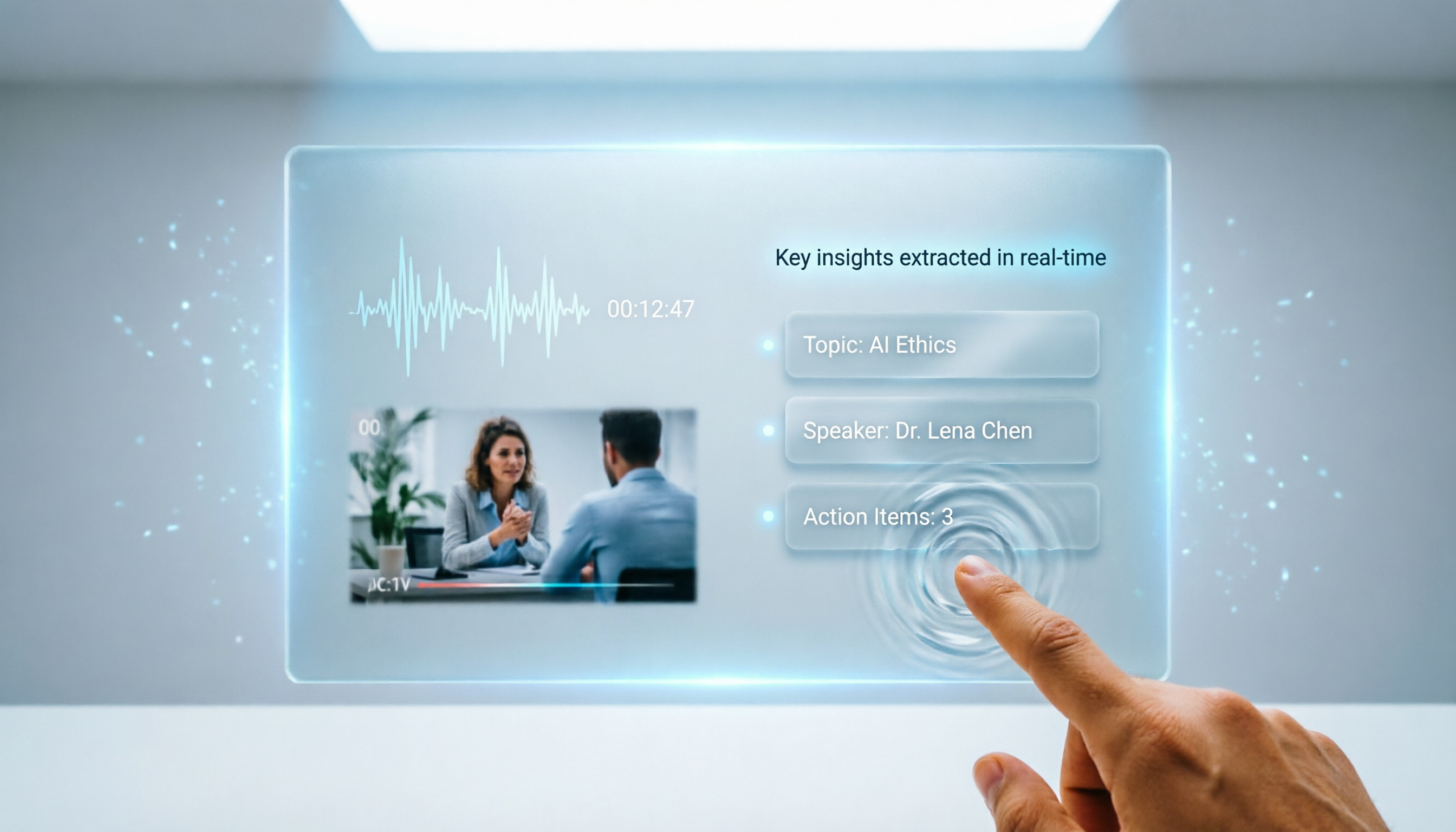
Upload audio or video and automatically get a transcript, summary, and action items
Highlights at a glance
- Multiple input sources: Live recording, audio/video files, and YouTube/Bilibili links are all supported — no need to switch between several apps.
- Powerful AI post-processing: It doesn't just produce a transcript; it generates summaries, action items, and mind maps in one click, and you can export the results to Notion, Google Docs, and more.
- No cross-platform limits: iPhone, Android, and web are all covered. Work on your office computer, then keep asking questions from your tablet at home.
Limitations to keep in mind
The free plan includes 100 minutes of transcription per month; heavy users may need to upgrade to Pro. For the average worker with two or three meetings a week and a few short videos, it's usually more than enough. Also, very long videos (over two or three hours) take more time to process, so it's better to upload them in smaller chunks.
Who is it for?
If you often need to organize Cantonese or Mandarin video content, want to ask AI questions directly after recording, or work across multiple devices, Tinrec is currently the most comprehensive choice on the market.
What are the alternatives to Tinrec?
Notta
Notta is also a multi-platform transcription tool that supports video links and meeting notes, with solid accuracy. However, it mainly focuses on transcription and translation, and lacks Tinrec's AI Q&A feature — after recording, you can't ask questions directly and are stuck scrolling through the transcript. If you don't care about AI interaction, Notta is worth considering, but if you want better efficiency, Tinrec is clearly the stronger choice.
TurboScribe
TurboScribe focuses on batch transcription, which is great for people who need to process large numbers of audio and video files at once. Unfortunately, it doesn't support pasting video links directly — you have to download the file and upload it, adding extra steps. It also has no AI Q&A, so after transcription you're on your own to organize the key points. Compared with Tinrec, TurboScribe is better for one-off bulk processing, while Tinrec is better for daily quick summaries and deeper content understanding.
How to avoid pitfalls: 3 common mistakes when choosing a video summarizer
Mistake 1: Blindly chasing high accuracy claims
Many tools claim they're 99% accurate, but those are lab results. In the real world, with noise, multiple speakers, and accents, accuracy drops. Always test with your own actual recordings before judging a tool.
Mistake 2: Ignoring cross-platform needs
If you record on your iPhone but need to process files on a Windows computer at the office, choosing an iOS-only tool will be a headache. Make sure it has a web version or cross-platform support, so it stays convenient.
Mistake 3: Treating a transcript as a summary
Some people go with cheap transcription-only tools, thinking a text file is all they need. But you still have to read through a 30-minute transcript to find the key points — the time cost is just as high. Paying a little more for a tool with AI summaries and Q&A is what actually saves time. Like Tinrec: ask one question and get the answer — that's the way modern users should work.
Conclusion: Which one should you choose?
In short, if the audio and video you need to handle is mainly Cantonese or Mandarin, and you want one platform to handle recording, link-based processing, AI Q&A, and export, Tinrec (秒聽錄音) is the most balanced choice.
Here's a quick decision guide by scenario:
- Need Cantonese video summaries + direct link pasting → Tinrec (best support, with AI Q&A)
- Want automatic action items and the ability to ask questions after meetings → Tinrec (the only option with AI Q&A)
- Cross-platform use (iPhone + Android + computer) → Tinrec (all three platforms covered)
- Primarily working with English content and want a free option → Otter.ai (free 300 minutes/month, but no Cantonese support)
- Need to transcribe a large number of files at once and don't mind having no AI Q&A → TurboScribe (strong batch processing, but no link-pasting feature)
The safest approach? Try the Tinrec free plan first — 100 minutes per month is enough to summarize several videos and meetings. Upgrade later if you find it useful; there's no need to pay from day one.
Reference Sources
- Video too long to watch? A must-have tool for learning and fan content! Long video summaries and foreign language video translation made easy - PanSci 泛科學
- One-Click Video-to-Text: 3 AI Video Summarization Tools for Fast, High-Quality Key Takeaways - Tinrec Blog
- AI Video Summarization: Use AI to Quickly Summarize YouTube Video Highlights - JJTECHSHOW
- Summarize YouTube with GPT: A Free Online Video Summary Tool
- Free AI Video Summarizer — Accurate, Fast, and with Timestamps - WayinVideo
Turn every recording into actionable outcomes
Get 60 free transcription minutes when you sign in. No credit card required.
Related Reading
You might also like

4 Online Music Format Converters Compared for 2026: Which Free Converter Is Best?
Want to convert music to MP3, WAV, or other formats? This article reviews 4 free online music conversion tools, comparing conversion speed, supported formats, privacy, and ease of use to help you find the best solution.
2026 Short Video Key Point Extraction Tools: 3 Tools Hands-On Tested and Buying Advice
Quickly extract key points from short videos and turn them into reusable text without manually pausing and typing. This article hands-on tests three tools—Tinrec, Notta, and Otter—comparing real-world performance in online video transcription, AI summaries, Q&A search, and cross-platform capabilities to help you find the best short video key point extraction solution.

2026 AI Meeting Notes Tools Compared: 5 Tested for Automatic Meeting Minutes – Which Is the Most Hassle-Free?
Spending two hours in meetings and another two on notes? This hands-on comparison tests 5 popular AI meeting notes tools, including Tinrec, Notta, and Otter.ai, across automatic meeting minutes, Chinese speech recognition, AI Q&A, and cross-platform support—helping you find the best free and paid options.

2026 Work Summary App Free Plans: 2 Options at a Glance
Looking for a free app that automatically generates work summaries? This article compares Tinrec and Otter.ai on five dimensions—Chinese transcription, input sources, AI features, pricing, and export options—to help you find the best productivity tool for meeting, interview, and course notes.

2026 Tested & Compared: 3 Automatic Video Summarizer Tools — Which One Gives the Most Accurate Chinese Summaries?
Tired of wasting time on long YouTube videos? AI-powered automatic video summarization is the time-saving fix. I tested three tools — Tinrec, Notta, and TurboScribe — for their ability to summarize Chinese-language videos. From link support to summary quality and post-processing features, here's the full breakdown, and why Tinrec is currently my top pick as an all-in-one audio/video organization solution.

4 Best Phone Voice-to-Text Apps Reviewed in 2026: Which AI Meeting Notes Really Save You Time?
Tired of spending hours transcribing meeting recordings, class notes, and interviews? We tested Tinrec, Otter.ai, Plaud Note, and Yating—comparing accuracy, AI features, and free plans to help you find the phone voice-to-text app that actually saves you time.

How to Summarize Workplace Short Videos in 2026: A Complete 5-Step Guide
Workplace short videos are everywhere, but do you forget them right after watching? This article teaches you how to use Tinrec to turn short videos into text summaries and key notes, paired with AI Q&A to boost memory, and build your personal learning database in 5 simple steps.

2026 Test: 4 Video-to-Meeting Minutes Tools Compared—Which AI Summary Really Saves Time?
Do free tools really work for turning meeting recordings into minutes? We tested Tinrec, Otter.ai, Notta, and Yating Transcript, comparing Chinese accuracy, AI summaries, cross-platform flexibility, and value for money—so you can pick the best tool for handling video meetings.

Tutorial: 2026 Online Text-to-Speech Tools - No-Install, Multilingual AI Recommendations
This article rounds up practical online text-to-speech tools for 2026, from free plans to professional services. It highlights how Tinrec turns synthetic voice into organized, searchable knowledge assets — perfect for creating audio content and managing files afterward.