
Turn recordings into transcripts and summaries in minutes
Upload audio or video for multilingual transcription, AI notes, and action items
"Just finished a two-hour meeting and the boss wants a key summary by afternoon."
"The interview recording has background noise; I'm going crazy trying to transcribe it and still can't find the key points."
These are probably the most dreaded scenarios for administrative staff, students, and content creators. With AI technology maturing, today's mobile recording apps are no longer just "tape recorders" — they are "AI secretaries" that can instantly produce transcripts and notes. But with so many tools on the market, which one processes the fastest? Which supports Chinese and Taiwanese? Which can auto-generate to-do items?

This article compiles the latest 2026 benchmark data, providing a comprehensive review of 9 mainstream tools (including Meeting Ink, Tinrec, Plaud, Vocol.ai, etc.). We evaluate from the dimensions of transcription speed, language support, summary quality, and cross-platform integration to help you find the best productivity tool.
Quick Navigation Conclusions:
- For ultimate speed and Taiwanese Hokkien recognition: Prioritize Meeting Ink.
- For cross-device sync (phone/computer) and action item management: Recommend Tinrec (Ting Listening Recorder).
- For call recording on the go: Choose Plaud (requires hardware).
- For lightweight tasks and translation needs: Consider Vurbo.ai.
2026 Buyer's Guide: 4 Evaluation Dimensions for Voice-to-Text Apps
Before downloading an app, clarify your core needs to avoid paying for features that don't fit:
- Real-time: Do you need to "see text as you record" (good for lectures/speeches) or "upload and transcribe after recording" (good for interviews)?
- Language recognition: Beyond standard Chinese, do you need Taiwanese Hokkien, Hakka, or code-switched Chinese-English tech meeting content?
- Post-processing efficiency: Can the tool automatically distinguish speakers (speaker diarization)? Can it auto-generate "to-do items" or "decision summaries"? This is key to saving time.
- Cross-platform and integration: After recording on your phone, can you directly edit on a computer web version? Does it support importing video links?
In-Depth Review of Popular Voice-to-Text Tools
Based on the latest 2026 benchmark data, we selected several standout tools for analysis.
1. Meeting Ink: The Speed & Localization Star
According to test data, Meeting Ink transcribed a 26-minute standard audio file in just 1 minute 58 seconds with stable upload time. Its biggest advantage is deep localization, supporting Taiwanese Hokkien and Hakka recognition, and seamless integration with Google Calendar. It's a smooth choice for Google Workspace enterprise users. However, in the free version, occasional manual page refresh is needed to check status.
2. Tinrec (Ting Listening Recorder): The All-Around Assistant Emphasizing "Understanding & Action"
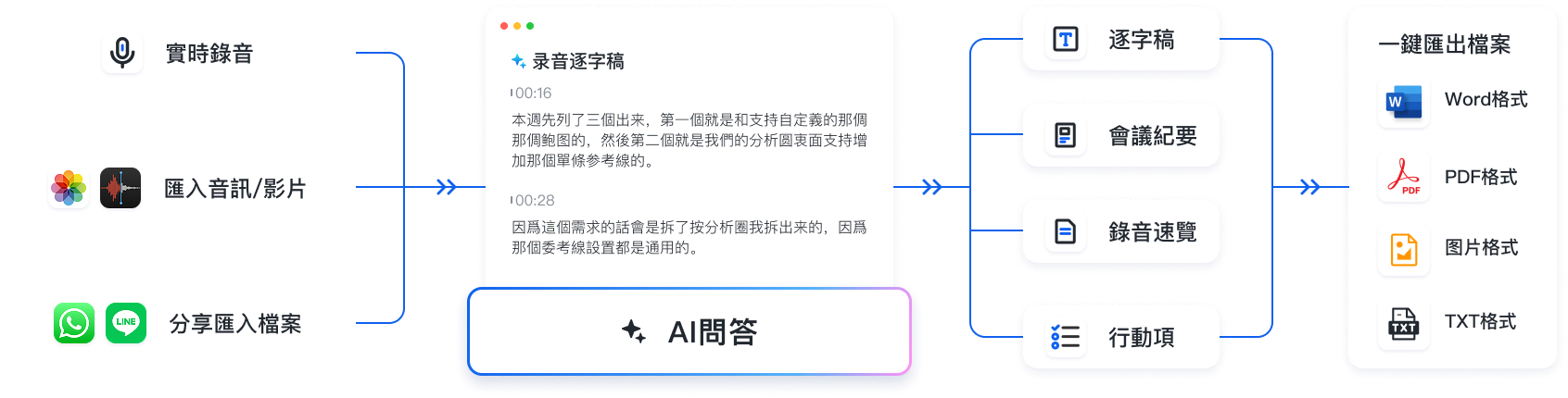
Tinrec's positioning goes beyond just producing transcripts; it emphasizes a complete workflow from "recording to action." It supports iOS, Android, and Web multi-device sync, especially suitable for users who record on phone and then organize on computer at the office.
- Core Features: In addition to real-time voice-to-text, it has a powerful AI chat query function. You don't need to re-read the entire transcript; you can directly ask the AI: "What is the budget limitation mentioned in the meeting?" AI answers based on recording content.
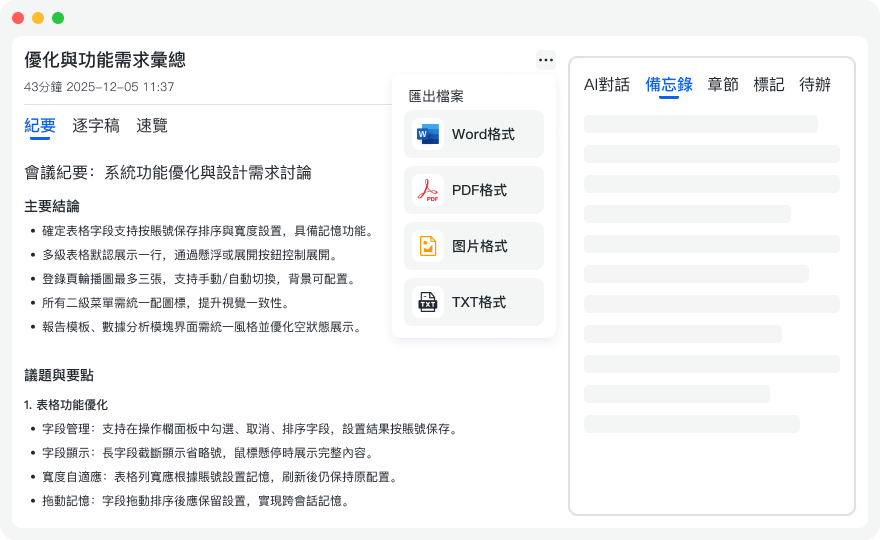
- Differentiator: Compared to pure transcription tools, Tinrec automatically extracts "meeting minutes" and "action items," solving the pain point of "notes but no execution." It also supports converting YouTube videos or podcast links directly into notes, great for learning scenarios.
3. Plaud: A Hardware-Enabled Call Recording Solution
Plaud combines a physical recording card with an app. Tests show its app operation is stable, especially suitable for iPhone call recording (due to iOS restrictions, pure software call recording is difficult). The downside is you must buy hardware, and the current version has weak speaker diarization and no real-time caption display; it's a post-recording organization tool.
4. Vocol.ai & Otter.ai: Strengths in Collaboration and English
- Vocol.ai: More oriented toward project management collaboration, supports keyword search and playback, but tests show slower transcription speed (about 3 minutes 29 seconds for a 26-minute file) and no real-time captioning.
- Otter.ai: An old veteran in English recognition, with smooth real-time captions, but relatively weak Chinese support and limited free features.
Stop organizing recordings by hand
Upload audio or video and automatically get a transcript, summary, and action items
5. Other Tools (Good Tape, Yating Transcription, Vurbo.ai)
- Good Tape: Simple interface, but free version has extremely long waiting times (maybe over 1 hour), suitable for non-urgent users.
- Yating Transcription: Developed in Taiwan, strong Taiwanese Hokkien recognition, fast upload speed, but summary generation occasionally queues.
- Vurbo.ai: Focuses on translation, but tests show occasional language misdetection (e.g., Chinese translated to Japanese). Suitable for non-serious meeting assistance.
Specifications & Speed Comparison Table of 9 Mainstream Voice-to-Text Apps
For easier selection, here's a comparison of core dimensions:
| Tool Name | Core Strength | VTT Speed (Reference) | Real-time Transcription | AI Summary/Action Items | Pricing/Free Tier |
|---|---|---|---|---|---|
| Meeting Ink | Fast speed, Taiwanese Hokkien support | Very Fast (~<2 min) | Yes | Yes (includes templates) | Free trial / Subscription |
| Tinrec | Multi-device sync, AI chat query | Real-time streaming | Yes | Yes (auto extracts action items) | 100 min free per month |
| Plaud | Call recording (requires hardware) | Fast (~49 sec) | No | Yes (basic) | Hardware cost + Subscription |
| Otter.ai | English recognition, Zoom integration | Average (~3.5 min) | Yes | Yes | Limited free tier |
| Vocol.ai | Team collaboration | Slow (~3.5 min) | No | Yes | Credit-based / Subscription |
| Yating | Taiwan local languages | Slow (~4.5 min) | Yes | Yes (queues) | Hour packs / Subscription |
| Good Tape | Minimalist UI | Slow (free version queues) | No | No (free version) | Subscription |
| SeaMeet | Teams/Meet integration | Moderate (~3.8 min) | Yes | Yes | Free: 20 hours/month |
| Vurbo.ai | Translation | Fast (but long workflow) | Yes | Yes | Subscription |
(Note: Processing speeds are based on a 26-minute standard audio file test; actual performance varies with network and file size.)
Practical Guide: How to Achieve Real-Time Voice-to-Notes with Mobile Apps
Regardless of which tool you choose, the core workflow is similar. Using the feature-rich Tinrec as an example, here's how to turn sound from different sources into usable notes:
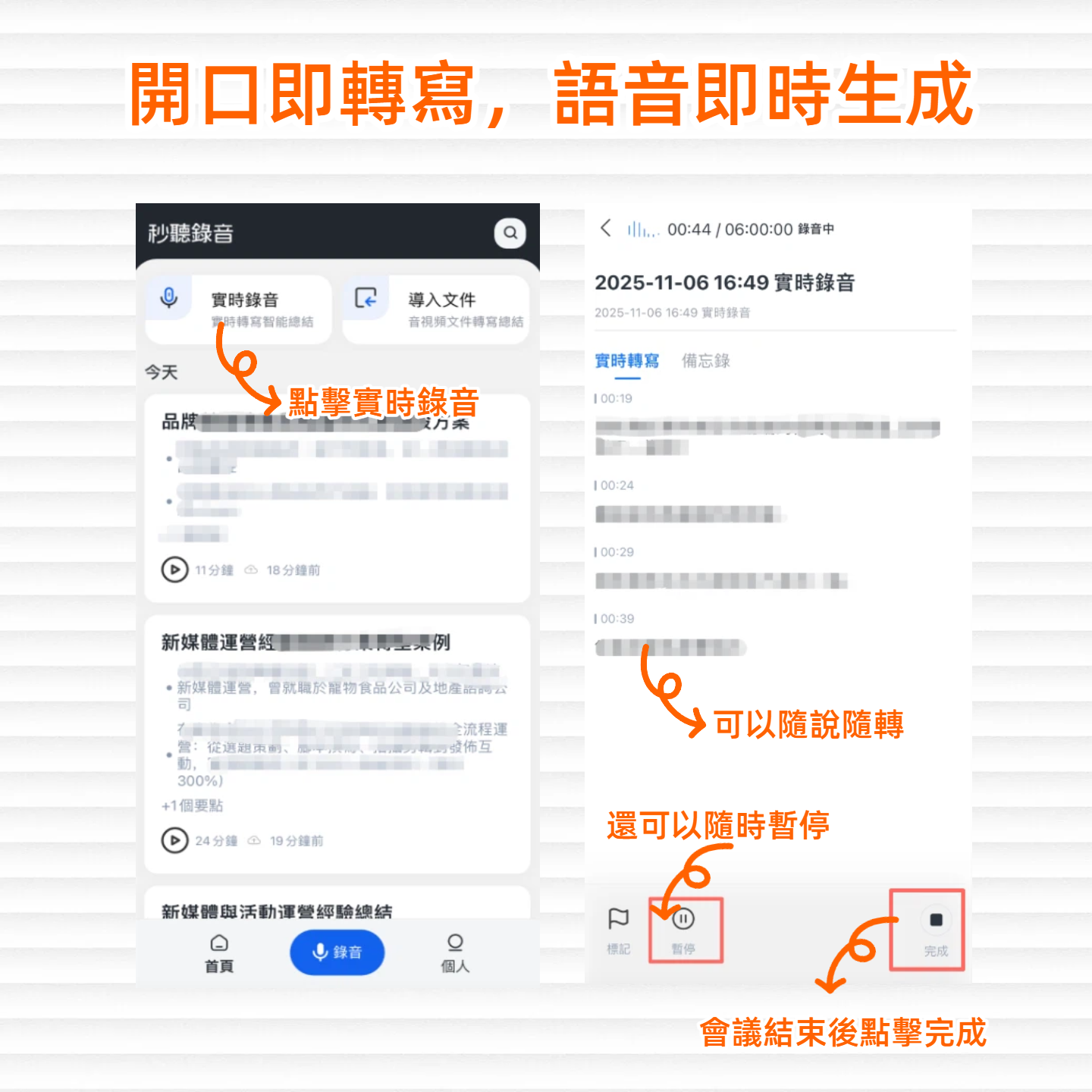
Scenario 1: In-Person Meeting/Lecture Recording (Real-Time Transcription)
When you're in a live setting and want to see text as you listen:
- Open the app or web version, click Real-Time Voice-to-Text Recording.
- The system starts recording and displays real-time captions on screen. Keep your phone close to the speaker for better audio quality.
- After recording, tap "Generate Summary." AI automatically organizes meeting highlights and to-do items.
Scenario 2: Organizing Existing Audio Files (File Upload)
If you have recordings from a voice recorder or a colleague's file:
- Go to Audio File to Text.
- Upload mp3, wav, or m4a files.
- Wait for cloud transcription (usually a 1-hour audio file takes only a few minutes), then edit speaker labels.
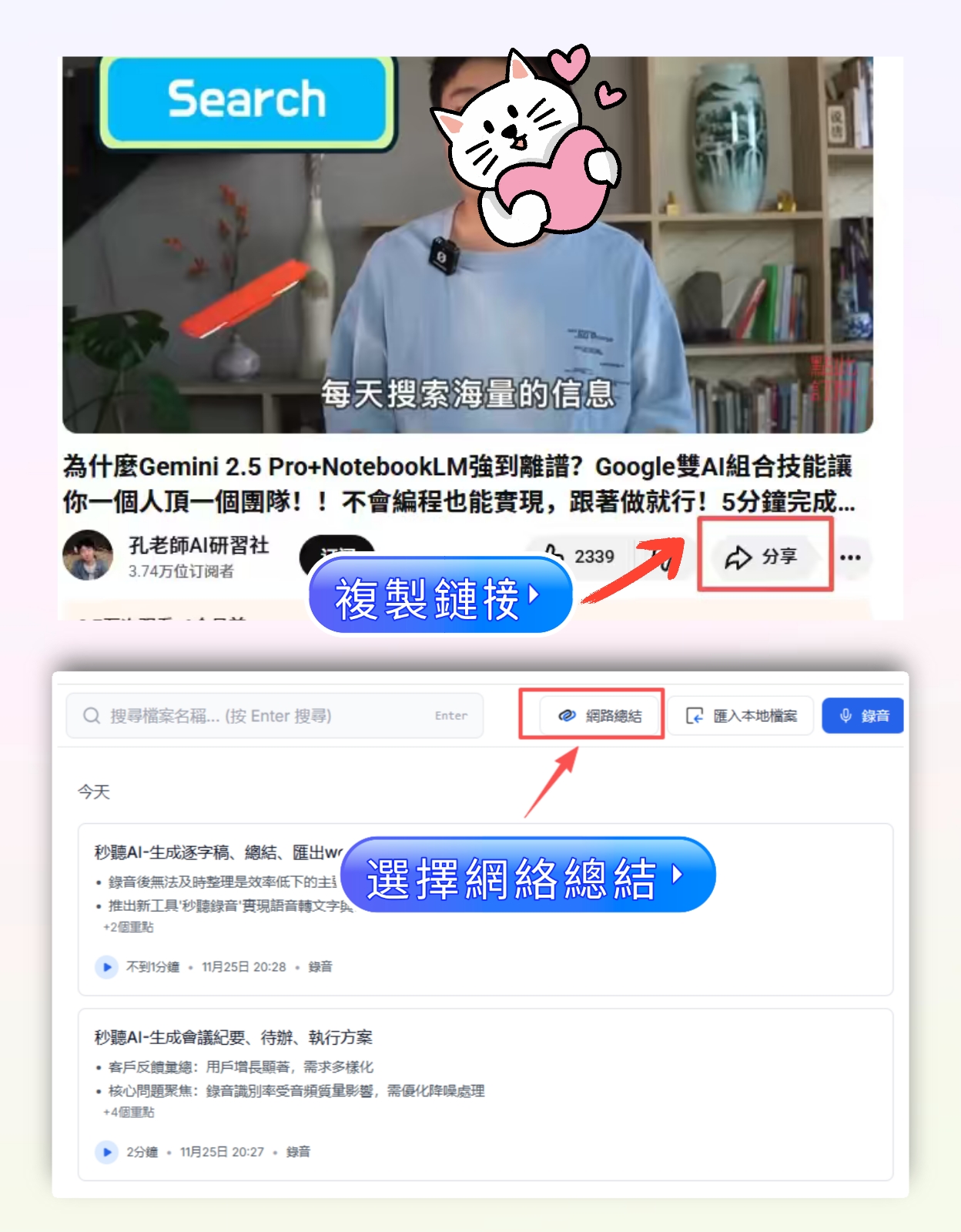
Scenario 3: Processing YouTube or Podcasts (Link Transcription)
To take notes from online courses or competitor videos:
- Copy the video or podcast URL.
- Use Podcast/Online Video to Text function to paste the link.
- The system directly extracts the audio track and converts it into notes, saving download time.
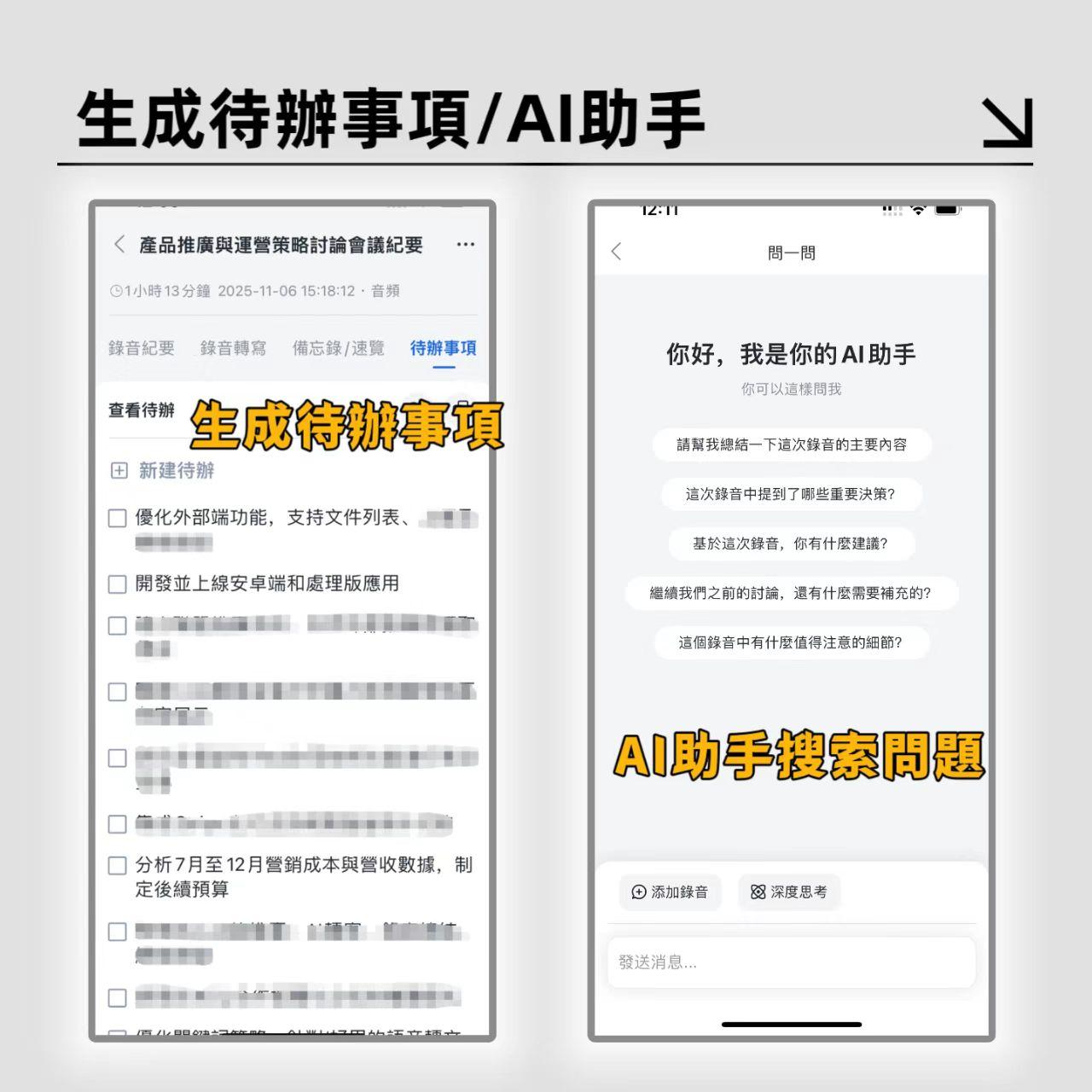
Scenario 4: Quick Review of Key Points (AI Query)
Facing a transcript of tens of thousands of words and don't want to read from scratch?
- Open AI Chat Query.
- Type a question, e.g., "What was the conclusion about the marketing budget in this meeting?"
- AI searches the recording content and summarizes the answer, which is more accurate than traditional keyword search (Ctrl+F).
FAQ
Q1: Why can't my iPhone record LINE or phone calls?
Due to iOS privacy policy restrictions, most software apps cannot perform "system internal recording" (i.e., recording audio played from the phone). For call recording needs, you typically need external hardware (like Plaud) or use speakerphone with another device.
Q2: Are the free tiers of these tools sufficient?
It varies greatly. For example, Meeting Ink offers a free trial; Tinrec provides 100 minutes free per month; Good Tape's free version has long queues. For heavy users (journalists, secretaries), subscribing to a paid plan for priority processing and full summary features is recommended.
Q3: Will noisy recording environments affect transcription accuracy?
Absolutely. While AI has noise reduction, "physical pickup" is key. Place your phone close to the speaker or use a directional mic. Overlapping speech from multiple people is still challenging even for the best AI models.
Q4: Can I record directly from Teams or Google Meet?
Yes. SeaMeet is specifically designed with extensions for such scenarios; Meeting Ink supports a bot joining meetings. With Tinrec or other apps, you can use a "web page tab recording" method to capture online meeting audio.
Q5: Can transcripts differentiate who is speaking?
Most advanced tools (Meeting Ink, Tinrec, Otter) support speaker diarization, automatically labeling Speaker A, Speaker B. Accuracy depends on audio quality; manual name correction is usually needed after transcription.
Q6: Is it safe to upload data to the cloud?
This is a top concern for enterprise users. When choosing a tool, review its privacy policy. Most paid-tier tools (Meeting Ink, Tinrec Enterprise) use encrypted transmission and storage and do not use user data for public model training.
Turn every recording into actionable outcomes
Get 60 free transcription minutes when you sign in. No credit card required.
Related Reading
You might also like

3 Speech-to-Text Tools Tested in 2026: Is the Free Version Enough? Tinrec Offers the Best Value
This tutorial reviews free speech-to-text tools, focusing on Tinrec, and shows how to use the free version to quickly convert meetings, interviews, and course recordings into transcripts and summaries. It also includes buying tips and FAQs.

2026 Tested: 4 Best Free Speech-to-Text Tools Compared – Which Free Plan Is Most Practical?
We tested 4 popular free speech-to-text tools, comparing free quotas, accuracy, and AI features to help you find the best option for meeting notes and transcripts.

2026 Hands-On Comparison of 4 Speech-to-Text Tools: Which AI Meeting Notes Really Save Time?
How do you choose a speech-to-text tool? This article tests Tinrec, Otter, Notta, and PLAUD, covering accuracy, AI summarization, cross-platform support, and team collaboration to help you find the best meeting notes solution.

4 iOS Voice-to-Text Apps Tested in 2026: Tinrec's AI Meeting Notes Save You Hours of Organizing
This article tests 4 iOS voice-to-text tools, comparing the built-in Voice Memos, Tinrec, PLAUD NotePin, and Yating Transcript, and tells you when to use the free built-in option and when to upgrade to Tinrec with AI meeting notes and team collaboration.

2026 Review: 4 Speech-to-Text Tools Compared – Which Is Best for Chinese Meetings and Team Collaboration?
We tested Tinrec, Otter.ai, Notta, and Granola for speech-to-text, focusing on Chinese meetings, bot-free recording, team collaboration, and file import. Get our recommendations.

2026 Free Speech-to-Text Tools Compared: Which Is Best for Meeting Notes?
We tested three free speech-to-text tools—Tinrec, Otter, and Notta—comparing free quotas, meeting organization, AI Q&A, and cross-platform support to help you pick the best option for meeting minutes.

3 iPhone Voice-to-Text Solutions Compared in 2026: Built-in Notes, Voice Memos, or Tinrec?
After updating to iOS 18.4 on iPhone 12 and later, the built-in Notes and Voice Memos apps can transcribe recordings into text. But if you need AI summaries, cross-platform export, or team collaboration, Tinrec is a more complete choice. This hands-on comparison helps you weigh the pros and cons of each option.
2026 Hands-On Comparison of 3 Recording-to-Text Apps: Which Is Best for Chinese Meeting Minutes and Team Collaboration?
Tired of transcribing meetings yourself? This hands-on test of Tinrec, Notta, and Otter.ai covers Chinese transcription, bot-free recording, AI summaries, and team spaces to reveal which tool truly saves you time on meeting minutes.

4 Best Speech-to-Text Platforms in 2026: Free Options for Meeting Notes
We tested 4 speech-to-text platforms in 2026, from Tinrec to MyEdit, cSubtitle, and Otter, to help you find free or entry-level solutions for meeting notes, transcripts, and AI summaries.