
Turn recordings into transcripts and summaries in minutes
Upload audio or video for multilingual transcription, AI notes, and action items
In the fast-paced workplace environments of Hong Kong and Taiwan, meeting notes are often one of the most time-consuming administrative tasks. Especially when dealing with Cantonese or mixed Chinese-English scenarios, manual transcription is not only inefficient but also prone to missing key points. Many users are looking for tools that offer free online trials with high accuracy, hoping to quickly convert hours of audio recordings into editable transcripts.
This article will review the 6 most popular voice-to-text tools on the market in 2025. We will evaluate them based on language support (especially Cantonese), hardware requirements, AI summarization capabilities, and free quotas.
Quick Navigation Conclusions:
- If you have a sufficient budget and prefer a physical recording device: Prioritize Plaud Note or iFLYTEK.
- If you don't want to carry extra hardware and need cross-platform collaboration and AI summaries: Try Tinrec or Monica.
- If you are a developer or tech enthusiast: Whisper by OpenAI is a powerful open-source option.
1. In-Depth Review of Popular Voice-to-Text Tools in 2025
Based on market buzz and actual features, here is an analysis of mainstream tools for Cantonese and Chinese users:
1. Plaud AI (Note / NotePin)
This tool has been widely discussed on social media recently, focusing on an "AI recording card" hardware. It combines a physical device with a software service.
- Features: Supports 112 languages including Cantonese and Mandarin. The hardware is slim and portable, suitable for business professionals.
- Price & Barrier: Requires purchasing the hardware (approx. HK$1,199), which includes 300 minutes of transcription per month.
- Best for: Business professionals who are used to using physical recorders and have a budget for hardware.
2. Tinrec
Unlike tools tied to hardware, Tinrec is a "software-first" AI recording assistant that supports iOS, Android, and web versions, emphasizing a complete workflow from recording to action.
- Features: Supports mixed recognition of Cantonese, Chinese, and English. Beyond transcription, its standout feature is AI smart analysis, automatically generating meeting summaries, action items, and supporting "AI conversation queries" for recording content.
- Price & Barrier: The free version provides 100 minutes of transcription per month, with no need to purchase hardware.
- Best for: Students, remote workers, and office workers who don't want to carry extra devices.
3. iFLYTEK
A veteran in Chinese speech recognition, known for high accuracy.
- Features: Exceptionally high recognition accuracy for dialects (including Cantonese) and professional terminology, suitable for serious scenarios like legal and medical fields.
- Price & Barrier: Hardware is relatively expensive (approx. HK$2,900), primarily a one-time hardware purchase.
- Best for: Professionals in specialized fields who demand top accuracy and have a sufficient budget.
4. Otter.ai
An internationally known meeting notes tool, but with clear limitations in the Chinese market.
- Features: Strong English recognition and speaker differentiation, high automation.
- Note: Limited Cantonese support. If your meetings are entirely in English, it's a good choice; but if they include Chinese or Cantonese, it's not recommended as a primary tool.
- Best for: All-English meetings in multinational companies.
5. Whisper by OpenAI
An open-source speech recognition model by OpenAI with a powerful technical core.
- Features: Extremely high recognition accuracy, and completely free (if self-hosted).
- Price & Barrier: While open source and free, the usage barrier is high, typically requiring coding skills or high-performance computing, with no ready-made user-friendly interface.
- Best for: Developers and engineers.
6. Monica
A versatile AI assistant plugin; voice-to-text is one of its features.
- Features: User-friendly interface, simple operation, supports Cantonese.
- Price & Barrier: Offers 30 minutes of free trial, then requires a subscription (approx. HK$65/month).
- Best for: Light users and browser plugin enthusiasts.
2. Tool Comparison Table: Which Is the Best Value?
To help you choose more intuitively, we have compiled a comparison table of core dimensions:
Stop organizing recordings by hand
Upload audio or video and automatically get a transcript, summary, and action items

| Dimension | Tinrec | Plaud Note | iFLYTEK | Otter.ai | Whisper (OpenAI) |
|---|---|---|---|---|---|
| Hardware Required | No (Mobile/Web) | Yes (Recording card) | Yes (Recorder) | No | Requires a computer |
| Cantonese Support | ✅ Supported (including mixed) | ✅ Supported | ✅ Precise support | ❌ Poor | ✅ Supported |
| Core Strength | AI conversation queries, action item extraction | Physical recording quality, call recording | High accuracy in professional fields | Strong English recognition | Open source, free, privacy control |
| Free Quota | 100 min/month | Requires hardware purchase (bonus minutes) | None (hardware buyout) | Limited trial | Unlimited (self-hosted) |
| AI Summary/Action Items | ✅ Auto-generated | ✅ Auto-generated | Supported on some models | ✅ Supported (English) | Requires custom integration |
3. Deep Dive: Why Do You Need a "Software-Based" AI Recording Assistant?
For users who don't want to carry extra hardware cards or recorders, software solutions like Tinrec offer greater flexibility. Beyond basic "record to text," modern workflows value "post-processing of information."
1. More Than Just a Transcript: It's a Decision Assistant
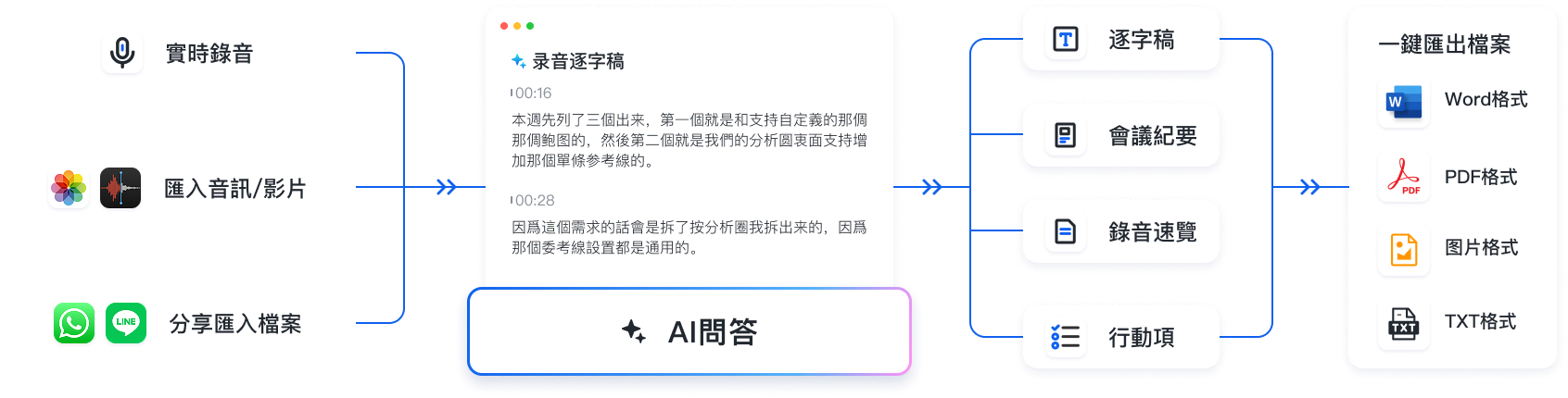
Traditional tools produce transcripts that can be thousands of words long, making them time-consuming to read. Tinrec emphasizes extracting actions from recordings. It can automatically distinguish speakers and generate structured "meeting summaries" and "to-do lists," allowing you to assign tasks immediately after a meeting.
2. Find Answers by Asking, Replacing Ctrl+F
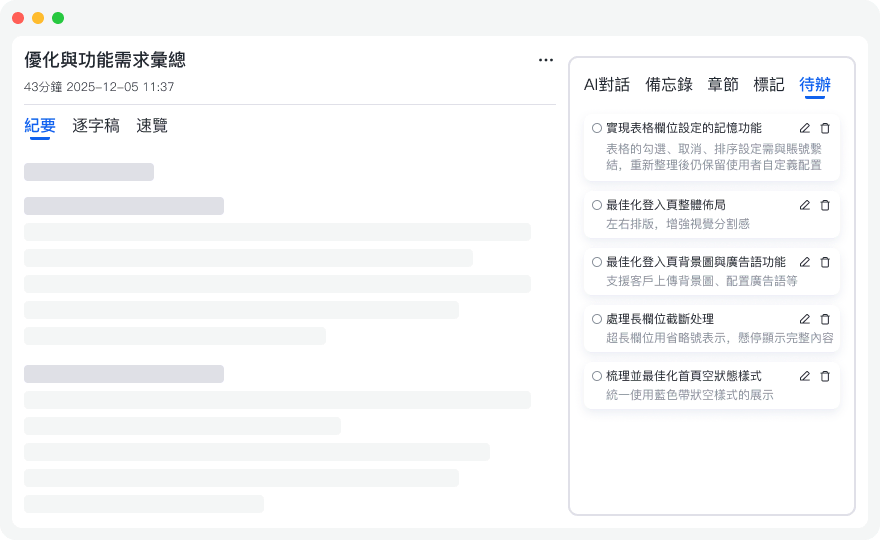
This is the biggest difference with new-generation AI tools. For a 2-hour interview or lecture recording, you don't need to replay it; just use the AI conversation query feature. For example, type: "What was the Q3 budget the boss mentioned?" and the system will answer directly based on the recording content. This is very useful for reviewing classes or recalling meeting details.
3. Diverse Input: Even Videos Can Be Transcribed
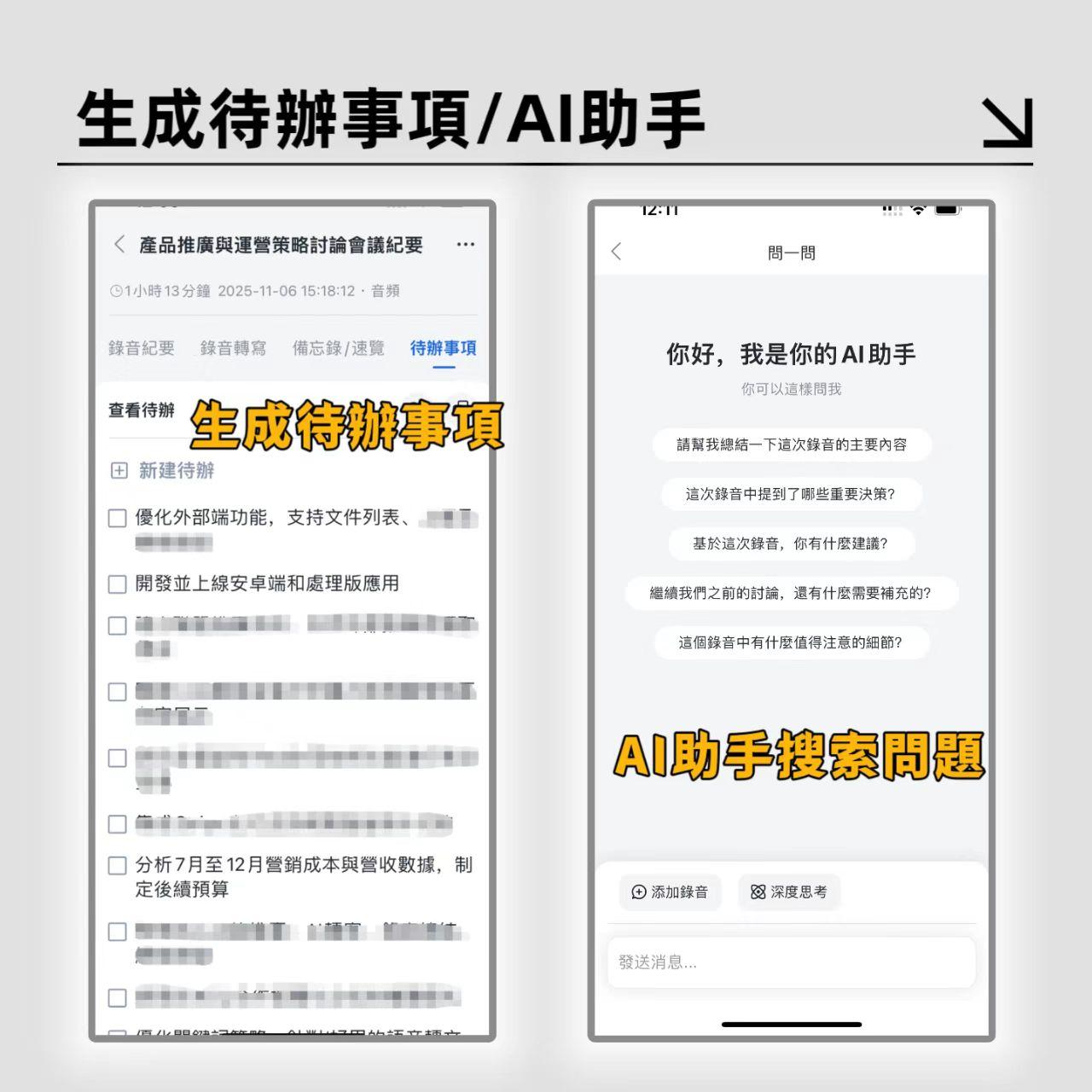
In addition to live recordings, learners often need to organize YouTube tutorials or podcast content. Tinrec supports importing audio/video files and even allows pasting online video links for analysis and summarization—something hardware recorders can't easily do.
4. Practical Tutorial: How to Quickly Produce Cantonese Meeting Notes on Your Phone
Below, using Tinrec as an example, we demonstrate how to produce high-quality meeting notes using only your phone without a physical recorder:

Step 1: Start Recording or Import a File
- Live meeting: Open the Tinrec app or web version, select "Real-time voice-to-text." The system will display a waveform and start recognition immediately.
- Existing file: If you recorded with the iPhone's built-in Voice Memos, use the "Audio file to text" feature to upload.
Step 2: Select Language Mode
In settings, ensure the recognition language includes "Cantonese" or "Traditional Chinese." Tinrec supports multilingual recognition, adapting to the common mixed Chinese-English context in Hong Kong.
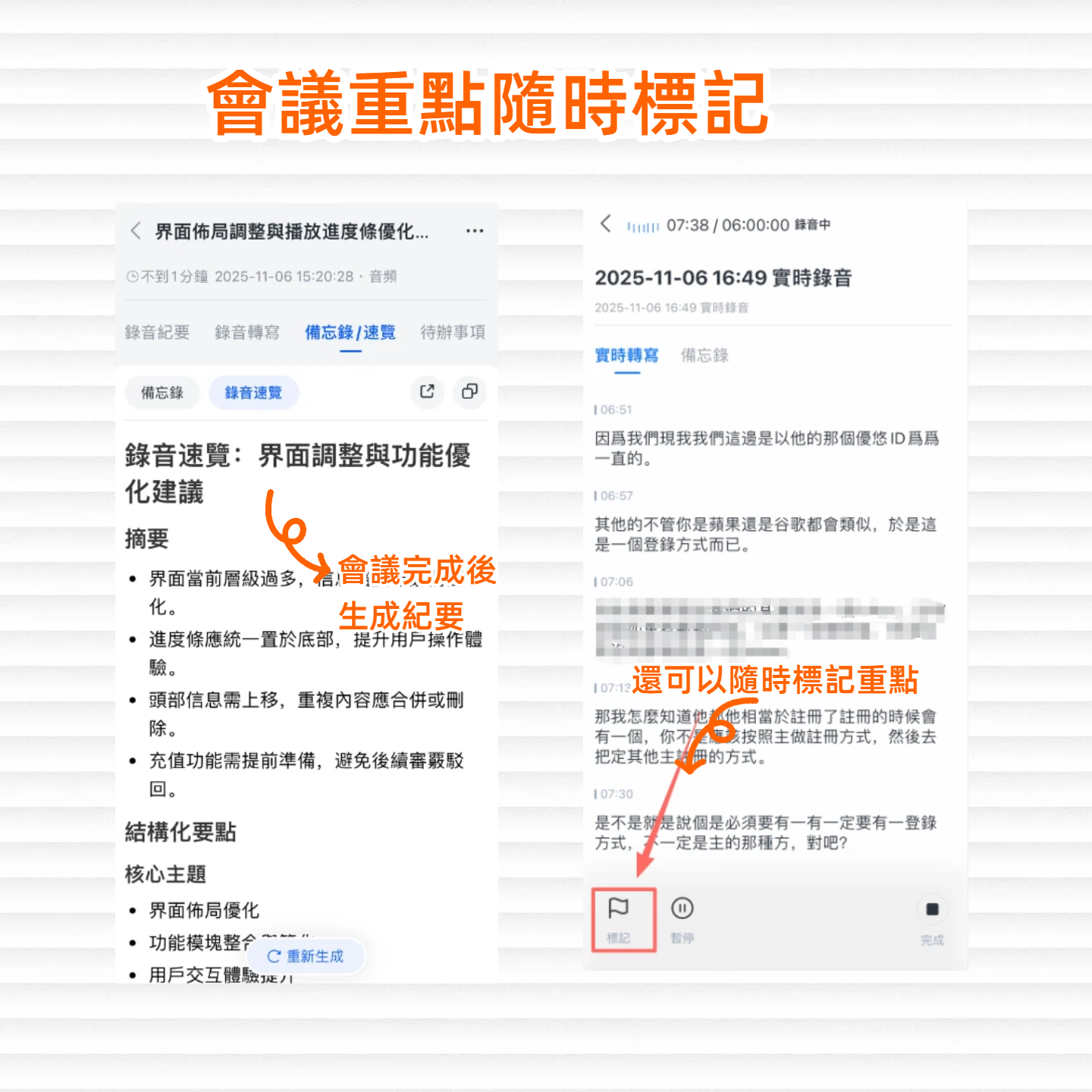
Step 3: Mark Key Points in Real Time
During recording, if you hear an important decision, tap the "Mark" button on the interface. This helps the AI more accurately capture key moments when generating summaries later.
Step 4: Get AI Summary and Action Items
After recording, the system will automatically process and produce a transcript. Tap "AI Summary" to get a complete note containing main topics, conclusions, and action items.
Step 5: Export and Share
Finally, you can export the organized content as Word, PDF, or Markdown and send it directly to meeting participants.
5. FAQ
Q1: Can these tools really understand Cantonese?
A: Yes, Plaud, iFLYTEK, and Tinrec have mature support for Cantonese. However, note that if the accent is very strong or includes a lot of specialized jargon, accuracy may still be affected. It's advisable to choose tools that allow post-editing of transcripts.
Q2: Can iPhone call recordings be transcribed?
A: Due to iOS privacy restrictions, most apps cannot directly record phone calls. Plaud solves this with a hardware attachment; software-based tools like Tinrec recommend using speakerphone or uploading a recorded audio file for transcription.
Q3: What are the limitations of Tinrec's free version?
A: Tinrec offers 100 minutes of free transcription per month, which is sufficient for occasional meeting needs. If you exceed the quota, you can upgrade to Basic or Pro versions.
Q4: How is privacy and security ensured for meeting notes?
A: Please review the privacy policy when choosing a tool. Most paid or enterprise-grade tools (such as Plaud, Tinrec, iFLYTEK) encrypt data and do not use user data for public model training.
Q5: Can I use only the web version, or do I need to download an app?
A: Most hardware tools require an app for data transfer. Tinrec, however, supports a web version, meaning you can directly process recordings from Zoom or Google Meet on your computer without transferring files between your phone and computer.
Q6: Can I directly convert YouTube videos to text?
A: Yes. Tinrec has a "Podcast/Video to text" feature. Just paste the link to generate a summary, which is great for quickly digesting long video content.
Turn every recording into actionable outcomes
Get 60 free transcription minutes when you sign in. No credit card required.
Related Reading
You might also like

2026 Review of 3 Transcription Tools: How Tinrec Saves Hours on Dcard Users' Biggest Pain Point
Struggling to choose a transcription tool? This article starts with common pain points from Dcard users and tests Tinrec's real-time transcription, AI summaries, and team collaboration to help you save hours of manual transcription.

Tinrec Recording-to-Text in 2026: Cantonese Transcription + Auto Meeting Minutes
Hands-on test of Tinrec recording-to-text: Cantonese transcription, AI meeting minutes, and bot-free recording. See how it compares and where it fits.

2026 iPhone Recording-to-Text Test: Built-in Voice Memos vs Tinrec, 3-Dimension Comparison, Which Is Worth It?
How to choose iPhone recording-to-text tools? This article tests the built-in Voice Memos and Tinrec, comparing accuracy, language support, and post-processing, and shares pitfalls to avoid and buying advice.

The Complete Guide to Recording-to-Text in 2026: Hands-On Free Tools and Time-Saving Tips for Students
A senior student tests multiple recording-to-text tools, sharing how to choose and use free versions, leverage AI to organize transcripts, and why Tinrec is the top choice for Chinese-language courses and meetings.
2026 Hands-On Comparison of 2 Recording-to-Text Tools: Tinrec vs Yating, Which Free Version Is More Useful?
This article compares Tinrec and Yating in 5 dimensions: free plans, post-transcription processing, meeting recording methods, team collaboration, and multi-device support. If you need more than just transcripts—an AI meeting assistant that can organize to-dos, summaries, and team data—Tinrec is the more complete choice.

3 Speech-to-Text Tools Tested in 2026: Is the Free Version Enough? Tinrec Offers the Best Value
This tutorial reviews free speech-to-text tools, focusing on Tinrec, and shows how to use the free version to quickly convert meetings, interviews, and course recordings into transcripts and summaries. It also includes buying tips and FAQs.

2026 Tested: 4 Best Free Speech-to-Text Tools Compared – Which Free Plan Is Most Practical?
We tested 4 popular free speech-to-text tools, comparing free quotas, accuracy, and AI features to help you find the best option for meeting notes and transcripts.

2026 Hands-On Comparison of 4 Speech-to-Text Tools: Which AI Meeting Notes Really Save Time?
How do you choose a speech-to-text tool? This article tests Tinrec, Otter, Notta, and PLAUD, covering accuracy, AI summarization, cross-platform support, and team collaboration to help you find the best meeting notes solution.

4 iOS Voice-to-Text Apps Tested in 2026: Tinrec's AI Meeting Notes Save You Hours of Organizing
This article tests 4 iOS voice-to-text tools, comparing the built-in Voice Memos, Tinrec, PLAUD NotePin, and Yating Transcript, and tells you when to use the free built-in option and when to upgrade to Tinrec with AI meeting notes and team collaboration.