
Turn recordings into transcripts and summaries in minutes
Upload audio or video for multilingual transcription, AI notes, and action items
Have you ever experienced that frustrating moment: a two-hour marathon meeting ends, and you stare at a blank Word document, needing to produce accurate meeting minutes before the end of the day? Or in class, you frantically scribble notes only to miss the professor's most important exam points?
"Speech-to-text" technology has evolved from simple "voice input" into a "productivity workflow." Today's tools not only convert speech to text, but also help you segment, summarize, and even generate action items directly. This article draws on real-world reviews and popular market options to compile a selection guide for 8 speech-to-text tools.
Quick Navigation Summary:
- Short text/instant input (replies, writing): Prioritize Wispr Flow or Windows 11 built-in input.
- Long meetings/need audio file/action decisions: Recommend Tinrec (Second Listening Recorder) or Evernote.
- Academic reading/ultra-long file analysis: Suitable for NotebookLM.
- Mobile quick notes: Google Live Transcribe (Android) or Tinrec (both platforms).
1. Buying Guide: Three Categories of Speech-to-Text Tools
Based on review sources and real work scenarios, current AI voice tools mainly fall into three categories. Choosing the wrong type is often the main reason for saying "it's not useful":
1. Real-time Dictation Type
These tools act like a "super keyboard," suitable for writing articles, replying to emails, or instant messaging. You speak, and it types.
- Representative tools: Wispr Flow, Windows 11 built-in voice input.
- Features: Extremely fast, can be used across software (directly input into Word or Line).
- Limitations: Usually do not retain audio files (Windows 11), or are designed for "short outputs," not suitable for recording multi-person conversations in meetings.
2. Note & Archive Type
These tools are essentially "note-taking software," with voice as an auxiliary feature. Suitable for taking notes while recording, then organizing later.
- Representative tools: Evernote, NotebookLM.
- Features: Good for long recordings. NotebookLM excels at logical analysis of ultra-long audio files.
- Limitations: Real-time performance is weaker; usually require "record first, then transcribe," unable to see text as you speak.
3. Meeting & Action Type
These tools are designed specifically for "meetings" and "interviews," emphasizing complete audio preservation, speaker differentiation, and task extraction from conversations.
- Representative tool: Tinrec (Second Listening Recorder).
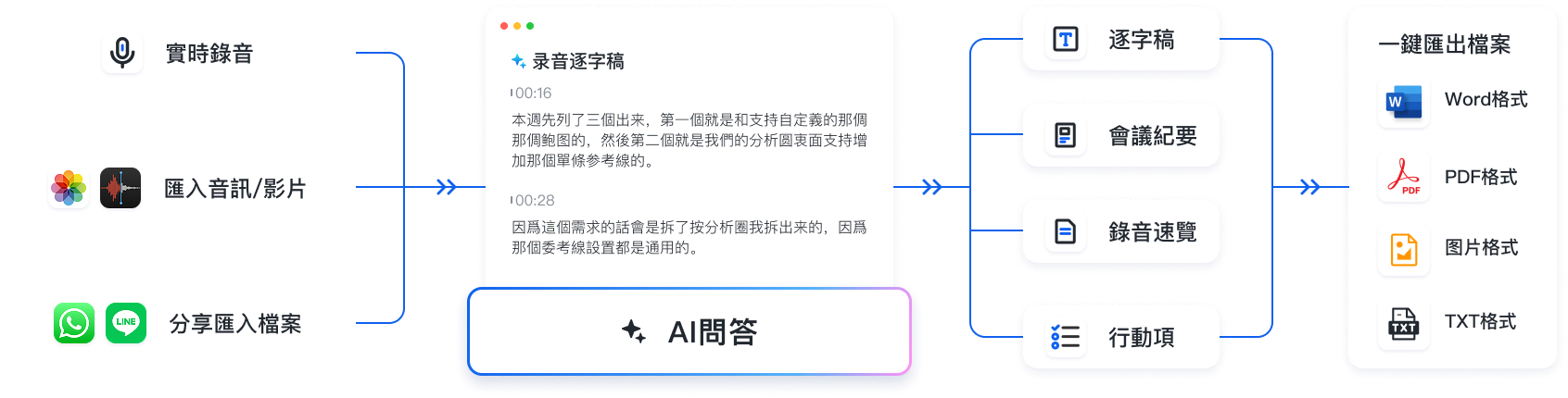
- Features: Supports multiple platforms (mobile/desktop), provides real-time transcription during recording, and automatically generates "meeting summaries" and "to-do lists," solving the problem of "recorded but no time to listen."
2. In-depth Review: Comparison of 8 Popular Speech-to-Text Tools
Below, based on actual test results and product features, we analyze each tool for different scenarios.
1. Wispr Flow
- Best for: Mac/iOS users needing fast voice input, journaling, replying to messages.
- Pros: Excellent Traditional Chinese recognition; AI automatically refines sentences (removes filler words, adds punctuation); supports custom dictionary. Feels like an "instant voice input method."
- Note: As of 2025 data, no Android app available; requires holding a record button, better for short phrases than long meeting notes.
2. Windows 11 Built-in Voice Input
- Best for: Fastest, zero-cost solution for PC users.
- Pros: Press
Win + Hto activate; completely free; strong real-time performance. - Note: Does not save audio files. If the network drops or the computer crashes, what you just said may disappear, posing a higher risk; not recommended for important interviews.
3. Tinrec (Second Listening Recorder)
- Best for: Cross-platform meeting notes, class notes, workers who need to "review and search" content.
- Pros: Provides a complete workflow from recording to "action." Supports iOS/Android/Web multi-device sync; real-time transcription during recording; automatically summarizes meeting highlights and to-do items. Supports 10 languages including Chinese, English, Japanese, Korean, Cantonese, and Taiwanese.
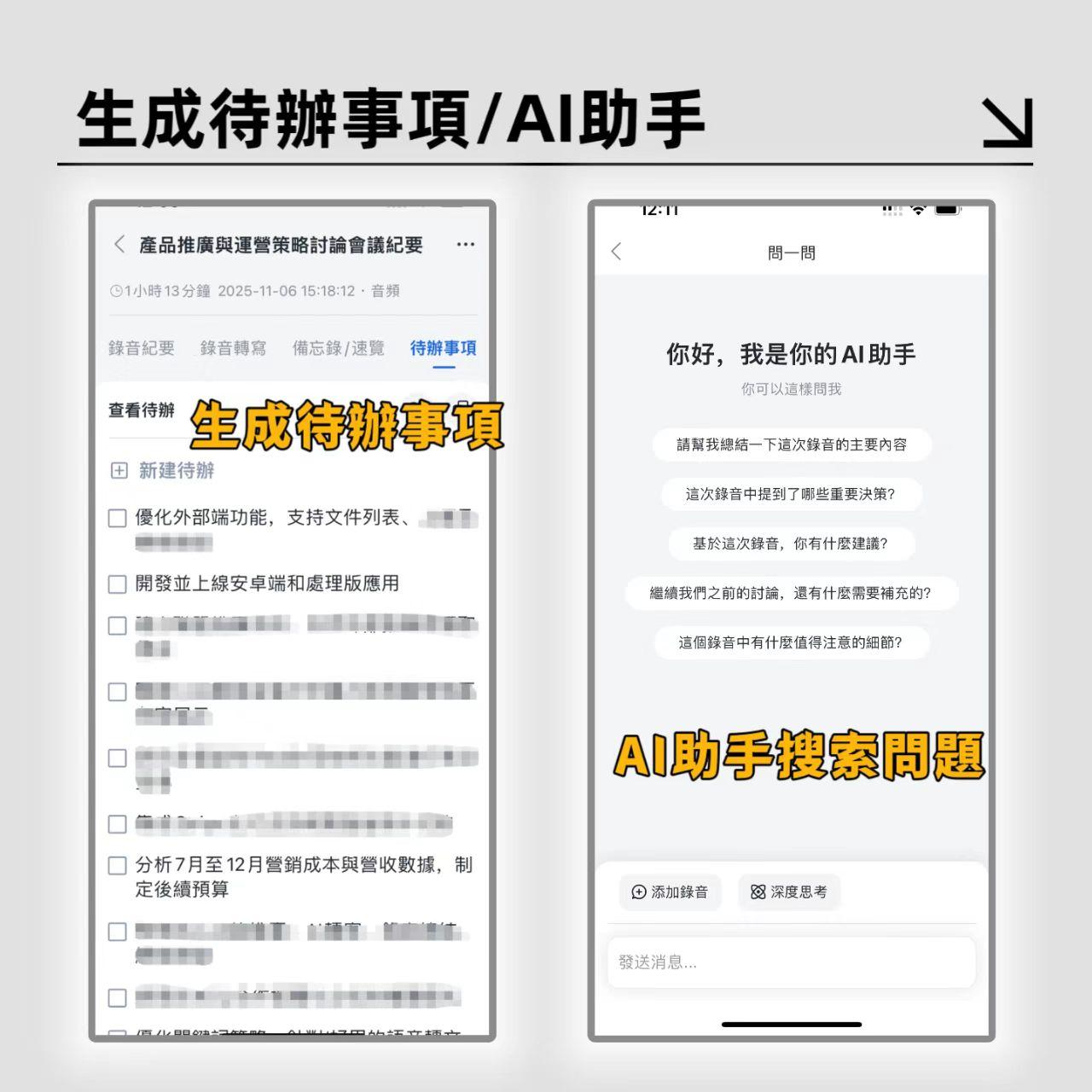
- Differentiator: Compared to traditional voice recorder apps, Tinrec features an "AI chat query" function. You can directly ask the AI: "What was the budget mentioned in today's meeting?" without having to listen to the entire recording.
4. Evernote
- Best for: Long-time users who are accustomed to using Evernote for notes.
- Pros: Suitable for 5-30 minute recordings; audio files are saved in notes and refined by AI with segmentation.
- Note: Occasionally, Traditional Chinese may be recognized as Simplified Chinese, requiring secondary correction.
Stop organizing recordings by hand
Upload audio or video and automatically get a transcript, summary, and action items
5. NotebookLM
- Best for: Organizing "already recorded" ultra-long meeting files or academic symposiums.
- Pros: Designed by Google for data organization; can upload large audio files and use AI for deep Q&A and summarization.
- Note: Not suitable for "real-time" recording scenarios; workflow is more suited for "post-analysis."
6. Google Live Transcribe
- Best for: Android users needing a portable dictation device, hearing assistance.
- Pros: Real-time transcription; works for long sessions without interruption.
- Note: Output text is "raw transcription," lacking refinement and punctuation; error rate for Traditional Chinese character selection is relatively high; best for preserving raw material.
7. ChatGPT / Gemini
- Best for: Brainstorming, organizing scattered thoughts into articles.
- Pros: Strongest understanding ability; can rewrite fragmented speech into coherent emails.
- Note: Uploads can fail when the network is unstable; usually do not retain original audio, posing a risk of data loss.
3. Detailed Tool Feature Comparison Table
To help you choose more intuitively, we compared key dimensions of mainstream tools:

| Dimension | Tinrec (Second Listening Recorder) | Wispr Flow | Windows 11 | Evernote | NotebookLM |
|---|---|---|---|---|---|
| Primary Use Case | Meeting minutes & action transformation | Real-time voice input method | PC quick input | Note attachment recording | Database analysis |
| Platform Support | iOS, Android, Web | Mac, iOS, Win | Windows | All platforms | Web |
| Real-time Transcription | ✅ Supported (real-time display) | ✅ Supported (segment by segment) | ✅ Supported (sentence by sentence) | ❌ (Post-recording) | ❌ (Post-recording) |
| Save Audio | ✅ Cloud sync & save | ✅ Local save | ❌ No save | ✅ Note attachment | ✅ Cloud save |
| Language Support | Chinese/English/Japanese/Korean/Taiwanese etc. | Multiple languages | Multiple languages | Multiple languages | Multiple languages |
| AI Summary/Action | ✅ Meeting summary + to-do list | ✅ Text refinement only | ❌ Punctuation only | ✅ Summary | ✅ Deep analysis |
| Free Tier | 100 minutes per month | Limited trial | Free | Requires subscription | Free (with limits) |
4. Practical Tutorial: Build an "Record Now, Use After Meeting" Workflow with AI
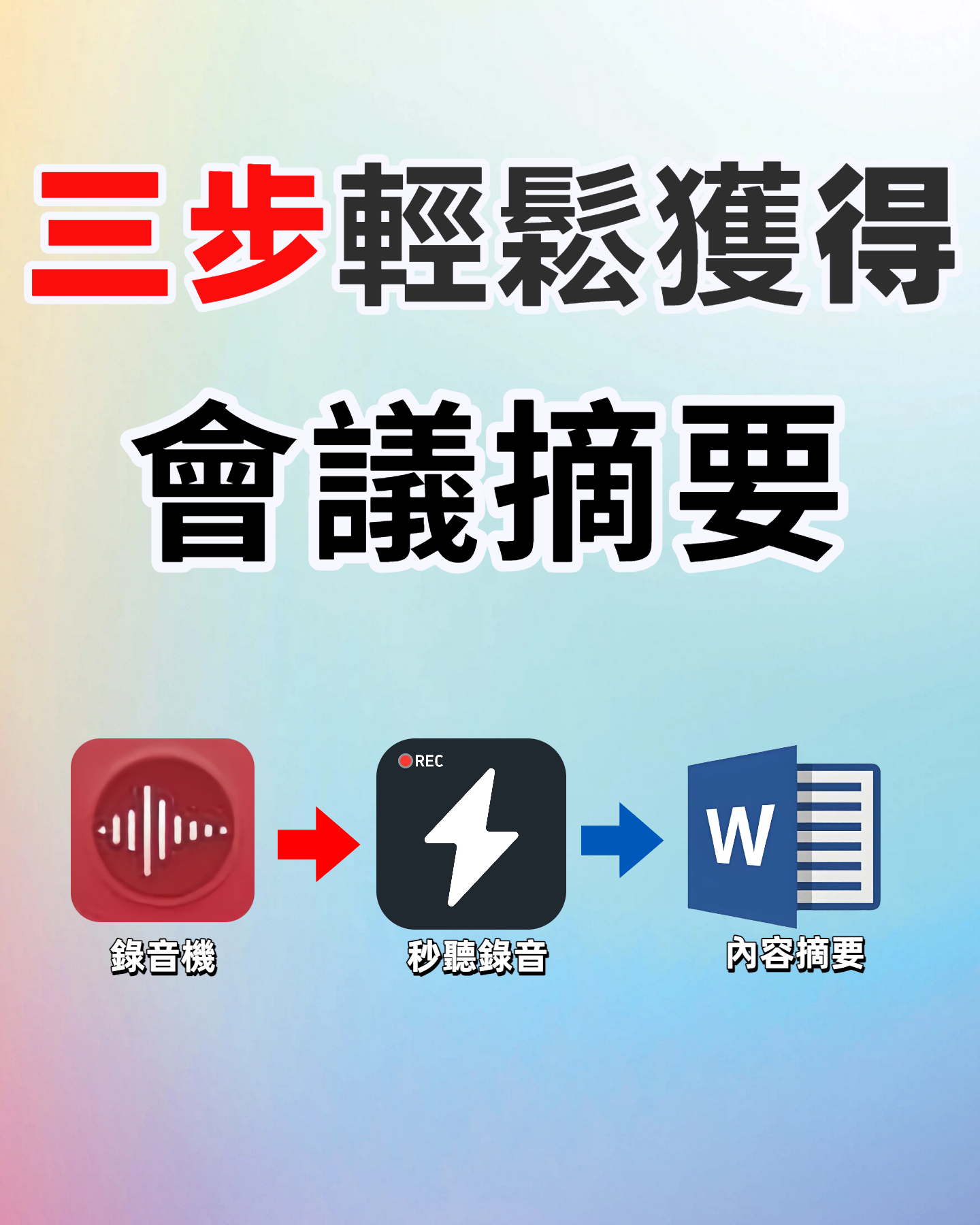
After choosing the right tool, you also need the correct process. Below, we use Tinrec as an example to show how to turn a 60-minute meeting into a 5-minute actionable note:
Step 1: Start Real-time Recording (or Import a File)
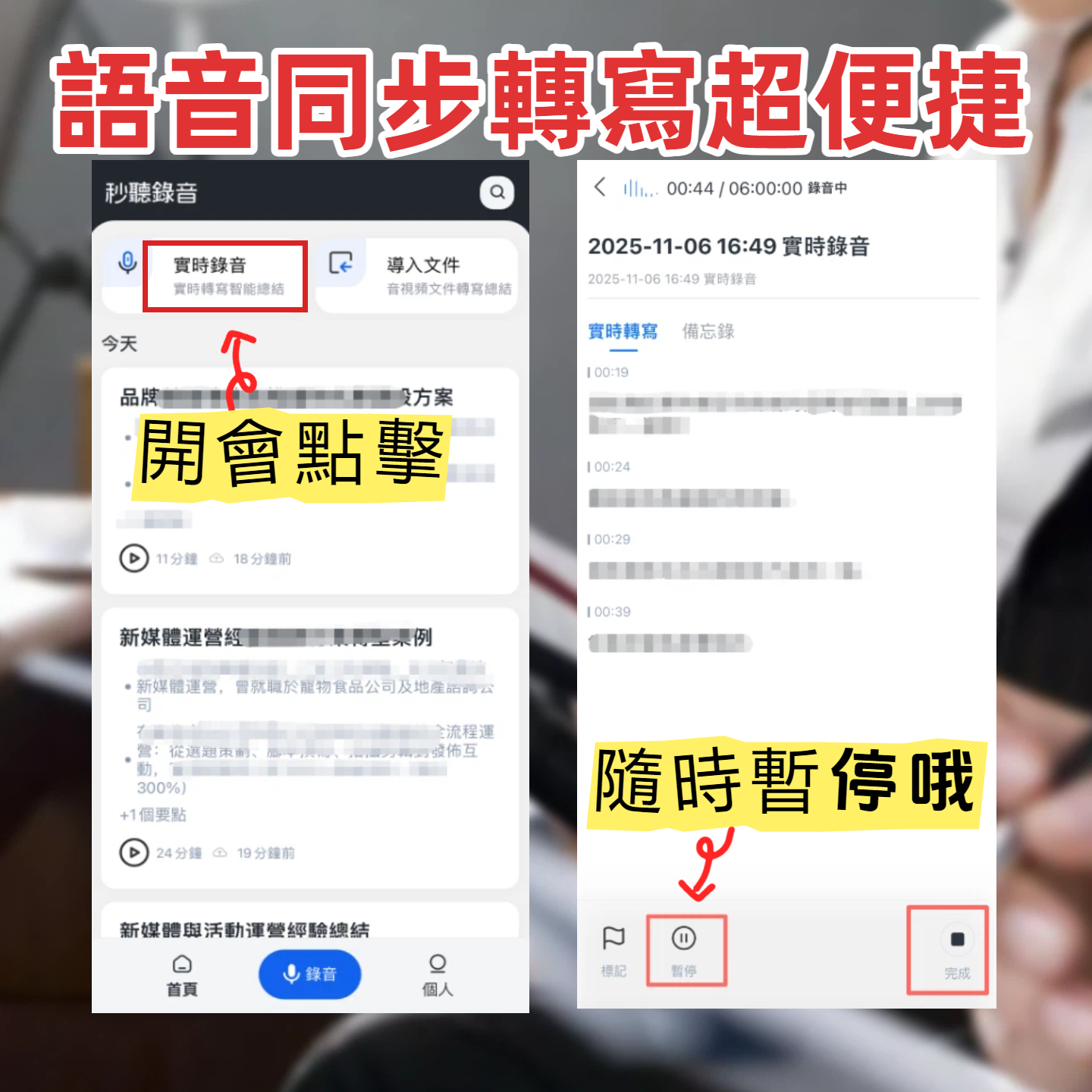
- In-person meeting: Open the app or web version, tap "Start Recording." Tinrec converts speech to text in real-time, displayed on the screen. This lets you visually "confirm" what you heard during the meeting.
- Online meeting/file: If using Teams or Google Meet, you can use the web version to record; if you have an existing audio file, use the Audio File to Text feature to upload.
- Link to Text: For YouTube videos or podcast links, you can also directly parse them via Video Link to Text.
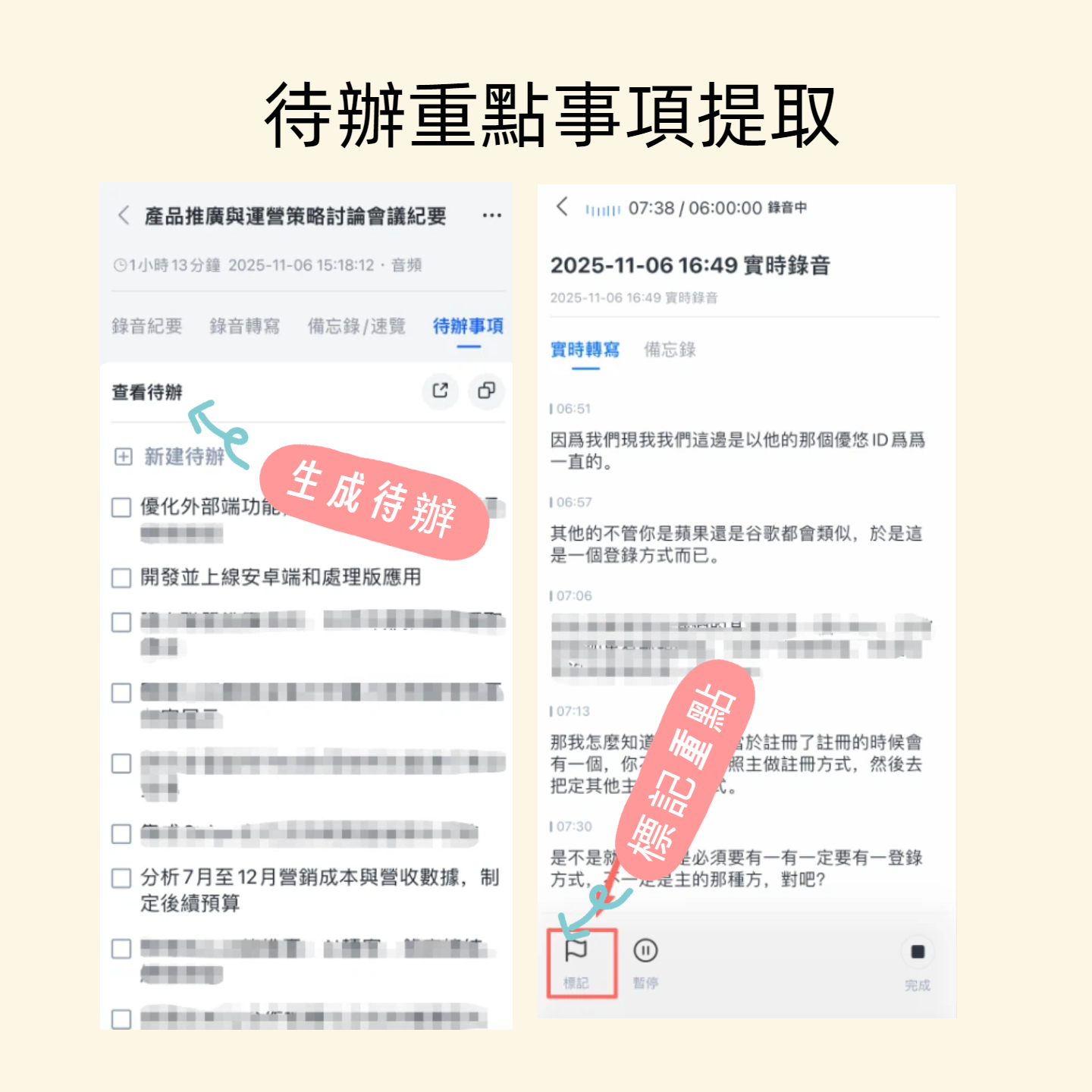
Step 2: Differentiate Speakers and Mark Key Points
- During recording, if you hear an important decision, tap the "Mark" button to quickly locate it later.
- The system automatically identifies different speakers (Speaker 1, Speaker 2). After the meeting, you can rename them to "PM," "Client," or "Manager."
Step 3: AI Automatically Generates Meeting Summary
- After recording ends, don't waste time reading the entire transcript. Directly tap AI Summary. Tinrec will generate based on your recording:
- Full Summary: Get the gist of one hour in one minute.
- To-do List: AI extracts sentences like "Submit report by next Friday" or "John is responsible for contacting the vendor" and automatically lists them.
Step 4: Use AI Chat to Query Missing Information
- This is the most efficient step. If you forget a detail, you don't need to re-listen to the audio; simply use the AI Chat Query function.
- Example questions: "What were the client's concerns about pricing?" "What was the deadline mentioned in the meeting?" The AI will answer based on the recording content.
5. Frequently Asked Questions (FAQ)
Q1: Will recording on iPhone be interrupted by incoming calls? Most recording apps work fine under normal use, but an incoming call can interrupt recording. It is recommended to enable Airplane Mode or Do Not Disturb on your phone for important meetings, or use Tinrec's web version on a computer.
Q2: If the meeting mixes English or Taiwanese, can the AI understand it? This depends on the tool's language model. Tinrec supports 10 languages including Chinese, English, Japanese, Korean, Cantonese, and Taiwanese, suitable for bilingual or multilingual meeting environments common in Taiwan. Google Live Transcribe also handles multilingual switching quite well.
Q3: What is the accuracy of speech-to-text? In a quiet environment, mainstream tools (e.g., Wispr, Tinrec, NotebookLM) usually achieve over 90% accuracy. In noisy environments or when multiple people speak simultaneously, accuracy decreases. It is recommended to use a directional microphone or place the phone near the main speaker.
Q4: What limits does the free version typically have? Most have time limits. For example, Tinrec offers 100 free minutes per month; Evernote's free version has note size limits; Windows 11 is free but lacks file saving. Choose a plan based on your monthly usage.
Q5: Can I transcribe YouTube videos or podcasts? Yes. Tinrec and some online tools support a "link to text" feature—just paste the URL to generate a transcript and summary, very useful for quickly digesting long video content.
Q6: Is the privacy of recording files secure? It's important to choose a reputable service. Windows voice input processes locally without saving; Tinrec and Evernote provide encrypted cloud storage. If handling highly confidential meetings, check the tool's privacy policy.
Turn every recording into actionable outcomes
Get 60 free transcription minutes when you sign in. No credit card required.
Related Reading
You might also like

Which Speech-to-Text Tool Is Best? A Practical Comparison and Buying Guide for Traditional Chinese Users
Compare Tinrec, Otter, Fireflies, Granola, and more across four dimensions: Traditional Chinese transcription quality, bot-free recording, post-meeting outputs, and team collaboration, to help professionals in Taiwan and Hong Kong choose the best speech-to-text solution.
Which Speech-to-Text Tool Is Easiest to Learn? A Guide Based on Learning Curve
Compare the ease of learning of popular speech-to-text tools from a learning cost perspective, and get a complete workflow from recording to usable meeting notes to help sales, product development, and government employees get started quickly.

How to Choose the Best Recording-to-Text Tool in 2026: A Complete Guide from Transcripts to Actionable Meeting Minutes
This article compares the leading recording-to-text tools in 2026, covering capture methods, Chinese language support, post-meeting outputs, and team collaboration. It helps sales, business, and product development professionals select the most suitable tool based on meeting type and team size, and master the complete workflow from recording to actionable meeting minutes.
Which Speech-to-Text Tool Is Easiest to Learn? Choosing the Most Beginner-Friendly Option Based on Learning Cost
Looking for an easy-to-learn speech-to-text tool? This article starts from learning cost, compares the ease of learning of mainstream tools, breaks down the key steps to get started quickly, and provides recommendations for different groups such as sales, product R&D, and government employees, helping you learn and start using a tool in the least amount of time.

How to Choose the Best Recording-to-Text Tool in 2025: From Transcripts to Actionable Meeting Minutes
Meeting recording-to-text tools are no longer just about transcription. This article compares Tinrec, Otter, Fireflies, Notta, Granola, and other mainstream tools in terms of capture methods, Chinese language support, and post-meeting outputs, and explains how to generate action items from transcripts and build team knowledge, helping you choose the right tool for your meeting scenarios.

2026 Free Speech-to-Text Solutions: 5 Tools Compared
PTT hotly discusses speech-to-text apps. We tested Tinrec and 4 other tools, comparing free quotas, Cantonese accuracy, and AI features to help you save time on meeting notes.

4 Best Recording-to-Text Tools in 2026: How to Choose Based on Free Credits and AI Features
We tested the latest 4 recording-to-text tools in 2026, from free credits to AI Q&A and bot-free recording, to help you find the most time-saving option.

Tinrec vs Otter.ai in 2026: A 5-Dimension Comparison for Chinese Users
We tested Tinrec and Otter.ai for Chinese meetings, bot-free recording, AI Q&A, cross-platform support, and team collaboration to help you choose the right transcription tool and save overtime hours.

5 Best Recording-to-Text Tools in 2026 Compared: Tinrec vs MyEdit, Yating, and More
After testing multiple free recording-to-text tools, here's why Tinrec became my go-to for meeting notes from a mid-level manager's perspective—and whether the free plan is enough.