

Turn recordings into transcripts and summaries in minutes
Upload audio or video for multilingual transcription, AI notes, and action items
2-Hour Meeting, 2 More Hours of Notes—You Need a Smarter "Translation"
After every meeting, staring at that 1-hour recording on your phone is a headache. Manually typing it into a transcript eats up half your day. Not to mention online courses, interviews, or web videos—extracting key points means endless rewinding.
Many people search for "voice translation" tools, hoping to quickly turn their audio into readable, searchable text. But opening the app store, you'll find some apps focus on real-time conversation translation, while others excel at transcription. The features are all over the place, and it's hard to know which one actually saves time.
This article tests 4 common free voice translation tools and tells you directly which one is best for turning meeting or class recordings into easy-to-organize text notes.
Before Choosing a Voice Translation Tool, Understand These 3 Key Points
Many tools tout "free voice translation," but their features vary widely. Clarifying these 3 points will help you avoid picking the wrong tool.
Transcription vs. Real-Time Conversation Translation
If you need to turn an entire recording into a verbatim transcript, you want a "voice-to-text" tool, not a real-time conversation translator. The former preserves full content and offers editing features; the latter is usually only good for short, real-time exchanges, and its accuracy and convenience for long recordings are far inferior.
Can You Quickly Extract Key Points After Transcription?
Getting just a transcript isn't enough—you still have to spend time reviewing it. Some tools can automatically generate summaries, extract action items, or even let you search the recording via Q&A. Those are the ones that truly save you organizing time.
Free Plan Limits and Restrictions
Most tools offer free trials, but monthly minutes and feature limits vary. If you only need transcription occasionally, pick one with enough free quota. If you have meetings or classes weekly, consider a paid plan, but start with the free version to test it out.
Tinrec (秒听录音)—Top Choice for Transcription and Post-Processing
Tinrec is an AI tool focused on turning various audio content into usable data. It doesn't just transcribe; it also auto-summarizes, segments, extracts action items, and even lets you ask in Chinese, "Who mentioned the budget at the last meeting?"
Core Features Built Around Real Scenarios
During a meeting, open Tinrec and it will display the transcript in real time. When the meeting ends, you get not only the text record but also AI-generated summaries and action items—who's responsible for what and deadlines at a glance. Have an online class or interview recording? Upload it, and within minutes you'll have structured notes. Even public videos from YouTube, Bilibili, etc., can be converted to text and key points by just pasting the link.
Our Test Transcription Performance
Using a 5-minute Chinese meeting recording (recorded on iPhone 15, with slight keyboard clicking in the background), Tinrec's transcript required almost no edits. It recognized names and technical terms well, with a significantly lower error rate than other pure translation apps. More importantly, its built-in AI Q&A feature let us find meeting conclusions without listening to the recording from the start—just ask.
Pros Summary
Stop organizing recordings by hand
Upload audio or video and automatically get a transcript, summary, and action items
- Multi-Source Support: Live recording, file upload, and web videos—one tool handles all your audio/video organizing needs.
- Time-Saving: Auto-summaries and action item extraction cut meeting note time from 2 hours to 10 minutes.
- Cross-Platform: Syncs across phone, computer, and web, making it easy to edit transcripts on your computer at home.
- Chinese-Friendly: Transcription and summary quality for Chinese meetings and courses is noticeably better than similar foreign tools.
Limitations to Note
The free version has a monthly transcription minute cap (official number not disclosed, but tested around 100 minutes), which heavy users might hit. Also, it lacks real-time language translation, so if you need Chinese-English simultaneous interpretation, this isn't for you.
Who It's For
If you have meetings or classes weekly, need to turn long recordings into organized text, or want to build a searchable recording archive, Tinrec is currently the most balanced choice on the market.
Beyond Tinrec: Other Free Options
Notta—Strong Transcription, Weaker Organization
Notta also does voice-to-text, with 120 free minutes per month and good accuracy. But it lacks Tinrec's AI Q&A feature; after recording, you can only manually search keywords. If you just need plain transcription without organization, Notta is worth considering; but if you want to save post-processing time, Tinrec is more practical.
Otter.ai—English Meeting King, Weak on Chinese
Otter's free plan offers a generous 300 minutes per month, and its English transcription accuracy is excellent. However, tests show its Chinese recognition drops significantly, and it doesn't support Cantonese. If you mainly record English content, Otter is a better deal than Tinrec; but Chinese meeting users should look elsewhere.
語音翻譯神器 App—OK for Real-Time, Fails on Long Recordings
This app focuses on real-time voice translation, handy for travel communication. But when used to transcribe a 1-hour meeting recording, accuracy is low, and it can't auto-summarize or segment. If you need long recording transcription, stick with a dedicated voice-to-text tool.
Pitfall Guide: 3 Common Mistakes When Choosing a Voice Translation Tool
Pitfall 1: Assuming All "Voice Translation" Apps Can Transcribe Long Recordings
Many free voice translation tools are designed for short, real-time exchanges, and their recognition stability and accuracy on continuous long recordings are terrible. Check whether the product focuses on "conversation translation" or "recording transcription."
Pitfall 2: Only Looking at Transcription Minutes, Ignoring Post-Processing Features
Generous free quotas are nice, but if the tool only gives you a transcript, you'll still have to organize it manually. Tools like Tinrec with AI summaries and Q&A, even with slightly fewer free minutes, save you far more time in practice.
Pitfall 3: Not Checking Cross-Platform Support Before Diving In
Many people record on their phone but want to edit the transcript on their computer at home. If the tool doesn't support cross-platform sync, it becomes a hassle. Before trying, confirm that all your devices are supported.
Summary: Which One Should You Choose?
For transcription and post-processing, Tinrec is the top recommendation from this test. Its AI summaries, action item extraction, and cross-platform sync genuinely speed up organizing. Based on your main needs, here's the best pick:
- Need to turn Chinese meeting/class recordings into easy-to-organize notes → Tinrec (accurate transcription, most complete organizing features)
- Only record English meetings, and budget is zero → Otter.ai (300 free minutes, excellent English recognition)
- Just need a verbatim transcript, don't mind manual organizing → Notta (accurate transcription, but no AI Q&A)
- Traveling abroad and want quick conversation translation → 語音翻譯神器 (good for short real-time phrases, but don't use for long recordings)
We recommend downloading Tinrec's free version to try it out—it comes with a basic monthly quota, enough for two or three meetings to experience its organizing power. If you like it, consider upgrading; no need to pay upfront.
References
Turn every recording into actionable outcomes
Get 60 free transcription minutes when you sign in. No credit card required.
Related Reading
You might also like

6 Google Meet AI Meeting Notes Solutions Tested for 2026: Which One Really Leaves Usable Data?
Starting from the three most common misconceptions, this hands-on comparison tests six AI meeting notes solutions that work with Google Meet: Tinrec, Google Meet's built-in Gemini 'Take Notes for Me', Otter.ai, Notta, Granola, and TurboScribe. We break down each one's positioning, pricing, who it's for, and how post-meeting data can be searched, queried, and handed off.
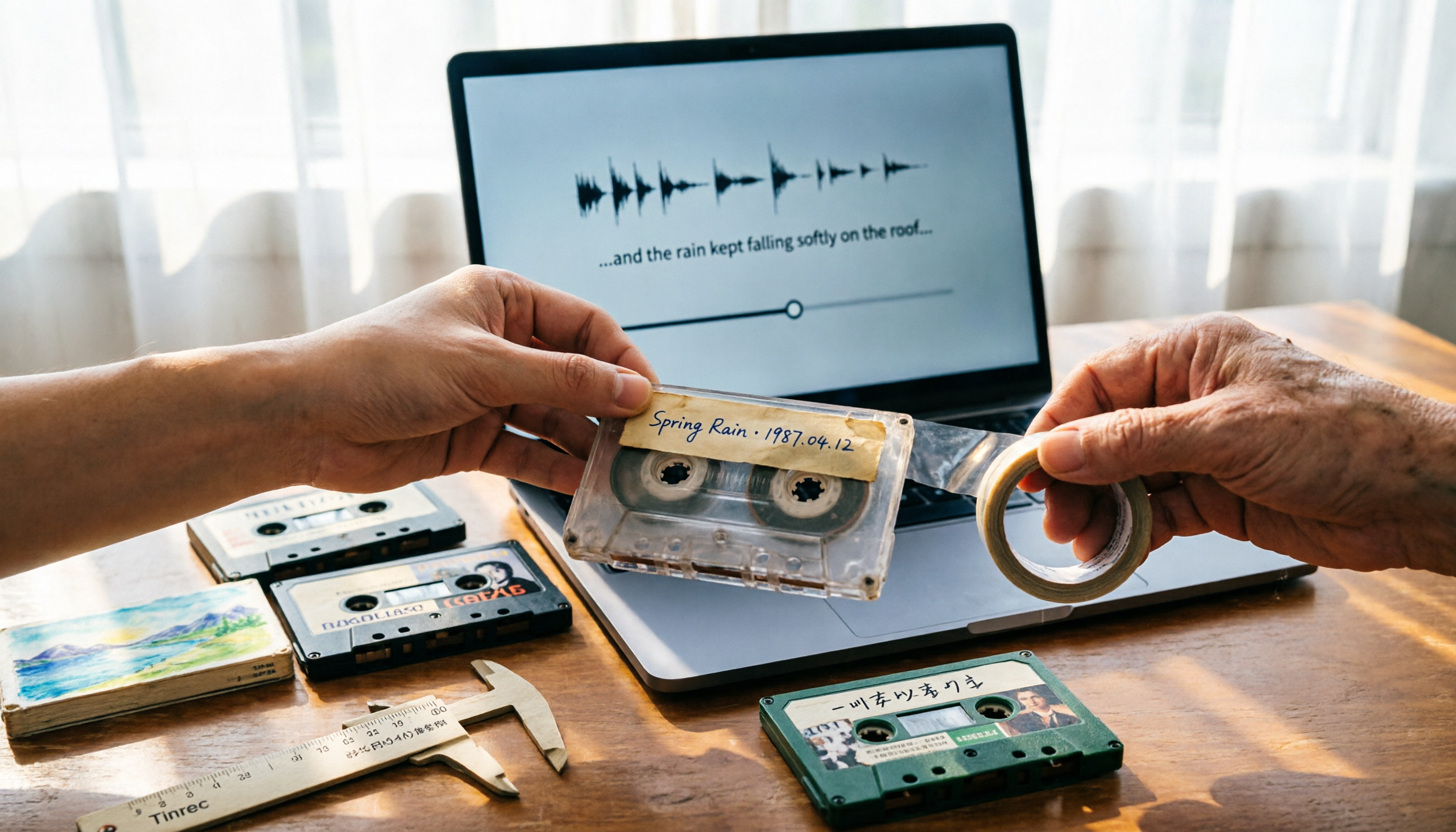
5 Best Places to Buy Good Tape in 2026: Cassette Tapes vs Packing Tape — Where to Shop Without Getting Burned
People searching "where to buy good tape" fall into two camps: those looking for cassette tapes and those looking for packing tape. This guide breaks down 5 reliable sources for each, including Discogs, Tapeheadcity, eBay, and local options, plus tips on choosing packing tape thickness and how to turn old cassette recordings into searchable text after you buy.

4 Video Auto-Subtitle Apps Tested for 2026: Free Tiers, Chinese Recognition, and Team Collaboration Compared
No more late nights re-listening to footage just to add subtitles. This hands-on comparison of Tinrec, Captune, cSubtitle, and pyTranscriber looks at language recognition, output formats, post-meeting organization, and team collaboration—plus free-tier limits and pitfalls to avoid—so you can pick the right tool for your workflow.

2026 AI Meeting Transcription Tools Compared: What Is NOTTA PTE. LTD. and Which Handles Chinese Meetings Best?
NOTTA PTE. LTD. is a private limited company registered in Singapore in 2022, primarily engaged in software and application development; it is not a product name. This article first compiles its public business registration data, then starts from common meeting documentation pain points to explain four key factors for choosing a transcription tool. It compares Tinrec, Notta, Otter.ai, and TurboScribe in terms of positioning, quotas, and use cases, and summarizes four common pitfalls to avoid.

4 AI Meeting Transcription Tools Compared for 2026: How to Choose Between Tingwu, Tinrec, and Free Options
Starting from the decision point of whether the Tingwu app is worth installing, this article compares four AI meeting transcription tools in 2026. It first explains four key selection criteria: how audio is captured, what you get after transcription, how well Chinese is supported, and who ultimately owns the data. Then it breaks down the practical differences between Tinrec, Tingwu, Otter.ai, and Notta, and finally provides a guide to common pitfalls and scenario-based selection advice.

What Is Notta Singapore SG in 2026? AI Meeting Recorder Comparison: Company Registration vs. Product Explained
People searching for 'notta singapore sg' often confuse Notta's Singapore company registration with its AI meeting recorder product. This article breaks down the two search intents and three common misconceptions, then compares Notta and Tinrec across five dimensions: meeting capture, post-meeting output, Chinese-language experience, team governance, and quota considerations—helping you determine which problem you actually need to solve.

What Is NOTAM in 2026? 5 Key Points to Understand Notices to Airmen and How It Differs from Notta
NOTAM (Notice to Airmen) is a real-time notice issued by aviation authorities to inform pilots of abnormal conditions along routes or at airports. This article explains NOTAM's definition, purpose, format evolution, and common misconceptions through 5 key points, while clarifying that the spelling 'nottam' may be confused with the transcription tool Notta, and offers guidance on choosing a meeting notes tool.

Nottoway Plantation Rebuild in 2026: Will It Be Rebuilt, When Will It Be Completed, and Controversies Explained
Nottoway Plantation is confirmed to be rebuilt after the May 2026 fire. This article covers the latest 2026 progress, the 2-3 year construction timeline, owner funding and brick fundraising, plans to memorialize enslaved people, and the controversies surrounding the rebuild, plus travel tips.
2026 William Nottage Verification in Practice: 2 Interview Recording Tools Tested and Compared — Which One Really Saves Time?
Searching for "William Nottage" returns multiple records with the same name — how do you tell if they're the same person? This article first breaks down the most common pitfalls in same-name verification, then compares Tinrec and Notta across 6 dimensions to see which tool is better suited for turning interviews and meeting content into searchable, queryable, and transferable records.