
Turn recordings into transcripts and summaries in minutes
Upload audio or video for multilingual transcription, AI notes, and action items
Do you often feel like meeting notes are never-ending? Faced with lengthy meeting recordings, just listening back can take hours, and you often miss the key points. If you've ever felt anxious about "which one is the decision point?", then what you need is an "AI meeting summary software".
This article reviews the popular AI summary tools on the market in 2026, including hardware-focused Plaud Note, English-specialized Otter.ai, and Tinrec, which emphasizes software integration and action item management. We will compare them in terms of "recognition accuracy", "free quota", "features", and provide practical tutorials.

Quick Navigation Conclusion:
- If you prefer a physical recorder and have a sufficient budget: Plaud Note is the top choice for hardware integration.
- If you value cost-effectiveness and "post-meeting action management": Tinrec provides a complete workflow from recording to summary to to-do list.
- If you work in an all-English environment: Otter.ai's English recognition remains the market benchmark.
Why Do You Need AI Meeting Summary Software?
AI summary tools are not just about converting speech to text; they are great helpers in solving the modern workplace "information overload". Traditional recorders can preserve sound, but the information density is extremely low, and the cost of replaying is high. The new generation of AI tools mainly solves three major pain points:
- Save time: Convert a 2-hour meeting recording into a 500-word summary in minutes.
- Extract action items: Automatically filter out chit-chat and identify "who" needs to complete "what task" and "by when" (To-Do List).
- Multilingual processing: For cross-border meetings or foreign language classes, AI can recognize and translate in real time, lowering the comprehension barrier.
2026 Selected 7 AI Meeting Summary Tools Review
Below, based on free plan, accuracy, usability, and extensibility, we have compiled 7 tools worth considering.
1. Plaud Note - Top Choice for Hardware Integration
Plaud Note is a product that combines dedicated hardware (card-sized recorder) with an app. Its biggest feature is attaching to the back of the phone via MagSafe, solving the limitation of iPhone not being able to record calls.
- Free plan: 300 minutes of transcription per month.
- Target users: Business professionals who are used to physical recorders and have frequent call recording needs.
- Pros: One-touch recording, integrated GPT and Claude models, high-quality summaries.
2. Notta - Veteran in Business Meetings
Notta is well-known in the business circle, supporting real-time transcription and real-time translation, especially suitable for cross-border online meetings. It can identify different speakers and integrate with Zoom and Google Calendar.
- Free plan: 120 minutes of transcription per month.
- Target users: Cross-border teams, meeting scenarios requiring real-time translation subtitles.
3. Tinrec - All-in-One Assistant Focused on "Understanding and Action"
Tinrec is an AI software tool emphasizing "from recording to action", supporting iOS, Android, and web. Compared to other tools, Tinrec particularly strengthens the "AI chat query" feature, allowing users to retrieve recording content via Q&A, rather than just reading transcripts.
- Free plan: 100 minutes of recording transcription per month.
- Paid advantage: Basic plan costs only $4.9 per month for 600 minutes, offering great value.
- Key features:
- Multi-device sync: Record on phone, view on computer, seamless transition.
- Smart summary: Automatically generate meeting minutes, conclusions, and action items.
- Video to text: Import YouTube or Podcast links to directly produce summaries.
- Target users: Office workers and students who value cost-effectiveness and need to organize a large number of meeting action items.
4. Otter.ai - Dominant in English Meetings
Otter.ai is widely used in European and American enterprises, specializing in English speech recognition. Although Chinese support is weaker, in all-English environments, its recognition speed and accuracy are very high.
- Free plan: 300 minutes per month.
- Target users: Foreign companies, all-English meeting environments.
Stop organizing recordings by hand
Upload audio or video and automatically get a transcript, summary, and action items
5. Claude - Expert in Long Text Summaries
Although Claude itself is an AI model rather than dedicated recording software, many people paste transcripts into Claude for summarization. It performs well in contextual understanding of long texts.
- Target users: Academic researchers, users needing in-depth analysis of long papers or reports.
6. Google Gemini - Free Web Summary Tool
Google users can directly use Gemini to summarize YouTube videos or web content. It is very convenient for quick information access and is completely free.
- Target users: General public, those needing to quickly browse online information.
7. ChatGPT - High-Freedom Instruction Operation
Through ChatGPT, you can paste transcripts and give specific prompts, such as "Please summarize the meeting key points in bullet points."
- Target users: Advanced users who prefer customized output formats.
Comparison: AI Summary Software Features and Pricing
To help you understand the differences, we have compiled the following comparison table:
| Tool | Core Positioning | Free Quota/Month | Languages Supported | Key Features | Best For |
|---|---|---|---|---|---|
| Plaud Note | Hardware recorder integration | 300 minutes | Multilingual | Call recording, physical button | Face-to-face interviews, phone conferences |
| Tinrec | Software all-in-one assistant | 100 minutes | Chinese, English, Japanese, Korean, etc. 10 languages | AI chat query, action item extraction, video link to text | Team meetings, lecture notes, content creation |
| Notta | Online meetings | 120 minutes | Multilingual | Real-time translation, calendar integration | Cross-border online meetings |
| Otter.ai | English voice | 300 minutes | English primarily | Strong English real-time recognition | English-speaking work environments |
| Google Gemini | Information retrieval | Free | Multilingual | Direct YouTube/web page summary | Personal learning, online data organization |
Practical Tutorial: How to Complete Meeting Minutes in 3 Steps with AI Tools
After choosing a tool, how do you apply it in actual work? Below, using Tinrec's operation logic as an example, we demonstrate how to turn a meeting into an action list:
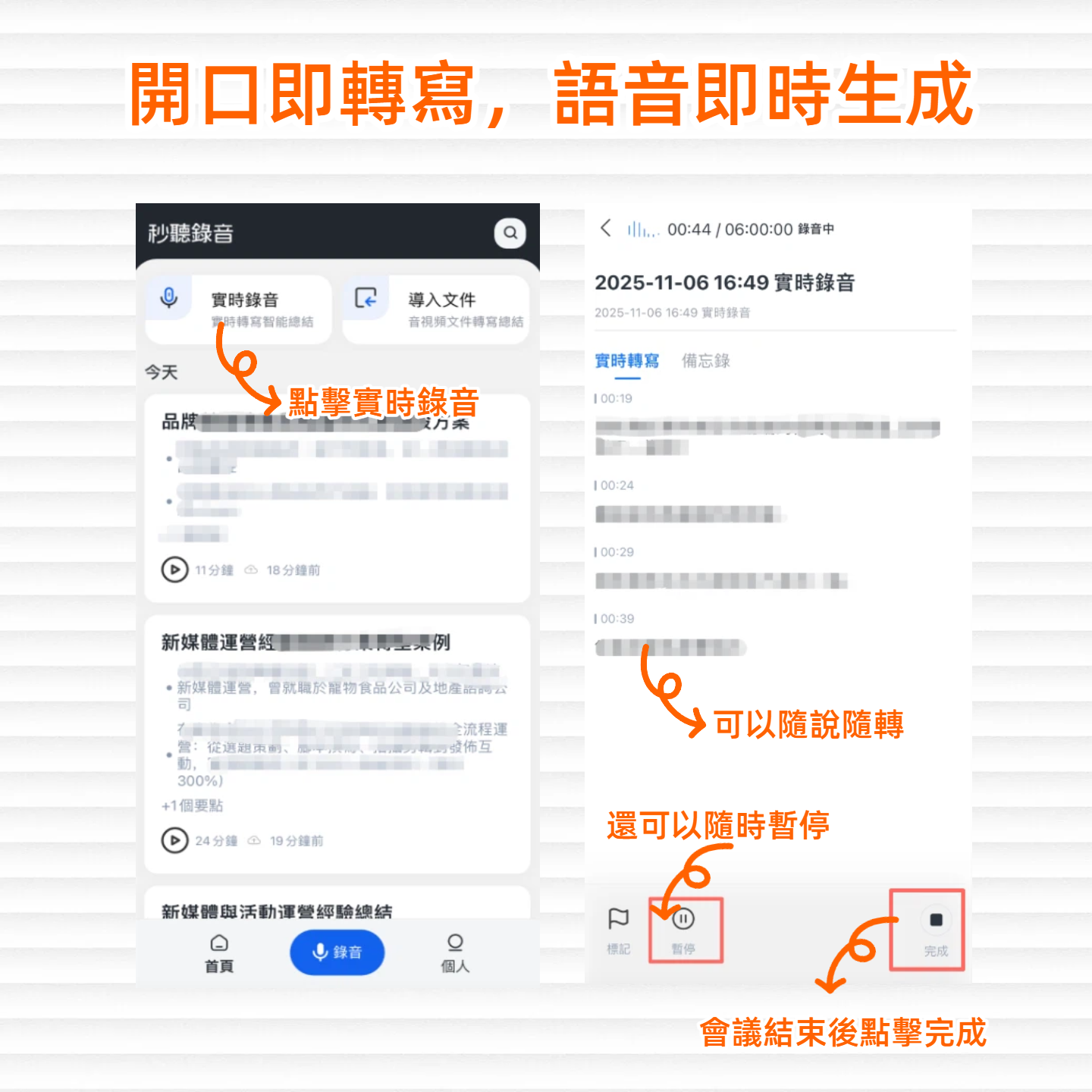
Step 1: Start Recording or Import Files
At the start of the meeting, open the app and click "Real-time recording to text". For online meeting recordings or web podcasts/YouTube videos, you can import via "Audio file to text" or "Paste link".
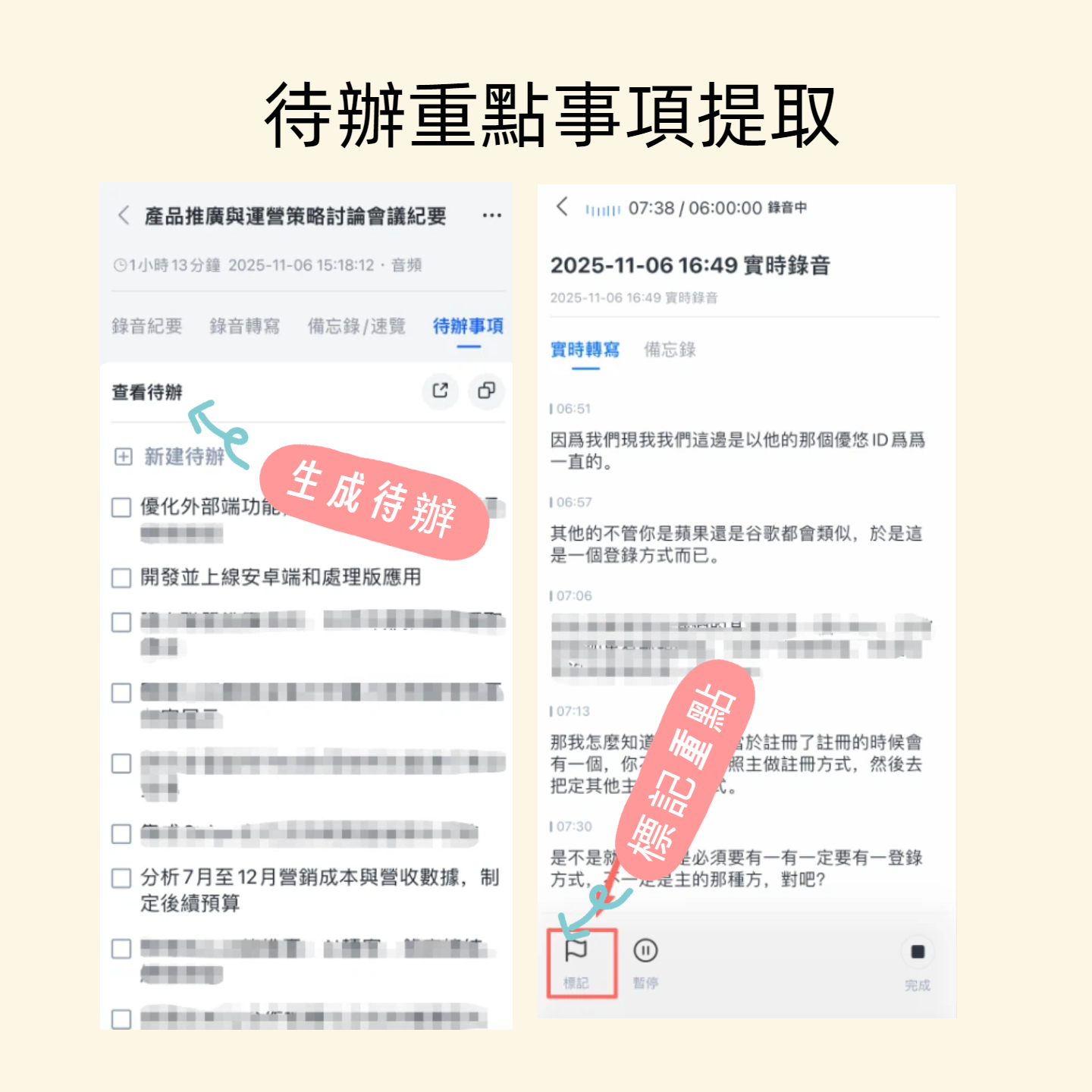
Step 2: Get Transcript and AI Summary
After recording ends, the system automatically transcribes. Besides a transcript with speaker labels, AI simultaneously generates a "meeting summary", automatically summarizing:
- Meeting conclusions
- To-Do List
- Key decision points

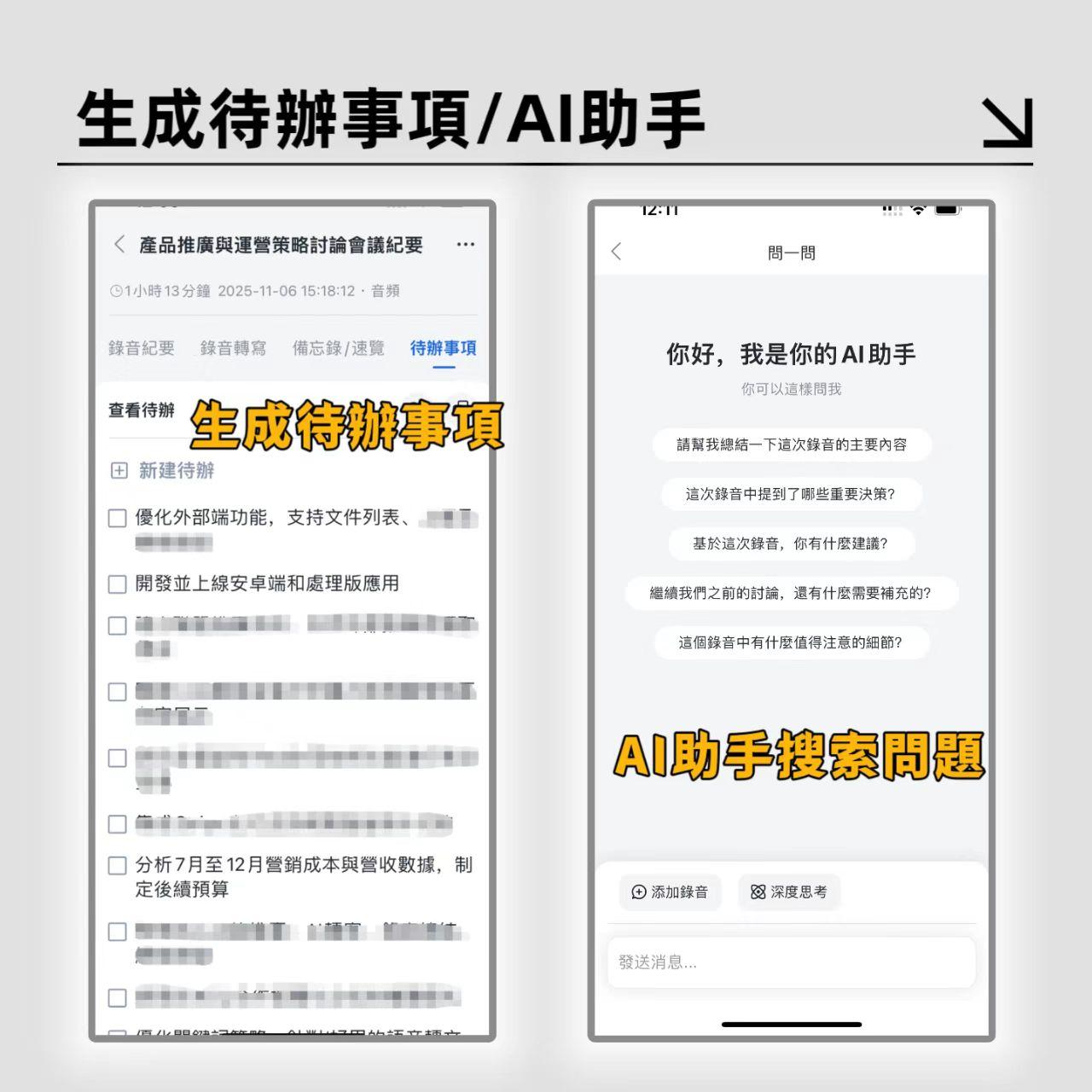
Step 3: Use AI Chat Query for Missing Details
This is a feature ordinary recorders cannot do. If you want to confirm "What was the manager's specific opinion on the budget?", no need to replay the recording. Simply enter your question in Tinrec's "AI chat query" field, and AI will answer directly based on the recording content, indicating the timestamp in the original audio.
Frequently Asked Questions (FAQ)
Q1: Can these tools record phone calls on iPhone? Due to iOS privacy policies, apps usually cannot directly record regular phone calls. If you need this, you must use a hardware recording device like Plaud Note, or use speakerphone and record with another device (e.g., a phone or computer with Tinrec).
Q2: What if I run out of free quota? Most tools use a subscription model. It's recommended to first use the free quota to test Chinese recognition accuracy. For example, if Tinrec's free 100 minutes run out, the Basic plan (~$4.9/month) expands to 600 minutes, which is sufficient for most office workers.
Q3: Are my recordings secure? When handling business secrets, security is critical. When choosing a tool, ensure it has data encryption technology. Reputable services (such as Plaud, Notta, Tinrec) typically have cloud encryption and user data deletion rights to prevent data leaks.
Q4: Can it recognize Taiwanese or Cantonese in meetings? Current AI models mostly support multilingual recognition. Tinrec supports 10 languages including Chinese, Taiwanese, Cantonese, English, Japanese, etc., making it relatively friendly for Taiwan's common bilingual meeting environments.
Q5: What's the difference between a transcript and an AI summary? A "transcript" is a word-for-word conversion of all spoken content, usually very long and full of filler words. An "AI summary" is generated by the model after understanding, highlighting key points, conclusions, and action items. Efficient workers usually only read the summary and refer back to the transcript only when in doubt.
Q6: Can I use these tools to watch YouTube videos for learning? Yes. Some tools like Tinrec support direct input of YouTube or Podcast links; the system automatically downloads the audio and converts it into a text summary, which is very useful for organizing online course notes or competitor analysis videos.
Conclusion
Choosing the right AI meeting summary software can free you from tedious paperwork. It is recommended to first evaluate your core needs: do you need hardware recording (Plaud), an all-English environment (Otter), or a cost-effective software assistant emphasizing "action item management" and "AI query" (Tinrec)? Make good use of tools so that meetings are no longer time killers but starting points for productivity.
Turn every recording into actionable outcomes
Get 60 free transcription minutes when you sign in. No credit card required.
Related Reading
You might also like

How to Write a Meeting Summary Email: 3 AI Tools Tested in 2026, This One Works Best for Chinese Meetings
A meeting summary email isn't just pasting a transcript. This article breaks down the 3 most common mistakes in writing meeting summary emails, the 4 key structures you need to master, and tests Tinrec, Otter.ai, Granola, and Notta in Chinese meeting scenarios to help you produce a meeting recap email with clear decisions and action items in the shortest time.

4 AI Meeting Agents Tested in 2026: Which One Turns Meetings into Trackable Actions?
A hands-on comparison of 4 AI meeting agents in 2026, covering bot-free recording, Chinese transcription, AI Q&A, action item extraction, and team data governance. Tinrec is featured as the main example, with use cases for personal and team plans, pricing limits, and pitfalls to avoid.

2026 Cross-Department Meeting Notes Tools Compared: Which One Captures Decisions and Action Items?
Cross-department meeting notes often turn into verbatim transcripts, leaving decisions and action items lost after the meeting. This article starts with common pitfalls, outlines tool selection criteria, and compares Tinrec, Otter.ai, Notta, and Granola in hands-on testing, plus explains how to use team spaces to retain cross-department meeting data.

2026 Comparison of 4 Sales Meeting Follow-Up Email Tools: How AI Summaries Save Time
After a meeting, the client disappears—how do you write a follow-up email that gets a reply? This article breaks down practical approaches to sales meeting follow-up emails and uses Tinrec to demonstrate the complete workflow from meeting recording, transcription, AI summaries, to action item extraction, with 5 key considerations for choosing a tool and FAQs.
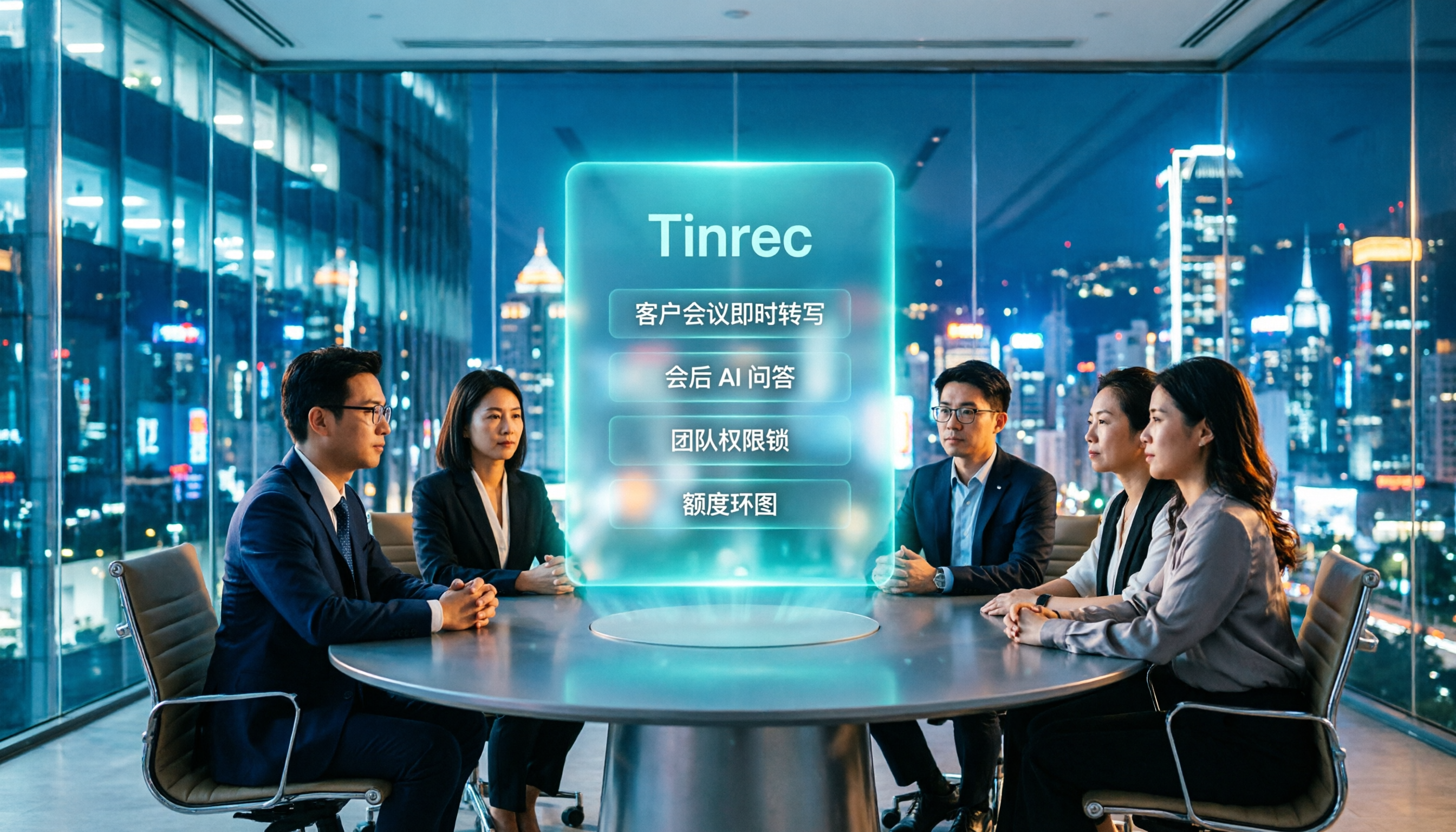
2026 AI Meeting Tools for Client Calls Compared: Tinrec vs Otter.ai vs Notta for Chinese-Language Meetings
How do you choose an AI tool for client meetings? We tested Tinrec, Otter.ai, and Notta across five dimensions—Chinese transcription, bot-free recording, post-meeting AI Q&A, team permissions, and pricing—to help teams find the best fit for recording client meetings.

What Is a Meeting AI Agent and Which One Is Best? 5 Tested in 2026 for Chinese Meetings and Team Knowledge Retention
A meeting AI agent is not just a faster typewriter. This article starts with common misconceptions, breaks down the three layers of meeting AI agents, and uses Tinrec as an example to explain bot-free meeting recording, AI Q&A, action item extraction, and team knowledge retention. It concludes with 5 key points to consider when choosing a tool.

How to Choose Meeting Collaboration Tools in 2026: 5 Steps to Tell Them Apart from Project Management Tools
Meeting collaboration tools vs. project management tools—which one actually fits your team? This article compares Tinrec and Asana across 5 dimensions, covering meeting notes, AI summaries, task tracking, team knowledge retention, and pricing, so you can pick the right tool based on your pain points.

Tinrec vs Notta 2026: 5-Dimension Comparison for Meeting Action Plan Software
After the meeting, who takes action? This article compares Tinrec and Notta across 5 dimensions—automatic to-do extraction, Chinese meeting experience, bot-free online meeting recording, and team data governance—to help you decide which is better for turning meetings into actionable plans.
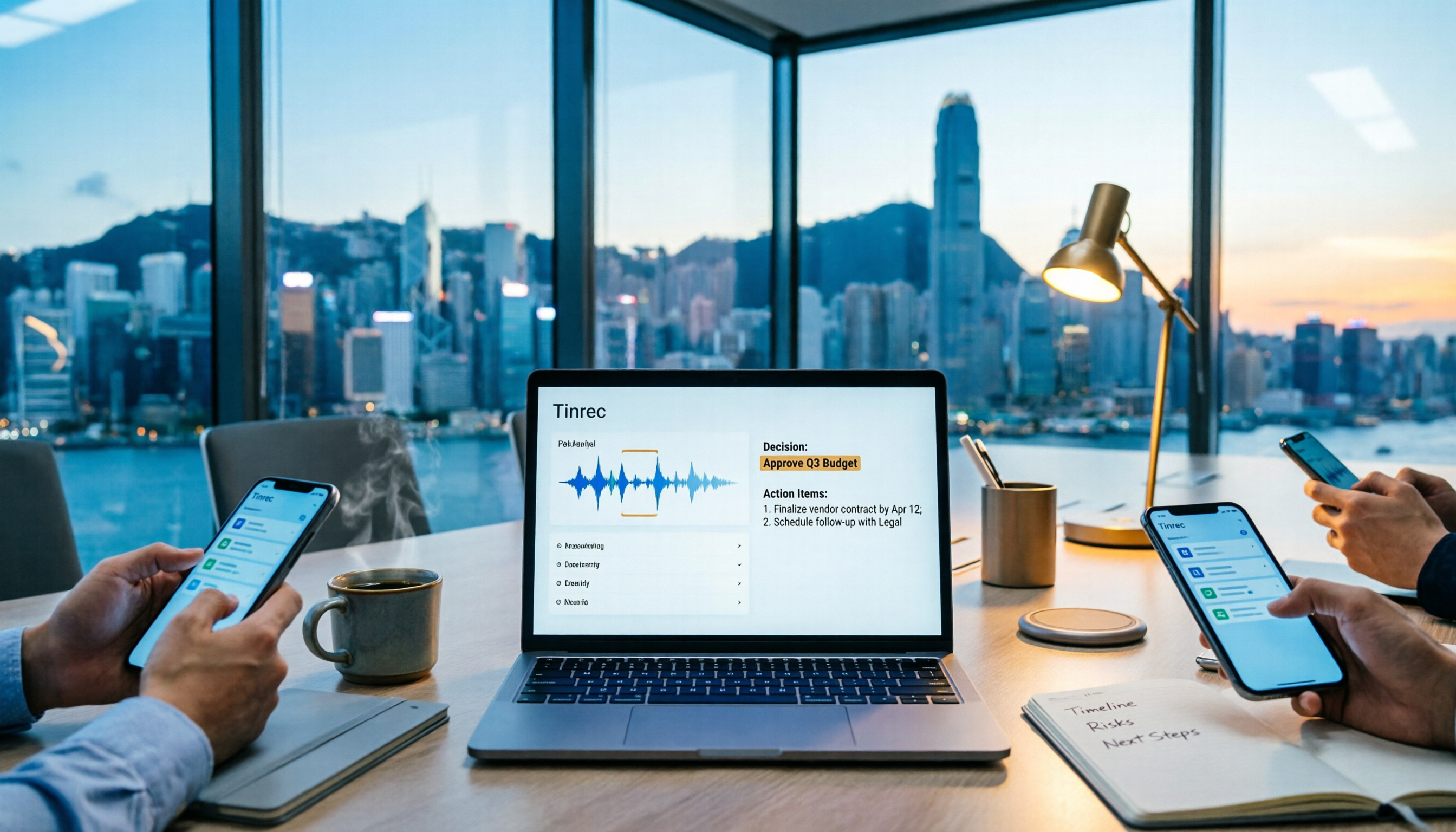
Tinrec vs PLAUD Note 2026: 6-Dimension Comparison for Project Meeting Minutes
Get a ready-to-copy project meeting minutes template, then compare Tinrec and PLAUD Note across 6 dimensions: recording capture, online meeting support, minutes generation, AI Q&A, team collaboration, and pricing structure. Decide between software and hardware for your project meetings.