
Turn recordings into transcripts and summaries in minutes
Upload audio or video for multilingual transcription, AI notes, and action items
Facing Cantonese meetings filled with "code-switching" (mixing English and Cantonese), or hours-long dialect interviews, generic speech recognition software often outputs gibberish, making subsequent transcription a time-consuming disaster. For administrative staff, students, and creators, choosing a tool that understands the dialect is key to saving hours of manual typing.
This article provides an in-depth review of 2026's dialect-optimized transcription tools, including a multi-dimensional comparison table, step-by-step tutorials, and FAQs.

Quick navigation suggestion: If you need ultra-precise video subtitles, consider Subanana first. If you prioritize meeting efficiency and want an end-to-end solution from recording to action items, Tinrec (Quick Voice Recording) is worth evaluating. For lightweight video creators, Taption offers a convenient web-based service.
Why Is Cantonese Voice-to-Text Especially Difficult? (Current Pain Points)
Most commercial speech recognition engines are trained on standard Mandarin or English. When encountering Cantonese—a language with strong regional characteristics and grammatical habits—they often face three major pain points:
- Frequent Code-Switching: For example, in tech launch events or foreign company meetings, speakers naturally switch between Cantonese and English professional terms, instantly confusing single-language models.
- Discrepancy Between Spoken and Written Language: Cantonese includes many colloquial characters (e.g., "嘅", "喺"). Without a "spoken-to-written" conversion function, the transcript becomes unusable for formal meeting minutes or articles.
- Background Noise Interference: In real meeting or interview scenarios with poor recording environments, generic software accuracy drops significantly, increasing manual proofreading time.
2026 Top Cantonese Speech-to-Text AI Tools: Comparison & Review
Tools on the market can be categorized by use case: "video post-production" and "productivity note-taking." Below is a breakdown based on test data and feature analysis.
1. Subanana: The Specialist for Cantonese Video Subtitles
According to in-depth reviews, this tool developed by a Hong Kong team excels in Cantonese recognition. In code-switching scenarios, accuracy reaches 97.5%; even with background noise, it maintains 93.4%. Its strength lies in "spoken-to-written" conversion, making it ideal for YouTubers and video creators adding subtitles.
2. Taption: A Lightweight Option for Video Creators
Taiwan-based online tool Taption offers a user-friendly interface with no installation required. Although its accuracy in Cantonese code-switching tests is about 85.3%—slightly lower than specialized tools—it supports bilingual recognition and direct YouTube link import, making it a convenient alternative for lighter creative needs.
3. Premiere Pro & ArcTime: Challenges for Traditional Post-Production
Adobe Premiere Pro is the industry standard for professional editing, but its built-in speech recognition drops to about 75.6% accuracy when faced with Cantonese and noise, requiring extensive manual correction. ArcTime requires credits; for users who only need "transcripts" for meeting notes rather than "timed subtitle files," these traditional tools have a higher learning curve.

4. Tinrec (Quick Voice Recording): A Cross-Language Productivity Solution
If the core need is not "making subtitles" but "taking meeting, class, or interview notes," Tinrec (Quick Voice Recording) offers a workflow from recording to understanding. It covers 10 languages including Chinese, English, Taiwanese, and Cantonese, solving pain points in multilingual meetings. Unlike tools that require "upload after recording," it supports real-time transcription and automatically generates summaries and action items, helping users skip reading lengthy transcripts.
Cantonese Voice-to-Text Comparison Table: 5 Core Dimensions
To simplify decision-making, here is a comparison table across 5 core dimensions to help you quickly find the right tool:
Stop organizing recordings by hand
Upload audio or video and automatically get a transcript, summary, and action items
| Dimension | Subanana | Tinrec (Quick Voice Recording) | Taption | Premiere Pro |
|---|---|---|---|---|
| Primary Strength | Cantonese subtitles, spoken-to-written conversion | Meeting notes, multi-language/dialect support, AI chat | Video subtitles, Taiwan-based team | Professional video editing & timeline integration |
| Real-Time Transcription | No (requires file upload) | Yes (real-time transcription while recording) | No (requires file upload) | No (analyzes after recording) |
| Language Support | Cantonese-optimized (high accuracy) | Auto-detects 10 languages including Cantonese, Taiwanese | Traditional Chinese, English | Multiple languages (weaker dialect & noise resistance) |
| AI Summary & Action Items | No | Yes (auto-generates meeting notes & to-dos) | No | No |
| Use Cases | YouTubers adding professional subtitles | Meetings, classes, interview notes, work notes | Short video subtitle creation | Professional film post-production workflow |
| Pricing & Free Tier | Basic free plan available | Free version (up to 100 minutes per month) | Pay-per-minute | Requires Adobe subscription |
Hands-On Tutorial: How to Efficiently Process Dialect Meetings & Interviews with AI
In the past, processing long Cantonese recordings meant manually pausing and typing. Today, AI tools can drastically shorten the workflow. Below, using Tinrec as an example, we break down the 4 key steps from recording input to extracting key points:
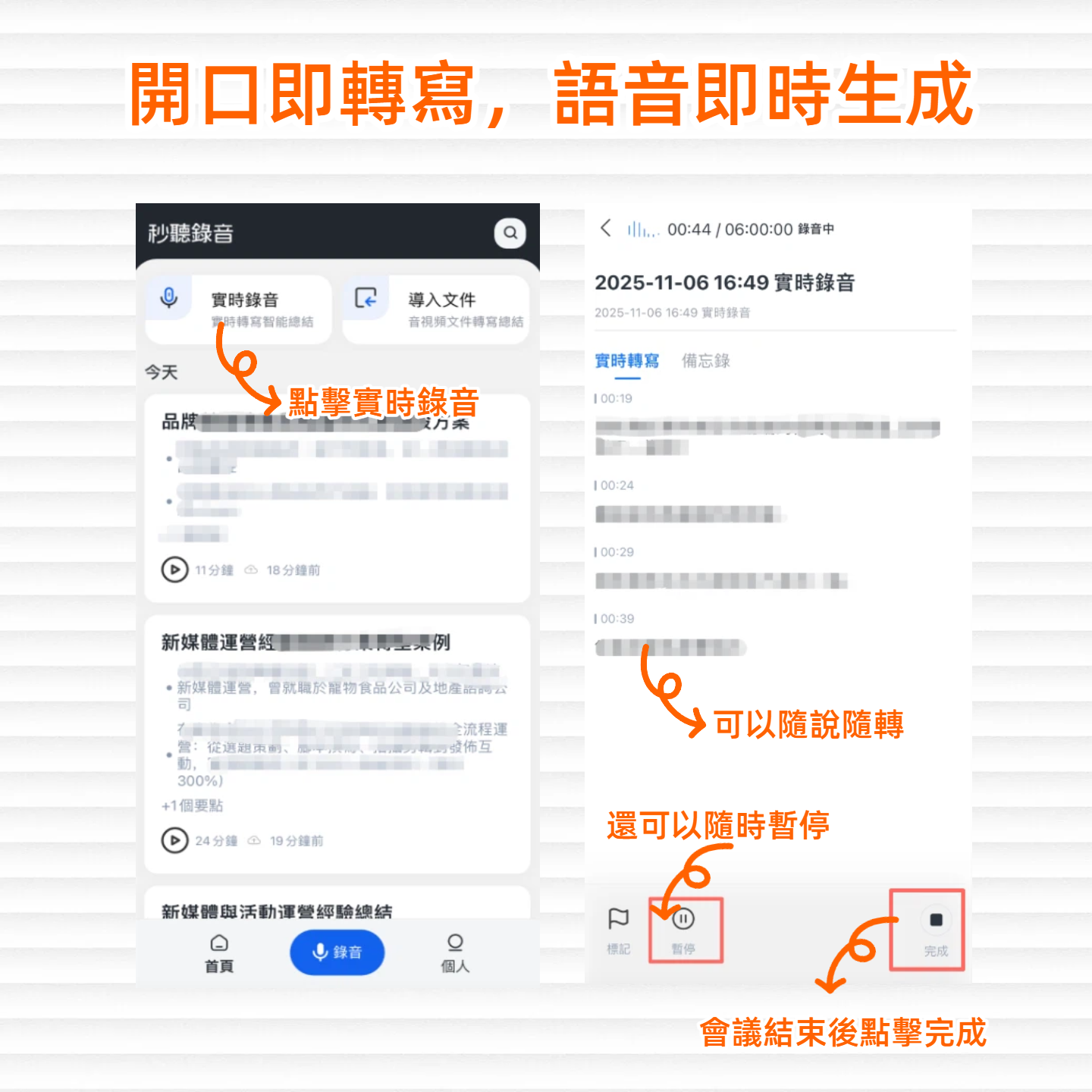
Step 1: Choose the Right Recording Input Method
Select the appropriate audio import method based on your scenario:
- Real-Time Voice-to-Text: For ongoing in-person meetings or classes, open the mobile or web app and tap this feature. The system transcribes while recording, allowing you to mark key points instantly.
Step 2: Process Existing Audio or Video Files
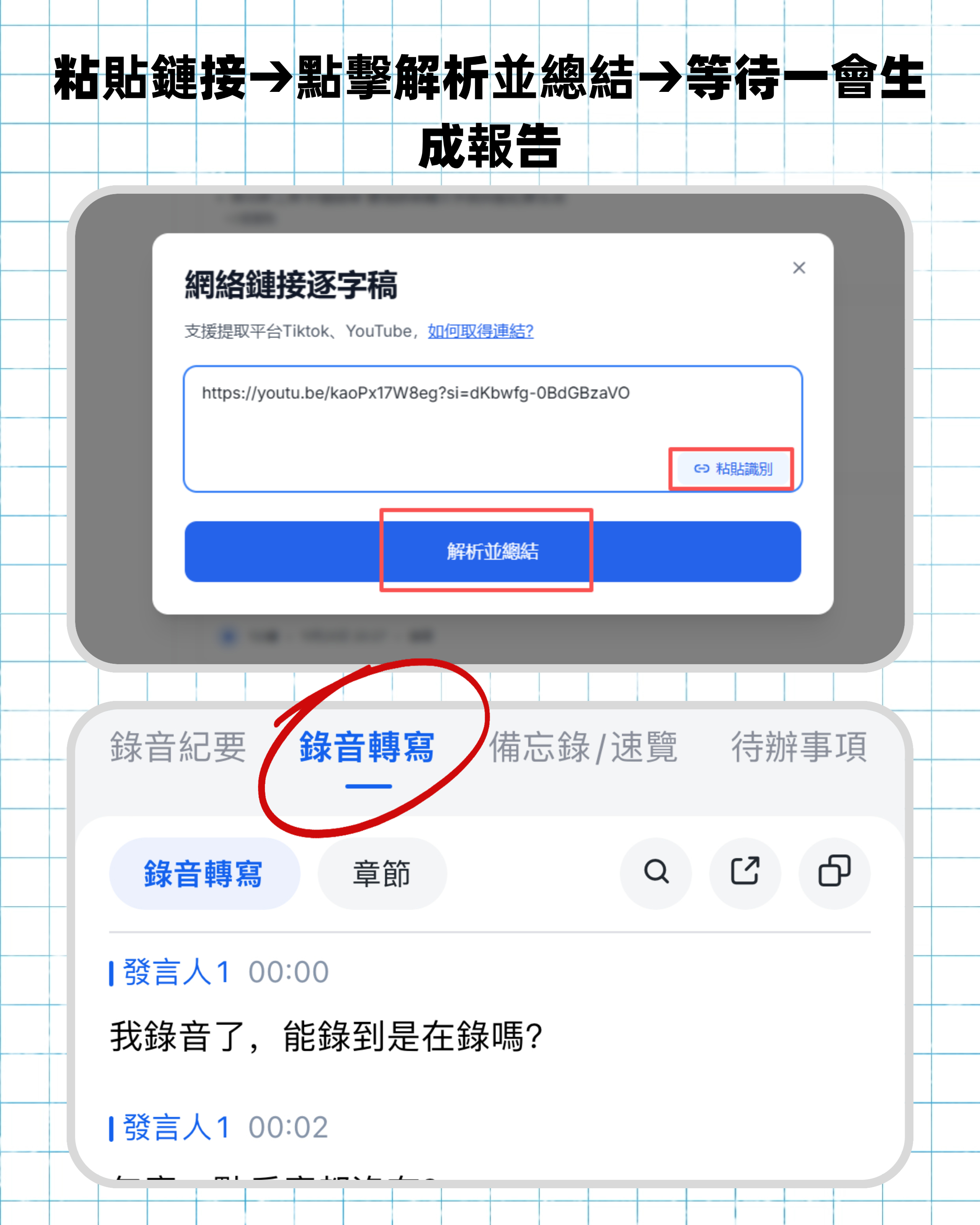
If the audio source is already recorded, choose one of these import methods:
- Audio File to Text: Upload audio files in common formats like mp3, m4a, wav in batch—ideal for voice recorder or iPhone Voice Memos files.
- Podcast/Online Video to Text: To transcribe a Cantonese interview on YouTube, simply paste the URL—no downloading needed.
Step 3: Auto-Extract Meeting Summaries & Action Items
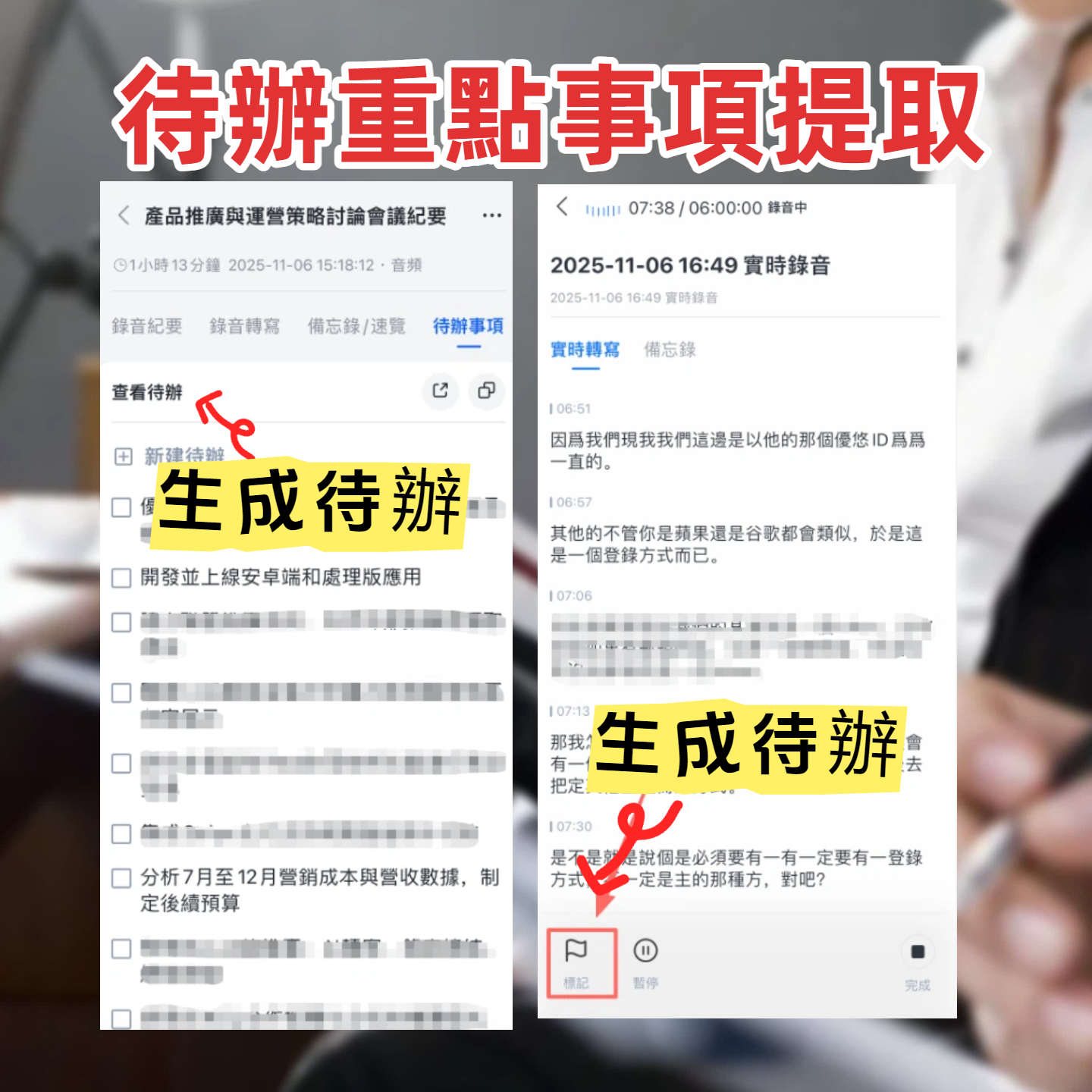
Once you have the transcript, don't read through the entire log. Use the auto-summarization feature:
- View AI Summary: The system automatically distinguishes speakers and summarizes each section's key points.
- Extract Action Items: For work meetings, the tool auto-identifies conclusions and follow-up to-dos, turning recordings into actionable task lists.

Step 4: Use AI Chat to Query Key Details
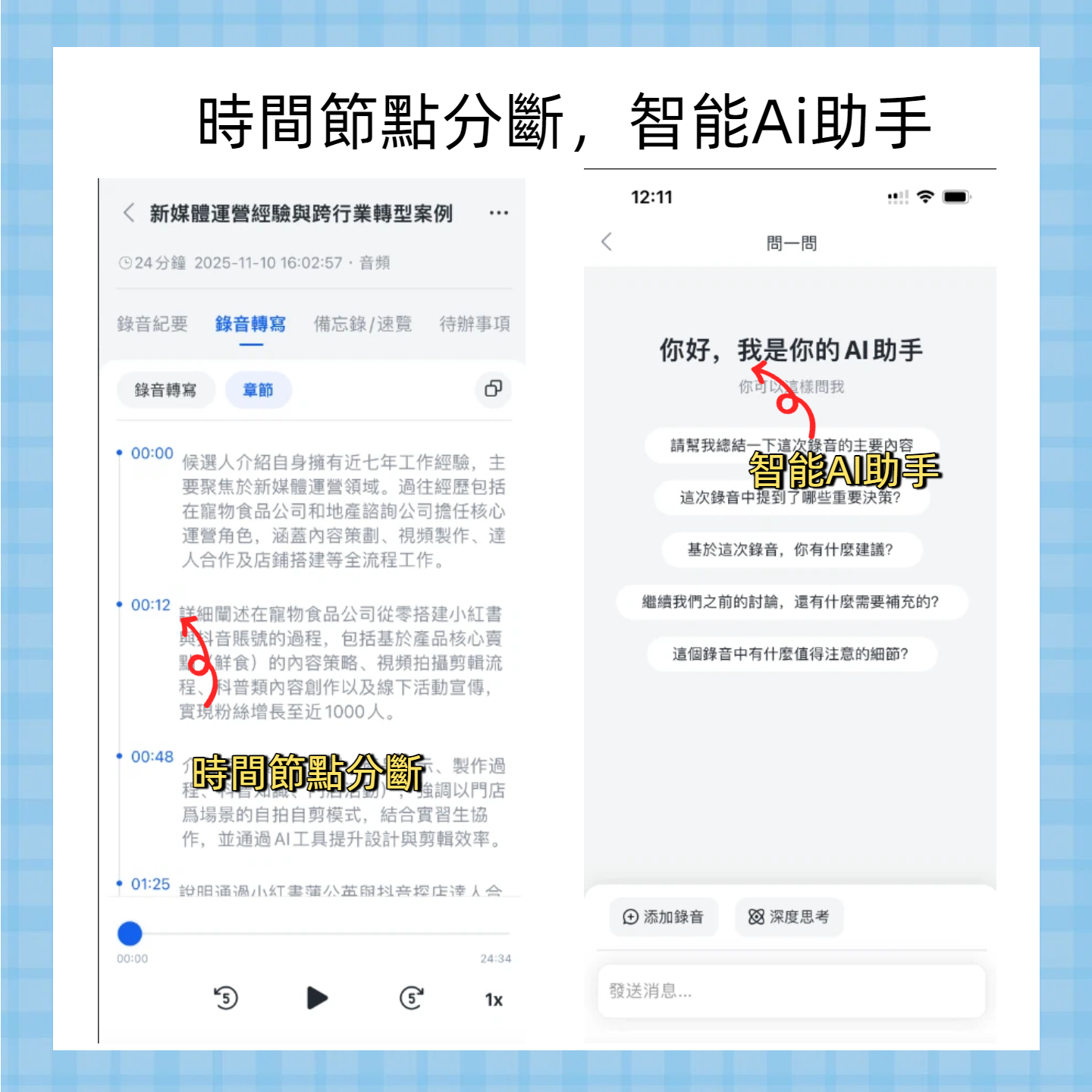
If you need to find specific data from a 2-hour interview, instead of using Ctrl+F, use the AI Chat Query function.
Simply type: "What was Q3 market revenue mentioned by the interviewee?" The AI will semantically search the entire recording and answer directly—like asking an assistant who attended the entire meeting.
Cantonese & Dialect Transcription FAQ
Q1: Can iPhone recordings be directly converted into accurate Cantonese transcripts? iPhone's built-in Voice Memos cannot directly export accurate dialect-recognized transcripts. It's recommended to export the recording (e.g., as m4a) and upload it to a web-based tool that supports dialect recognition, or use a third-party app that supports real-time transcription during recording.
Q2: How to quickly transcribe online meeting recordings from Teams or Meet? If the platform's built-in transcription doesn't support Cantonese, download the meeting recording and upload it to a third-party voice-to-text tool. Tools with "speaker diarization" can clearly identify different colleagues' contributions, making meeting minutes easier.
Q3: Do these Cantonese voice-to-text tools offer free tiers? Most tools offer trial quotas. For example, Subanana has a basic free plan; Tinrec offers a free version with up to 100 minutes of recording processing per month, including full AI summary features—suitable for daily or light office use.
Q4: Why is Cantonese recognition poor in editing software like Premiere Pro? Cantonese includes many specific colloquial words (e.g., "嘅", "喺") and frequent code-switching. Traditional editing software typically uses generic language models. Without specialized training on Cantonese corpora, accuracy drops significantly in noisy environments.
Q5: What's the difference between video subtitle tools and meeting transcript tools? "Video subtitle tools" prioritize absolute timeline accuracy and SRT/VTT format export. "Meeting transcript tools" focus on content comprehension and downstream use, often providing auto-generated summaries, action item extraction, and AI query features—better suited for workplace and learning scenarios.
Q6: Will processing long, code-switching Cantonese recordings take a long time? Cloud-based AI tools typically parse hours of audio in minutes. If the source is a public YouTube video, some tools offer "URL parsing" to quickly process without downloading and uploading large files.
Turn every recording into actionable outcomes
Get 60 free transcription minutes when you sign in. No credit card required.
Related Reading
You might also like

2026 Free Chinese Speech-to-Text Options: Otter vs. Tinrec Compared
Can Otter.ai actually transcribe Chinese? The official supported language list only includes Simplified Chinese, not Traditional Chinese. This article compares Otter.ai and Tinrec across language support, meeting capture methods, post-meeting workflows, free quotas, and team governance to help Chinese meeting users decide which one to choose.

Otter.ai vs Tinrec in 2026: 5-Dimension Comparison — Which Is Better for Chinese Support?
Does Otter.ai support Chinese? Its official language list includes Simplified Chinese, but Traditional Chinese is not listed. This article breaks down the three most common misunderstandings about Chinese support, compares Otter.ai and Tinrec across five dimensions for Chinese meetings, transcription, post-meeting organization, and team collaboration, and includes a pitfalls guide and selection advice to help Hong Kong office workers save proofreading time.

3 Meeting Transcription Apps Tested for 2026: Otter's Chinese Support vs. Tinrec — Which Is Enough?
People searching for 'otter app Chinese' really want to know: can Otter handle Chinese meetings? This article starts with 5 key buying criteria, tests Tinrec's bot-free recording and post-meeting AI Q&A, compares Otter.ai, Notta, and Granola side by side, and ends with clear recommendations and pitfalls to avoid.

Otter vs Beaver in Chinese: 5 Key Differences to Tell Them Apart (2026)
Otter is 水獺 in Chinese, but beaver is translated as 河狸, 海狸, or 水狸—so memorizing names only makes things more confusing. This guide tackles common misconceptions and provides five practical identification points: classification, tail, teeth, webbed feet, and behavior. You'll learn a method you can use the next time you see a photo or a live animal, plus a note on the often-overlooked sea otter and coypu.

4 Chinese Transcription Tools Tested in 2026: Can Otter Really Transcribe Chinese?
Otter.ai's official language page lists Simplified Chinese only, with Traditional Chinese not included—how should users in Taiwan decide? Starting from real Chinese meeting scenarios, this article breaks down 4 key purchasing factors and compares Otter.ai, Notta, TurboScribe, and Tinrec on Chinese transcripts, post-meeting organization, and team collaboration, plus the 4 most common purchasing mistakes.

Tinrec vs Notta 2026: 5-Factor Comparison — Which Free AI Speech-to-Text Tool Is More Cost-Effective?
When searching for 'vocal ai free,' most people only look at how many free minutes are offered, but overlook the maximum length per recording, how meetings are recorded, and whether the transcript can be used directly afterward. This article compares Tinrec and Notta across 5 dimensions, from free quota, bot-free recording, post-meeting organization, to team data ownership, and tells you which tool suits which type of user.

How to Use Vocol.ai Free Version in 2026? 5 Steps to Choose the Right AI Meeting Notes Tool
People searching for 'Vocol.ai free' usually want to know if the free quota is enough. This article uses 5 checkpoints to compare Vocol.ai's free version with Tinrec item by item—from how free minutes are calculated, how to record online meetings, post-meeting outputs, to team governance—helping you make a clear decision before purchasing.

Vocal Folds vs Vocal Cords: 5 Key Differences Explained (2026)
The most common Chinese translation of vocal folds is "聲帶" (vocal cords), also known anatomically as "聲襞" (vocal folds). This article compares vocal folds and vocal cords, including pronunciation, example sentences, and related terms, to help you quickly understand this English term.

4 AI Recording Tools Compared in 2026: Is Plaud Note or Tinrec Better for Students?
In 2026, the most-searched "PLAUD recording review" really comes down to a more basic question: are you buying an extra piece of hardware, or a post-recording workflow? Starting from real student use cases, this article first explains the 4 key factors to consider when choosing, then hands-on compares Tinrec, PLAUD Note, Otter.ai, and Notta on their differences, free tiers, and long-term costs, and finally gives selection advice segmented by scenario.