
Turn recordings into transcripts and summaries in minutes
Upload audio or video for multilingual transcription, AI notes, and action items
After a one- or two-hour meeting, do you spend half a day replaying the audio, typing, and summarizing key points? Or do you record a lecture or interview but let the file sit in a folder because organizing it is too tiring?
To solve these pain points, this article provides an in-depth review of the leading speech-to-text tools in 2026. It covers evaluation criteria, a comparison table of 5 popular tools (including language support, real-time capability, summaries & action items, AI query, pricing, etc.), actionable step-by-step guides, and a FAQ section.
Quick Navigation Conclusion: If you only need simple short audio transcription, your phone's built-in voice recorder will do. If you heavily rely on online meetings (e.g., Teams, Google Meet) and need automatic extraction of "decisions and action items," or if you handle multilingual content, consider a professional AI recording assistant with AI summarization and conversational query features (e.g., Tinrec or similar tools with a complete workflow).
1. Why You Need a Professional Speech-to-Text Tool (Pain Points Analysis)
In daily work and study, we often rely on recordings to preserve information, but traditional recording has many drawbacks:
- Extremely low information density, high cost of replaying: People speak at about 150–200 words per minute, while reading speed is two to three times faster. Replaying a one-hour recording often takes more than an hour—very inefficient.
- Most tools only provide raw transcripts, not a "decision summary": Many early speech recognition tools only produce dense text. After a meeting, you still have to read through everything and manually extract conclusions and to-do items, saving no time.
- Difficulty searching for specific information: Traditional transcripts rely on Ctrl+F to search for keywords; if you forget the exact word used, finding the relevant section is tough.
- Cross-language and multi-context challenges: In global meetings, foreign language classes, or discussions mixing in Taiwanese Hokkien, traditional tools often fail to switch languages accurately, resulting in garbled or error-filled transcripts.
2. How to Choose the Best Speech-to-Text Tool (Core Evaluation Criteria)
When selecting a tool, don't just look at "accuracy"; evaluate whether it integrates into your real workflow. Consider these 5 dimensions:
- Language support: Does it support your common languages? Can it automatically handle mixed languages (e.g., Chinese-English, Mandarin-Taiwanese)?
- Real-time capability & multi-format import: Does it support "transcribe as you record"? Can it upload existing MP3, WAV files, or even online video links (e.g., YouTube)?
- Summary & action item generation: After transcription, does the tool automatically generate meeting minutes, conclusions, and a to-do list?
- AI interactive query capability: Can you ask questions about the content? (e.g., "What did the boss say about the marketing budget?")
- Pricing & free tier: Is the free plan sufficient for occasional needs? Is the subscription good value for long-term use?
3. 2026 Top 5 Speech-to-Text Tools: Recommendations & Comparison Table
Below are 5 different solutions with a multi-dimensional comparison:
1. Built-in Voice Recorder (e.g., iPhone/iOS Voice Memos)
The easiest tool to access; suitable for short, ad-hoc voice notes. Drawbacks: no automatic well-formatted transcript, no AI summary, and insufficient for long meetings.
2. Yating (雅婷) Transcriber (Localized Chinese/Taiwanese Tool)
Optimized for Taiwanese accents and context; performs well with Mandarin-Taiwanese mixed speech. Good for interviewers needing raw transcripts, but AI summary and action item extraction are basic.
3. Otter.ai (English Meeting Leader)
Well-known for English transcription; ideal for purely English business meetings and foreign online courses. Integrates well with Zoom and Teams. Weakness: very limited support for Chinese and other Asian languages.
4. Good Tape (Best for Large File Uploads)
Developed by a Danish team; clean interface; supports multilingual audio uploads using advanced AI. Advantages: generous free tier and strong security; lacks "real-time transcription" and AI dialogue query.
Stop organizing recordings by hand
Upload audio or video and automatically get a transcript, summary, and action items
5. Tinrec (秒聽錄音) (Complete AI Workflow Recording Assistant)
Positioned as a full workflow assistant from "recording → understanding → action." Supports iOS, Android, and web; offers up to 10 languages (including Chinese, English, Japanese, Taiwanese Hokkien, Cantonese, etc.) with automatic identification. Its key differentiator: converting time-based content into "scannable, searchable, actionable text." Besides accurate transcripts, it automatically generates meeting summaries and to-do lists, and supports semantic-level AI conversation queries.
💡 Tool Comparison Table
| Dimension | Built-in Voice Memos | Yating Transcriber | Otter.ai | Good Tape | Tinrec |
|---|---|---|---|---|---|
| Language Support | Depends on device | Chinese, Taiwanese | English primarily | Multilingual | 10 languages (auto-detect including CN/EN/JP/TW/Cantonese, etc.) |
| Real-time Transcription | Record only, no live text | Yes | Yes | No (upload only) | Yes (real-time, no delay) |
| AI Summary/Action Items | None | Basic | Yes (English only) | None/Minimal | Yes (auto-generate minutes & to-dos) |
| AI Chat Query | None | None | Yes | None | Yes (semantic search) |
| Export & Multi-Platform | Local mainly | TXT/SRT | Multiple formats/Cloud | TXT/SRT | Cross-device sync (iOS/Android/Web) |
| Pricing/Free Tier | Free | Basic free tier | Free tier available | Free tier available | 100 mins/month free; Pro high value |
4. Practical Guide: How to Efficiently Turn Speech into Actionable Tasks
With the right tool, you also need to know how to use it effectively. Below, using Tinrec as an example (due to its multi-functionality and conversion intent), we break down SOPs for 4 common scenarios:
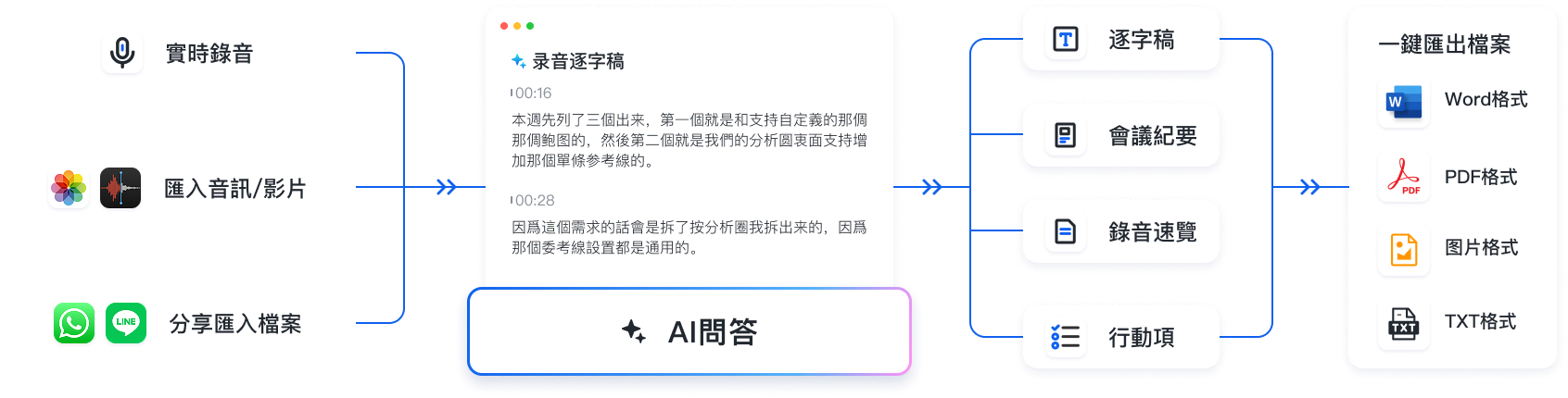
Step 1: In-Person Meetings & Classes: Enable "Real-time Transcription"
During a physical meeting or class, open the app or web version.
- Go to Live Recording to Text interface.
- Tap record; the tool will convert speech to text in real-time with no delay.
- You can review what's been said at any time; when the meeting ends, the transcript is ready—no waiting for upload.
Step 2: Process Existing Audio Files: Use "Audio File to Text"
If a colleague sends you a two-hour meeting recording (MP3/M4A/WAV):
- Go to Audio File to Text feature.
- Drag and drop the file; the system transcribes quickly.
- Once done, you'll see the transcript with automatic speaker identification (Speaker 1, Speaker 2), plus an "AI Meeting Summary" and "Action Items" at the top.

Step 3: Self-Study: Import "Video Links/Podcast to Text"
Found a great YouTube tutorial or a valuable podcast? Want to take notes without typing?
- Copy the video or podcast URL.
- Go to Video to Text section and paste the link.
- The tool automatically extracts audio and transcribes it. Whether for content creators' inspiration notes or students' study highlights, it maximizes absorption efficiency.
Step 4: Recover Forgotten Details: Use "AI Chat Query"
What if Ctrl+F fails to find a keyword?
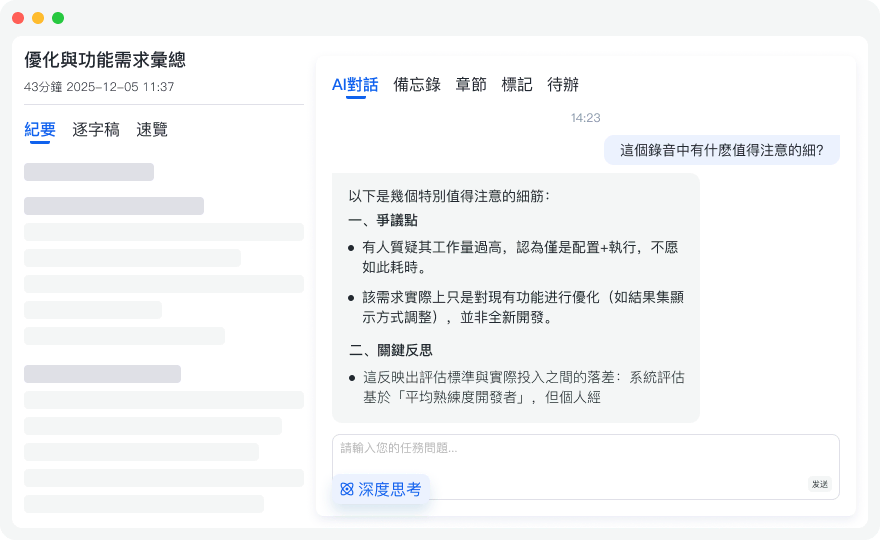
- Next to the transcript, open the AI Chat Query window.
- Ask in natural language, e.g., "What were the marketing team's next steps in this meeting?"
- The AI will synthesize the entire recording's context, provide the answer, and highlight the source paragraphs—making finding key info as simple as asking a human assistant who attended the entire meeting.
5. Frequently Asked Questions (About Speech-to-Text, iPhone, Teams, etc.)
Q1: Can the iPhone's built-in recorder transcribe speech? Or do I need a third-party tool?
Although iOS has improved built-in features, the Voice Memos app cannot directly export a well-formatted transcript with speaker labels and punctuation. For meeting summaries and key points, it's recommended to use a professional transcription app.
Q2: Can I use speech-to-text tools with Teams or Google Meet online meetings?
Yes. Many mainstream tools offer solutions. If using a web browser for Teams/Meet, you can enable system audio recording or use a tool that supports web page recording for real-time transcription. After the meeting, if you have the recorded audio/video file, you can upload it directly via the "audio upload" feature.
Q3: How much free transcription time do tools usually offer?
Policies vary. For example, Tinrec's free plan gives up to 100 minutes per month—plenty for occasional personal notes or short meetings. If you need more, you can choose Basic or Pro plans for longer transcription time.
Q4: Can tools handle very long recordings (e.g., over 2 hours) and summarize them?
Yes, this is a strength of modern AI recording assistants. Most new tools, after generating a transcript, run it through a large language model (LLM) to filter out filler words and summarize into bullet-point decisions and action items.
Q5: Can tools recognize mixed languages (e.g., Chinese and English, or Taiwanese)?
Traditional tools often require setting a single language, causing errors with mixed code-switching. Choose a tool with "multi-language auto-detection" (e.g., one that supports 10 languages) to significantly reduce the cost of understanding and organizing cross-language meetings or foreign language classes.
Q6: Can I transcribe YouTube videos or podcasts directly?
If the tool supports "URL parsing," you can paste the YouTube or podcast link, and the system will extract audio and generate text—ideal for media workers and content creators to compile scripts or study notes.
Turn every recording into actionable outcomes
Get 60 free transcription minutes when you sign in. No credit card required.
Related Reading
You might also like

5 Best AI Meeting Note Tools Tested in 2026: Which One Turns Recordings into Usable Meeting Minutes?
We tested 5 AI meeting note tools, comparing speech-to-text, AI summaries, team collaboration, and pricing to help you find the best fit for your workflow, with sample meeting minutes included.

2026 Hands-On Comparison of 2 AI Meeting Note Tools: Tinrec vs Granola – Which Is Better for Chinese Meetings?
Struggling with meeting notes? This comparison of Tinrec and Granola, two bot-free AI meeting tools, tests them across five key areas: recording methods, file import, Chinese language support, post-meeting workflow, and team management, to help you pick the best solution for Chinese meetings and team collaboration.

2026 Free AI Meeting Minutes Platforms Compared: 5 Tools Reviewed
A 2026 comparison of free AI meeting minutes platforms, hands-on testing 5 tools including Tinrec, analyzing free quotas, Cantonese transcription, AI Q&A, and team features to help you save time and avoid overtime.

6 Best AI Meeting Recorder Apps of 2026: Hands-On Comparison for U.S. Professionals
This hands-on comparison reviews Tinrec, Notta, Otter.ai, Fireflies.ai, Granola, and TurboScribe, covering transcription, summarization, pricing, and team features to help you choose the right AI meeting assistant.

2026 Free AI Meeting Minutes Solutions: 4 Tools Compared
A 2026 roundup of free AI meeting minutes plans, comparing Tinrec, Notta, Otter, and Granola. We help you choose the right tool based on bot-free recording, Chinese language support, post-processing, and team collaboration.
Tinrec vs Notta 2026: 5-Dimension Comparison - Which Is Better for Chinese Meeting Notes?
Spending two hours in a meeting and another two organizing the notes? This article compares Tinrec and Notta across 5 dimensions to help you decide which online AI meeting notes app suits Chinese users best, with tips to avoid common pitfalls and buying advice.

2026 Free AI Meeting Minutes Solutions: 3 Tools Compared
Tired of spending two hours on meeting notes? This hands-on review from a mid-level manager's perspective covers the free plans of Tinrec, Otter.ai, and Notta, helping you decide which fits your meeting habits best.
5 Best AI Meeting Minutes Platforms in 2026: A Hands-On Comparison for Chinese Meetings and Team Collaboration
Tired of manually replaying and transcribing meeting recordings? This article compares 5 AI meeting minutes platforms—from Tinrec to Notta, Otter, Fireflies, and Granola—covering free plans, core features, and ideal use cases to help you find the most time-saving meeting tool.

2026 Review of 5 Online AI Meeting Minute Tools: How Tinrec Turns Meetings into Searchable Assets
Tired of spending hours on meeting notes? This hands-on review, featuring Tinrec's instant recording, compares 5 common online meeting minute solutions, covering bot-free recording, AI summaries, action items, and team spaces to help you pick the right tool.