
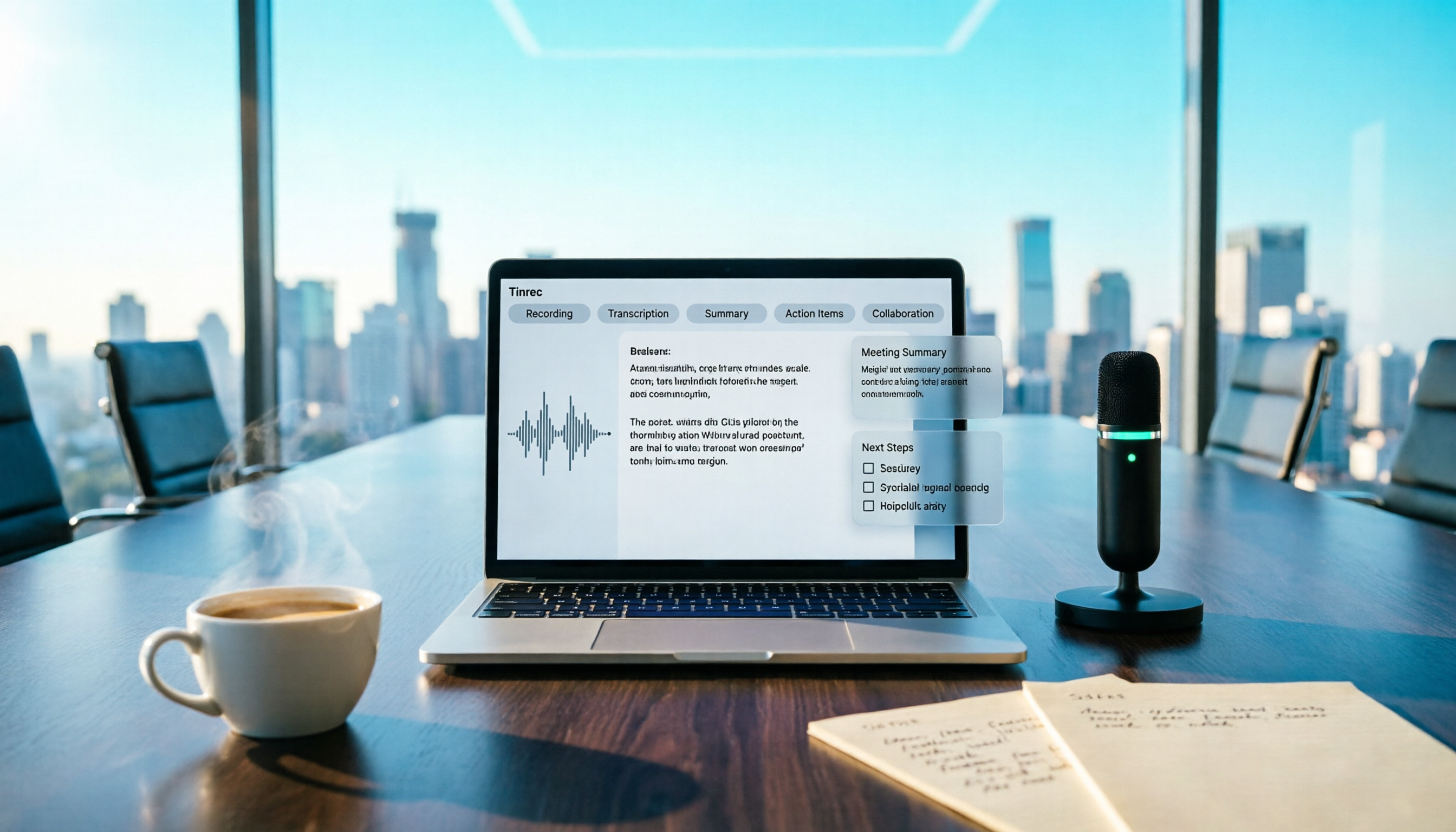
Turn recordings into transcripts and summaries in minutes
Upload audio or video for multilingual transcription, AI notes, and action items
Why Your Meeting Notes Are Always "Recorded but Never Read"
Many teams don't struggle with a lack of documentation—they struggle with recordings that might as well not exist. An hour-long meeting recording sits in cloud storage, and to find a single decision, you have to scrub the timeline, listen to speakers, and type up your own notes. Even with ChatGPT, there's an extra step of manually pasting the transcript into the chat—and when meetings pile up, this workflow falls apart.
This guide skips the theory and breaks "AI meeting notes" into 5 actionable steps: from recording, transcription, AI summarization, action item tracking, to team archiving. Along the way, we'll compare ChatGPT's free and paid plans, the Whisper transcription workflow, and integrated meeting tools like Tinrec to help you decide which path fits your needs.
First, Understand: AI Meeting Notes Aren't Just "Speech-to-Text"
Before choosing a tool, clarify what you want as the final output. A useful meeting record should include at least four layers:
| Layer | Output | Purpose | |---|---|---|---| | Transcript | Full spoken text | Verify original statements, cite sources | | Summary & Chapters | Key points, topic structure | Quickly review meeting content | | Action Items | Tasks, assignees | Track post-meeting progress | | Collaborative Data | Shared, searchable files | Turn meetings into organizational knowledge |
If you only need a transcript, ChatGPT with Whisper or a standalone speech-to-text tool is sufficient. But if you need to track actions directly after meetings and let new hires look up past decisions, treat the tool as a meeting database, not just a converter.
5 Steps: From Meeting Recording to Team-Ready Meeting Notes
Step 1: Choose Your Recording Method—Meeting Bot vs. Bot-Free Desktop Recording
Two common AI recording methods for online meetings:
Meeting bot: Joins Zoom, Meet, or Teams as a participant, automatically recording and transcribing. Pros: no manual effort. Cons: an "AI participant" appears in the meeting, which some companies or client meetings may not welcome.
Bot-free desktop recording: The user actively starts a desktop tool that captures the computer's system audio. No extra participant joins the meeting, making it ideal for client meetings or internal discussions where low disruption is key.
ChatGPT's Record mode falls into the latter category: it records meetings directly in the macOS version of ChatGPT, providing real-time transcription and summary generation. This feature is currently available with ChatGPT Plus, and also works with Pro, Business, Enterprise, and Edu plans.
Tinrec also uses bot-free desktop recording, supporting Zoom, Google Meet, Microsoft Teams, and Webex. The difference is that Tinrec is positioned as a "meeting notes and team collaboration tool," so post-meeting organization, follow-up questions, export, and team archiving all happen in one interface.
Step 2: Turn Audio into Transcripts—Whisper, ChatGPT Record, or Integrated Tools
If you have audio or video files, pairing ChatGPT with Whisper is a common DIY approach: upload the media to the cloud, use an automated workflow to have Whisper generate a transcript, then feed it into ChatGPT for summarization. This workflow is free or low-cost, but requires setting up automation yourself, and moving files between tools adds waiting time.
ChatGPT's Record mode simplifies this step: audio is transcribed in real time, so there's no need to upload files separately. It's ideal for individual users who don't want to maintain automation workflows and primarily have online meetings.
Integrated tools like Tinrec support three input sources: real-time recording, online meetings, and audio/video file uploads. After recording, you see the transcript, summary, and chapters in the same workspace. If you handle in-person interviews, historical recordings, and online meetings, this route saves the most switching overhead.
Step 3: Generate AI Summaries and Action Items—Prompts Matter More Than Tools
Whether you use ChatGPT, Claude, or Tinrec's built-in summarization, the quality of AI meeting notes largely depends on your instructions. An effective meeting summary prompt should include:
Stop organizing recordings by hand
Upload audio or video and automatically get a transcript, summary, and action items
- Meeting objectives and topic scope
- Types of information to preserve (decisions, disagreements, consensus, action items)
- Output format (paragraph summary, bullet points, action item table)
- Glossary of proper nouns and abbreviations
For example, with ChatGPT, you can upload the transcript and instruct: "Based on this transcript, create meeting notes including: 1. Meeting objectives, 2. Key discussion points, 3. Decisions made, 4. Action items with owners, 5. Tasks to complete before the next meeting."
Tinrec has built-in summaries, chapters, and action item extraction, so users don't need to repeatedly paste prompts. However, it's still recommended to set team-specific terms before recording to improve recognition of product names, project codes, and other jargon.
Step 4: Turn Action Items into Trackable Tasks
The most common failure point in meeting notes is action items scattered throughout the text, with no one revisiting them after the meeting. AI tools can extract action items, but you still need to establish a tracking mechanism.
ChatGPT can compile action item lists from transcripts and even draft notification emails to send tasks to relevant team members. However, subsequent tracking, updates, and archiving still need to happen in your project management tool or document system.
Tinrec's action item extraction separates tasks into a dedicated view, and team members can review them in the team space. With its AI Q&A feature, you can ask "What was the decision on Project X from the last meeting?" without digging through transcripts. For departments tracking multiple meetings over time, this is closer to a usable meeting asset than plain text summaries.
Step 5: Consolidate Meeting Data into a Team Space
The biggest difference between personal and team use is where meeting data lives. Personal tools keep records in individual accounts; when a member leaves or changes devices, the data becomes inaccessible.
ChatGPT's Record mode is currently geared toward personal use, suitable for individuals who organize notes and then manually share them with the team. If you need the entire department to access meeting notes and new members to review historical decisions, you'll need a team meeting tool.
Tinrec's team plan centralizes meeting recordings, transcripts, summaries, and action items in one team space, with member invitations, role and seat management, usage analytics, and audit logs. Team resources belong to the team, and when a member exits, ownership can be transferred to another active member, ensuring historical meeting data doesn't leave with the individual.
How to Choose: Free, ChatGPT Plus, or Team Meeting Tools
| Use Case | Recommended Plan | Reason |
|---|---|---|
| Occasionally organizing a recording, limited budget | ChatGPT free tier or Whisper DIY workflow | Low cost, manual steps are acceptable |
| Weekly online meetings, want to save time | ChatGPT Plus (with Record mode) | Real-time transcription and automatic summaries |
| Department or project team needs shared meeting notes | Team meeting tool (e.g., Tinrec for Teams) | Unified space, member management, searchable history |
| Need bilingual meetings, real-time translation, dual-language transcripts | Tinrec | More complete support for Chinese and multilingual meetings |
| Don't want a bot in meetings but need recordings | Tinrec or ChatGPT Record | Bot-free desktop recording, recordings available for review |
A practical way to decide: first ask who will see and use your meeting notes. If it's just you, ChatGPT with Whisper is plenty. If the notes need to be tracked, searched, and handed off by the whole team, use a team meeting tool to elevate meetings from "personal notes" to "organizational data."
Conclusion: Decide Whether You Need "Transcription" or a "Meeting Database"
ChatGPT and Whisper solve the efficiency problem of turning audio into readable text, making them ideal for personal or light use. ChatGPT's Record mode further simplifies the recording-to-summary workflow, making it a practical built-in feature for Plus users.
If your need is team collaboration—multi-user access, historical reference, action item tracking, member handoffs—then integrated meeting tools like Tinrec are closer to what you're looking for. They connect recording, transcription, summarization, action items, and team space into a single workflow, so meeting notes aren't just archived files but data your team can continuously use.
One final note: regardless of the tool, recording and transcribing meetings should comply with local laws, and you should obtain consent from participants where required. AI summaries save time, but for critical decisions, always cross-check the transcript and original recording.
References
- Meeting notes a hassle? ChatGPT+Whisper gets it done in one go! Automatic transcription, summaries, and sending—Business Next
- ChatGPT "Record Mode" Debuts! Meeting Notes and Voice Memos Turned into AI-Organized Content at One Click—Curated Insights
- Top AI Meeting Note Tools in 2026: Time-Saving Essentials for Meetings
- How to Take AI Meeting Notes? A Complete Guide from Writing Principles, Tool Selection to Automation Prompts—Manager Today
- How to Use AI for Meeting Notes? How to Organize Meeting Transcripts? AI Speech-to-Text Tutorial—104 Career Hub
Turn every recording into actionable outcomes
Get 60 free transcription minutes when you sign in. No credit card required.
Related Reading
You might also like

Good Tape Billing and Invoices: The Complete Guide to Subscription Management, Cancellation, and Flexible Pricing Compared with Tinrec
Received a Good Tape charge but unclear about the details? This article explains Good Tape's subscription plans, invoice retrieval, billing management, and cancellation process, and compares Tinrec's flexible pricing from a cost perspective to help you make a budget-friendly choice.

How to Choose a Free Speech-to-Text Plan: From Usage Limits to Meeting Minutes – A Practical Guide
Are free speech-to-text tools really free? This article breaks down the real limitations of free plans from three angles: usage limits, per-session duration, and feature restrictions. It compares the free versions of Otter, Notta, TurboScribe, Fireflies, Granola, and Tinrec, and offers recommendations for different user groups such as sales, product/engineering, and government employees, helping you decide whether a free plan is sufficient and when it's worth upgrading to a paid one.

How to Use AI Transcription in 2026: 5 Steps to Turn Recordings into Actionable Meeting Notes
AI transcription software isn't just about converting speech to text. This article takes a practical workflow approach to rethink the true purpose of transcripts: from recording, transcribing, and organizing to tracking action items—turning every meeting and interview into searchable, queryable, reusable assets.

Apple Podcast Transcripts in 2026: Turn Podcasts into a Language Learning Database with Built-in Tools
Apple Podcast transcripts officially launched with iOS 17.4, but many people only use them as subtitles. This article takes a practical approach, showing you how to use built-in translation, select-and-copy, and keyword search to turn English podcasts into a readable, searchable, and reviewable language learning resource.

2026 AI Meeting Notes Software Test: Tinrec vs Otter vs Notta – Which Saves You the Most Time?
Tired of spending hours on meeting minutes after endless meetings? We tested 5 AI meeting note tools, comparing Cantonese recognition, online meeting recording, AI summaries, and team collaboration to help Hong Kong professionals find the best time-saving solution.

6 Best AI Meeting Note Tools Compared in 2026: Which Free Plan Is Enough?
AI meeting note tools are proliferating, but are the free plans sufficient? This article tests six popular options across dimensions like bot-free recording, Chinese transcription, AI summaries, action item extraction, and team collaboration, and explains in which scenarios Tinrec suits US users better.

The Complete 2026 Guide to ChatGPT Voice-to-Text Transcription: From Recording to Searchable Notes
Tired of messy transcripts after recording lectures? This guide walks you through a real student's workflow—from voice input and transcript cleanup to class notes and group discussion records—and compares free and paid options that work for students.

2026 Free AI Transcription Tools Roundup: 3 Options Compared
A look at 3 truly free, unlimited AI transcription tools, from NotebookLM to desktop recording solutions. Avoid the 'free for a few minutes, then paywall' trap and build a workflow that turns recordings into actionable data.

2026 AI Meeting Notes Software Guide: Bot-Free Recording + Automated Action Items
A mid-level manager who attends 15 meetings weekly tests AI meeting notes software—from missing action items to turning meetings into searchable, collaborative, trackable team assets. This guide covers bot-free recording, AI summaries, action item extraction, and team spaces, with an honest comparison of Otter, Notta, Granola, and more.