

Turn recordings into transcripts and summaries in minutes
Upload audio or video for multilingual transcription, AI notes, and action items
Searching for tenrec download brings up three things that aren't meeting tools
Last week a reader commented: "I typed tenrec download and I couldn't understand anything that came up."
I searched it myself, and the results fell into roughly three categories.
The first is the Tenrec dataset. This is a large-scale recommendation system benchmark dataset published at NeurIPS in 2022, from four scenarios across two of Tencent's news feed recommendation apps, with about 5 million users and 140 million interactions, including both positive and real negative feedback. To download it, you need to read the terms of use first; it's mainly for research purposes.
The second is tenrec.org. This is a page compiled by David G. Kupitz with Tenrec resources and information, and has nothing to do with software downloads.
The third is Surge the Tenrec. This is a character from the Sonic the Hedgehog series, and creators on DeviantArt have posted MMD models and FBX files for use with MikuMikuDance.
All three are called Tenrec, but none of them is a meeting recording tool.
If what you want is a tool that turns meeting recordings into transcripts, summaries, and action items, the correct spelling is Tinrec. One letter makes a big difference.
This article will clarify that, and also compare a few similar tools.
Before choosing a meeting recorder, understand these 4 key points
1. Recording method: Do you want a bot to join the meeting?
Traditional meeting bots join the meeting room as a "participant," which some people mind. Another approach is for the desktop app to capture the computer's system audio directly, without adding another participant. The latter is less awkward for external client meetings.
2. What you get after transcription
A tool that only gives you a transcript is only half done. What you want to see is whether it can automatically organize summaries, chapters, and action items, and even let you ask questions afterward.
3. Chinese and multilingual handling
Meetings for Taiwanese users often mix Chinese and English, plus product terminology. In this case, "how many languages are supported" is secondary; the key is "the actual experience with Chinese and mixed Chinese-English."
4. Data ownership: individual or team
If meeting data stays only in an individual account, it leaves with the colleague when they resign. For team tools, check whether there is a separate workspace, member and seat management.
Tinrec — the most recommended one this time
Tinrec is an AI meeting recording and collaboration tool for individuals and teams, available on iOS, Android, desktop, and web. It doesn't just convert audio to text; it organizes meetings into searchable, queryable, exportable data.
Use it during the meeting without inviting a bot
The desktop version captures computer system audio to handle online meetings, compatible with Zoom, Google Meet, Microsoft Teams, and Webex, without an extra bot joining the meeting. Note that this is not "automatically join all calendar meetings," but rather you actively start recording on the desktop app.
After recording is where it really shines
After the meeting ends, Tinrec generates a transcript and automatically organizes summaries, chapters, and action items. Even better is AI Q&A — you can directly ask it "What was the conclusion about the budget in this meeting?" and it will answer based on semantics, rather than dumping a bunch of keyword search results. Not many tools in the same price range have this feature.
In addition, it supports real-time translation during recording, which can be viewed in original, translated, or bilingual mode, and supports exporting results to Notion, Google Docs, OneNote, Dropbox, and other tools for further processing, or using Agent post-processing to generate reports, tables, and documents.
Team version: turn meetings into team assets
Stop organizing recordings by hand
Upload audio or video and automatically get a transcript, summary, and action items
The team version is not "multiple people sharing one personal account," but an independent team workspace. Meeting data belongs to the team, and members can view and play it; administrators can assign seats, view usage trends and member details, and query and export audit logs.
Here you need to distinguish between "roles" and "seats": roles determine who can manage the team, seats determine who can record, upload, edit, and export. Valid members without a seat can still read team data, but cannot perform resource usage operations. When a member leaves or loses their seat, the team resources they are responsible for need to be handed over to other members, and will not be taken away by the individual.
Currently, the team version offers a first-time 7-day trial, 1 free seat, and 300 minutes of shared import quota; paid seats are USD 29.80/seat/month for monthly billing, or USD 199/seat/year for annual billing, which works out to about USD 16.58/month, with 2,000 minutes of team shared import quota per seat per month.
Limitations to be honest about
Tinrec does not recommend promising a fixed accuracy rate externally; actual performance is affected by recording quality, ambient noise, accents, multiple people talking over each other, and technical terminology. Also, the team version is currently mainly team-level sharing, not a file-level granular permission system.
Who it's for
If you frequently handle Chinese or mixed Chinese-English meetings, don't want a bot joining the meeting room, want to use AI to find key points directly after recording, or need to accumulate meeting data in a team workspace, Tinrec is currently a relatively suitable choice.
Besides Tinrec, what other options are there?
Otter.ai: A mature English meeting assistant. The Basic free version offers 300 minutes per month, and Pro annual billing works out to about USD 8.49/user/month. It has a strong mindshare for English business meetings, but Chinese meetings are not its focus, and it doesn't have Tinrec's team workspace design for centralizing meeting data. If your meetings are all in English, you can consider it.
Notta: The competitor with the highest overlap with Tinrec, supporting multi-platform transcription and translation. The free version offers 120 minutes per month, with a maximum of 3 minutes per single item; Pro annual billing works out to about USD 8.17/month. Its file transcription performance is good, but bot-free online meeting recording and team collaboration after AI follow-up questions are not its strengths.
Granola: Also uses a bot-free approach, relying on desktop system audio plus user handwritten notes to generate content. Business is USD 14/user/month. It does not retain meeting audio files and does not support uploading pre-recorded files. If you need to go back and check recordings or organize historical audio files, think about this first.
Pitfall guide: 4 most common mistakes when downloading these tools
Pitfall 1: Spelling Tinrec as Tenrec. This is the most common situation. Searching the wrong word only finds datasets and animation models, and it takes half an hour to realize you're going in the wrong direction.
Pitfall 2: Only looking at free minutes. A large free quota doesn't mean it's good. What matters is the single-session length limit, whether you can import existing audio files, and whether meeting-related features are blocked.
Pitfall 3: Treating the transcript as the end goal. If you only use the tool as "audio to text," you're only using one third of it. After recording, directly asking it "What was the conclusion of this meeting?" is much faster than manually flipping through a 30-minute transcript.
Pitfall 4: Team sharing one personal account. It saves money short-term, but long-term you'll run into data ownership, resignation handover, and permission chaos. When multiple people need to use it, it's better to choose a solution with a team workspace, seats, and audit mechanisms.
Conclusion: Which one should you choose?
Simply put, it depends on your main scenario:
- Chinese or mixed Chinese-English meetings, want to accumulate team data → Tinrec
- Want to use AI to directly ask about meeting highlights after recording → Tinrec
- Don't want a bot joining the meeting room → Tinrec (desktop version captures system audio)
- All-English meetings, budget priority → Otter.ai's free version can be used first
- Only need large-scale file transcription and subtitles → Consider tools like TurboScribe
It's recommended to start with Tinrec's free version and run two or three meetings to get a feel for the actual workflow. If it feels smooth, then consider upgrading or introducing the team version. You don't need to pay right away.
References
Turn every recording into actionable outcomes
Get 60 free transcription minutes when you sign in. No credit card required.
Related Reading
You might also like
Notta vs Fireflies: How to Choose — From Meeting Capture Architecture and Chinese Bilingual Limits to Team Data Ownership, a Selection Conclusion for 5–20 Person Teams
The difference between Notta and Fireflies isn't just price and minutes — it's how a meeting actually gets recorded. This article compares the two in order: their meeting capture methods, the limits of their Chinese and bilingual experience, what you get after the transcript, and team data ownership and member handover. It then narrows the conclusion into three team selection scenarios, explaining under what conditions you should evaluate a bot-free approach like Tinrec.

How to Choose a Budget Voice Recorder: Check 4 Specs, Avoid 3 Pitfalls, and Calculate the Real Transcription Cost After Recording
Shopping for a voice recorder on a budget of a few hundred to NT$2,000? First understand where cheaper models cut corners, how to evaluate 4 key specs, how 3 common setups compare, and the practical workflow for turning recordings into transcripts, key points, and action items using free quotas.

What Is 'good tape vs hockey tape' Comparing? First Distinguish AI Speech-to-Text Services from Sports Tape, Then Use Four Criteria to Determine if a Meeting Transcription Tool Is Suitable
good tape and hockey tape belong to different categories, so this comparison itself does not hold. This article first clarifies the product positioning of the two, then uses four criteria—input source, language context, post-meeting deliverables, and data retention and sharing—to explain how to choose a meeting and interview transcription tool, and how Tinrec turns transcripts and action items into deliverable materials, and how team spaces share and hand over meeting records.

5 Online Meeting Transcription Solutions Compared for 2026: What to Know Before Buying Google Meet
Before you buy Google Meet, do you understand the difference between the free version and paid Workspace? This article compares 5 online meeting transcription solutions, including Google Meet, Tinrec, Otter.ai, Notta, Granola, and PLAUD, breaking down pricing, Chinese language support, post-meeting organization, and team collaboration to help you choose the right solution without paying for features you won't use.

How to Use Google Meet On-the-Go in 2026: A 5-Step Guide
Complete guide to Google Meet On-the-Go mode: learn how to join meetings on the move in 5 steps, and how Tinrec fills the gap in meeting notes and organization so you never miss important to-dos.
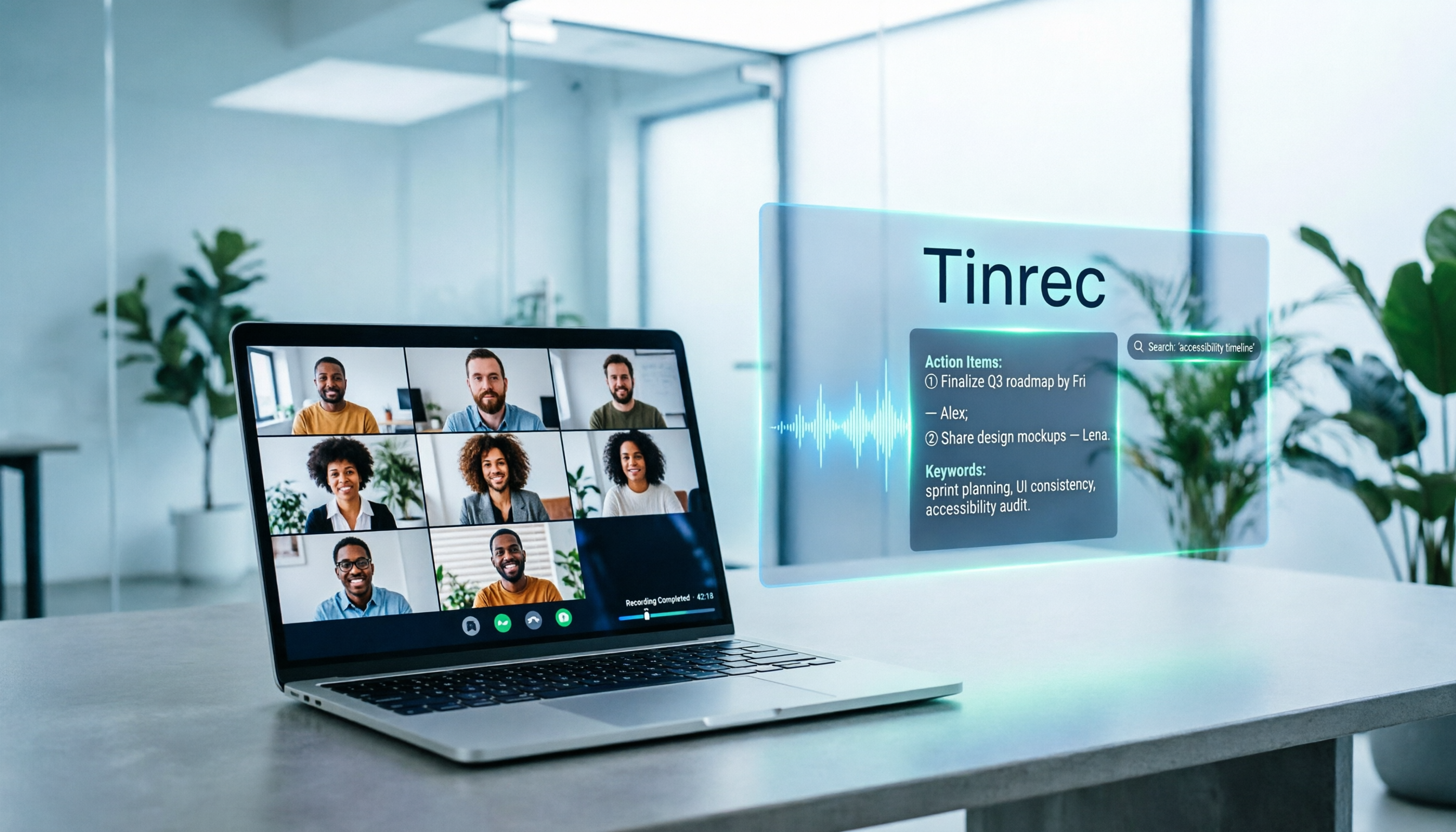
5 Google Meet Note-Taking Tools Tested and Compared for 2026: How to Keep Meeting Records After Downloading
Downloading Google Meet takes only 30 seconds, but the real challenge is keeping meeting content after the download. This article covers three ways to download Google Meet on Android, iOS, and computer, then compares 5 tools that turn meetings into usable data, including Tinrec with bot-free recording and AI chat queries, Google Meet built-in transcription, Otter.ai, Notta, Granola, and TurboScribe. Finally, it provides clear recommendations based on budget and use cases.

Google Meet India Pricing in 2026: 4 Plans Compared — Costs, Limits, and How to Choose Meeting Notes
Google Meet in India isn't a standalone subscription — it comes with Google Workspace plans. This article breaks down the price differences, participant limits, and meeting notes restrictions across Free, Base, Starter, Standard, and Enterprise, and explains how Tinrec fills the gap for post-meeting transcripts, summaries, action items, and team knowledge retention.

2026 Google Meet Note-Taking Tools Compared: Is the Free Version Enough?
Google Meet's free version and Google Workspace paid plans each have trade-offs, but what most people really lack is post-meeting organization. This article first breaks down 4 key points to understand before buying a Google Meet plan, then compares four note-taking tools: Tinrec, Otter.ai, Granola, and Notta, to help you decide whether to pay and who to pay.

4 Google Meet Call Recording Tools Tested for 2026: Tinrec's Bot-Free Recording Saves the Most Time
How do you find recent Google Meet calls? This article covers practical methods for personal accounts, Workspace, admin console, and Tinrec, helping you understand call history entry points, limitations, and post-meeting workflows so your Google Meet meetings aren't just timestamps—they're searchable, summarized, queryable, and shareable with your team.