
Turn recordings into transcripts and summaries in minutes
Upload audio or video for multilingual transcription, AI notes, and action items
Just finished recording an important meeting on your iPhone, but can't figure out where the recording is saved? Even if you find it, listening back to a one-hour voice memo and transcribing it word by word is time-consuming and prone to missing key details.
This article fully explains the default storage location for iPhone recordings and provides practical export tutorials. Additionally, we break down the differences between the native Voice Memos app and AI transcription tools, complete with a multi-dimensional comparison table, step-by-step practical guides, and a FAQ section.
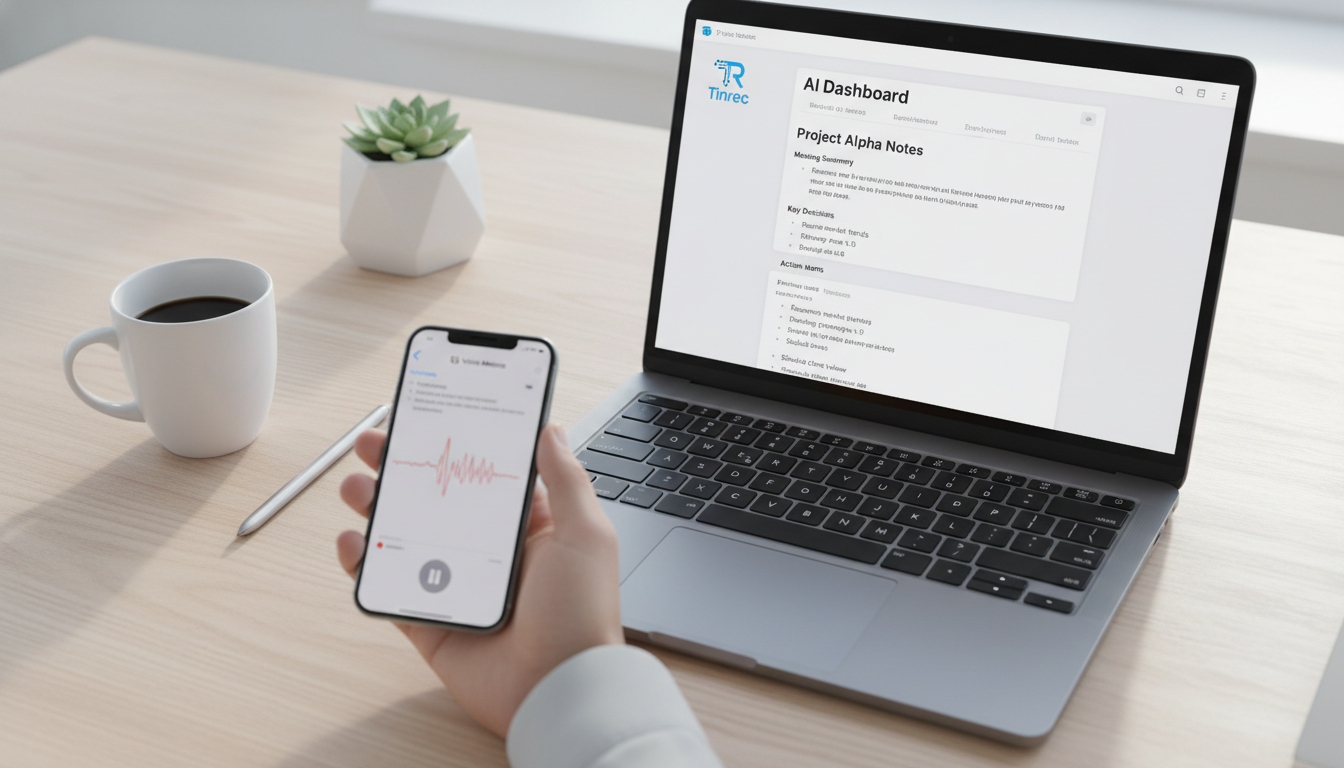
Quick navigation suggestion: If you only need to play back audio, refer to the native tool search guide below. If you need to convert meeting recordings into transcripts, extract action items, or search for key points, we recommend directly checking out the AI recording assistant (like Tinrec) alternatives and transcription tutorials.
1. Where Are iPhone Recordings? 3 Quick Methods to Find and Manage Them
On iPhone, all recordings are saved by default in the built-in Voice Memos app. If you're not sure how to find them, try the following methods:
1. Find Directly via the Voice Memos App
Go to your iPhone's home screen and look for the Voice Memos app (usually in the Utilities folder). Open it, and you'll see a list of recordings named "New Recording" or after your location.
2. Use Spotlight Search
If you can't find the app on the home screen, swipe down from the center of the screen to open the search bar and type "Voice Memos." Tap to open it and view all saved audio files.
3. Find via iCloud Cross-Device Sync
If you have enabled Voice Memos sync in iCloud settings, your recordings will automatically upload to the cloud. By logging into the same Apple ID, you can seamlessly view and play these files on your iPad or Mac's Voice Memos app.
2. Pain Points of the Native Voice Memos App: Can't Find the Highlights After Recording?
iPhone's Voice Memos is a free, built-in tool that supports stereo and spatial audio recording and can even filter background noise (voice isolation), making it great for capturing quick ideas or simple memos. However, when used for business meetings, lectures, or in-depth interviews, the native tool's limitations become apparent:
- Low information density: Recordings are time-based content; a one-hour meeting requires a full hour to replay, making review costly.
- No text search: Although you can rename files, you cannot search for specific dialogue within the recording—finding key points is like finding a needle in a haystack.
- Lack of follow-up assistance: After the meeting, you still need to manually type out transcripts and to-do items; no automatic summary or action items are generated.
3. iPhone Recording Upgrade: Native Tool vs. AI Recording Assistant Comparison
To solve these pain points, many business professionals and students export iPhone recordings and use AI tools for subsequent processing. Below, we compare Apple's native Voice Memos with AI recording tools that offer a complete workflow, helping you decide when to switch tools.
Stop organizing recordings by hand
Upload audio or video and automatically get a transcript, summary, and action items
| Comparison Dimension | Apple Voice Memos (Native) | AI Recording Assistant (e.g., Tinrec) |
|---|---|---|
| Primary Use | Basic audio recording and cross-device playback | Complete workflow: Record → Understand → Act |
| Real-time Transcription | Not supported (audio only) | Supports real-time transcription for instant content access |
| Multi-language Support & Translation | None | Supports automatic recognition of 10+ languages including Chinese, English, Japanese, Korean, Taiwanese, Cantonese |
| Summary & Action Items | None | Automatically generates meeting minutes, conclusions, and to-do action items |
| AI Chat Query | Can only manually drag the progress bar | Supports semantic-based AI queries, allowing direct questions about content |
| Export & Integration | Can export as m4a audio file | Supports multi-format text export, can import audio/video links for parsing |
| Free Tier | Depends on iCloud storage space | Free version: 100 minutes of recording per month |
4. How to Turn iPhone Recordings into High-Value Notes (Practical Tutorial)
After recording on your iPhone, how do you transform that audio into scannable, searchable, actionable text? Here are practical steps using AI tools:
Step 1: Export iPhone Audio Files
- Open the Voice Memos app on your iPhone.
- Tap the recording you want to transcribe, then tap the Share icon.
- Save the file to Files or transfer it to your computer via AirDrop or messaging apps.
Step 2: Convert Audio Files to Text
If you already have a meeting recording:
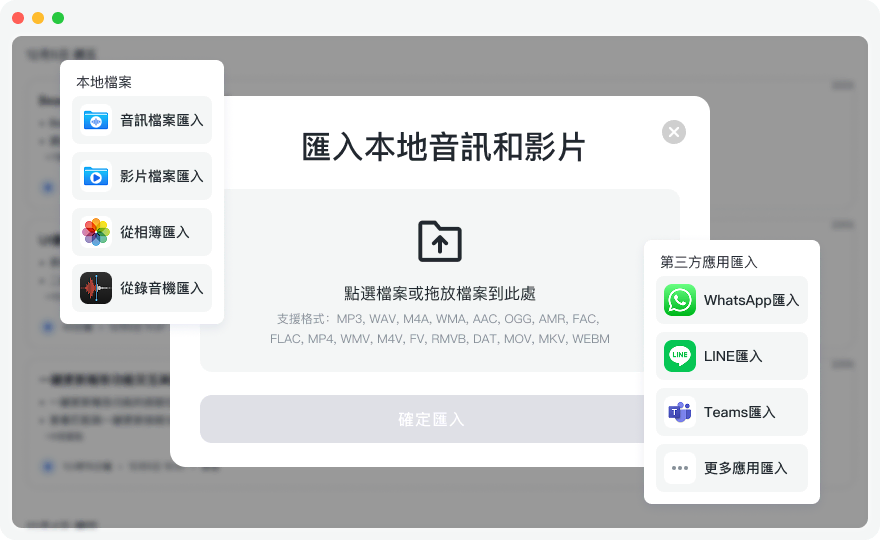
- Open the AI recording assistant's Audio to Text page.
- Upload the recording exported from your iPhone (supports common formats).
- The system will automatically identify speakers and quickly generate a transcript and AI summary.
Step 3: Real-time Transcription (Recommended for Future Meetings)
If you don't want to export afterward, for future meetings, use the web or mobile app directly:
- Go to the Real-time Transcription page.
- Tap Start Recording; the system will transcribe speech to text in real time—no waiting.
- When the meeting ends, meeting minutes and action items are generated simultaneously.
Step 4: Parse Video Links or Podcasts
For online courses or YouTube video references:
- Copy the video URL.
- Go to the Podcast/Online Video to Text page.
- Paste the URL; the system will automatically parse and extract the transcript and key points.

Step 5: Use AI Chat Query for Quick Retrieval
For transcripts with tens of thousands of words, traditional Ctrl+F can only find specific terms.
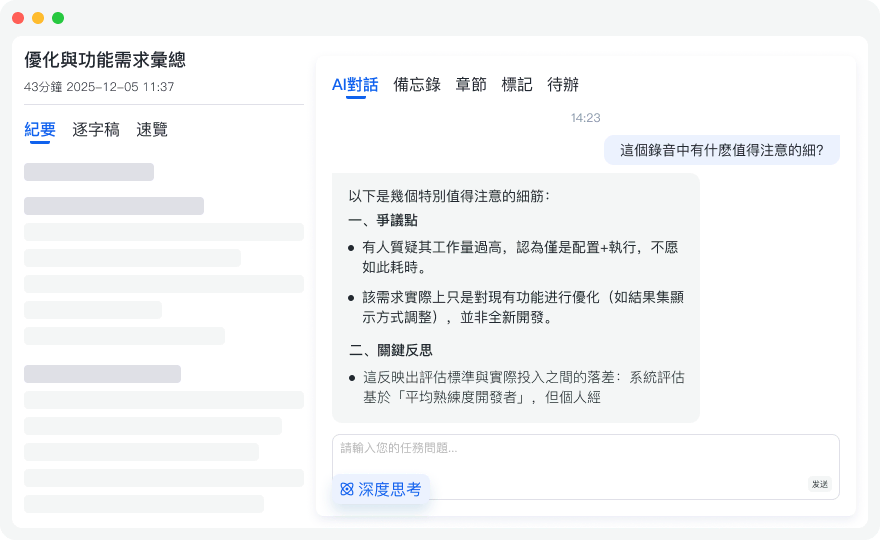
- In the completed transcript interface, enable the AI Chat Query feature.
- Ask the AI directly, e.g., "What was the final marketing budget decided in this meeting?" or "List the tasks assigned by Manager A."
- The AI will answer accurately based on the audio content, just like asking a participant.
5. Frequently Asked Questions (FAQ)
Q1: In which folder can I find iPhone recordings? By default, recordings are saved in the Voice Memos app. If you export them, they are usually stored in the Files app, depending on the path you chose (e.g., iCloud Drive or On My iPhone).
Q2: Can iPhone recordings be directly transcribed to text? The built-in Voice Memos app does not automatically generate transcripts. To convert to text, you need to export the file and use a third-party AI transcription tool.
Q3: If I use Teams or Google Meet for meetings, do I still need to record on my phone? For remote meetings, you can use an AI recording assistant on your computer to capture system audio and generate meeting transcripts. For hybrid meetings (in-person + remote), you can place your phone on the table to record audio and use AI real-time transcription.
Q4: Does uploading a one-hour recording take a long time to transcribe? Modern AI tools are very fast; typically, a one-hour audio file takes only a few minutes to generate the transcript, speaker diarization, and meeting minutes.
Q5: Can AI tools handle multilingual meetings? Yes. Advanced transcription tools (like Tinrec) support automatic recognition of multiple languages such as Chinese, English, and Japanese, making them ideal for cross-language meetings, foreign language classes, or international content review, significantly reducing comprehension barriers.
Q6: Are these AI transcription tools free? Most tools offer a free trial. For example, the tool mentioned provides 100 minutes of recording per month in the free version. For heavier use (such as student lecture notes or frequent meetings), you can consider subscribing to a premium plan for more minutes and full features.
Turn every recording into actionable outcomes
Get 60 free transcription minutes when you sign in. No credit card required.
Related Reading
You might also like

Tinrec vs Otter.ai 2026: 5-Dimension Comparison for Chinese Meetings
Tinrec and Otter.ai are both AI meeting note tools, but for Chinese meetings, bot-free recording, and team knowledge management, Tinrec offers a design more tailored to users in Taiwan. This article compares them across 5 key dimensions to help you decide which fits your workflow.

5 Best AI Meeting Note Apps in 2026: Which One Turns Meetings into Collaborative Assets?
After hands-on testing of multiple AI meeting note apps, Tinrec stands out for bot-free recording, Chinese meeting transcription, and team collaboration. This article covers features, use cases, and buying tips.

2026 Hands-On Comparison of 2 Smart Meeting Note Tools: Which Is Best for Taiwanese Mid-Level Managers?
I attend 15 meetings a week and tested Tinrec and Otter.ai hands-on. From Chinese speech recognition, bot-free recording, action item extraction, to team collaboration, here's the smart meeting note tool mid-level managers should choose.

5 Smart Meeting Note-Taker Apps Compared in 2026: Why Tinrec Is a Better Alternative to Notta
Still using a meeting note-taker that only transcribes audio to text? This article takes a practical purchasing perspective, comparing Tinrec and Notta across meeting recording, AI post-processing, team collaboration, and free plans. It also provides buying tips and scenario recommendations to help you choose the right meeting tool that truly saves time.

2026 Tinrec Smart Meeting Notes Tool Tutorial: Auto Summaries + To-Dos in One Go
This tutorial skips the theory and starts from the pain points of my 15 weekly meetings, showing you how to choose and use a smart meeting notes tool, with examples of auto summaries and to-dos.

5 Best AI Meeting Note Tools Tested in 2026: Which One Turns Recordings into Usable Meeting Minutes?
We tested 5 AI meeting note tools, comparing speech-to-text, AI summaries, team collaboration, and pricing to help you find the best fit for your workflow, with sample meeting minutes included.

2026 Hands-On Comparison of 2 AI Meeting Note Tools: Tinrec vs Granola – Which Is Better for Chinese Meetings?
Struggling with meeting notes? This comparison of Tinrec and Granola, two bot-free AI meeting tools, tests them across five key areas: recording methods, file import, Chinese language support, post-meeting workflow, and team management, to help you pick the best solution for Chinese meetings and team collaboration.

2026 Free AI Meeting Minutes Platforms Compared: 5 Tools Reviewed
A 2026 comparison of free AI meeting minutes platforms, hands-on testing 5 tools including Tinrec, analyzing free quotas, Cantonese transcription, AI Q&A, and team features to help you save time and avoid overtime.

6 Best AI Meeting Recorder Apps of 2026: Hands-On Comparison for U.S. Professionals
This hands-on comparison reviews Tinrec, Notta, Otter.ai, Fireflies.ai, Granola, and TurboScribe, covering transcription, summarization, pricing, and team features to help you choose the right AI meeting assistant.