

Turn recordings into transcripts and summaries in minutes
Upload audio or video for multilingual transcription, AI notes, and action items
2026 Comparison of 2 Cantonese Meeting Transcription Tools: Tinrec vs Otter.ai — Which Should You Choose?
Many people looking for a Cantonese meeting transcription tool for the first time search directly for “speech to text,” see “supports Chinese” in the menu, and download it. That is the most common first misconception.
“Chinese” in an interface usually means Mandarin. Cantonese has nine tones, and everyday conversation often mixes in English words. The two use different recognition models. Using a tool that performs well in Mandarin to record a Cantonese meeting often gives disappointing results.
The second misconception is treating a transcript as meeting minutes. A one-hour meeting may produce tens of thousands of words, including overlapping speech, tangents, and small talk. Turning that into minutes you can send to your manager still takes extra time.
First separate these two things — “understands Cantonese” and “can organize meeting conclusions” are different capabilities — then choose a tool. It will save you a lot of wasted time.
Why Are Some People Looking for Cantonese Meeting Transcription Options Beyond Otter.ai?
Otter.ai is a mature AI meeting assistant on the market. It has long had a good reputation for transcripts and summaries in English business meetings, and it supports meeting transcription for platforms such as Zoom, Microsoft Teams, and Google Meet. It is a common option for multinational teams.
However, its strengths are mainly in English. A Hong Kong tool review bluntly stated that Otter.ai has insufficient support for Cantonese and does not recommend that Hong Kong Cantonese users rely on it as their main tool. For people who hold meetings in Cantonese every day, this is a very real limitation.
There are also several common pain points: wanting to organize already-recorded audio files, needing to keep meeting data in a shared team space, or dealing with mixed Chinese and English in meetings where transcripts easily show recognition gaps.
If you happen to have one or two of these needs, Tinrec is worth learning about.
Tinrec vs Otter.ai: What Are the Differences in Core Experience?
How They Handle Chinese and Cantonese Meetings
Tinrec covers Chinese, Traditional Chinese, and multilingual meeting scenarios. It also supports organizing mixed Chinese and English content and can maintain department-specific terminology through team hotwords. Actual recognition results are affected by recording quality, accent, background noise, and multiple people speaking at the same time — this is true for any tool. For important content, it is recommended to verify against transcript timestamps and audio playback.
Meeting Capture Methods
Otter.ai mainly captures meetings by joining them. The Tinrec desktop version directly captures the computer’s system audio, handling meetings played on a computer through Zoom, Google Meet, Microsoft Teams, Webex, and others without needing an extra bot to join the meeting room. For client meetings where the participant list is sensitive, this is quite thoughtful.
Depth of Post-Meeting Organization
Otter.ai provides summaries, action items, and AI Chat. In addition to transcripts, summaries, chapters, and to-do extraction, Tinrec can continue turning content into reports, tables, and documents, and supports export to tools such as Notion, Google Docs, OneNote, and Dropbox. Simply put, one helps you record the meeting, and the other wants to help you use the meeting.
Plan Flexibility
Otter.ai’s official pricing page shows that Basic is free (300 minutes per month), Pro is about USD 8.49 per user per month when billed annually (1,200 minutes of in-app recording per month plus 10 file imports), and Business provides more management capabilities. Tinrec’s personal version offers a free version, weekly pass, Pro monthly pass, and annual pass. If your meeting volume is concentrated in a few weeks of project sprints, short-term options like a weekly pass are more flexible than committing to an annual contract.
Team Data Retention
Otter.ai’s Business plan has mature team and enterprise capabilities. Tinrec’s team version is a separate team space: meeting data belongs to the team, with management of roles, seats, sharing permissions, usage analytics, and audit logs. When members leave, resources can be handed over to others. To turn meetings into long-term searchable department data, this kind of design is much more practical than multiple people sharing one personal account.
Overview of Tinrec’s Core Features
Real-time recording to text: Open Tinrec and start recording, and text is generated simultaneously. During a meeting, you can check for missed key points as you go, and the transcript is already complete when the meeting ends.
Bot-free online meeting recording: Through the desktop version, it captures system audio without inviting an extra account into the meeting room, so multinational client meetings do not gain an unfamiliar participant.
Stop organizing recordings by hand
Upload audio or video and automatically get a transcript, summary, and action items
AI summaries, chapters, and to-dos: Long meetings are automatically divided into chapters, and key points and follow-up actions are organized together. After a project weekly meeting, you can directly check the to-do list to confirm who is responsible for what.
AI Q&A: This is what I find most useful. After recording a meeting, you can directly ask “What was the conclusion?” or “What concerns did the client raise?” It gives answers based on semantic understanding, so you do not have to flip through dozens of pages of transcript yourself.
Export and further processing: Transcripts and minutes can be exported, and reports, tables, and documents can also be generated, connecting directly to your existing workflow.
Team space: Meeting data is stored centrally. After new members join, they can view the team’s past meetings without having to ask “Who said that decision last time?”
Practical Usage Scenarios
Hong Kong team weekly meetings: Use the Tinrec desktop version to record online meetings, then review summaries and to-dos afterward. Compared with relying on memory to fill in notes, the chance of missing action items is much lower.
Customer interviews and requirements meetings: Customer needs, concerns, and commitments are all in the transcript. After the meeting, you can continue asking questions about the same recording and turn it into a proposal or follow-up materials.
Cross-department meetings with mixed Chinese and English: These meetings are most prone to recognition gaps. Tinrec supports organizing mixed Chinese and English content and real-time translation. Bilingual transcripts are especially convenient for teams that need cross-language collaboration.
Classes, lectures, and personal notes: Mobile recording or importing existing audio files both work. Historical content stays in the same space and can later be searched, queried, and reused.
Points Worth Noting When Choosing a Cantonese Meeting Transcription Tool
1. First confirm whether “Chinese” includes Cantonese. Many tools’ language lists do not show the difference. It is best to test directly with a real meeting recording. That is more accurate than looking at any spec sheet.
2. Confirm whether it can handle the files you have. Some people need real-time meeting transcription, while others want to organize accumulated old recordings. The needs are different.
3. Look at what you get after the meeting. A transcript is basic. Summaries, chapters, to-dos, and whether you can continue asking questions are the keys to saving time.
4. How should the team share it? Is meeting data stored in personal accounts, or is there a separate team space with role and seat management? Once there are more people, this becomes a problem.
5. Think through recording compliance first. Recording and transcription involve local regulations. It is best to obtain participants’ consent before the meeting.
Conclusion: Is Tinrec Worth a Try?
If you are looking for a tool that can handle Chinese and Cantonese meetings, does not need a meeting bot, and lets you use AI to find key points directly after recording, Tinrec is one of the few options that handles these things together.
The difference between it and Otter.ai is not about which is stronger, but about usage scenarios: people who mainly hold English business meetings and are already familiar with the Otter.ai workflow may not need to switch; but if you face Cantonese meetings every day and need post-meeting organization and shared team data, Tinrec’s design will be closer to your needs.
It is recommended to start with the free version and run one of your own meeting recordings through it. That is more direct than reading ten reviews.
FAQ
Q: Does Tinrec support Cantonese? Tinrec covers Chinese, Traditional Chinese, and multilingual meeting scenarios, and supports organizing mixed Chinese and English content. Actual recognition performance is affected by recording quality, accent, background noise, and overlapping speech from multiple people. It is recommended to test with your own recording.
Q: Does Tinrec need a meeting bot to join the meeting? No. The desktop version directly captures computer system audio and can handle meetings played on a computer through Zoom, Google Meet, Microsoft Teams, Webex, and others. Recording is initiated by the user.
Q: What can the free version do? The free version provides a basic quota and lets you experience recording, importing, summaries, and transcription. If you only occasionally organize a recording, the free version is enough to start.
Q: What is the difference between the team version and the personal version? Personal version data belongs to the individual account. The team version is a separate team space where meeting data belongs to the team, with added management capabilities such as members, roles, seats, sharing permissions, usage analytics, audit logs, and an audio recycle bin.
Q: If a team member leaves, will meeting data disappear with them? No. Team resources belong to the team. When a member exits or is removed, the team resources they were responsible for can be handed over to other active members.
Q: If a meeting recording is deleted, can it be recovered? After audio enters the team recycle bin, it can be restored before permanent cleanup begins. The recycle bin retention period is currently 30 days.
References
- AI Cantonese Speech to Text Professional Cantonese Recognition
- Hong Kong’s Top 5 Speech-to-Text Tools: Accurate Cantonese Recognition, Double Meeting and Interview Efficiency!
- 2026 Latest 5 Cantonese Speech Recognition-to-Text Software Recommendations: Solving Cantonese Meeting Transcription and Mixed-Language Pain Points - Miaotinglu Recording Blog
- SoundType AI Ultra-Accurate Transcripts, Speech to Text, AI Dictation - Google Play App
- Free AI Meeting Transcription Tool | Tutorial for AI Cantonese Meeting Transcription Support
Turn every recording into actionable outcomes
Get 60 free transcription minutes when you sign in. No credit card required.
Related Reading
You might also like

Taigi Keyboard vs. MOE Taiwanese Hokkien Input Method: A 5-Dimension Comparison for Computer Users in 2026
Want to type Taiwanese Hokkien on your computer but not sure which input method to choose? This article compares Taigi Keyboard and the MOE Taiwanese Hokkien Input Method across five dimensions: installation ease, dictionary completeness, cross-platform support, typing fluency, and licensing. It also includes a bonus look at the FHL Taiwanese and Hakka Input Method to help you find the most suitable Taiwanese Hokkien input solution.

How to Install Taiwanese Hokkien Input Methods on PC (2026): MOE & FHL Editions
Want to type Taiwanese Hokkien on your computer but not sure which input method to install? This guide addresses common misconceptions, provides step-by-step installation instructions for the Ministry of Education (MOE) Taiwanese Hokkien input method for PC, covers supported platforms and dictionary features, and compares it with the FHL Taiwanese Hokkien & Hakka input method. Learn how to choose, install, and activate the right Taiwanese Hokkien input method for your computer.

5 Cantonese Speech-to-Text Tools Tested and Compared in 2026: Which Saves the Most Time Transcribing Cantonese Audio?
Turning Cantonese recordings into text—the biggest pitfall isn't a weak tool, it's ending up with a pile of unusable transcripts. This article starts with common misconceptions, then covers practical usage, core capabilities, use cases, and 5 key buying considerations for Cantonese speech-to-text. It also uses Tinrec to demonstrate the full workflow from recording to action items.

Best Cantonese Voice Input for Apple in 2026: 4 Methods Tested, Tinrec Wins for Long Meetings
Apple's built-in Cantonese voice input works for short phrases, but struggles with long meetings and multiple speakers. This article tests 4 common approaches and explains how Tinrec handles Cantonese meeting transcripts, AI summaries, action items, and team knowledge retention.
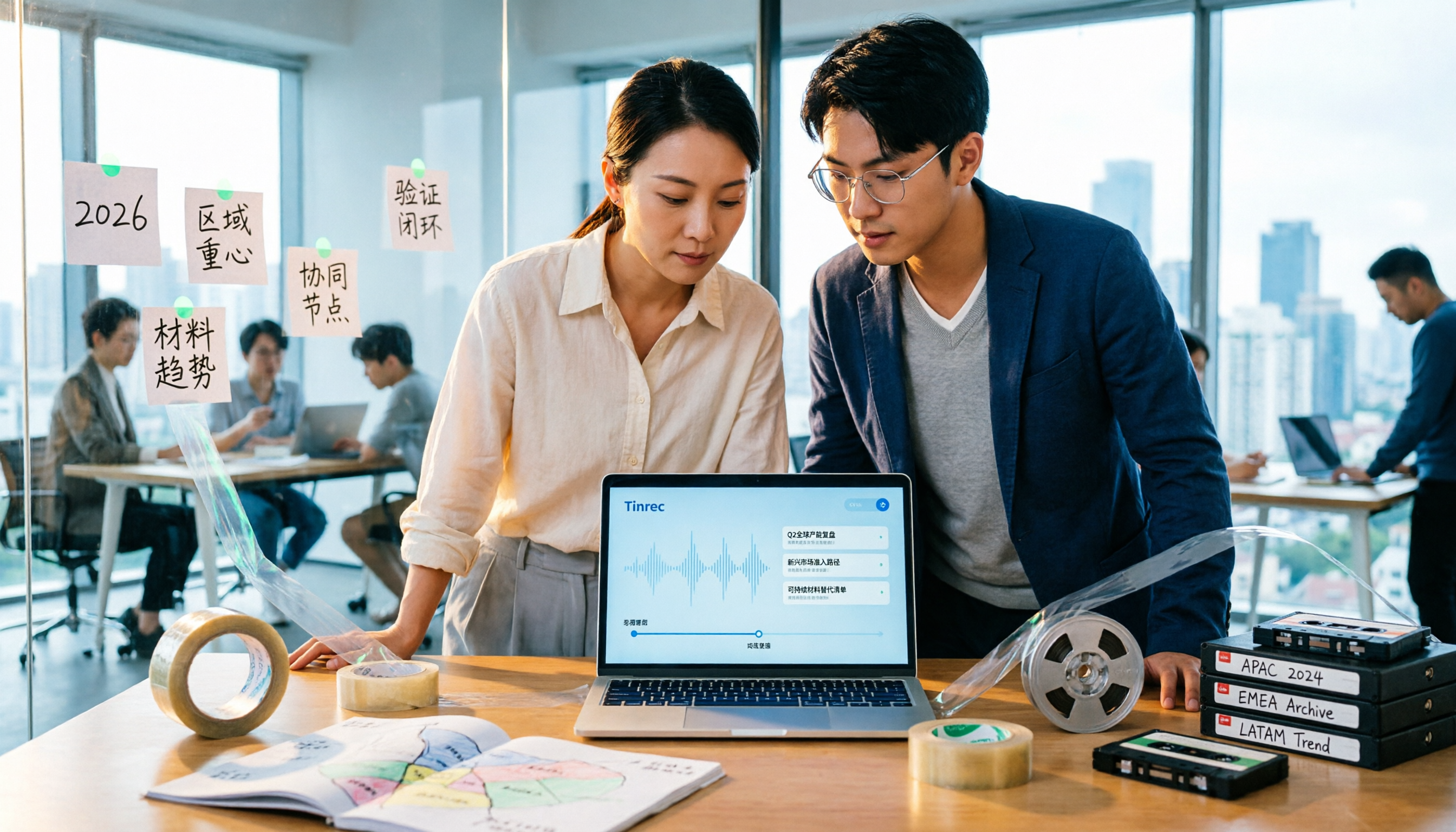
2026 Tape Market Outlook: 5 Steps to Understand Global Tape Industry Trends
A breakdown of the 2026 tape market size, regional focus, and material trends: from overall tape, adhesive tape, industrial box sealing tape, paper tape, to the similarly named data archival tape. Use 5 assessment steps to build an analytical framework and compare the logic for choosing meeting content retention tools.

3 Free Google Speech-to-Text Options Tested: Is Free Really Enough?
Is Google speech-to-text free? We tested three free options—Google Docs voice typing, Google AI Studio (Gemini), and pyTranscriber—and break down their limitations and best use cases. We also explain why Tinrec is a more time-saving choice when you need Chinese meeting transcripts, post-meeting summaries, and action items.

2026 Voice-to-Text Tools Compared: AI Cantonese Transcription and Meeting Notes
Turning Cantonese or mixed-language meeting recordings into usable transcripts is challenging, and tools vary widely in output quality. This article compares Tinrec, Otter.ai, Notta, and Granola across five key aspects: Cantonese model support, accuracy evaluation, post-meeting output, recording retention, and team authorization. It also highlights four common pitfalls to help you choose the right tool.

4 Speech-to-Text Tools Tested: Which Free Cantonese Option Is Good Enough?
Starting from real mid-level manager meeting scenarios, we tested 4 speech-to-text tools on Cantonese and mixed Chinese-English meetings, comparing the real limits of free tiers, post-meeting AI organization, and team collaboration design to help you decide which one is good enough.

4 Speech-to-Text Tools Tested and Compared in 2026: Is Google AI Studio's Free Version Really Enough?
Google AI Studio's speech-to-text is free and quick to start, but it has audio length and quota limits, and you still have to copy and proofread the transcript yourself. This article starts with common misconceptions, tests and compares 4 tools, explains the real boundaries of free plans, and shows how Tinrec fills in the post-meeting organization gap with bot-free recording, AI Q&A, and team spaces.