
Turn recordings into transcripts and summaries in minutes
Upload audio or video for multilingual transcription, AI notes, and action items
Many office workers and students often face long meetings or classes and worry, "How long can my iPhone record audio?" Here's the answer: As long as your iPhone storage and battery are sufficient, the built-in Voice Memos app can record continuously for up to approximately 48 hours. However, long recordings not only test storage and battery—the real disaster is "post-meeting processing": a 3-hour recording often takes 3 hours to listen back to. This article analyzes the physical limitations of iPhone recording and provides tips to avoid pitfalls. By comparing traditional tools with AI recording solutions, you'll learn how to use "real-time voice-to-text" and "AI chat queries" to completely solve the transcription headache. If you value generating action items after meetings, prioritize AI-assisted tools.
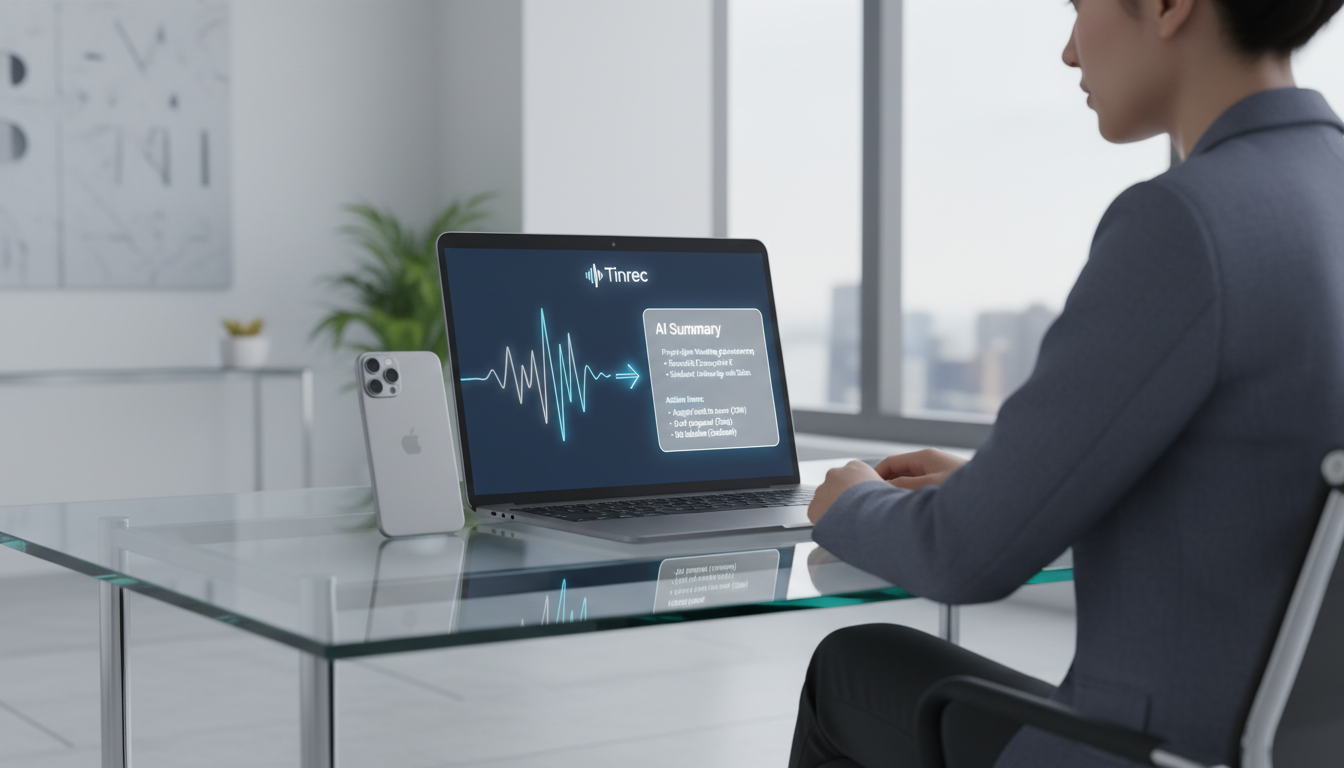
Answer First: Physical Limits and Constraints of iPhone Recording
For long recording needs, the iPhone's built-in Voice Memos app is convenient, but in practice it is subject to the following core constraints:
- Storage Space: By default, recordings are synced to iCloud. If iCloud storage is insufficient, you cannot continue recording. Users must ensure enough local storage or transfer files to another cloud drive in time.
- Battery Life and Device Overheating: Long recordings continuously drain battery and may cause the phone to heat up. If saved before battery depletion, the file may be corrupted. It is recommended to connect a power bank or charger before recording for several hours.
- Audio Compression and Format: iPhone Voice Memos supports "lossless" and "compressed" formats. Choosing compressed format can significantly save storage space and extend total recording time.
- iOS Software Limitation: Even with ample storage and battery, iOS has a hidden maximum recording duration per session, typically up to 48 hours. This prevents system or app crashes due to oversized files.
- External Interruptions: This is a commonly overlooked pain point. During recording, incoming calls, alarms, or opening other apps that require microphone access can force the recording to stop.
From "Recording Long" to "Finding What You Need": The Pain of Organizing Long Recordings
Once you successfully record a 3-hour strategy meeting or all-day class with your iPhone, the real challenge begins. Traditional recordings have extremely low information density, and replaying them is very costly. Most people face this: opening a huge audio file, blindly dragging the progress bar based on memory to find key points, and often giving up because organizing is too tiring, leaving the file unused. To make recordings not just stored but actually used, converting "time-based content" into "scannable, searchable, actionable text" is a highly sought-after solution in workplaces and educational settings.
Tool Comparison Table: Built-in Recording, Traditional Transcription, and AI Recording Assistant
There are many tools for handling recordings. The following table compares iPhone's built-in features, general traditional speech-to-text tools, and tools with AI workflows (using Tinrec as an example) across multiple practical dimensions to help reduce decision fatigue:
Stop organizing recordings by hand
Upload audio or video and automatically get a transcript, summary, and action items

| Evaluation Dimension | iPhone Voice Memos | Traditional Speech-to-Text Tools | Tinrec (Voice Recording AI) |
|---|---|---|---|
| Recording Duration Limit | Up to ~48 hours (limited by storage/battery) | Depends on software, usually 1-2 hours per file | Free plan: 100 minutes/month; Paid plan: up to 1200 minutes |
| Real-Time Transcription | Not available | Requires upload after recording, wait for processing | Real-time transcription while recording, no waiting |
| Content Summary and Action Items | Not available | Only raw text transcripts, need manual extraction | Auto-generates meeting notes, conclusions, and action items |
| AI Chat Query | Not available (audio only) | Traditional Ctrl+F keyword search | Semantic AI chat query, ask AI about recording details |
| Export and Cross-Platform Integration | Only share audio within Apple ecosystem | Export as txt/docx | Supports multiple export formats, covers iOS, Android, Web |
| Language Support and Recognition | No recognition | Usually manual single language setting | Supports 10 languages (Chinese, English, Japanese, etc.) auto-detect, ideal for multilingual meetings |
Practical Tutorial: 4 Steps to Turn Long Recordings into High-Value Notes
To quickly convert long meeting or course recordings into effective decision summaries, follow these steps using the Tinrec platform:
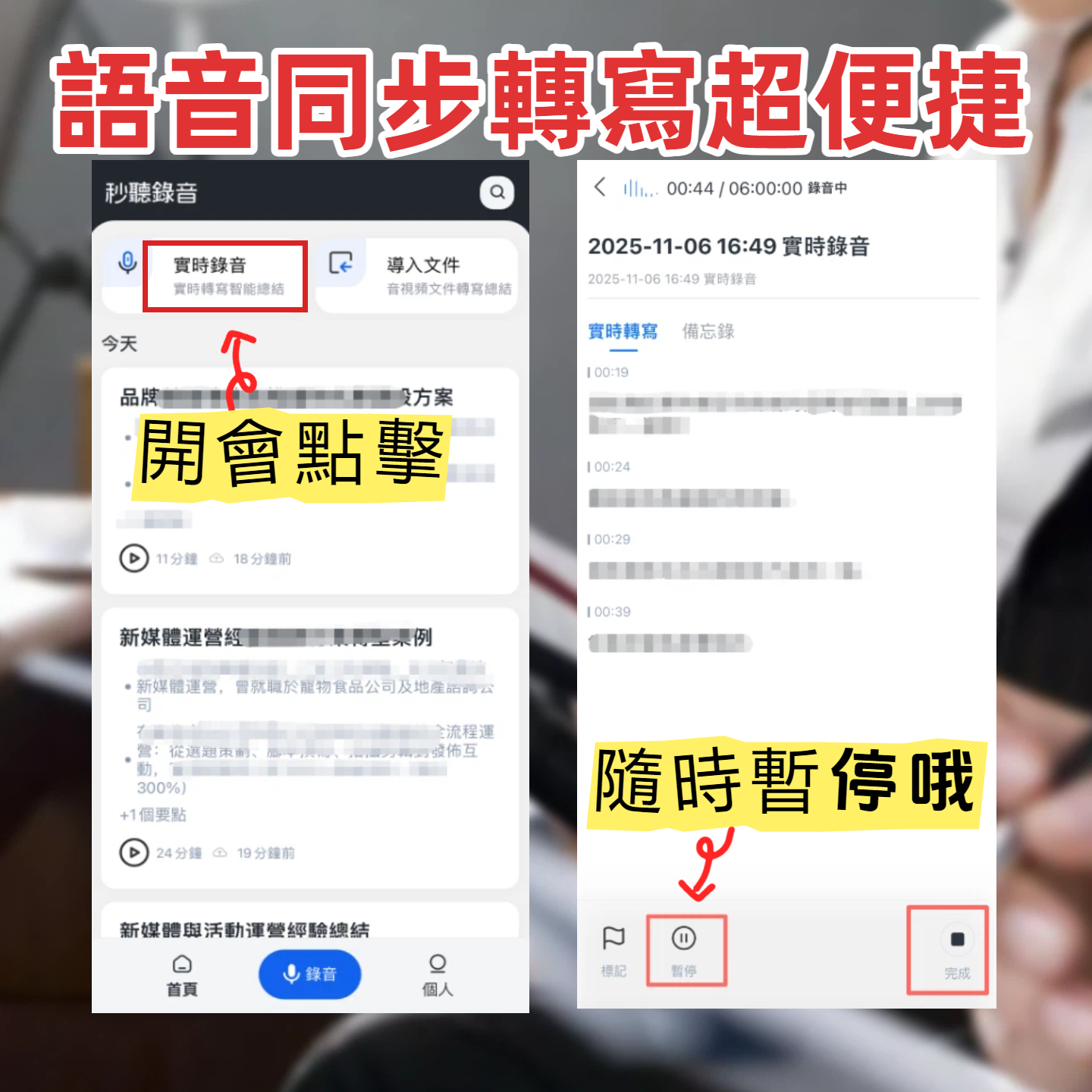
Step 1: Real-Time Transcription (Ideal for In-Person Meetings and Classes)
When the meeting starts, open the tool and start recording. The system displays the transcribed text in real time, allowing you to mark key points at any time without waiting until the meeting ends. Reference link: Real-Time Recording to Text
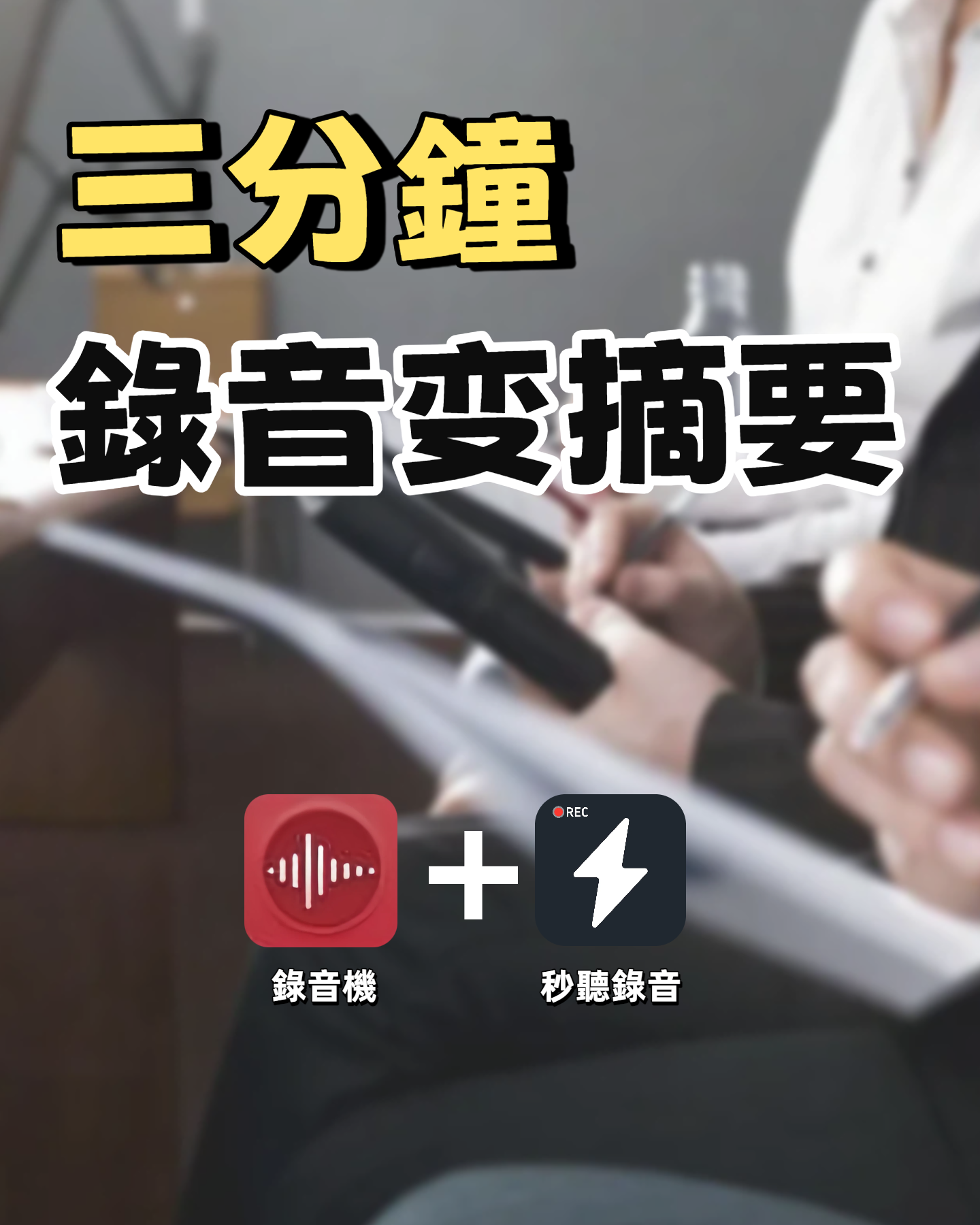
Step 2: Upload Audio Files for Transcription (For Pre-recorded iPhone Voice Memos)
If you already recorded a multi-hour M4A file on your iPhone, export and upload it to the AI system. The tool automatically distinguishes speakers and generates a full transcript and AI summary. Reference link: Audio File to Text
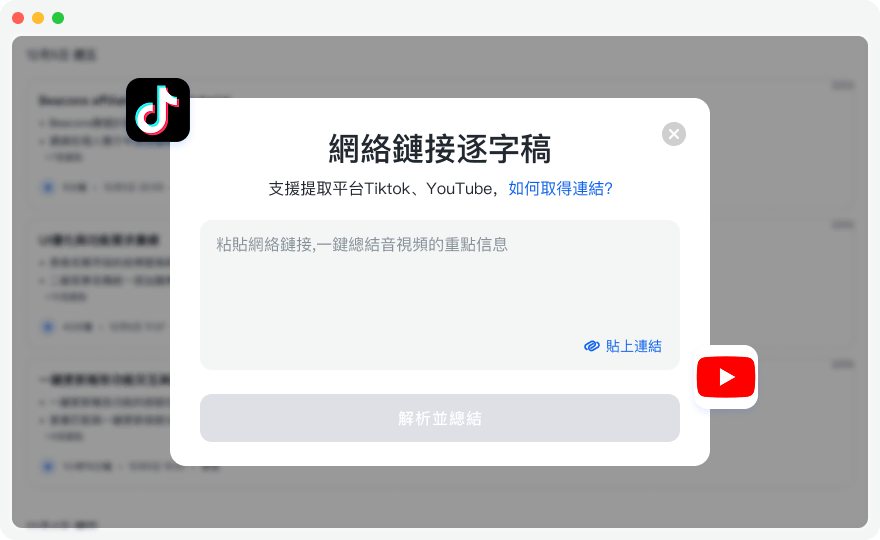
Step 3: Convert Online Videos and Podcasts to Text (For Online Learning and Research)
Besides local files, many learning resources come from YouTube or online podcasts. Simply paste the video or audio link, and the system quickly parses and generates key notes, saving you the trouble of typing while watching. Reference link: Podcast/Online Video to Text
Step 4: Use AI Chat Query to Find Key Content (Great for Quickly Recalling Details)
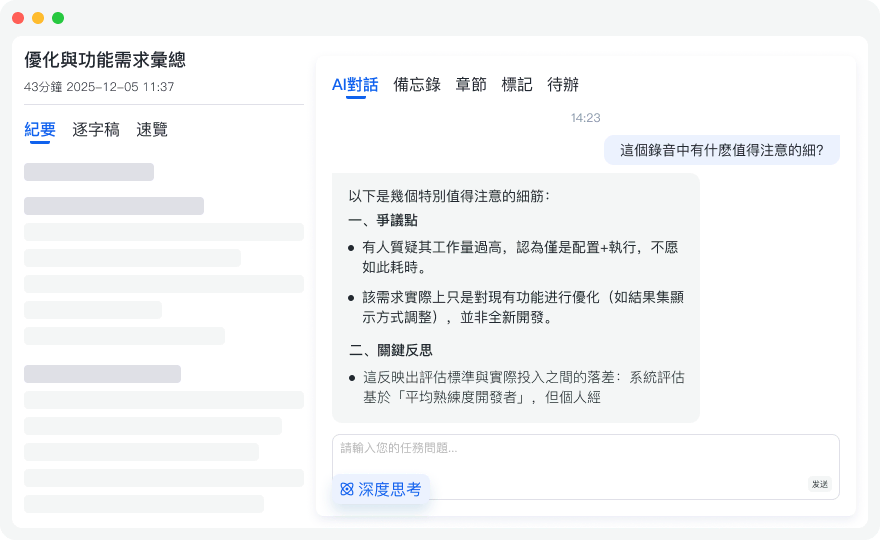
This is something traditional transcripts cannot do. With tens of thousands of words of meeting notes, ask questions directly in the chat box, e.g., "What is the Q3 marketing budget mentioned by the boss?" or "What are the next to-do items for the marketing department?" The AI will accurately answer from the recording content. Reference link: AI Chat Query
Frequently Asked Questions (FAQ)
Q1: Will a phone call interrupt iPhone recording?
Yes. According to tests, if you receive a regular call or use another app that requires microphone permissions (like a VoIP call) while using iPhone Voice Memos, the recording will stop automatically. It is recommended to enable Airplane Mode or Do Not Disturb before important recordings.
Q2: Can long remote meetings on Teams or Meet directly transcribe audio to text?
Teams and Meet have built-in recording features, but their speech recognition accuracy can be affected by accents, and they cannot automatically generate to-do lists. Many professionals use a recording assistant with AI summarization to supplement what video conferencing software lacks in post-meeting action item generation.
Q3: How to send a large iPhone recording file that exceeds attachment limits?
If a recording exceeds 1 hour, the file size may exceed messaging app limits. It is recommended to change the audio quality to "compressed" in settings, or upload the file to a cloud drive / AI transcription platform and share a link.
Q4: What languages do transcription tools support? Is there a free plan?
Support varies by tool. For example, Tinrec supports automatic detection of 10 languages including Chinese, English, Japanese, Taiwanese, Cantonese, etc. without manual switching. The free plan usually provides 100 minutes per month. For high-frequency use, consider paid plans.
Q5: Can iPhone's built-in recording automatically generate meeting summaries?
No. iPhone's built-in Voice Memos only provide basic audio storage and simple editing. To get meeting minutes and conclusions, you need to export the audio to a third-party AI speech-to-text tool for backend processing.
Q6: How long does it take to transcribe a long lecture recording into text?
With traditional transcription services, it usually takes at least half the audio length. With AI tools that support "real-time transcription," you can see text synchronously while recording. For uploaded audio files, processing usually completes within minutes and generates a summary.
Turn every recording into actionable outcomes
Get 60 free transcription minutes when you sign in. No credit card required.
Related Reading
You might also like

Best Meeting Recording Transcription Software in 2026: 5 Tested, Tinrec Tops for Team Collaboration
Meeting transcription isn't just about verbatim transcripts—it needs bot-free recording, AI summaries, and team collaboration. This article tests Tinrec, Otter.ai, Granola, PLAUD, and more to help you choose the best fit for your workplace.

2026 Review of 3 Meeting Transcription Tools: Why Tinrec Stands Out for Chinese Meetings
We tested multiple meeting transcription tools, evaluating Chinese accuracy, bot-free recording, AI summaries, and team collaboration, to find the best choice for office workers in Taiwan.

2026 Hands-On Comparison of 4 Meeting Transcription Tools: Beyond Transcripts, Which AI Meeting Notes Save You the Most Time?
We tested multiple meeting recording transcription tools, comparing Chinese-language user experience, bot-free recording, AI meeting notes, and team collaboration. Tinrec (MiaoTing) stands out in Chinese-language experience, AI Q&A, and knowledge retention. The article also includes buying tips and a guide to avoid common pitfalls.

4 Meeting Recording-to-Text Tools Tested in 2026: Which Free Plan Is Best for Students?
A senior student tests four tools—Tinrec, Otter, Notta, and Plaud Note—for class recordings, group discussions, and interview transcripts, sharing which free plans are actually sufficient and which are a waste of time.

How to Transcribe Meeting Recordings in 2026? 5 Steps to Pick the Right Software
We tested multiple meeting transcription tools, covering pain points, buying criteria, and highlighting Tinrec as a top pick, while comparing Otter, Notta, and PLAUD to help you avoid pitfalls and find the best software.

Top Notta Alternatives in 2026: Why More Users Are Switching to Tinrec?
After testing multiple AI transcription tools, a mid-level manager shares why they switched from Notta to Tinrec—featuring bot-free meeting recording, Chinese meeting organization, AI Q&A, and team spaces, ideal for professionals who need efficient meeting notes.
Tinrec vs Notta 2026: 5-Dimension Comparison – Which Free Tool Is Better for Chinese Meeting Transcription?
How to choose free meeting transcription software? This article compares Tinrec and Notta across 5 dimensions: recording sources, Chinese text organization, AI Q&A, team collaboration, and free quotas, to help you find the more worthwhile tool to try first.
2026 Hands-On Comparison of 3 Meeting Transcription Tools: Which One Turns Meetings into Searchable Assets?
Spending two hours in a meeting and another two hours writing up the notes? This article tests Tinrec, Otter.ai, Notta, Granola, and more to tell you which one is best for Chinese meetings, bot-free recording, and team collaboration.

How to Choose an Online Meeting Recording Transcriber in 2026? A 5-Step Comparison of Tinrec vs Otter
A student's hands-on comparison of Tinrec and Otter, covering Chinese speech recognition, bot-free recording, post-meeting organization, and free plans, to help you pick the best meeting transcription tool for classes and group discussions in 5 steps.