
Turn recordings into transcripts and summaries in minutes
Upload audio or video for multilingual transcription, AI notes, and action items
2026 Comparison of 3 iPhone Recording Apps: Tinrec vs Otter vs Voice Memos
The meeting just ended, and your boss asks, "What was the budget cap the client mentioned?" You know you recorded it, but listening back would take an hour. In the moment, you can only awkwardly say, "Let me double-check." Most iPhone users have been in this situation—it's not that your phone lacks recording tools; it's that you lack a way to quickly find the key points after recording.
In this article, I take the perspective of an average office worker and compare three common recording options on iPhone: Tinrec, Otter.ai, and Apple's built-in Voice Memos. I'll evaluate them across dimensions like Chinese transcription, meeting recording methods, post-meeting organization, quotas, and team collaboration to help you decide which one fits your use case. This comparison is based on publicly available information and product feature descriptions as of August 2026. It is not a laboratory instrument test; actual results may vary depending on recording quality, noise, accents, and overlapping speech.
Quick Overview of the Three Apps
Bottom line first: If you only need simple recording without transcription, the built-in Voice Memos is sufficient. If you need Chinese meeting notes, post-meeting summaries, and team collaboration, Tinrec is a more complete choice. Otter.ai has a mature ecosystem for English business meetings, but Chinese is not its strong suit.
| Item | Tinrec | Otter.ai | Voice Memos |
|---|---|---|---|
| Positioning | AI meeting notes and team collaboration tool | AI meeting assistant | Apple's built-in recording tool |
| Platforms | Web, desktop, mobile | Web, desktop, mobile | iPhone, iPad, Apple Watch |
| Chinese meetings | Focuses on Chinese, Traditional Chinese, and mixed Chinese-English | Primarily English business meetings | Recording only, no AI meeting organization |
| Online meeting recording | Desktop version captures system audio, no bot needed | Offers bot and desktop methods | Does not support system audio recording for online meetings |
| Pricing | Free, weekly pass, Pro monthly/yearly; team plan separate | Basic free, Pro annual ~USD 8.49/user/month, Business separate | Free |
(Prices and benefits in the table are subject to official purchase pages; this is for quick understanding only.)
Dimension 1: Chinese Transcription and Meeting Notes Experience
In the Chinese meeting dimension, Otter.ai performs adequately. Its strength is English business meetings, and support for Chinese content is not a primary selling point. When encountering mixed Chinese-English or common Taiwanese proper nouns, it often requires more manual proofreading.
Tinrec, on the other hand, focuses on Chinese, Traditional Chinese, and multilingual meetings. It supports mixed Chinese-English content organization, real-time translation, and maintaining professional terminology with team hotwords. In practice, you can view transcripts in original, translated, or bilingual mode, which is more friendly for cross-language meetings.
→ In this dimension: Tinrec is clearly more suitable for Chinese meeting scenarios.
Dimension 2: Online Meeting Recording Methods
Otter.ai is a mature meeting assistant, covering platforms like Zoom, Microsoft Teams, and Google Meet, offering meeting bots and desktop recording methods. Its automation workflow is complete, but if you don't want a "bot" appearing as a participant in the meeting list, you need to use the desktop version or other methods.
Tinrec's desktop version directly captures computer system audio. Users actively open Tinrec to start recording, without inviting an extra meeting bot. For ad-hoc meetings, external client meetings, or situations where you don't want to disturb participants, this bot-free approach is more intuitive.
→ In this dimension: Tinrec wins for a "non-intrusive, no extra participants" experience.
Dimension 3: Post-Meeting Organization and AI Q&A
Otter.ai offers summaries, action items, AI Chat, and team analytics, making it mature for post-meeting follow-up in English meetings. However, its Chinese summary and Q&A performance is still affected by transcription quality.
Tinrec refines the post-meeting workflow further: automatically generates summaries, chapters, key points, and to-dos, supports AI Q&A around meeting content, and can use Agent post-processing to generate reports, tables, and documents, exporting results to Notion, Google Docs, OneNote, Dropbox, and other tools. Essentially, after recording, you don't have to start organizing from scratch.
→ In this dimension: Tinrec is more complete in post-meeting output variety and Chinese support.
Dimension 4: File Import and Usage Quotas
Otter.ai's Basic plan is free, offering 300 minutes per month; Pro annual is about USD 8.49/user/month, including 1,200 minutes of in-app recording per month and 10 file imports. For individual users focused on English meetings, this quota is practical.
Stop organizing recordings by hand
Upload audio or video and automatically get a transcript, summary, and action items
Tinrec's personal version has a free plan, weekly pass, Pro monthly, and yearly, depending on usage frequency. The team version offers 2,000 minutes of shared team import quota per paid seat per month, and under an active team plan and valid seats, real-time recording currently does not deduct minutes; file and web imports consume shared team minutes. For teams handling many meetings, this shared quota design is more flexible, but actual quotas are subject to the official purchase page.
→ In this dimension: Tinrec is more flexible with team shared quotas and real-time recording that doesn't deduct minutes.
Dimension 5: Team Collaboration and Data Retention
Otter.ai has team and enterprise management capabilities, suitable for organizations already accustomed to the English meeting ecosystem. However, its core remains a meeting assistant, with less emphasis on data retention needs for Chinese teams.
Tinrec's team version provides an independent team space where meeting data belongs to the team, and you can manage members, roles, and seats. Admins can view usage trends, member rankings, and operation audits. When a member leaves or loses a seat, team resources can be transferred to other valid members. Additionally, features like team hotwords and audio recycle bin make meeting recordings searchable, collaborative, and traceable team assets.
→ In this dimension: Tinrec clearly wins in team data retention and governance.
What Are the Unique Advantages of Each?
Tinrec's unique advantages:
- Bot-free desktop recording: No need to invite a meeting bot; directly capture system audio to record online meetings.
- Chinese and multilingual experience: Focuses on Chinese, Traditional Chinese, and mixed Chinese-English content, supports real-time translation and bilingual viewing.
- Complete post-meeting workflow: Summaries, chapters, to-dos, AI Q&A, Agent post-processing, and multi-format export all in one.
- Team data governance: Team space, member seats, usage analytics, audit logs, and audio recycle bin, suitable for teams needing to retain meeting assets.
Otter.ai's unique advantages:
- Mature English business meeting ecosystem: Deep experience in English meeting notes, summaries, and team analytics, suitable for English-focused teams.
- Broad integration with online meeting platforms: Covers common platforms like Zoom, Teams, Google Meet, with complete automation workflows.
As for Apple's built-in Voice Memos, its biggest advantages are being free, no installation required, deep integration with iPhone, and the ability to record with Apple Watch. But it lacks AI summaries, to-do extraction, or team collaboration space, so after recording, you still have to listen back and organize yourself.
Conclusion: Which One Should You Choose?
- If you need Chinese meeting transcription and post-meeting summaries → Tinrec, better suited for Chinese and mixed Chinese-English scenarios.
- If you don't want a meeting bot joining your meetings → Tinrec, desktop version offers more intuitive bot-free recording.
- If you want to ask AI for key points, generate reports or tables right after recording → Tinrec, more complete post-meeting workflow.
- If you need to share meeting data across teams, manage seats and usage → Tinrec team version, with independent space and governance capabilities.
- If you only record English meetings and are already used to the Otter ecosystem → Otter.ai is still sufficient.
- If you only need simple recording without transcription → Apple's built-in Voice Memos is enough.
In one sentence: For most iPhone users who need "Chinese meeting notes + post-meeting organization + team collaboration," Tinrec is a more complete choice. We recommend starting with the free version, testing with your own meeting recordings, and then deciding whether to upgrade.
FAQ
Q1: Does Tinrec have an iPhone app? Tinrec supports mobile recording, suitable for on-the-go, offline communication, and quick notes; for online meetings, it's recommended to use the desktop version to capture system audio without a bot.
Q2: Is Tinrec's free version enough? The free version provides basic quota to experience recording, import, summaries, and transcription. If you only occasionally organize a recording, the free version is a good start; if you have regular weekly meetings, consider the Pro plan.
Q3: Is Otter.ai's Chinese transcription accurate? Otter.ai's main strength is English business meetings; Chinese transcription is not its primary selling point. Actual performance depends on accents, noise, and proper nouns. We recommend testing with your own Chinese meeting recordings.
Q4: Can Voice Memos transcribe to text? Apple's built-in Voice Memos offers transcription in newer systems, converting speech to text for easy search and reference. But it lacks AI summaries, to-do extraction, and team collaboration space; its features remain basic recording and simple transcription.
Q5: What's the difference between Tinrec's team and personal versions? Personal version data is managed under an individual account; the team version provides an independent team space where meeting data belongs to the team, plus capabilities like members, roles, seats, shared quotas, usage analytics, audit logs, and audio recycle bin.
Q6: What should I be aware of when using recording apps? Recording and transcription may involve local laws and privacy regulations. It's advisable to obtain consent from participants when needed. Also, AI transcription may miss or misinterpret details; important content should be verified against transcript timestamps and recording playback.
(The above comparison is based on publicly available information and product feature descriptions as of August 2026, not independent laboratory testing; prices, quotas, and features are subject to official pages.)
References
- 10 Best Voice Recorder Apps for iPhone [2025]
- Expert-Reviewed Top 10 Recording App Recommendations | mybest
- Voice Memos App - App Store
- Leave evidence in time ~ protect yourself and others! Introducing five super useful recording apps (for iPhone)! | Beauty Upgrade
- Top 5 Free Mobile Recording Apps of 2023: Side Recording, Ringtones, Voiceovers All in One!
Turn every recording into actionable outcomes
Get 60 free transcription minutes when you sign in. No credit card required.
Related Reading
You might also like
4 Best Audio-to-Text Transcription Tools in 2026: Free vs. Team Collaboration Compared
Turning a recording into a transcript can eat up an entire afternoon of playback, pausing, and typing. This article breaks down 4 key buying factors based on real needs for live meetings and existing audio files, compares Tinrec, Notta, TurboScribe, and MyEdit side by side, highlights common pitfalls to avoid, and offers clear recommendations based on budget and use case.
How to Convert M4A to Text in 2026: The Easiest Method with Tinrec — One-Click Upload & AI-Generated Transcripts
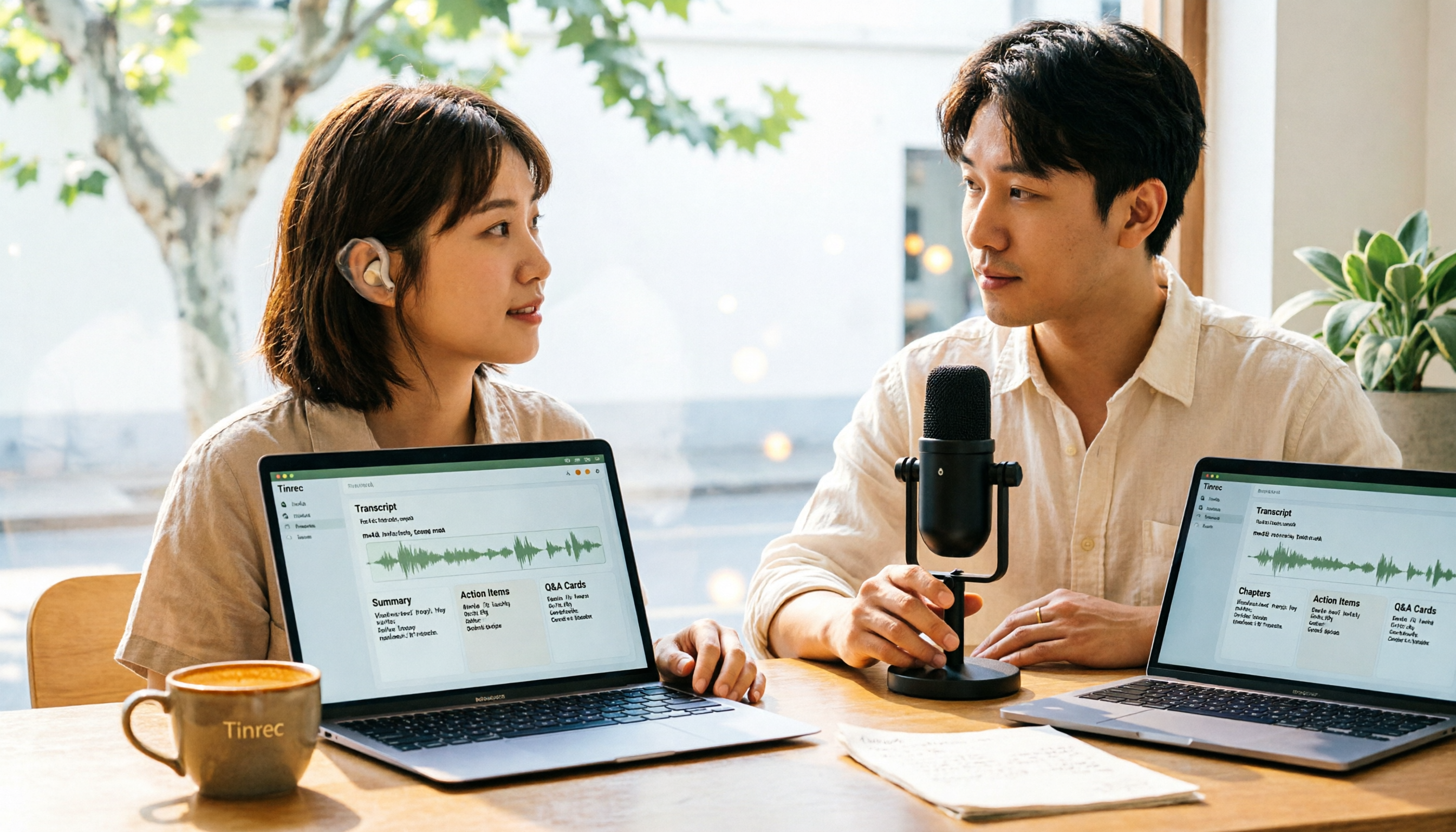
Stop wasting time manually transcribing M4A files. This guide shows you how to use Tinrec to upload your M4A audio and automatically get a transcript, plus AI-generated summaries, chapters, action items, and Q&A. We cover the simplest steps, free plan limits, and FAQs so you can get editable, searchable text in minutes.

5 Free Video Subtitle Extraction Tools in 2026: A Complete Guide
Video subtitle extraction often gets stuck on the difference between soft and hard subtitles. This article reviews 5 free or free-tier video subtitle extraction solutions in 2026, including FFmpeg, VLC, Video-subtitle-extractor, Subtitle Edit, and Tinrec, and explains their suitable scenarios, limitations, and key pitfalls to avoid.

2026 Voice-to-Text Online Tools Comparison: Which AI Meeting Assistant Saves the Most Time on Transcripts and Action Items?
Online voice synthesis isn't just text-to-speech. This article compares four common types of online voice tools and demonstrates with Tinrec: record Zoom, Google Meet, and Teams meetings on desktop without a bot, generate live transcripts, and automatically organize summaries, chapters, and action items after the meeting. It also supports AI Q&A, real-time translation, and multi-format export. The team version turns meeting data into a collaborative, traceable team asset.

5 Best Real-Time Speech-to-Text Software in 2026: Which Handles Chinese Meetings and Post-Meeting Notes Best?
Still spending two hours after a meeting organizing the transcript? This article tests 5 real-time speech-to-text software, comparing Chinese recognition, bot-free meeting recording, AI Q&A, and team collaboration, and honestly lists each solution's pricing and limitations to help you decide which one best fits your work scenario.

Best Video Summarizer Tools in 2026: Hands-On Test of 4 Options, Tinrec Shines for Chinese and Post-Meeting Organization
No time to watch long videos? We tested 4 video summarizer tools, comparing subtitle-free video processing, AI follow-up Q&A, Chinese and mixed Chinese-English recognition, and export workflows. We also highlight 3 common buying mistakes to help you find the best video summarization solution for your needs.
5 AI Meeting Note Tools Tested and Compared for 2026: Which One Saves the Most Time Auto-Generating Meeting Minutes?
Still spending an hour after a meeting writing up notes? This article starts with common meeting note pitfalls, distills common approaches into 5 key selection criteria, and uses Tinrec to demonstrate how to automatically turn recordings into transcripts, summaries, and action items. It also covers the differences between the free and team versions, how to record online meetings without a bot, real-world use cases, and FAQs.

Complete Guide to YouTube Content Summarization in 2026: From Transcripts to AI Summaries
Videos pile up, but the key points get harder to find. This guide covers practical methods for summarizing YouTube content, from transcripts and AI summaries to follow-up questions and team knowledge retention. It compares browser extensions, web-based summarization tools, and Tinrec, helping you choose the right workflow.

2026 Text-to-Speech Tools Compared: Most People Get It Wrong, Meeting Recordings Still Unorganized
Many people searching for 'text-to-speech' actually need to turn meeting, interview, and course audio into usable text. This article first clarifies what text-to-speech can do, then breaks down the other half that most teams really need to add. Using Tinrec as an example, it explains how real-time transcription, AI summaries, action item extraction, AI Q&A, and team spaces work, and finally provides 5 purchasing checkpoints and FAQs.