

Turn recordings into transcripts and summaries in minutes
Upload audio or video for multilingual transcription, AI notes, and action items
2026 Comparison of 3 Cantonese Speech-to-Text Tools: Complete Tinrec Tutorial
When it comes to Cantonese speech-to-text, the first thing to determine isn't "which tool is most accurate" but "where is your recording coming from?"
Online meetings, in-person interviews, and pre-recorded audio files—these three scenarios require completely different approaches. Choose the wrong direction, and no amount of tweaking settings later will fix it.
The second question is: do you just need a transcript, or a meeting record you can send out directly? If you still have to spend half an hour organizing summaries and action items after transcription, the time saved is actually limited.
Take Tinrec as an example—it connects recording, transcription, summarization, action items, and team archiving into one workflow. Below, we'll walk you through actual scenarios to show how it works and what to look for when choosing a tool.
What Can Cantonese Speech-to-Text Do for You?
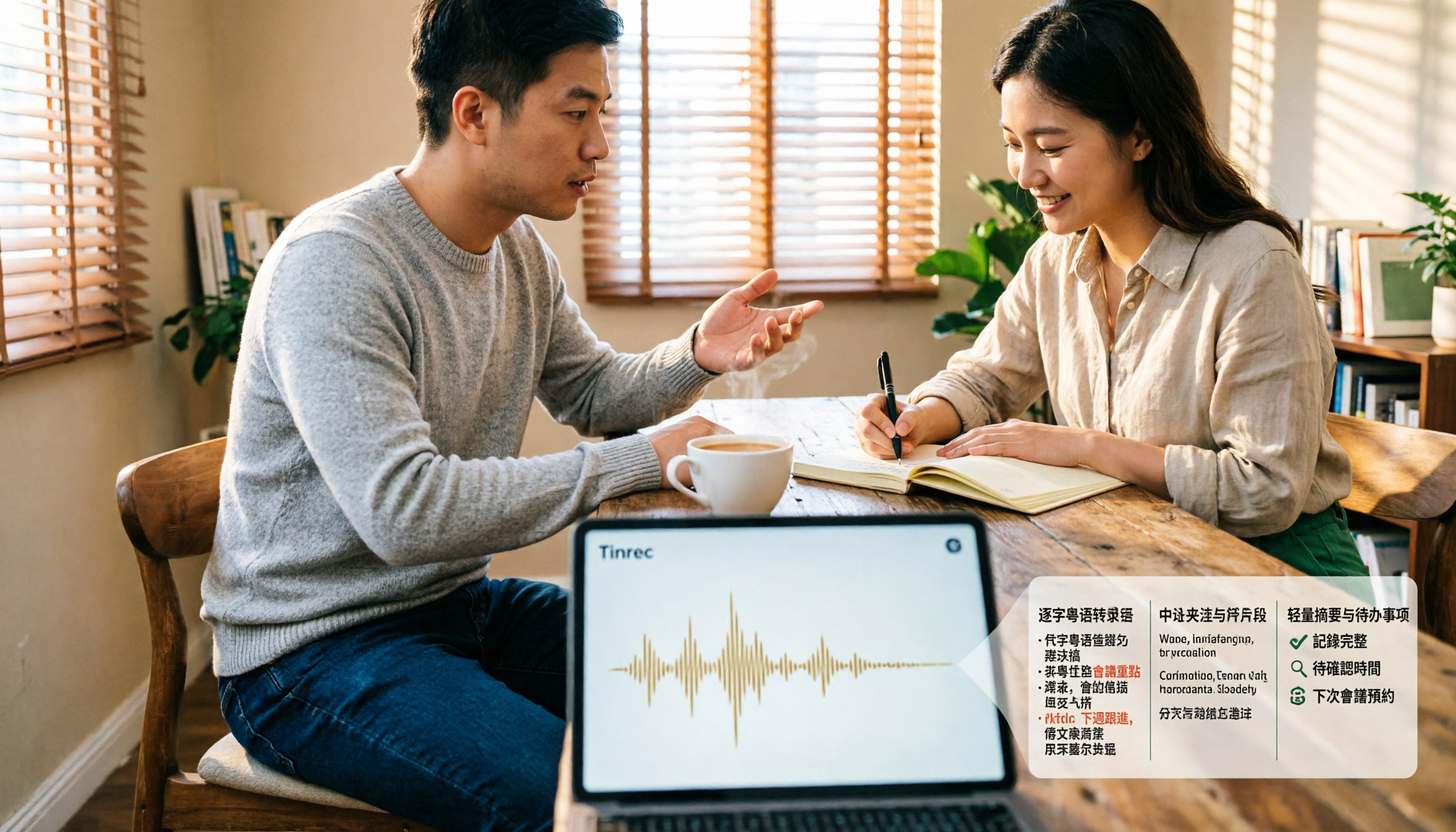
Scenario 1: No more overtime after meetings to catch up on notes A one-hour meeting used to mean another forty minutes organizing key points. With Tinrec, transcription happens simultaneously with recording, and after the meeting, AI generates summaries, chapters, and action items—who's responsible for what and when it's due, all at a glance.
Scenario 2: Turn a two-hour interview into searchable text The hardest part of interviews isn't listening—it's finding things later. Tinrec converts recordings into searchable transcripts. When you need to confirm what a client said, just search for keywords instead of re-listening to the entire recording.
Scenario 3: Turn old audio files and videos into reusable material If you have a pile of historical meeting recordings and course videos, leaving them sitting there only makes them harder to find. Import them into Tinrec to convert to text, and this content becomes searchable, queryable, and can be reorganized into reports or documents.
Scenario 4: Smooth reading even with mixed Chinese-English meetings Meetings in Hong Kong often mix Chinese and English within a single sentence. Tinrec supports mixed Chinese-English content processing, keeping English terms as-is rather than forcing them into phonetically similar Chinese characters, making subsequent reading less prone to misunderstanding.
What Are the Core Capabilities of Cantonese Speech-to-Text?
Real-time transcription: text appears as you record It doesn't start transcribing after recording ends. With Tinrec, transcription happens simultaneously during the meeting, so you can verify key points as you listen and stay calm even when asked for details on the spot.
Bot-free online meeting recording Many tools require a meeting bot to join the room to record. Tinrec's desktop version takes a different approach: it directly captures your computer's system audio to handle Zoom, Google Meet, Microsoft Teams, Webex, and other online meetings—no extra bot needed on the participant list.
AI summaries and chapters A giant block of transcribed text is hard to use. Tinrec automatically generates summaries and divides content into chapters based on discussion flow, so you can quickly jump to key sections even in long meetings.
Action item extraction and AI Q&A The easiest thing to miss in meetings is "who's doing what." Tinrec extracts action items from discussions; if you want to know a specific detail, you can ask questions directly about the meeting content—like which section mentioned the budget.
Multi-format export and post-meeting processing Organized content can be exported to Notion, Google Docs, OneNote, Dropbox, and other tools for continued use, and can also generate reports, tables, and documents that directly correspond to post-meeting deliverables.
Real-time translation and bilingual view For cross-language meetings, you can view original text, translation, or bilingual content during recording—no need to wait until after the meeting to find someone to translate.
Practical Application Scenarios
Project weekly meetings and decision meetings Regular weekly meetings are most prone to "what did we say last time" disputes. With Tinrec recording meetings, converting to transcripts, and generating action items, decision basis stays in one place—when you need to look back at conclusions, just search.
Customer interviews and requirement confirmation Customer interview content is often fragmented yet critical. Tinrec can convert entire conversations to text and organize key points, then export as documents after the meeting—giving you a complete record to reference when sending to clients for confirmation.
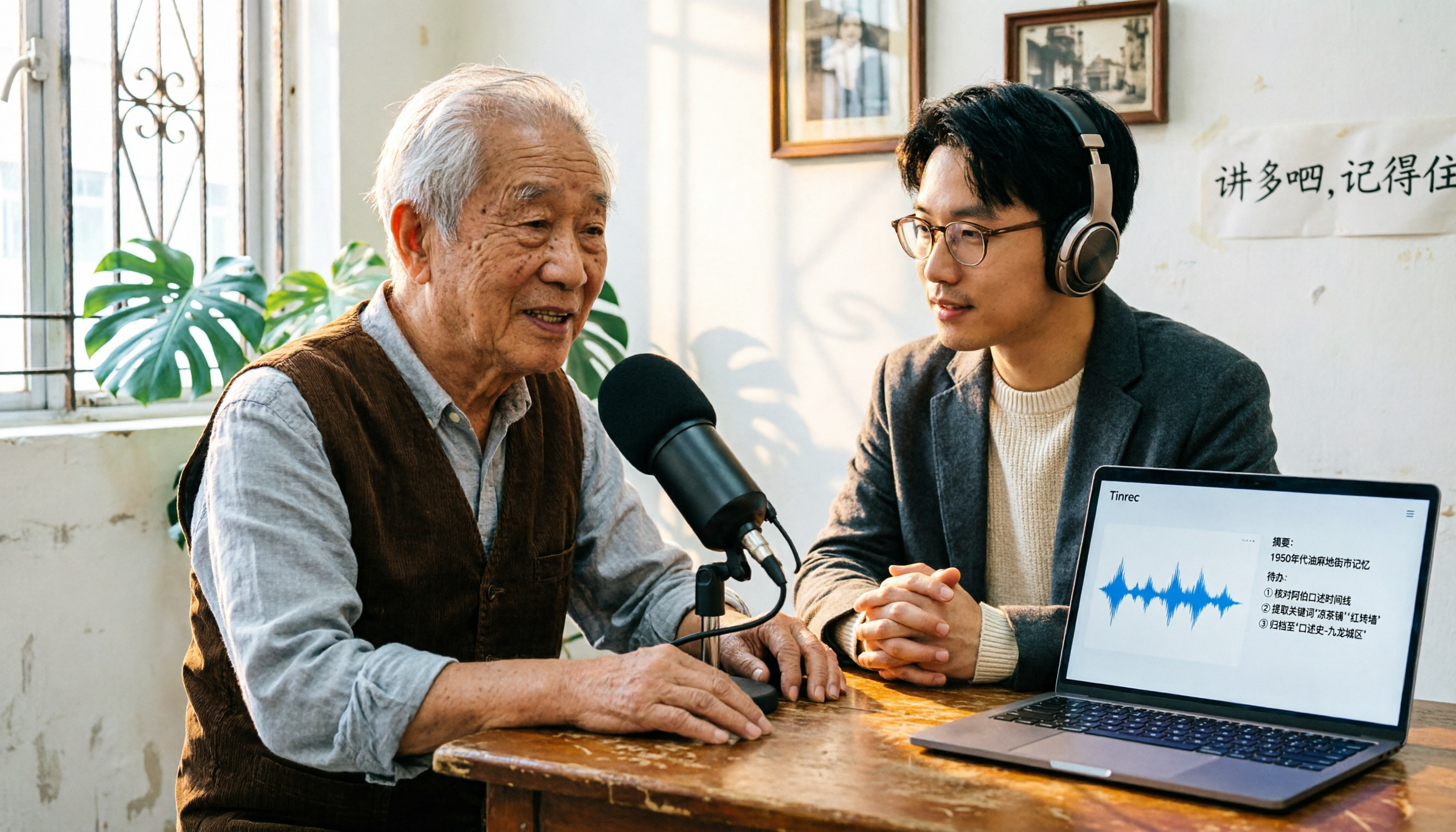
Classroom and research interviews Cantonese lectures or interview recordings used to require slow manual transcription. With Tinrec, first convert to transcripts, then ask questions about specific sections and organize into summaries—saving massive amounts of re-listening time.
Stop organizing recordings by hand
Upload audio or video and automatically get a transcript, summary, and action items
Content creation and subtitle preparation For adding subtitles to videos or writing articles, the most time-consuming part is actually transcription. Organize Tinrec-generated transcripts first, then proceed with subtitles or rewriting—much faster than starting from scratch.
How to Use Cantonese Speech-to-Text: 4 Steps with Tinrec
Step 1: Choose your recording source For online meetings, use the desktop version to let Tinrec capture system audio; for in-person meetings and interviews, use real-time recording; if you have pre-recorded files, simply upload audio or video files. Three sources correspond to three entry points—first confirm which one you have.
Step 2: Confirm language and output settings Tinrec supports Chinese, Traditional Chinese, and multilingual meeting scenarios. If participants mix Chinese and English, remember to confirm settings first; if you need cross-language comparison, you can also enable real-time translation to view original, translated, or bilingual content.
Step 3: After transcription, check summaries and action items first Once the transcript is generated, first review the AI summary, chapters, and action items to confirm there are no misunderstandings, then look at transcript details. For areas needing follow-up, use AI Q&A to ask questions directly about meeting content.
Step 4: Export or add to team space For personal use, export directly as documents to bring into your existing workflow. For teams, place meeting data into Tinrec's team space so members can view, search, and reuse it later.
5 Things to Note When Choosing a Cantonese Speech-to-Text Tool
1. Does the recording source match? Are you recording online meetings, in-person interviews, or uploading old files? Some tools only do file transcription, others only do meeting bots. Tinrec covers real-time recording, desktop online meetings, and file transcription—confirm your main scenario before choosing.
2. How mixed Chinese-English is handled Cantonese meetings often mix English terms. If a tool forces English into Chinese phonetics, post-processing becomes painful. Tinrec supports mixed Chinese-English content processing—if this matters to you, test with your own recording.
3. Is there post-processing after transcription? Transcripts are just the starting point. Tinrec offers summaries, chapters, action items, AI Q&A, translation, and multi-format export after transcription—these are where real time savings happen.
4. How team data is owned If you need team sharing, note that "members," "roles," and "seats" are three different things. In Tinrec's team version, active members can view, play, and read data even without a seat, but recording, uploading, editing, and importing/exporting require a seat; data belongs to the team and won't disappear when members leave.
5. How costs and quotas are calculated The free version is suitable for occasional recording organization; for short-term intensive use, consider a weekly pass; for consistent weekly needs, Pro is suitable. Tinrec's team version currently offers a 7-day trial with 1 free seat and 300 minutes of team shared import quota; paid seats are USD 29.80/month or USD 199/year (about USD 16.58/month), each paid seat includes 2,000 minutes of team shared import quota per month, and real-time recording under an active plan is currently not deducted by minutes. Actual prices and benefits are subject to the official purchase page.
Frequently Asked Questions
Q1: Does Cantonese speech-to-text require installing additional software? Not necessarily. If you just need to process pre-recorded audio files, you can start by uploading via the web version; to record online meetings on your computer, you'll need the desktop version to capture system audio. Tinrec offers web, desktop, and mobile versions.
Q2: Is the free version enough? It depends on your usage frequency. For occasional recording organization, Tinrec's free version basic quota is enough to try; if you have weekly meetings or interviews to process, upgrading makes more sense.
Q3: Can transcription accuracy be guaranteed? It's not recommended to expect fixed numbers. Actual performance is affected by recording quality, environmental noise, accents, multiple simultaneous speakers, and technical terminology. For important content, it's safer to cross-check with transcript timestamps and recording playback.
Q4: Does every team member need to buy a seat? No. Tinrec's team version separates roles and seats: roles determine who can manage the team, seats determine who can record, upload, edit, and import/export. Members without seats can still view, play, and read team data.
Q5: Do meeting recordings require consent? Yes, be mindful. Regulations on recording and transcription vary by region. Before recording, it's recommended to inform participants and obtain consent—this isn't just a compliance issue but also relates to the trust foundation of team usage.
Summary
The real hassle with Cantonese speech-to-text has never been the "transcription" action itself, but what to do with all that text afterward. First clarify your recording source and desired outcome, then choose a tool—this is far more practical than comparing prices from the start.
Tinrec's value lies in connecting the entire workflow: bot-free online meeting recording, transcript generation, summary and action item organization, AI follow-up questions, and finally placing into team space for continued use. If you handle Cantonese meetings or interviews weekly, try the free version with one of your own recordings to see if the organized results can be used directly.
References
- Free Cantonese Speech-to-Text App 2026 | Subanana
- Speechnotes | Hong Kong Cantonese | Speech to Text Online Notepad
- [Free Tool] Cantonese Speech-to-Text! Just upload a file or YouTuber link. Up to 96% accuracy - YouTuber AI | Spend time on creativity, leave the AI to do the hustle work.
- Text-to-Speech Cantonese - Toolbang
- "Free + Cantonese OK: How to use Google AI Studio to convert your recording to..."
Turn every recording into actionable outcomes
Get 60 free transcription minutes when you sign in. No credit card required.
Related Reading
You might also like

How to Use Cantonese Speech-to-Text in 2026: A 5-Step Beginner's Guide
2026 Cantonese speech-to-text tutorial: starting from common pitfalls, we break down 5 practical steps, 4 key points to understand before choosing a tool, and 4 pitfalls to avoid. We also share hands-on experience with Tinrec for Cantonese and mixed Chinese-English classroom recordings, and offer buying advice for students.
4 Cantonese Speech-to-Text Tools Tested and Compared for 2026: What's the Fastest Way to Transcribe Cantonese?
Transcribing Cantonese meetings, interviews, or YouTube videos is often much harder than Mandarin. This article compares 4 tools through hands-on testing, covering Cantonese models, spoken vs. written output, mixed Chinese-English handling, and post-transcription summaries and action items, so you can figure out the fastest way to transcribe Cantonese speech.

Best Cantonese Speech-to-Text Tools in 2026: 4 Tested, One Stands Out for Meetings
Tired of transcribing Cantonese meetings with mixed English and Chinese? This guide breaks down 4 key factors for choosing a Cantonese speech-to-text tool, compares Tinrec, Subanana, Otter.ai, and Notta in real-world tests, and highlights common pitfalls to help you find the tool that truly saves time.
2026 Cantonese Speech-to-Text Comparison: Is Google's Built-in Feature Enough?
Google's built-in voice input can transcribe Cantonese in real time, but it can't handle pre-recorded audio files and lacks summarization and to-do organization. This article addresses common misconceptions, outlines 3 key purchasing factors, and compares Google's built-in feature, Subanana, Notta, and Tinrec (秒聽錄音) through hands-on testing, with a guide to avoiding pitfalls and scenario-based recommendations.

What Is Cantonese Speech-to-Text in 2026: Definition & How to Choose a Tool
What does Cantonese speech-to-text actually do? This article starts with a clear definition, how it works, and common misconceptions, explains why Cantonese is harder to transcribe than standard speech-to-text, then compares Tinrec and PLAUD Note across six practical dimensions: hardware requirements, online meetings, importing old files, post-meeting output, team management, and long-term cost. It also includes six FAQs to help you decide which tool to start with.

2026 Cantonese Speech-to-Text Tools Compared: Which Handles Traditional Chinese Output and Post-Meeting Cleanup Best?
Starting from the decision question—do you need a verbatim transcript or meeting-ready material?—this hands-on comparison tests four Cantonese speech-to-text tools in 2026. It covers four key factors for choosing a Cantonese-to-Traditional Chinese tool, Tinrec's meeting organization and team collaboration workflow, plus use cases for other options and common pitfalls to avoid.

2026 Cantonese Audio to Text: Tinrec Free Trial + AI Meeting Notes
Last Wednesday, after a meeting with a Hong Kong client, I had to work overtime until 8 PM to transcribe a 78-minute Cantonese recording. This article shares my experience using Tinrec to handle Cantonese and mixed Chinese-English recordings: what the free version can do, its core capabilities, four practical use cases, five things to consider when choosing a tool, and the team plan's seats and management features, helping you find a truly time-saving audio-to-text tool in 2026.

4 Best Cantonese Speech-to-Text Tools in 2026: How to Choose for Meeting Notes, Transcripts, and AI Summaries
2026 comparison of the latest Cantonese speech-to-text tools, from free to paid. We tested Subanana, Monica, Cantosubai, and more, and analyzed Tinrec's advantages in meeting notes, AI Q&A, and team collaboration to help you find the best Cantonese transcription solution.

2026 Cantonese Speech-to-Text Comparison: Google Translate vs Gemini vs Tinrec
Should you use Google Translate for Cantonese speech-to-text, or do you need a dedicated tool? This article compares Google Translate, Gemini, and Tinrec, covering transcripts, post-meeting organization, online meeting recording, and team collaboration to help you decide which one to choose.