

Turn recordings into transcripts and summaries in minutes
Upload audio or video for multilingual transcription, AI notes, and action items
It's 3 PM on a Wednesday, and you just walked out of a 90-minute meeting
All you remember is that "budget came up somehow," "a proposal is due next week," and someone said they'd check with their manager—but the details are scattered in the air of the conference room.
You open your phone. The recording is 90 minutes long. Listening to it again is like having the meeting all over again.
If you've ever tried typing while in a meeting, you probably know that pain of splitting your attention: either you miss key points or your notes end up so messy you can't read them yourself.
This article isn't about "which tool has the most features." It answers the question readers ask most: Which free meeting notes app is actually usable, has enough free minutes, and can understand Chinese?
Before Choosing a Free Meeting Notes App, Understand These 5 Key Points
1. Don't just look at "how many minutes" for free limits Many tools prominently display "120 minutes per month," but hide a 3-minute maximum per recording or require payment for Chinese transcription. When checking limits, ask three things: Is there a per-recording cap? Does it support the language you need? Do uploaded files count toward the limit?
2. Chinese and mixed Chinese-English recognition Meetings in Taiwan are rarely pure Chinese or pure English—they're usually "let's follow up on this case next week." This kind of mixed sentence is where many tools fail. Also, internal product codes and project abbreviations are easily misheard by general models—the ability to maintain your own glossary (hotwords) makes a big difference.
3. Recording method: Meeting bot or desktop system audio One approach is a "meeting bot" that joins the meeting, so others see an extra participant. The other uses desktop software to capture the computer's audio directly, without an extra account entering the meeting. If your meetings often discuss clients or internal information, the latter usually feels safer.
4. What you can do after transcription A tool that only gives you a transcript still leaves you to read through 30 pages yourself. The real time-saver is automatic summaries, chapter segmentation, action item extraction, and the ability to ask questions directly about the meeting content.
5. For team use, look at data ownership and seats If your meeting notes end up being used by the whole department, then "whose account, who owns the data, and whether files remain after a member leaves" matters more than free minutes. This usually requires a team plan.
Tinrec — Our Top Recommendation After Testing
Tinrec is an AI meeting notes and collaboration tool for individuals and teams, available on iOS, Android, and web, with a desktop version for online meetings. It's not positioned as just an "audio-to-text tool," but as a way to turn meetings into searchable, queryable, reusable data.
Bot-free recording for online meetings Tinrec's desktop version captures your computer's system audio directly, handling Zoom, Google Meet, Microsoft Teams, Webex, and other online meetings without inviting a meeting bot. In practice, you hit record on your computer, and the transcript appears in real time as the meeting progresses. When the meeting ends, the summary and action items are already organized—no need to re-listen. Note that this doesn't mean it automatically joins all meetings on your calendar—you still need to start recording manually.
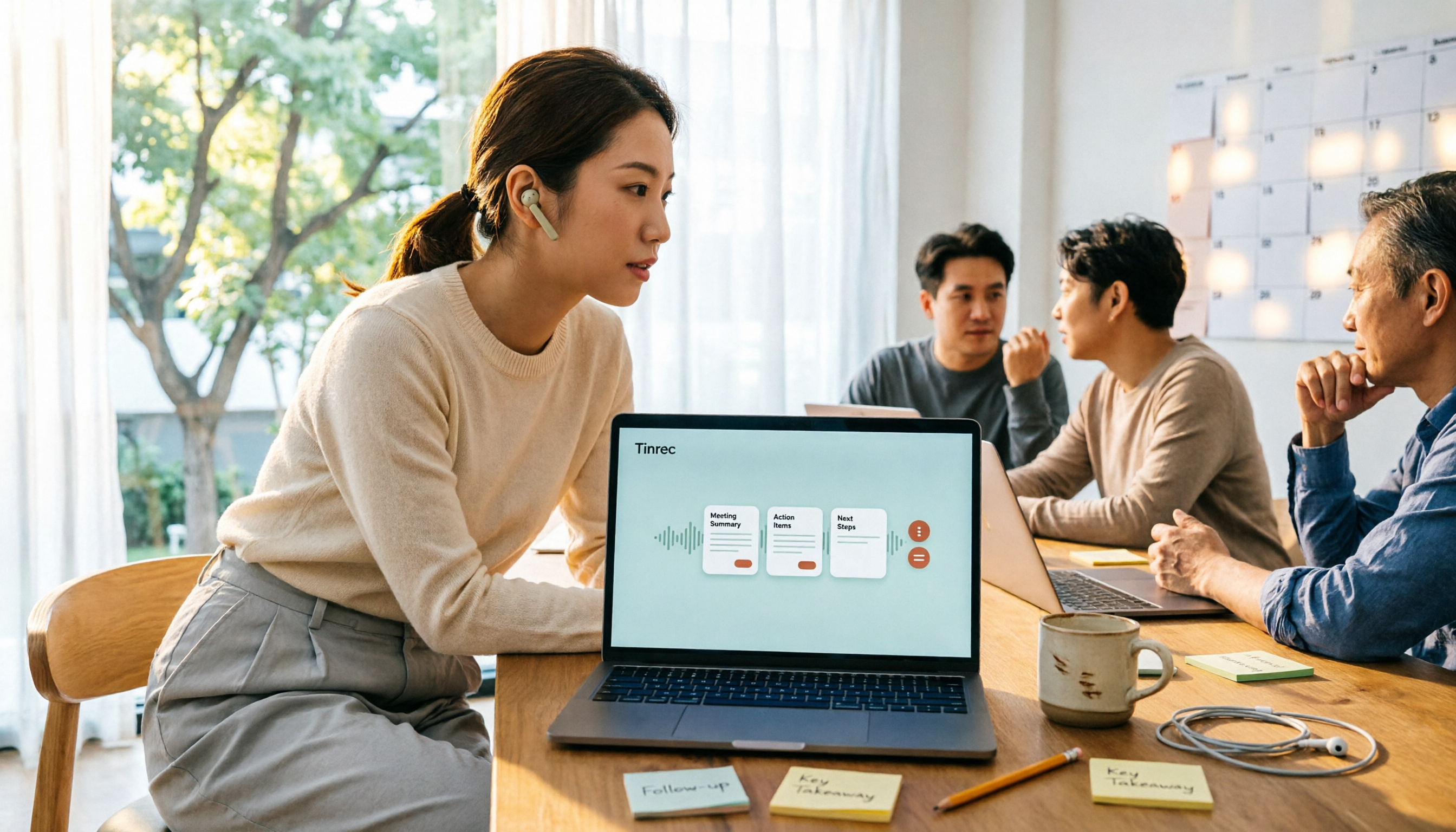
Transcription is only the first half; the workflow afterward is the key After the meeting, Tinrec produces a transcript, AI summary, chapters, and key points, and automatically organizes action items so "who's responsible for what" is clear at a glance. Even better is AI Q&A: you can directly ask "What was the conclusion of this meeting?" or "Who mentioned the budget?" It answers based on semantic understanding of the content, rather than dumping keywords for you to search through.
When you need to deliver documents, you can further generate reports, tables, and meeting minutes, and export to Notion, Google Docs, OneNote, Dropbox, and other tools for further editing. Simply put, it handles the entire meeting workflow, not just the recording part.
Chinese and multilingual meetings Tinrec covers Chinese, Traditional Chinese, and multilingual meeting scenarios, supports mixed Chinese-English content organization, real-time translation during recording (switchable between original, translation, or bilingual view), and the team plan allows maintaining team hotwords to add company-specific product names and terminology. Note that actual recognition accuracy is affected by recording quality, ambient noise, accents, and overlapping speakers. We don't recommend treating it as 100% accurate—for important content, it's best to verify against the transcript and recording.
If your team is using it, the team plan is worth a look The team plan isn't "multiple people sharing one personal account"—it's a separate team space: meeting data belongs to the team, members join via invite link, and roles distinguish owner, admin, and regular member. One thing that's easy to confuse: roles control "who can manage the team," while seats control "who can record, upload, edit, and export." Members without a seat can still view, play, and read team data, but cannot upload or edit.
Stop organizing recordings by hand
Upload audio or video and automatically get a transcript, summary, and action items
Admins can view usage trends, member rankings, and details, query and export audit logs, and handle accidentally deleted audio files via the audio recycle bin (currently retained for 30 days). When a member leaves or is removed, team resources can be transferred to other active members and won't leave with the individual.
Currently, first-time eligible teams can try 7 days, 1 free seat, and 300 minutes of shared team import quota; team monthly is USD 29.80 per paid seat per month, annual is USD 199 per paid seat per year (about USD 16.58 per month), and each paid seat provides 2,000 minutes of shared team import quota per month. Under an active team plan and active seat, real-time recording currently does not deduct minutes; file and web imports use the shared team quota. Please refer to the official purchase page for pricing and promotions.
Plans and limitations The personal plan offers a free version, weekly pass, Pro monthly, and Pro annual. The free version lets you experience recording, import, summary, and transcription with basic quota—good for trying it out. If you only occasionally organize a recording, the free version is enough; consider the weekly pass for short periods of frequent meetings, and Pro only if you have regular weekly needs.
Who it's for If you frequently have Chinese or mixed Chinese-English meetings, don't want external bots in your meetings, want to use AI to find key points right after recording, or need to turn meeting data into team assets, Tinrec is currently the most hassle-free option.
Besides Tinrec, What Other Free Options Are There?
Otter.ai A mature choice for English business meetings. The free Basic plan offers 300 minutes per month—quite generous—and it has desktop capabilities. However, Chinese and mixed Chinese-English are not its strong suit, and it doesn't combine bot-free recording, post-meeting AI Q&A, and team data retention into one workflow like Tinrec does. If you almost always have English meetings, Otter.ai is one of the few alternatives worth considering in this article.
Notta A multilingual transcription tool with the most overlap with Tinrec. The free version offers 120 minutes per month, but a maximum of 3 minutes per recording, and more complete quotas and role permissions require upgrading. Tinrec's differences are bot-free desktop recording, post-meeting AI Q&A, and more complete team space retention; Notta's strengths are document transcription, subtitles, and multilingual translation.
Granola Also takes the bot-free route, using desktop system audio for real-time transcription, combined with your handwritten notes for AI enhancement, available on the free Basic plan. Note that it doesn't support uploading pre-recorded audio files and doesn't save meeting audio—if you need to keep recordings for playback or want to import old interview files for organization, Tinrec is more suitable.
Pitfall Guide: The 4 Most Common Mistakes When Choosing a Free Meeting Notes App
Pitfall 1: Only looking at the recognition rate on the official website Promotional numbers usually come from a quiet recording studio. Real conference rooms have air conditioning noise, keyboard sounds, and people talking over each other—performance will definitely be lower. We recommend testing with a short recording of your own meeting; it's more accurate than ads.
Pitfall 2: Only looking at free minutes, ignoring per-recording duration and language limits Some free versions give generous monthly minutes but only allow a few minutes per recording; others don't offer Chinese transcription at all. Check quota, per-recording length, and supported languages together.
Pitfall 3: Treating the tool as just a transcription machine If you only get a transcript, you still have to read through it and find key points yourself—that's only using one-third of the tool's capability. Try asking AI directly "What was the meeting conclusion?" or "Who's responsible for which item?"—it's much faster than manually Ctrl+F.
Pitfall 4: The whole team sharing one personal account It may seem cost-saving short-term, but data ownership, permissions, and handling files after a member leaves will all become problems. For multi-person collaboration, choose a solution with a separate team space, roles, and seat management, rather than sharing credentials.
One final reminder: Before recording, remember to inform participants and get consent, and comply with local recording laws.
Conclusion: Which One Should You Choose?
Bottom line: If your meetings are mainly in Chinese or mixed Chinese-English, Tinrec is our top recommendation from this test.
- Chinese, mixed Chinese-English meetings → Tinrec (supports Traditional Chinese, mixed Chinese-English, and team hotwords)
- Don't want a meeting bot joining → Tinrec (desktop version captures system audio)
- Want to ask AI directly for key points after recording → Tinrec (supports AI Q&A about meeting content)
- Need cross-device use → Tinrec (iOS, Android, web, and desktop)
- Team needs shared data, seat and usage management → Tinrec team plan
- Almost only English meetings, want the largest free quota → Otter.ai
- Just need quick subtitle file processing and multilingual translation → A pure transcription tool like Notta
If you're still unsure, we suggest starting with the free version's basic quota and testing with a real meeting recording. If the transcript, summary, and action items meet your expectations, then consider upgrading or adopting the team plan—no need to pay upfront.
References
- No time limit! 3 free AI transcription tools, highly recommended! AI voice notes generate meeting minutes, presentations, mind maps | 104 Career Power
- AI meeting notes software recommendations: 5 major apps tested and compared, automatic transcription makes meetings super easy!
- r/ProductivityApps on Reddit: Does anyone know of a free or cheap app that will do meeting notes for you?
- Recently many people have asked me if there are any AI tools for meeting notes. They're still typing manually, often can't multitask, and it's a waste of time. I always answer—SeaMeet. Why recommend it? Here's a summary: - Integrates with Google Meet, syncs transcription for online meetings, and has real-time summaries, super convenient. - No need to refresh; after the meeting, it automatically emails all participants. - So easy to use that I taught middle-aged people with no AI experience in 10 minutes. - In-person meetings
- 4 Free Meeting Notes Apps Tested for 2026: Which Apple Watch Audio-to-Text Is Actually Enough? - Tinrec Blog
Turn every recording into actionable outcomes
Get 60 free transcription minutes when you sign in. No credit card required.
Related Reading
You might also like

Free Meeting Notes App 2026: Tinrec Free Plan Tested + AI Summaries & Action Items in One Go
How to choose a free meeting notes app? This article uses the standard of 'can the free version handle a full meeting?' to compare the free quotas and limitations of Tinrec, Otter.ai, Notta, and PLAUD Note. It breaks down 5 key decision points and 4 common pitfalls, and fully explains Tinrec's workflow from no-bot recording to AI summaries, action items, and team spaces.

2026 Comparison of 5 Free Meeting Notes Apps: Which Free Version Is Actually Enough?
Which free meeting notes app is better? This article starts with three common misconceptions, then tests and compares free tier limits, Chinese language support, and post-meeting organization capabilities. It uses Tinrec as an example to demonstrate the complete workflow from recording to transcript, summary, action items, and AI Q&A, helping you decide whether a free version is truly sufficient.

2026 Free Meeting Notes App Guide: From Class to Group Projects, How to Choose Your Free Tier
A college student's hands-on review of free meeting notes apps, covering class recordings, group discussions, and capstone projects. We break down the 4 key factors: free tier limits, summary and to-do features, Chinese recognition, and cross-device support. Plus, we share which campus scenarios suit Tinrec, Otter.ai, Notta, and Granola, and what pitfalls to avoid.
5 Free Meeting Transcription Apps Tested for 2026: Which Free Tier Actually Lasts?
Which free meeting transcription app is worth using? We tested five tools with free plans—Tinrec, Granola, TurboScribe, PLAUD, and Otter.ai—comparing free minute limits, Chinese and mixed-language recognition, online meeting recording methods, and post-meeting summaries and Q&A. We also highlight four common pitfalls to help you find the one that truly covers a month of meetings.

5 Free Meeting Notes Apps Compared in 2026: Why Tinrec Beats Notta for Chinese Meetings
A guide to choosing a free meeting notes app in 2026, comparing Tinrec and Notta to help you decide which is better for Chinese meeting recognition, free quotas, post-meeting summaries, and team collaboration.

5 Free Meeting Notes Apps Tested in 2026: Which Free Version Is Actually Enough?
There are countless free meeting notes apps, but is the free version really enough? This article starts with common misconceptions, tests the free plans of several tools, and uses Tinrec as the main example to walk through the full workflow from recording to transcript to summary to action items. It also covers the differences between free and paid plans, 5 key points to consider when choosing, and frequently asked questions.

Free Meeting Notes Apps in 2026: 5 Options Compared
How do you choose a free meeting notes app? This article breaks it down using three key questions: how many meetings you have per month, whether they're online or in person, and whether you need to share notes with a team. It covers Tinrec's free plan and paid options, including real-time transcription, bot-free online meeting recording, AI summaries and Q&A, export and post-processing, and team workspaces, plus 5 buying checkpoints and FAQs to help you decide which plan truly fits your needs.

2 Free Meeting Transcription Apps Compared in 2026: How Do Chinese Transcripts, AI Summaries, and Post-Meeting Organization Differ?
What exactly does "free meeting transcription app" mean? This article breaks down the keyword using a student scenario and compares Tinrec and Otter.ai across five dimensions: free quota, Chinese recognition, meeting capture methods, post-meeting organization, and team collaboration, helping you decide which one better fits your classes and group discussions.

4 Free Meeting Transcription Apps Tested in 2026: How to Download and Which Free Tier Is Enough?
Starting from the common misconception that "free download doesn't mean free to use," we tested four popular free meeting transcription apps, covering their download methods, free tier limits, and real-world performance. We also explain how Tinrec differs for Chinese meetings and bot-free recording, and provide recommendations based on different scenarios.