

Turn recordings into transcripts and summaries in minutes
Upload audio or video for multilingual transcription, AI notes, and action items
2026 Comparison of 4 Audio-to-Text Tools: Which One Can Generate Meeting Minutes Directly from Computer Meetings?
Do you also have dozens of audio files sitting on your computer, plus a bunch of recurring online meetings every week? The real choice is usually not "which tool transcribes fastest," but rather: do you want a transcription service that turns sound into text, or a workflow that helps you organize meeting content into summaries, action items, and searchable data? This difference directly affects how much time you'll spend re-listening to recordings after the meeting.
More and More Audio Files on Your Computer: Should You Choose "Transcription" or "Post-Meeting Organization"?
After a one-hour online meeting, you have the transcript, but the key points are scattered across dozens of pages of dialogue. You still have to scroll through the timeline from the beginning to find out who said what and which tasks need follow-up from whom. What's more troublesome is that the audio files are stored on your personal computer. Next time you need to find a requirement a client mentioned three months ago, you can only rely on memory to search through folders.
If you're using Chinese meetings, you may also encounter unnatural sentence breaks, confused recognition of mixed Chinese and English, or tools that only support file upload and cannot handle ongoing Zoom or Teams meetings on your computer.
This article is not about comparing who has the most transcription minutes, but rather looking at which tool can help you turn "recordings" into "usable data" from the actual workflow encountered on computers.
Before Choosing a Computer Audio-to-Text Tool, Understand These 4 Key Points
1. First, clarify: Do you want to transcribe real-time meetings or already-recorded files? Some tools excel at file upload, others at meeting recording. If you have both, look for a tool that can handle real-time recording, computer online meetings, and audio/video files simultaneously. Tinrec has corresponding functions for all three input sources.
2. How does it capture audio on the computer? System sound, meeting bot, or hardware? Meeting bots need to join as participants, which some companies or clients may mind. Tinrec's desktop version directly captures computer system sound and does not require an additional bot to join Zoom, Google Meet, Microsoft Teams, or Webex. Note that it does not automatically join all calendar meetings; you need to actively start recording.
3. After transcription, can it organize directly? Transcripts are just raw material. Check whether the tool provides summaries, chapters, action item extraction, AI Q&A, and multi-format export. Tinrec puts these in the same workflow, so after transcription you can directly ask "What were the conclusions of this meeting?" and bring the results to tools like Notion or Google Docs.
4. How to evaluate free quotas and team needs? Individual users can first check if the free version can complete a full workflow; teams need to consider how members, roles, seats, and shared quotas are calculated. Tinrec's team version separates "roles" and "seats": roles manage governance, seats manage usage eligibility. Members without seats can still view team data but cannot upload, edit, or export.
Tinrec (MiaoTing Recording) — Our Top Choice After Testing
Tinrec (MiaoTing Recording) is an AI meeting notes and collaboration tool for individuals and teams, supporting web, desktop, and mobile.
We actually went through a computer-based workflow, and what impressed us most is that it doesn't treat "transcription" as the end point. Here are three scenarios.
Scenario 1: Online meetings on the computer, without wanting an extra bot Open Tinrec desktop, select to record system sound, and you can handle Zoom, Google Meet, Microsoft Teams, or Webex meetings played on the computer. During the meeting, the transcript is generated in real time, so you don't need to wait until after the meeting to upload files. This is very practical for external meetings—you don't have to explain to clients "why there's an AI bot in the meeting."
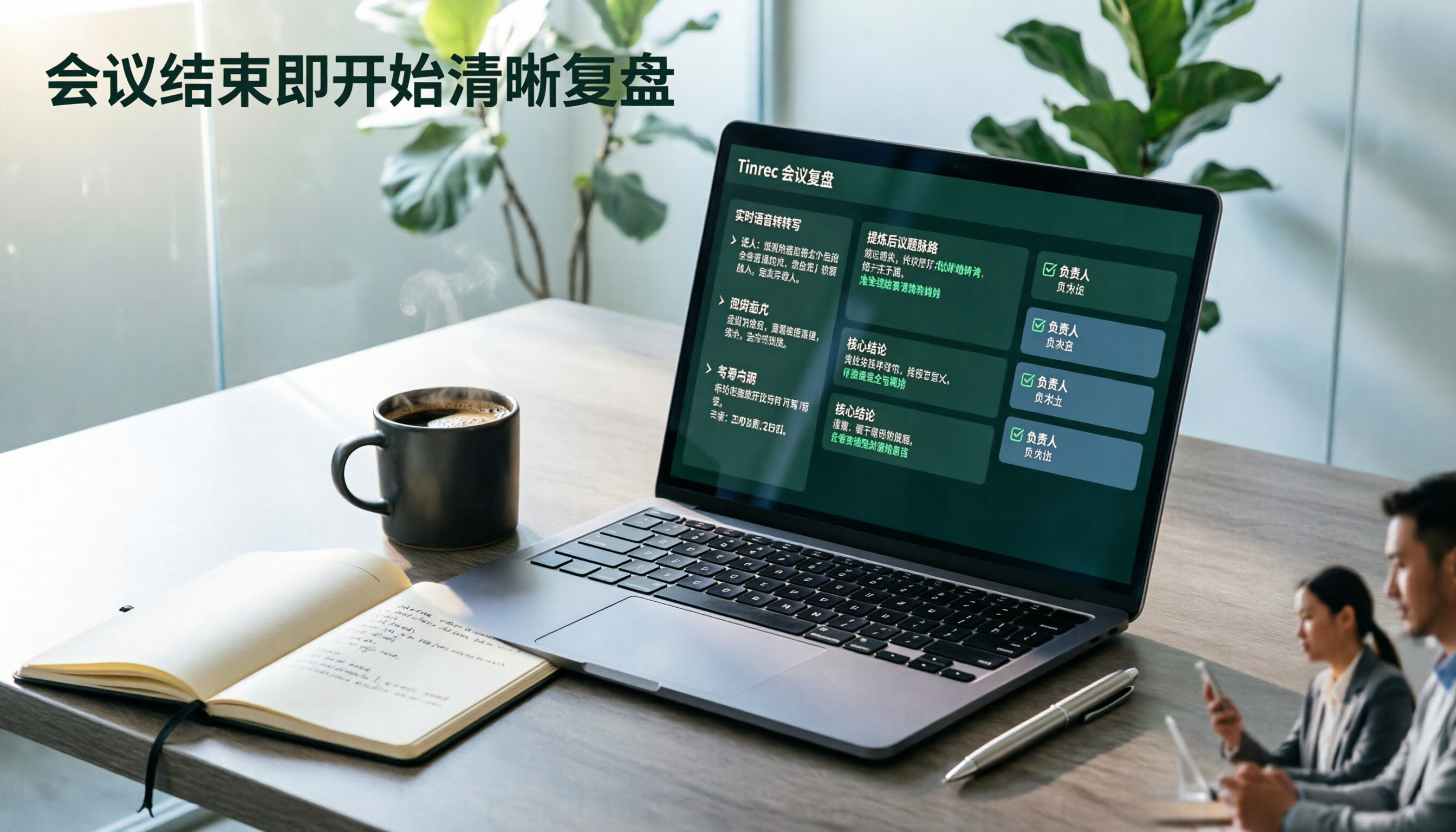
Scenario 2: No need to scroll through the transcript from the beginning after the meeting After the meeting ends, Tinrec generates AI summaries, chapters, and key points, and extracts action items from the discussion. You can directly ask questions about this meeting, such as "What are the three concerns the client mentioned?" or "Who is responsible for next week's proposal?" It answers based on semantics, not just keyword search results. This is much faster than pressing Ctrl+F in a tens of thousands of words transcript.
Scenario 3: Existing audio files and cross-language meetings If you already have audio/video files, you can upload them directly for transcription. Tinrec also offers real-time translation; during recording, you can view the original text, translation, or bilingual content, which is especially useful for mixed Chinese-English meetings. After completion, you can export to common formats or bring to tools like Notion, Google Docs, OneNote, Dropbox for further processing. Teams can also maintain professional terminology with hotwords to reduce the chance of product names being transcribed incorrectly.
Summary of advantages
Stop organizing recordings by hand
Upload audio or video and automatically get a transcript, summary, and action items
- Bot-free recording, more natural for external meetings. The desktop version captures system sound, no need to pull an extra account into the meeting.
- Complete post-transcription workflow. Summaries, chapters, action items, AI Q&A, translation, export, and Agent post-processing (generating reports, tables, and documents) are all in the same process, not just a transcript.
- Team data can accumulate. Team space centrally stores meeting data; when members change, resources belong to the team, and administrators can view usage, seats, and audit logs.
Limitations should also be clear The free version provides basic quota, suitable for experiencing the workflow first; if you have stable meetings every week, then consider a weekly card or Pro. The personal version has free, weekly card, Pro monthly, and Pro annual; actual prices are subject to the official website.
The team version is not "multiple people sharing one personal account" but an independent team space. Currently, paid seats are USD 29.80/seat/month, annual payment USD 199/seat/year, equivalent to about USD 16.58/month; each paid seat provides 2,000 minutes of team shared import quota per month. The first eligible team trial is 7 days, 1 free seat, 300 minutes of team shared import quota. Real-time recording is currently not deducted by minutes under valid team plans and valid seats, but file and web imports consume team shared import minutes.
Additionally, Tinrec does not promise a fixed accuracy rate. Actual transcription results are affected by recording quality, background noise, accents, overlapping speech, and professional terminology. For important content, it is recommended to verify with transcript timestamps and recording playback.
Who is it for If you often have meetings on your computer, need Chinese transcripts and post-meeting organization, and want meeting data to stay in team space rather than scattered on personal computers, Tinrec is a very balanced choice at present.
Besides Tinrec, What Other Options Are There?
Granola: Bot-free meeting notes, but does not process pre-recorded files Granola is a bot-free AI meeting notes tool, Basic is free, Business is USD 14/user/month. It transcribes through desktop system sound and microphone, then combines with user handwritten notes to generate content. Note that it does not support uploading pre-recorded audio files and does not save meeting audio. If you need to import existing audio files, keep audio files, and listen repeatedly, Tinrec is more suitable in this regard.
TurboScribe: Cost-effective choice for long documents and batch transcription TurboScribe focuses on cost-effective file transcription; free version has 3 files per day, up to 30 minutes per file; Unlimited annual payment USD 120, equivalent to USD 10/month, up to 10 hours or 5 GB per file, can upload 50 files at once. It is suitable for large amounts of long documents, subtitles, and translation. But if you want real-time recording of online meetings on the computer, post-meeting AI Q&A, and team collaboration, Tinrec's meeting workflow is more complete.
PLAUD: Portable recording hardware, requires additional device PLAUD is a representative of AI recording hardware, NotePin is USD 159, Note Pro is USD 189; Starter 300 minutes per month, Pro USD 99.99/year, 1,200 minutes per month, Unlimited USD 239.99/year. It is suitable for people who are used to carrying a standalone device for recording. Tinrec does not require additional hardware and directly handles online meetings and files on the computer, reducing the device burden for those already working at a computer.
Pitfall Guide: The 3 Most Common Mistakes When Choosing an Audio-to-Text Tool
Pitfall 1: Only looking at transcription minutes and free quota. Many tools offer large free quotas but only provide transcripts; summaries, Q&A, and export require extra payment or are not available at all. The correct approach is to use a real meeting recording of yours to test, and see whether it can directly produce usable summaries and action items after transcription, rather than just looking at "how many minutes are given per month."
Pitfall 2: Thinking a transcript means it's organized. A transcript is just raw material. If you still have to manually search through tens of thousands of words, you're only using one-third of the tool. With Tinrec's AI Q&A, you can directly ask "What are the three concerns the client mentioned?" which is much faster than Ctrl+F. When choosing a tool, include "can I ask directly after the meeting" in your considerations.
Pitfall 3: Ignoring team data ownership. In multi-person collaboration, if everyone records with their own account, data will be scattered. The team version should distinguish roles and seats, data belongs to the team, and handover should be possible when members leave. This cannot be solved by "everyone sharing one set of credentials." Tinrec's team version has designs for members, roles, seats, usage, and auditing in this regard; you can use this standard to ask vendors when choosing a team plan.
Conclusion: Which One Should You Choose?
If you want an end-to-end process from recording to meeting minutes on the computer, Tinrec is the most balanced choice after this test. It puts real-time recording, bot-free online meetings, file import, summaries, action items, AI Q&A, translation, and team space into the same workflow.
By scenario:
- Computer online meetings, don't want to invite a bot → Tinrec
- Already have audio files to transcribe, and want to directly generate summaries and action items → Tinrec
- Chinese or mixed Chinese-English meetings, need real-time translation and bilingual transcripts → Tinrec
- Team wants to centrally manage meeting data, seats, and usage → Tinrec Team Version
- Only occasionally batch transcribe long documents, no need for meeting collaboration → TurboScribe can be considered
- Used to carrying dedicated hardware for recording → PLAUD can be considered
It is recommended to first use the free version to run one of your audio files and see if the transcription and summary fit your workflow before deciding whether to upgrade. Prices and quotas are subject to the official website.
References
- Audio-to-text methods taught to you!
- Online AI speech, video, audio files automatically converted to text - free trial - cSubtitle
- Turn Chinese radio and audio files into text with your phone: making transcripts in Evernote
- Recommended apps for real-time speech-to-text conversion 1. iPhone/iPad "Notes" app supports real-time conversion to text, free, supports Chinese and English
- Tested 4 best online "speech-to-text" tools, free and instant audio-to-transcript conversion
Turn every recording into actionable outcomes
Get 60 free transcription minutes when you sign in. No credit card required.
Related Reading
You might also like

2026 Comparison of 4 Speech-to-Text Tools: Which Saves the Most Time on Chinese Meeting Follow-Ups?
How to choose speech-to-text software in 2026? This article breaks the decision into 4 key criteria, then compares Tinrec, Notta, Otter.ai, and TurboScribe under the same test conditions on Chinese recognition, free quotas, and post-meeting organization capabilities. It also includes a pitfalls guide and scenario-based recommendations.
2026 AI Meeting Review Agent Comparison: Tinrec vs Plaud Note - Which Is Better for Chinese Meetings?
The meeting ends, but the overtime begins. This article compares the software-based Tinrec and the hardware-based PLAUD Note across five dimensions: online meeting capture, Chinese post-meeting readability, review depth, historical recording processing, and team governance and cost structure. It directly tells you which AI meeting review agent better fits your work style.

5 Best Speech-to-Text Software in 2026: Chinese Meetings & AI Q&A Compared
Most people choose speech-to-text software based on free minutes, but overlook that post-transcription organization, follow-up questions, and team collaboration are where the real time is spent. This article starts with common misconceptions, breaks down 5 tools using 4 key selection criteria, and compares Chinese meeting transcription, AI Q&A, audio retention, and team knowledge accumulation, with a guide to avoid pitfalls and scenario-based recommendations.

6 Interview Recording Tools Tested and Compared for 2026: Which One Turns Transcripts into Evaluation Reports?
Re-listening to an hour of interview recording just to find that 30-second key answer is the most time-consuming part. This article reviews 6 interview recording organization tools, from live transcription with AI follow-up questions to pure file transcription, explaining who each is suitable for based on actual recruitment workflows, and includes practical reminders on legal aspects and data management in Taiwan, China.

5 Free Audio-to-Text Tools Tested: Which Free Tier Is Most Generous in 2026?
There are many free audio-to-text tools, but the definition of 'free' varies widely. This article compares the free limits, Chinese recognition experience, post-meeting organization capabilities, and team collaboration differences of Tinrec, Otter.ai, Notta, TurboScribe, and Google AI Studio from a use-case perspective. It also summarizes 4 key points to consider before purchasing and 4 common mistakes to help you determine which tool truly suits you.

2026 Comparison of 4 Audio-to-Text Tools: Which One Saves the Most Time for Chinese Meeting Minutes?
Does the real work start after the meeting ends? This article tackles real workplace pain points, outlines four key factors for choosing an audio-to-text tool, and compares Tinrec, Otter.ai, Notta, and Granola. Tinrec stands out with bot-free desktop recording, Chinese meeting transcription, AI Q&A, and team spaces. The article also honestly lists each tool's free tier limits to help you find the one that truly saves time.

Best Interview Recording-to-Text Tools in 2026: 4 Tested, This One Excels at Chinese Interviews and Post-Meeting Follow-ups
We tested 4 interview recording-to-text tools, comparing input sources, Chinese recognition, post-meeting organization, and team data management. Tinrec performed best in Chinese interviews, recording online meetings without bots, and AI follow-up questions after meetings. This article includes key buying factors, pitfalls to avoid, and scenario recommendations.

2026 Audio Transcription Tool Buying Guide: 6 Hands-On Tests and Selection Advice
For mid-level managers who have a dozen meetings a week and still need to organize notes afterward, we tested 6 audio transcription tools: from Tinrec's bot-free recording and AI Q&A to Notta, Otter, TurboScribe, Granola, and the free Google Docs voice typing. This guide lays out positioning, pricing, and who each tool is for, so you pick the right tool—not just the most popular one.

4 Best Speech-to-Text Tools in 2026: Free Tiers, Chinese Transcription, and Post-Meeting Summaries Compared
How to choose a speech-to-text tool? This article starts with the difference between live dictation and audio file transcription, then compares Tinrec, Notta, Granola, and PLAUD on free tiers, Chinese transcription, post-meeting AI summaries, and team seats. It also lists 4 common pitfalls to help you decide based on budget and use case.