
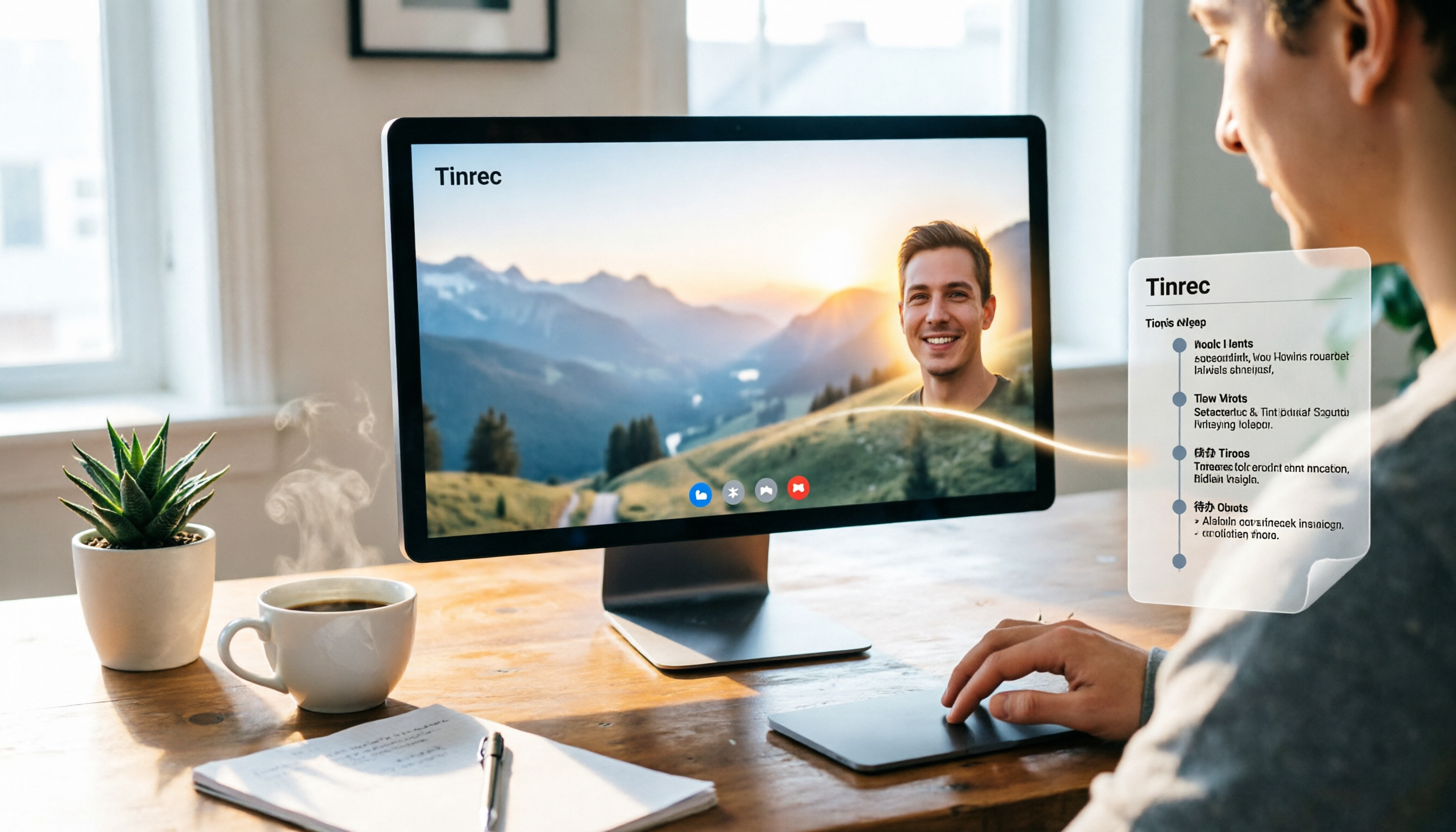
Turn recordings into transcripts and summaries in minutes
Upload audio or video for multilingual transcription, AI notes, and action items
“Does Google Meet have virtual backgrounds?” Yes, it does. But what really determines whether you can use it in your next meeting isn’t just “yes or no”—it’s several conditions that must all be met: which account you use, which device you’re on, which browser you use, and which region you’re in. If one is missing, the button simply disappears. So this article won’t just say “yes”—it breaks down each item: when it’s available, how to set it up, what’s going wrong if it doesn’t work, and finally a key point most people overlook—virtual backgrounds only save the view behind you, not your post-meeting notes.
Background too real? You’re actually solving two problems
Working from home, the background is a drying rack and unfolded laundry; at the office, colleagues walk back and forth behind you; in client meetings, the whiteboard still has last project’s numbers. In these scenarios, a virtual background really helps.
But there’s another, more nagging problem: after a one-hour meeting, you still spend another hour and a half organizing the transcript and meeting minutes. Whether the picture looks good or not, colleagues get used to it after a glance; but whether someone helps you record “who’s responsible, when it’s due” after the meeting is another matter.
If you have both problems, read on.
Google Meet virtual backgrounds: 5 key points to understand first
1. Account type Google clearly states: availability of backgrounds, filters, and styles depends on client type, account type, and Google Workspace admin settings. That means even if you’re a paid Workspace user, if your company IT has turned off visual effects, you won’t find the button in a meeting. Personal Gmail accounts and company accounts can see completely different options.
2. Device and browser Google explicitly notes that featured static background images are not supported in VDI (virtual desktop) environments. The entry points on desktop browsers and mobile apps are also different. Plus, virtual backgrounds are essentially real-time image processing, so if your device’s processor isn’t powerful enough, it will lag, and older browser versions may show the button but with degraded effects.
3. Some effects have regional and version restrictions Google’s documentation mentions that visual effects using cloud-based effects processing are only available to specific Workspace editions and specific countries or regions; other regions are being added gradually. Many tutorials don’t mention this, so if it works for someone else but not for you, it’s not necessarily your setup error.
4. When you join the meeting Participants who aren’t signed in to a Google account, or who have to “knock” and wait for the host to admit them, can only change backgrounds or use visual effects after joining the meeting. If you want to look polished before entering, sign in first.
5. Post-meeting notes This isn’t Google’s concern: virtual backgrounds won’t leave any text for you. It’s just a real-time overlay that disappears when the meeting ends. Transcripts, summaries, and action items all need to be handled separately.
Setup steps: desktop version
The following path is compiled from Google’s official documentation and third-party tutorials; actual button locations may vary slightly by version.
- Open Google Meet and join or preview a meeting.
- In the bottom right corner, find “Apply visual effects.”
- In the panel that appears, choose a background: pick from the featured gallery or upload your own image.
- You can also choose background blur, which is more subtle than a full virtual background and suitable when you don’t want to stand out.
- Close the panel; the effect applies immediately.
Two practical tips from testing:
- The view is mirrored. Your self-view is mirrored; other participants see the correct orientation. If you use an image with text, it looks reversed to you but correct to others—don’t worry.
- Lighting is crucial. Virtual backgrounds rely on detecting the edges of your portrait to “cut” you out; with poor lighting, backlighting, or a busy background, the edges may eat half your face or leave a ghostly outline. This isn’t a Google-specific flaw; it’s a common issue with all real-time background removal technology.
Want to test the effect without all your colleagues watching? Start a meeting with just yourself and experiment until you’re satisfied.
Tinrec — our top pick after testing
Now that we’ve covered the visuals, let’s talk about content. If your meetings are on Google Meet and you need to deliver notes afterward, we recommend Tinrec after testing. It’s an AI meeting notes and collaboration tool for individuals and teams, available on iOS, Android, desktop, and web.
No meeting bot—record Meet directly. Tinrec’s desktop version captures your computer’s system audio and directly processes Google Meet, Zoom, Microsoft Teams, and Webex meetings playing on your computer, without sending an extra bot to join the meeting as a “participant.” For client or external meetings, this is very practical—you don’t want clients to see a strange name appear in the participant list.
Stop organizing recordings by hand
Upload audio or video and automatically get a transcript, summary, and action items
Live transcript, automatic summary, chapters, and action items. The transcript is generated in real time during the meeting; once the meeting ends, AI has already organized the summary, chapter highlights, and action items. For cross-language meetings, there’s real-time translation—you can view only the original, only the translation, or bilingual side-by-side.
You can “ask” the meeting. This is the biggest difference from similarly priced transcription tools: after recording, you can directly ask questions about the meeting content, such as “What budget concerns did the client mention?” It answers based on semantic understanding, rather than dumping a bunch of keyword search results for you to sift through. For those who need to review client meetings from two months ago, the time saved is more than a little.
Export and post-processing. Transcripts and summaries can be exported to Notion, Google Docs, OneNote, Dropbox, and other tools for further use; you can also generate reports, tables, and documents based on meeting content.
Team edition: data belongs to the team, not individuals. The team edition is a separate team space, not “several people sharing one account.” Admins can assign seats, view team usage trends and member rankings, query and export audit logs, and manage team hotwords. Most practically: team data belongs to the team; when a member leaves or is removed, their resources need to be handed over to other active members—so you won’t have “meeting notes disappear when the person leaves.”
Pricing (subject to official purchase page): Team monthly USD 29.80 per paid seat per month; annual USD 199 per paid seat per year, equivalent to about USD 16.58 per month. Eligible teams get a 7-day trial, 1 free seat, and 300 minutes of team shared import quota for the first time; each paid seat provides 2,000 minutes of team shared import quota per month. Individual users have a free version, weekly pass, Pro monthly, and Pro annual, depending on usage density.
Limitations to note:
- Tinrec is not a calendar bot; it won’t automatically join all your meetings—you need to open the desktop app and start recording yourself.
- Real-time recording currently does not deduct minutes under a valid team plan and active seat; however, file uploads and web imports consume team shared import minutes.
- Official accuracy rates are not guaranteed. Actual performance is affected by recording quality, noise, accents, multiple people talking over each other, and technical terminology; for important content, verify against the recording.
- The team edition currently focuses on team-level sharing, not file-level granular permission control.
Besides Tinrec, what other options are there?
Otter.ai A mature choice for English business meetings. Basic is free for 300 minutes per month; Pro annual is about USD 8.49 per user per month, including 1,200 minutes of in-app recording and 10 file imports per month. If 90% of your meetings are in English, it’s cost-effective. But Chinese and Cantonese meetings are not its strong suit, and it lacks Tinrec’s bot-free desktop recording plus Chinese-meeting-oriented post-meeting output workflow. Subject to official pricing page.
Granola Also takes the bot-free route, transcribing via desktop system audio. Business is USD 14 per user per month, emphasizing “your handwritten notes + AI enhancement.” Note two hard limits: it does not support uploading pre-recorded audio/video files, and it does not save meeting audio files. If you need to keep the original audio for later review and verification, this is where Tinrec clearly outperforms it.
Notta Multi-platform transcription, translation, and subtitles are all available. Free is 120 minutes per month (max 3 minutes per session); Pro annual is about USD 8.17 per month for 1,800 minutes; Business annual is about USD 16.67 per seat per month. It overlaps most with Tinrec, leaning toward transcription, subtitles, and translation; Tinrec emphasizes post-meeting action items, AI Q&A, and Agent post-processing (generating reports, tables, documents). Subject to official pricing page.
Pitfall guide: 4 most common mistakes when choosing meeting tools
Pitfall 1: Assuming “has virtual background” means “you can use it.” Account type, admin settings, device, browser, regional version—if any one doesn’t match, the button won’t appear. Instead of asking around, start a separate meeting and test it yourself.
Pitfall 2: Only looking at visuals, not notes. Virtual backgrounds solve “do you look professional,” not “does anyone remember the conclusions after the meeting.” These two problems need separate tools.
Pitfall 3: Using a transcription tool as a typewriter. Only using it for transcripts means using only a third of its capability. After the meeting, directly ask it “What are the three decisions from this meeting?”—much faster than flipping through a 30-minute transcript yourself.
Pitfall 4: Ignoring data ownership. Meetings recorded on personal accounts leave with the person. For team use, think from the start about where data is stored, who has permissions, and how to hand over when members change.
Conclusion: How should you choose?
- Just want to fix the visuals → Check your Google Meet settings against the 5 conditions above, start a meeting and test until satisfied.
- Need to record Google Meet and auto-generate minutes → Tinrec (desktop captures system audio, no bot).
- Want to ask AI directly for answers after recording → Tinrec.
- Need to keep original audio for later review → Tinrec (Granola doesn’t save meeting audio).
- Team needs seat management, usage, audit → Tinrec Team edition.
- Meetings are 90% English, budget first → Otter.ai; this is one of the few scenarios where we recommend another tool.
Getting virtual backgrounds right only makes you look better on screen. What really lets you finish work on time is the automatically generated meeting minutes afterward. If you want to try, start with Tinrec’s free version to record one or two meetings, see if the output works for you, then decide whether to pay—no need to commit upfront.
References
- Change backgrounds & effects in Google Meet - Computer - Google Meet Help
- Does Google Meet Have Virtual Backgrounds? First Check If Your Device Supports It, Then Handle Post-Meeting Handoff - Official Tinrec Blog
- No Virtual background option - Google Meet Community
- How Do I Use Virtual Backgrounds in Google Meet Video Conferencing?
- Does Google Meet Have Virtual Backgrounds? Device, Browser, and Post-Meeting Notes Differences - Official Tinrec Blog
Turn every recording into actionable outcomes
Get 60 free transcription minutes when you sign in. No credit card required.
Related Reading
You might also like

2024 Google Meet Meeting Notes: 3 Solutions Tested — Which Saves the Most Time on Transcripts?
Google Meet added many new features in 2024, but built-in transcription isn't the same as meeting notes. This article breaks down the 3 most common misconceptions when choosing a meeting notes tool and 4 key buying criteria, then hands-on compares Tinrec, Google Meet's built-in transcription, and Otter.ai to see which one truly saves you time on post-meeting organization.

Google Meet Whiteboard vs Tinrec in 2026: 5-Dimension Comparison for Meeting Notes
Does Google Meet have a whiteboard? Yes, but it's only for drawing, not for keeping records. This article starts with an awkward weekly meeting and compares Google Meet's built-in whiteboard with Tinrec across 5 dimensions—meeting notes, post-meeting organization, and team knowledge retention—to help you decide when to use the whiteboard and when to let AI take over.

Best Way to Schedule Google Meet? 2026 Test of 5 Scheduling & Recording Solutions
There are actually 5 ways to pre-create a future Google Meet meeting: Google Calendar scheduling, creating a link from the Meet homepage, inserting a meeting directly in Gmail, reusing a permanent meeting code, and handing off to an AI meeting notes tool afterward. This article breaks down the applicable scenarios and limitations of each approach from a decision-making perspective, and explains how Tinrec fills the gaps in transcripts, summaries, and action items.
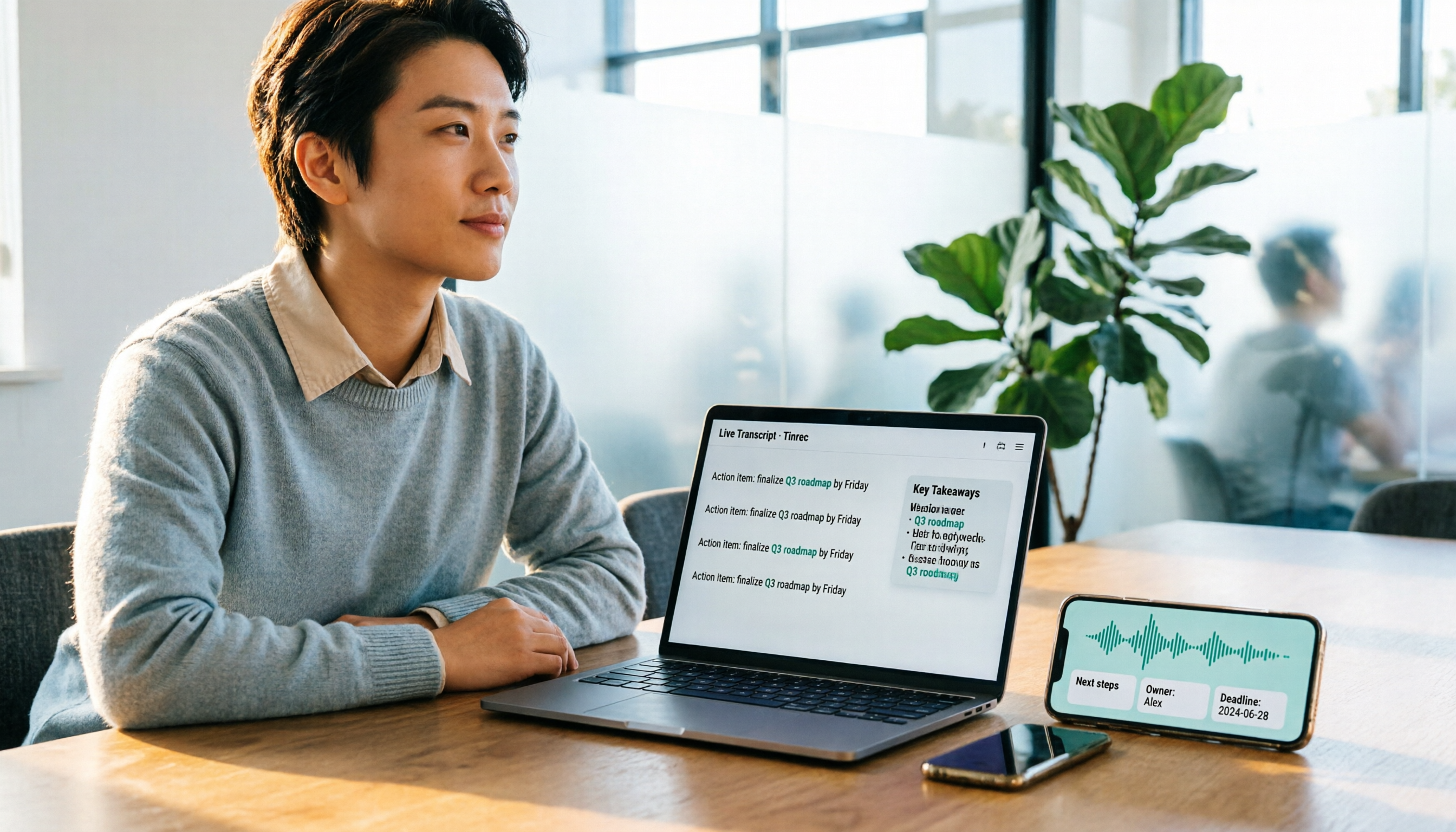
2025 Comparison of 2 Online Meeting Tools: Google Meet APK Download vs. Tinrec Meeting Notes
Many people search for google meet 2025 apk, only to find after installing that meeting content still isn't captured. This article starts from the common misconception that 'downloading an APK equals solving meeting notes' and compares Google Meet and Tinrec in terms of meeting notes, post-meeting organization, cross-platform support, and team collaboration, with APK download safety tips and practical buying advice.

Free Online Meeting Solutions in 2026: Google Meet and 4 Other Apps Compared
Searching for Google Meet 2024 APK usually means your phone can't install it or you want an older version. This article explains the two package names and APK version status for Google Meet on Android, then reviews the free and paid plans of 5 online meeting and meeting notes tools to help you decide which one to download.

4 Google Meet Alternatives for Android TV in 2026: How to Choose Between Video Calls and Meeting Notes
Google ended support for Meet calls on Android TV in early 2025, leaving TV meetings in a bind. This article compares practical approaches—Jami, browser-based calls, casting, and external cameras—and how Tinrec differs in post-meeting organization, helping you decide which combination is easiest.

Google Meet Breakout Rooms in 2026: Yes, It Has the Feature—But 3 Things It Can't Do
Does Google Meet have breakout rooms? Yes, but it can't record or livestream, and chat messages in rooms are deleted after the session. This article covers 5 limitations and 3 common misconceptions, and compares Tinrec, Otter.ai, Granola, and Notta for post-meeting notes and organization, helping you decide how to preserve breakout discussions.
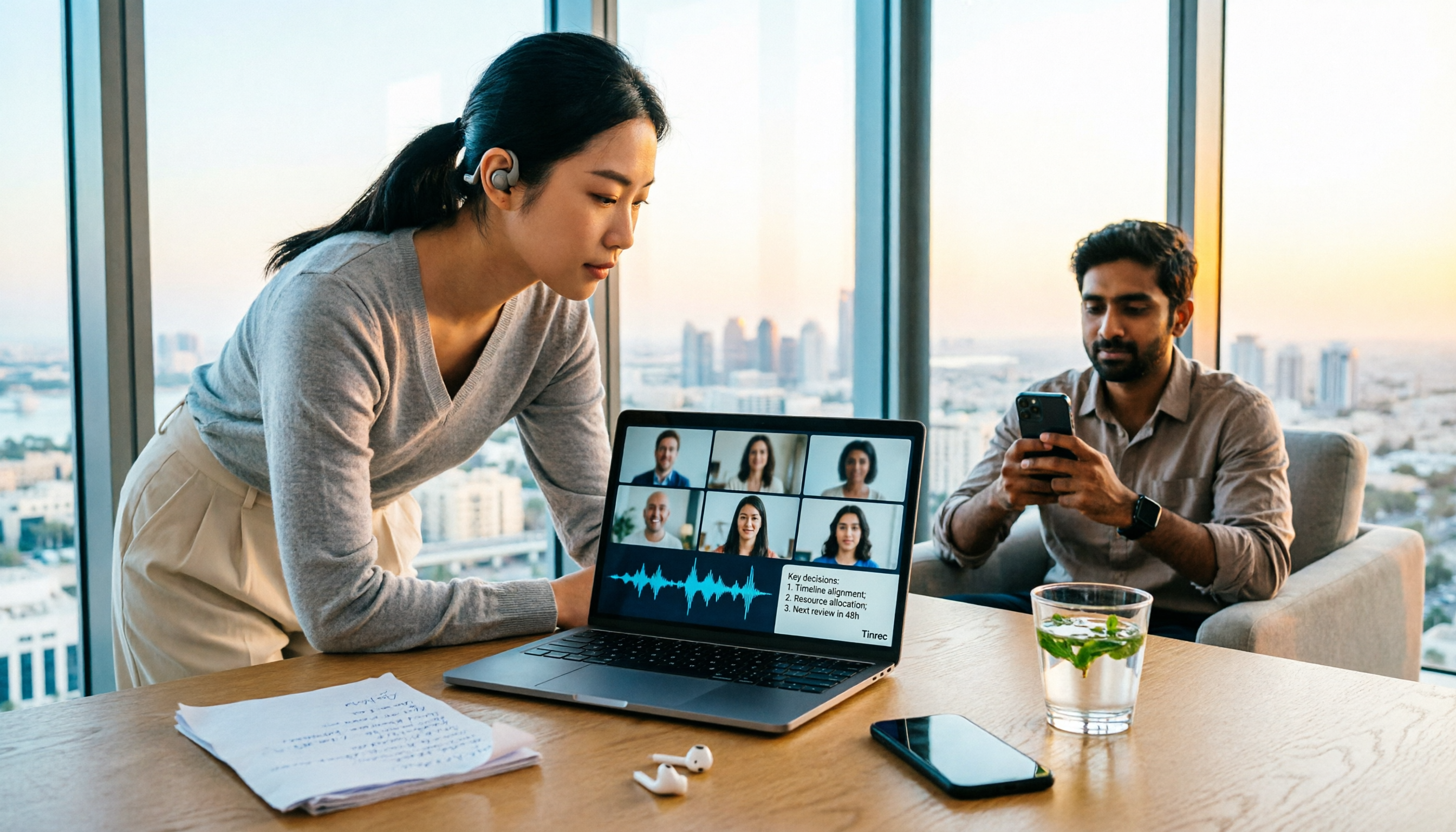
Google Meet in UAE 2026: Can You Use It? Call Restrictions Tested + 3 Backup Solutions
Can you use Google Meet in the UAE? This guide covers the current VoIP call restrictions, conflicting user reports, and how to test it upon arrival. Plus, 3 practical backup solutions, including Tinrec—a no-bot recording and AI meeting summarization tool—so you can keep complete meeting records even when calls are unstable.

3 Google Meet Note-Taking Tools Tested for 2026: Can You Get Transcripts Without a Bot?
In 2026, starting a Google Meet call is easy—the hard part is post-meeting organization. This article first explains how to join Meet and common pitfalls, then compares Tinrec, Otter.ai, Granola, and Notta across four key areas: how meeting audio gets into the tool, what happens after transcription, Chinese recognition, and data ownership. Find the meeting notes solution that truly saves you time.