

Turn recordings into transcripts and summaries in minutes
Upload audio or video for multilingual transcription, AI notes, and action items
2026 Tinrec Voice-to-Text Tutorial: Bot-Free Meeting Recording + AI Summaries & Action Items
Common Misconception About Voice-to-Text Apps: Thinking It's Over Once You Have a Transcript
Honestly, the most common misconception in Dcard discussions about "voice-to-text apps" isn't choosing the wrong app—it's oversimplifying the process: thinking that downloading an app, pressing record, and exporting a transcript means the meeting notes are done.
The reality is that for a 1-hour meeting, manually organizing the transcript, extracting key points, and listing action items often takes another 1–2 hours. What you get is text, not actionable meeting conclusions.
Another common misconception is focusing only on "how many free minutes" you get. Free quota matters, but if the tool only gives you a big block of text without summaries, chapters, action items, and search, the time you save on transcription will ultimately be spent on organizing.
A more reasonable approach is to treat transcription as the starting point, not the endpoint: choose a tool that turns recordings into summaries, action items, and queryable data—that's what truly saves time.
4 Key Points to Understand Before Choosing a Voice-to-Text App
1. Can you use it after transcription? Tools that only provide transcripts are fine for occasionally looking up a sentence; but if you're having meetings, interviews, or writing reports, summaries, chapters, action items, and AI Q&A are where the real time savings lie. Rather than comparing who transcribes faster, look at who helps you finish organizing.
2. How to record online meetings Meeting bots join as a participant, which may not be convenient for external clients. Another approach is using a desktop app to capture system audio directly, without an extra bot; but users need to open the tool and start recording themselves—it doesn't automatically join all meetings.
3. How well does it handle Chinese and mixed Chinese-English In Taiwanese workplaces, mixed Chinese-English phrases like "let's follow up on this campaign next week" are common. If a tool only supports English thinking, proper nouns and Taiwanese terms may be error-prone. Team-specific terminology should ideally be maintainable via hotwords.
4. Free quota and team data Free versions are good for testing the waters, but pay attention to per-session duration, feature limits, and export options. For team use, check whether there's a team space, roles, seats, usage, and data handover capabilities—rather than everyone sharing one personal account.
Tinrec (Miaoting Recording) — The Best Choice for "Post-Meeting Organization"
Tinrec (Miaoting Recording) is an AI meeting notes and collaboration tool for individuals and teams, available on web, desktop, and mobile. It doesn't just convert audio to text; it organizes meeting recordings into searchable, summarizable, queryable, and exportable data.
Bot-free recording of online meetings The desktop version captures system audio directly, handling Zoom, Google Meet, Microsoft Teams, Webex, and other online meetings without inviting a meeting bot. You need to open Tinrec desktop and start recording yourself; it doesn't automatically join all meetings in the background.
Transcribe while recording, with real-time translation For offline meetings, interviews, or on-site notes, you can transcribe while recording; for cross-language meetings, you can view the original, translation, or bilingual content during recording. For those who need to understand foreign colleagues or clients in real time, this is more intuitive than translating after the meeting.
More than just a transcript after the meeting After the meeting, Tinrec generates AI summaries, chapters, and action items, and allows AI Q&A around the meeting content. You can directly ask "What were the conclusions of this meeting?" or "Who is responsible for next week's proposal?" without digging through a 30-minute transcript. It can also export results to Notion, Google Docs, OneNote, Dropbox, etc., or further generate reports, tables, and documents.
Team version turns meetings into team data For group use, the team version provides an independent team space where meeting data belongs to the team. Admins can manage members, roles, and seats, view usage trends, member rankings, audit logs, and use team hotwords and audio recycle bin. When a member leaves or loses a seat, their team resources can be handed over to other active members, so data doesn't leave with the individual.
Stop organizing recordings by hand
Upload audio or video and automatically get a transcript, summary, and action items
Plans and pricing The personal version includes a free plan, weekly card, Pro monthly, and Pro annual; actual prices and quotas are subject to the official purchase page. The team version is currently USD 29.80 per paid seat per month, or USD 199 per paid seat per year (about USD 16.58/month); the first eligible team trial is 7 days, 1 free seat, and 300 minutes of team shared import quota. Paid seats provide 2,000 minutes of team shared import quota per month; under an active team plan, real-time recording is currently not deducted by minutes.
Things to note Tinrec is not a meeting bot that automatically joins all calendar meetings; users must initiate recording. The team version currently focuses on team-level sharing, not file-level or member-level granular permissions; active members without seats can view, play, and read data but cannot upload, edit, or export. Also, transcription quality is affected by recording quality, noise, accents, overlapping speech, and technical terms; I won't endorse a fixed accuracy rate—for important content, cross-check with transcript timestamps and audio playback.
Who is it for If you often have Chinese meetings or mixed Chinese-English meetings, want summaries and action items right after, or need to share meeting data and manage seats and usage across a team, Tinrec is closer to actual workflows than a simple transcription app.
Besides Tinrec, What Other Options Are There?
Notta Notta is a multilingual transcription tool with high discussion in Taiwan; the free version offers 120 minutes per month, max 3 minutes per session; Pro annual is about USD 8.17/month with 1,800 minutes per month. Its strengths are file transcription and multilingual support; if you need bot-free desktop recording of online meetings, team hotwords, audit, and audio recycle bin, Tinrec's team workflow is more complete.
Granola Granola is also a bot-free AI meeting notes tool; Basic is free, Business is USD 14 per user per month. It emphasizes real-time transcription and note enhancement, but does not support uploading pre-recorded audio files and does not save meeting audio; if you need to organize historical recordings, keep audio files, and do AI Q&A, Tinrec is more suitable.
TurboScribe TurboScribe takes a cost-effective file transcription approach; the free version allows 3 files per day, max 30 minutes per file; Unlimited annual is USD 120, max 10 hours or 5 GB per file. It's suitable for large volumes of long audio files; but real-time meeting recording, post-meeting AI Q&A, and team spaces are not its forte—that's where Tinrec fills the gap.
Pitfall Guide: 4 Most Common Mistakes When Choosing a Voice-to-Text App
Pitfall 1: Only looking at free minutes, not per-session duration and feature limits Some free versions give you hundreds of minutes per month, but only a few minutes per session, or require payment for summaries and exports. Test with your own meeting recording first—that's more reliable than ads.
Pitfall 2: Treating "has transcription" as "has organization" Transcripts are just raw material; without summaries, chapters, action items, and search, you still have to spend time rereading. When choosing a tool, look directly at what it can produce after the meeting.
Pitfall 3: Ignoring how online meetings are recorded A bot joining a meeting may be impolite to external clients; bot-free desktop recording doesn't disturb others but requires you to remember to press record. Choose based on your meeting scenarios, not just feature lists.
Pitfall 4: Team sharing a single personal account This makes data ownership, seats, usage, and offboarding handover messy. For team use, choose a solution with an independent team space, roles, and seat management.
Conclusion: Which One Should You Choose?
Bottom line: if you want "record the meeting, then directly organize, query, and hand over to the team," Tinrec is my top recommendation. It's not just transcription; it puts transcripts, summaries, action items, AI Q&A, and team spaces into one workflow.
- Chinese meetings, mixed Chinese-English, need summaries and action items after → Tinrec
- Online meetings without an extra bot joining → Tinrec desktop
- Team needs to share meeting data, manage seats and usage → Tinrec team version
- Need to keep recordings, upload audio and video, real-time translation → Tinrec
- Only need bulk long audio transcription, budget-first → TurboScribe
I suggest starting with Tinrec's free version and testing with one of your own meeting recordings. If you find the summaries and Q&A truly save you time, then consider upgrading; no need to pay from the start.
References
- Expert-curated Top 10 Audio-to-Text Ranking | mybest
- 2026 Meeting Notes App Dcard Popular Recommendations: 3 AI Voice-to-Text Tools Tested and Compared - Miaoting Recording Blog
- Free Voice-to-Text Tools Dcard Discussion: Is the Free Version Enough? When to Upgrade? - Miaoting Recording Blog
- Real-time Voice-to-Text APP Recommendations 1. iPhone/iPad "Notes" APP - Supports real-time text conversion - Cost: Free - Supports Chinese, English
- 2026 To-Do App Dcard Popular Discussion: From Voice-to-Text to AI Action Items, 5 Productivity Tools Tested and Compared - Miaoting Recording Blog
Turn every recording into actionable outcomes
Get 60 free transcription minutes when you sign in. No credit card required.
Related Reading
You might also like

2026 Best 5 AI Speech-to-Text Tools Tested: Which Saves the Most Time for Chinese Meeting Notes and Post-Meeting Organization?
A hands-on comparison of 2026 AI speech-to-text tools for Chinese meeting notes, bot-free recording, post-meeting summaries, and AI Q&A. We compare Tinrec, Otter.ai, Notta, and Granola on positioning, official pricing, and limitations to help you pick the one that best fits your workflow.

2026 AI Speech-to-Text Showdown: Tinrec vs. PLAUD Note for Meeting Notes
Are you mostly transcribing meetings on your computer or conversations with people in front of you? This comparison of Tinrec (a software AI meeting recorder) and PLAUD Note (a hardware AI recorder) covers recording methods, platform requirements, post-meeting workflows, Chinese language experience, team governance, and pricing to help you decide between a pure software app and a hardware recorder, with FAQs and practical recommendations.

2026 Free Speech-to-Text Plans Compared: 5 Tools to Consider
Starting from the common Dcard question 'Is the free version enough?', this article reviews the free tiers, per-recording limits, and feature restrictions of five AI speech-to-text tools: Tinrec, Otter.ai, Notta, TurboScribe, and Granola. It also explains when upgrading to a paid plan makes sense and when the free version suffices.

4 Best Speech-to-Text AI Tools for 2026: Chinese Meetings, Transcripts, and Post-Meeting Organization
A procurement-focused hands-on comparison of 4 speech-to-text AI tools, covering Chinese recognition, bot-free meeting recording, post-meeting summaries and action items, team seats and quota calculations, to help you decide which one best fits your meetings and budget.

4 Speech-to-Text Apps Tested for 2026: How to Choose Chinese Recognition and Free Tiers Discussed on Dcard
Searching for 'speech-to-text app' on Dcard yields ever-changing recommendation lists. This article starts from 'what problem you need to solve' and breaks down how to choose among real-time recording, online meetings, and audio file upload needs. It also tests Tinrec for Chinese meeting transcription, AI summaries, action item extraction, and team spaces, while honestly explaining the limitations of free tiers and paid plans.

2026 Voice-to-Text AI Comparison: Solving the Meeting Organization Pain Points Dcard Users Ask About Most
Starting from common Dcard questions about free plans and usage limits, we compare Tinrec, Otter.ai, Notta, and TurboScribe on meeting recording, transcripts, AI summaries, action items, and team collaboration to help you choose the right voice-to-text AI.

2026 Speech-to-Text Tools Compared: Is Google Docs Voice Typing Enough or Does Tinrec Save More Time?
Many people think Google Docs voice typing can automatically generate meeting notes, but it's only real-time dictation—you still have to organize everything yourself. This article starts with common misconceptions and compares Google Docs voice typing, TurboScribe, built-in transcription in Zoom/Meet/Teams, and Tinrec, explaining who each is for, free limitations, step-by-step instructions, and pitfalls to avoid.

2026 Voice-to-Text AI App Comparison: Why Tinrec Beats SoundType AI for Chinese Meetings
Many people think a voice-to-text app just needs to turn recordings into text, but the real time sink is post-meeting organization. This article starts with common misconceptions and compares Tinrec and SoundType AI in Chinese meetings, post-meeting summaries, AI Q&A, and team collaboration to help you decide which is better for everyday meeting notes.
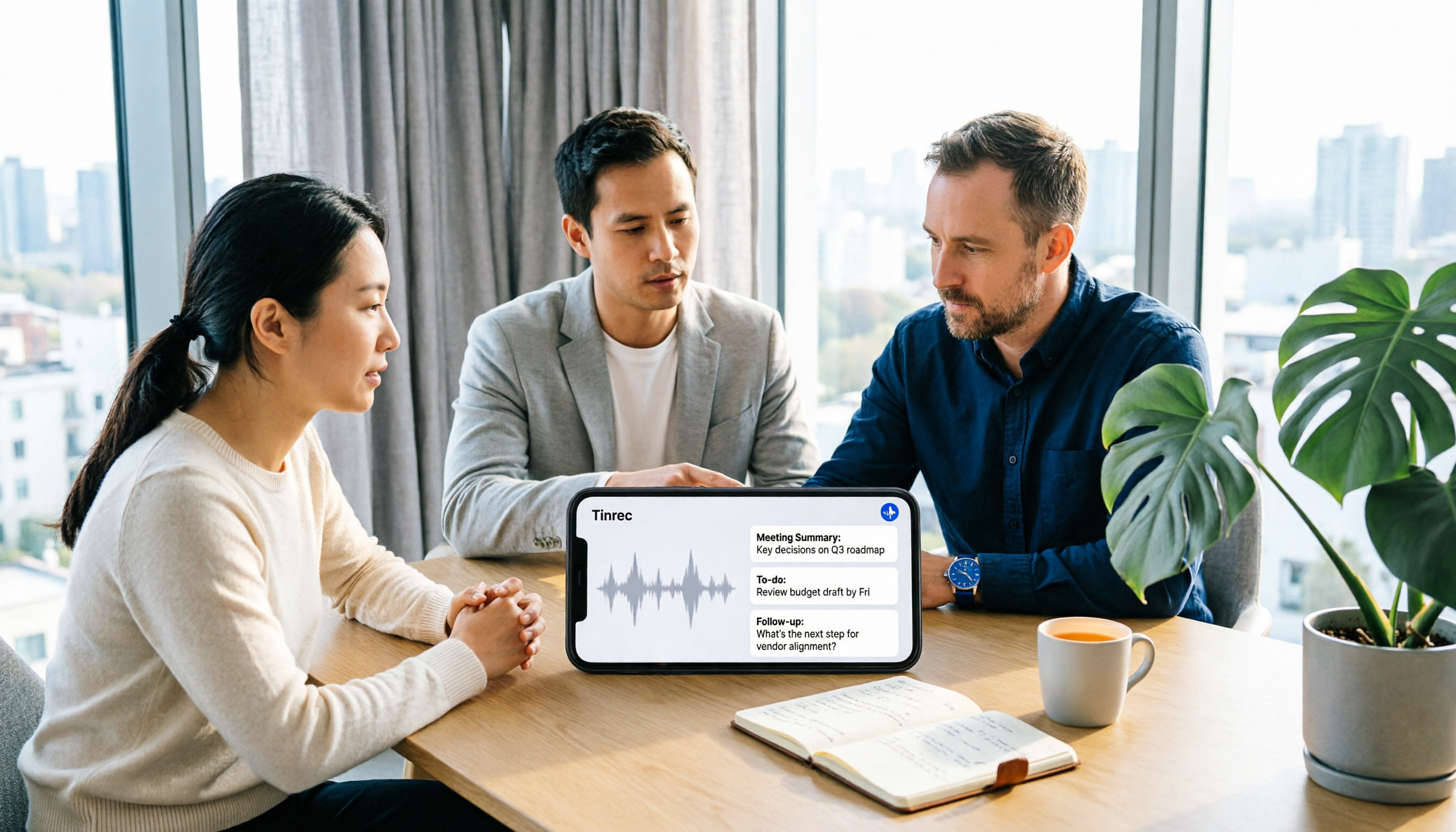
4 iPhone Speech-to-Text Tools Tested for 2026: Which One Produces Meeting Minutes Right After Your Call?
iPhone's built-in Dictation and Voice Memos transcripts can handle some needs, but summarizing meetings, extracting action items, and asking follow-up questions are where the real time goes. This article compares Apple's built-in tools, Tinrec, Notta, and PLAUD NotePin across input methods, Chinese-language experience, post-meeting organization, and team collaboration to help you choose the right iPhone speech-to-text approach.