

Turn recordings into transcripts and summaries in minutes
Upload audio or video for multilingual transcription, AI notes, and action items
When choosing a recording tool, many people's first question is 'Should I buy a dedicated recording device?' Actually, we can set that question aside for now.
The real question to decide first is: Do you want to 'capture the sound' or 'turn the meeting into searchable, actionable text data'? These two needs require different tools.
If you're currently searching for 'how to record with Plaud,' the steps for both the device and the app are explained clearly below. Then, look at the post-recording organization workflow, and you can decide whether it's worth the money.
Ask Yourself First: Are You Solving 'Recording' or 'Organizing'?
The first scenario is when you can't take out your phone. For in-person interviews, client sites, or phone calls, you need a small device that you can just press and go.
The second scenario is after a meeting, you have a one-hour audio file, but you still need to spend another hour typing up notes and figuring out who agreed to what. What you're lacking here isn't recording—it's organization.
These two needs are often discussed together, but they correspond to completely different products. Hardware recording devices excel at the former, while AI meeting tools excel at the latter.
How to Record with Plaud: Practical Operations in Three Scenarios
Let's start with the most common: recording directly with the device. According to Plaud's official instructions, the device can record independently without connecting to the app. Just press the record button to start—this is very convenient for impromptu situations.
The second method is triggering from the app. First, connect the Plaud device to the Plaud app. Once connected, tap start in the app, and it will command the connected device to record. This is suitable when your phone is on a tripod and you don't want to reach for the device.
The third method is phone call recording. The official operation guide is very specific: long-press the record button for about 1 second until you feel one vibration, indicating the call recording has started; to end, long-press again for about 1 second until you feel two vibrations, indicating the recording has ended.
Regarding battery life, official specs show differences among models: models with 400mAh can record continuously for up to 30 hours and standby for 60 days; models with 320mAh and 270mAh can record continuously for up to 20 hours and standby for about 40 days.
One important reminder: every official operation guide includes the same sentence—please inform the other party and obtain explicit consent before recording. In Taiwan, recording as a participant in a conversation generally does not violate the Communication Security and Surveillance Act, but if the recorded content is leaked or used for other purposes, it can still raise privacy and personal data issues. Saying 'I'll be recording for notes' at the beginning can save a lot of trouble in practice.
After Recording Is the Key: Plaud Gives You a Transcript, Then What?
Plaud's value lies in that second when you can start recording without thinking. It is equipped with an AI model that can produce timestamped transcripts, apply summary templates, and use Ask Plaud for cross-file inquiries.
But after going through the entire process, you'll find several points to consider.
First is the cost structure. According to the official page, the PLAUD NotePin is USD 159, and the Note Pro is USD 189. The Starter plan offers 300 minutes per month; Pro is USD 99.99/year with 1,200 minutes per month; Unlimited is USD 239.99/year. In other words, you're buying a device plus a subscription.
Second is scenario limitations. It's a portable hardware device, so online meetings require speakerphone or additional handling; when teams need to share data, the data mainly follows individual accounts.
Third, it won't help you identify key points. The transcript is complete, but turning it into 'what was decided, who is responsible, and when is it due' still requires someone to process it again.
Simply put, Plaud is great for people who are out and about, need physical buttons, and want to record phone calls. If your main meetings are on a computer, its advantages are less relevant.
Tinrec (Instant Recording) — If What You Want Is 'Data You Can Use Right After Recording'
Tinrec is an AI meeting notes and collaboration tool for individuals and teams. It supports real-time audio-to-text, bot-free online meeting recording, audio/video file import, and can also handle mobile recording.
Its biggest difference from pure recording devices is that it connects 'recording' and 'organizing'.
Record and transcribe simultaneously during meetings. For offline meetings or interviews, open Tinrec's real-time recording, and the transcript is generated synchronously—no need to wait until after the meeting to upload.
No need to invite a bot to online meetings. The desktop version directly captures computer system audio, handling meetings on Zoom, Google Meet, Microsoft Teams, Webex, etc., without requiring an extra bot account to join the meeting room. Note that this does not mean automatically joining all calendar meetings; you still need to actively initiate recording.
Stop organizing recordings by hand
Upload audio or video and automatically get a transcript, summary, and action items
Directly produce deliverable outputs after the meeting. After the meeting ends, Tinrec generates summaries, chapters, key points, and action items, and can also produce mind maps. For cross-language meetings, you can view the original text, translation, or bilingual comparison.
You can continue to ask questions. This is its most practical part. Instead of dragging through a 30-minute transcript to find 'who mentioned the budget last time,' just ask it directly. It answers based on semantics, not a list of keyword search results.
Results are portable. Supports multiple export formats and can export to Notion, Google Docs, OneNote, Dropbox, etc., for further processing. You can also use Agent post-processing to generate reports, tables, and documents.
For team use, Tinrec for Teams is a separate team space, not multiple people sharing a personal account. Data belongs to the team; members can view, play, and read even without a seat, but need a seat to record, upload, edit, and export. Administrators can manage roles, seats, sharing permissions, team hotwords, and view usage trends and audit logs; accidentally deleted audio can be restored from the recycle bin.
The current pricing for the team version is USD 29.80 per paid seat per month for monthly billing, or USD 199 per paid seat per year for annual billing (equivalent to about USD 16.58 per month). Each paid seat provides 2,000 minutes of shared team import quota per month; real-time recording within an active plan is currently not deducted by minutes. Eligible teams get a 7-day trial, 1 free seat, and 300 minutes of shared quota for the first time. Actual prices and benefits are subject to the official purchase page.
Limitations to be honest about: The free version provides a basic quota; heavy use requires an upgrade. Transcription requires an internet connection. Actual accuracy is affected by recording quality, noise, accents, multiple people talking over each other, and technical terms. For important content, it's recommended to cross-check the transcript timestamps with the recording. It also won't automatically join all your meetings.
Who it's for: People who mainly meet on computers, need Chinese transcripts and minutes, want to ask questions directly after meetings to find key points, or want to turn meeting data into team assets.
Besides Tinrec and Plaud, What Other Options Are There?
Notta is a multilingual transcription tool. The free version offers 120 minutes per month with a maximum of 3 minutes per item; Pro annual billing is about USD 8.17 per month with 1,800 minutes per month; Business annual billing is about USD 16.67 per seat per month. It performs well for pure file transcription, but lacks Tinrec's bot-free desktop meeting recording and team data accumulation workflow.
Otter.ai is a mature choice for English business meetings. Basic is free with 300 minutes per month; Pro annual billing is about USD 8.49 per user per month, including 1,200 minutes. If 90% of your meetings are in English and you only need meeting notes, it's cost-effective; but Chinese meetings and real-time translation are not its strong suit.
Built-in phone recording is completely free—just press and record. But it only gives you an audio file; transcripts, summaries, and action items are all up to you. Suitable for very light needs where you just need to keep a record.
Pitfall Guide: The 4 Most Common Mistakes When Choosing a Recording Tool
Pitfall 1: Thinking the recording will automatically become meeting notes. Recording only solves 'capturing the sound.' The hour of organizing from audio to minutes is the real cost—factor that in when choosing a tool.
Pitfall 2: Only looking at battery life and recording distance. 30 hours of battery life sounds impressive, but if your meetings are all on a computer, this spec is almost meaningless to you. First confirm your meeting format, then choose specs.
Pitfall 3: Ignoring recording consent and data retention. Informing and obtaining consent before recording is basic etiquette and legal risk management. Also, ask clearly how long audio files are retained and whether deleted files can be recovered.
Pitfall 4: Treating 'minutes' as the only metric. Enough minutes doesn't mean it's easy to use. What really determines efficiency is whether the transcript is searchable, whether summary templates fit your scenario, whether you can ask follow-up questions, and whether you can export to your existing workflow.
Conclusion: Which One Should You Choose?
To sum up in one sentence: If your question is 'how to record with Plaud,' the answer is three methods—button press, app trigger, and long-press for phone calls. The operation itself isn't difficult; the hard part is that hour after recording.
Need portability, physical buttons, phone call recording, long battery life → PLAUD NotePin (USD 159) or Note Pro (USD 189). The hardware experience is indeed solid.
Meetings mainly on computer, need Chinese transcripts, summaries, action items, and post-meeting Q&A → Tinrec. Desktop bot-free recording plus AI Q&A and export are where it stands out.
Need to leave meeting data for the whole team, with seat and usage management → Tinrec for Teams. Remember to distinguish roles and seats: roles govern governance, seats govern usage.
Just need to convert long audio files into subtitles or text → Batch transcription tools like TurboScribe are more suitable.
Meeting content is mainly in English → Otter.ai is a reasonable choice.
Recommended approach: Don't rush to buy hardware. Take the recording of your most recent meeting and run through the complete process with the free version to see if the transcript quality, summary format, and export results work for you. After one run, you'll know whether you really lack that device or that organizing workflow.
References
- Recording Operation Guide | Plaud Taiwan
- Plaud User Guide | Complete Tutorial and Operation Guide
- How to Transcribe Mobile Meeting Recordings? Use Plaud + AI Recording and Organizing in One Go
- Plaud Tutorial: From Note Pro Recording, Choosing Templates to Ask Plaud Follow-up—How to Make Meeting Notes Easier | TheAI Academy
- Recording via Plaud App – Help Center
Turn every recording into actionable outcomes
Get 60 free transcription minutes when you sign in. No credit card required.
Related Reading
You might also like
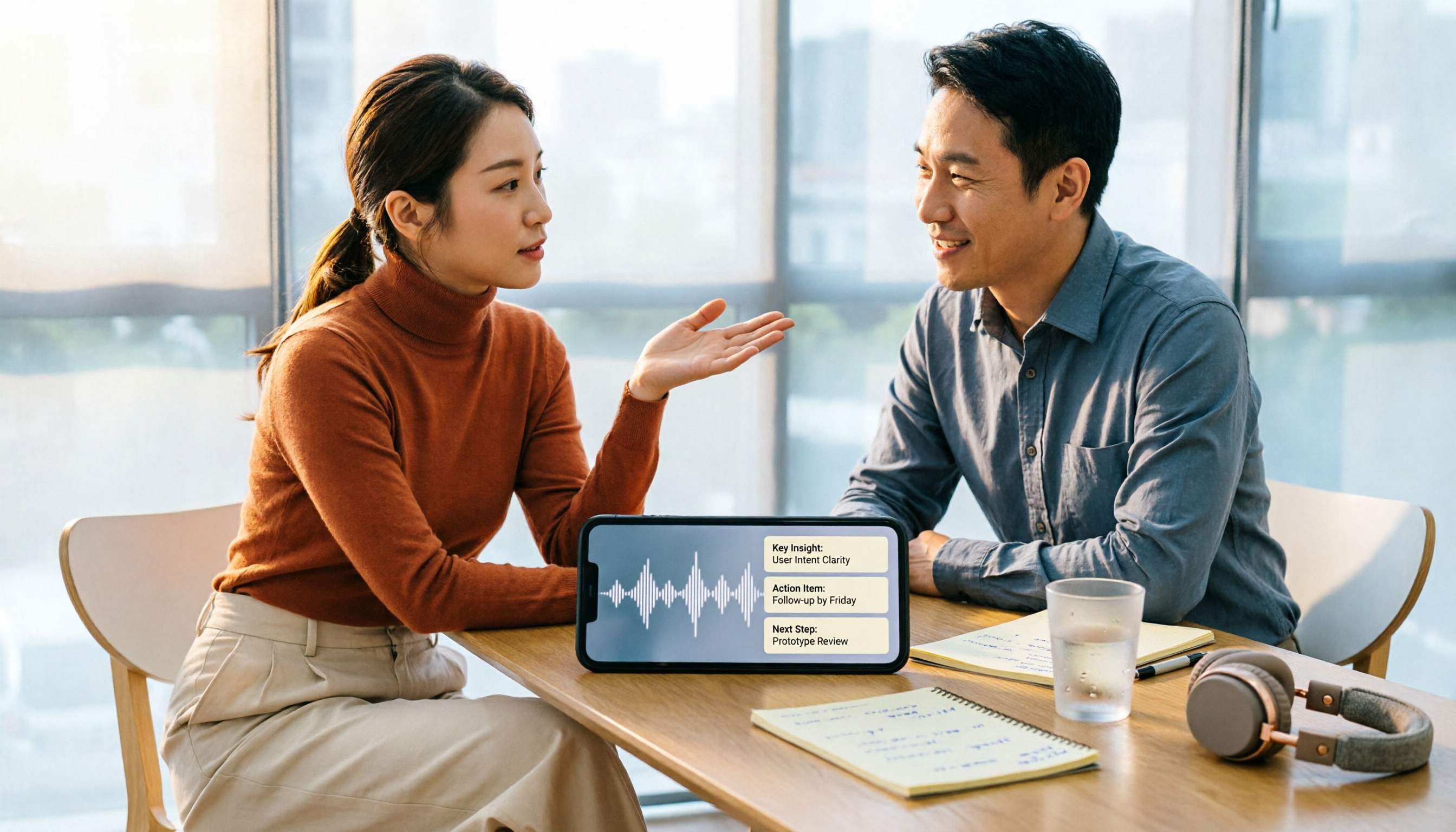
2026 AI Recording Tools Comparison: How to Use Plaud & Which Saves the Most Time After Meetings
Learn how to use Plaud recording—from Bluetooth pairing and vibration feedback to plan limits and restrictions—plus a hands-on comparison of Tinrec, Plaud, and Otter.ai for post-meeting organization to help you decide which approach saves the most time.
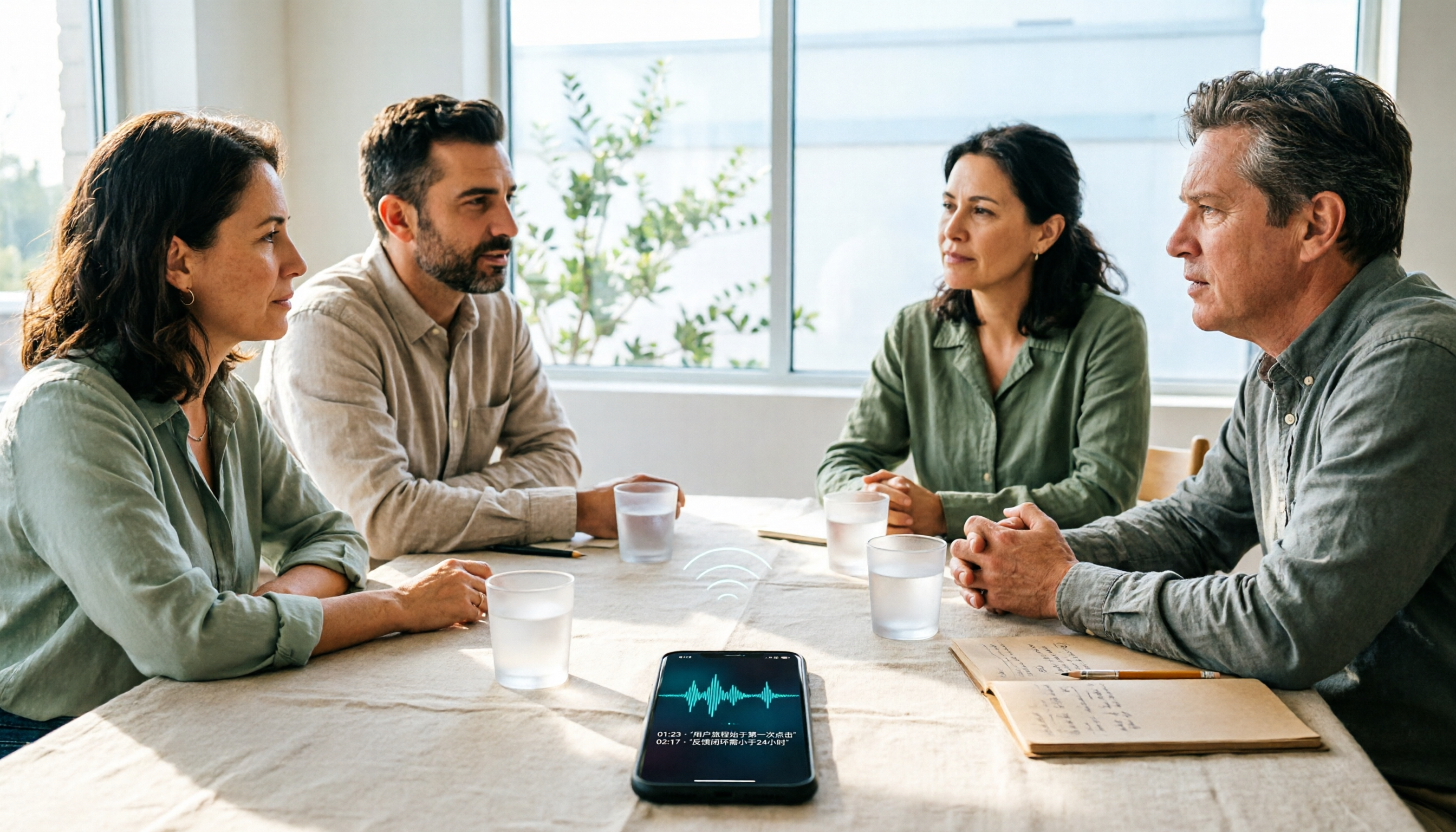
Plaud Recording Free Plans in 2026: 3 AI Meeting Note Tools Compared
Understand what "Plaud recording" means: recording with Plaud hardware or the Plaud app. Starting from this search question, this article compares the free tiers, pricing, and use cases of Plaud, Otter.ai, Notta, and Tinrec, and explains practical considerations such as getting consent before recording, helping you decide whether to buy hardware or choose a meeting notes workflow.
2026 AI Recording Tools Comparison: How to Use Plaud & Which Saves the Most Time After Meetings
Learn how to use Plaud recording—from Bluetooth pairing and vibration feedback to plan limits and restrictions—plus a hands-on comparison of Tinrec, Plaud, and Otter.ai for post-meeting organization to help you decide which approach saves the most time.
Plaud Recording Free Plans in 2026: 3 AI Meeting Note Tools Compared
Understand what "Plaud recording" means: recording with Plaud hardware or the Plaud app. Starting from this search question, this article compares the free tiers, pricing, and use cases of Plaud, Otter.ai, Notta, and Tinrec, and explains practical considerations such as getting consent before recording, helping you decide whether to buy hardware or choose a meeting notes workflow.
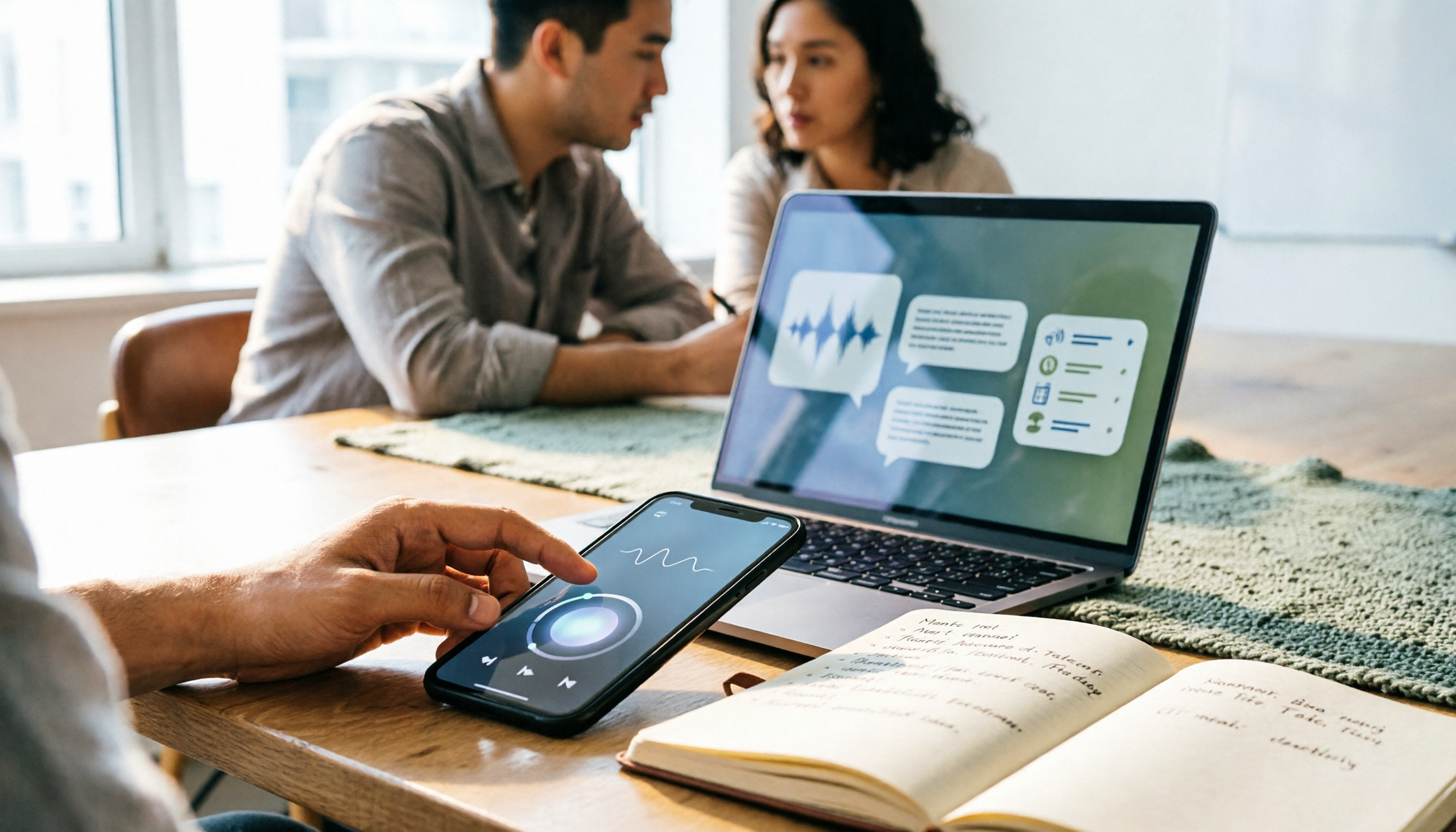
3 Best Audio-to-Text Tools in 2026: Plaud Recording Guide & Meeting Notes Comparison
From how to press the record button on Plaud and how files get into the app, to how transcripts and meeting notes are organized, this article walks through the actual workflow and compares Tinrec, Plaud, and Notta on recording methods, post-meeting organization, quotas, and pricing to help you decide which approach fits you best.
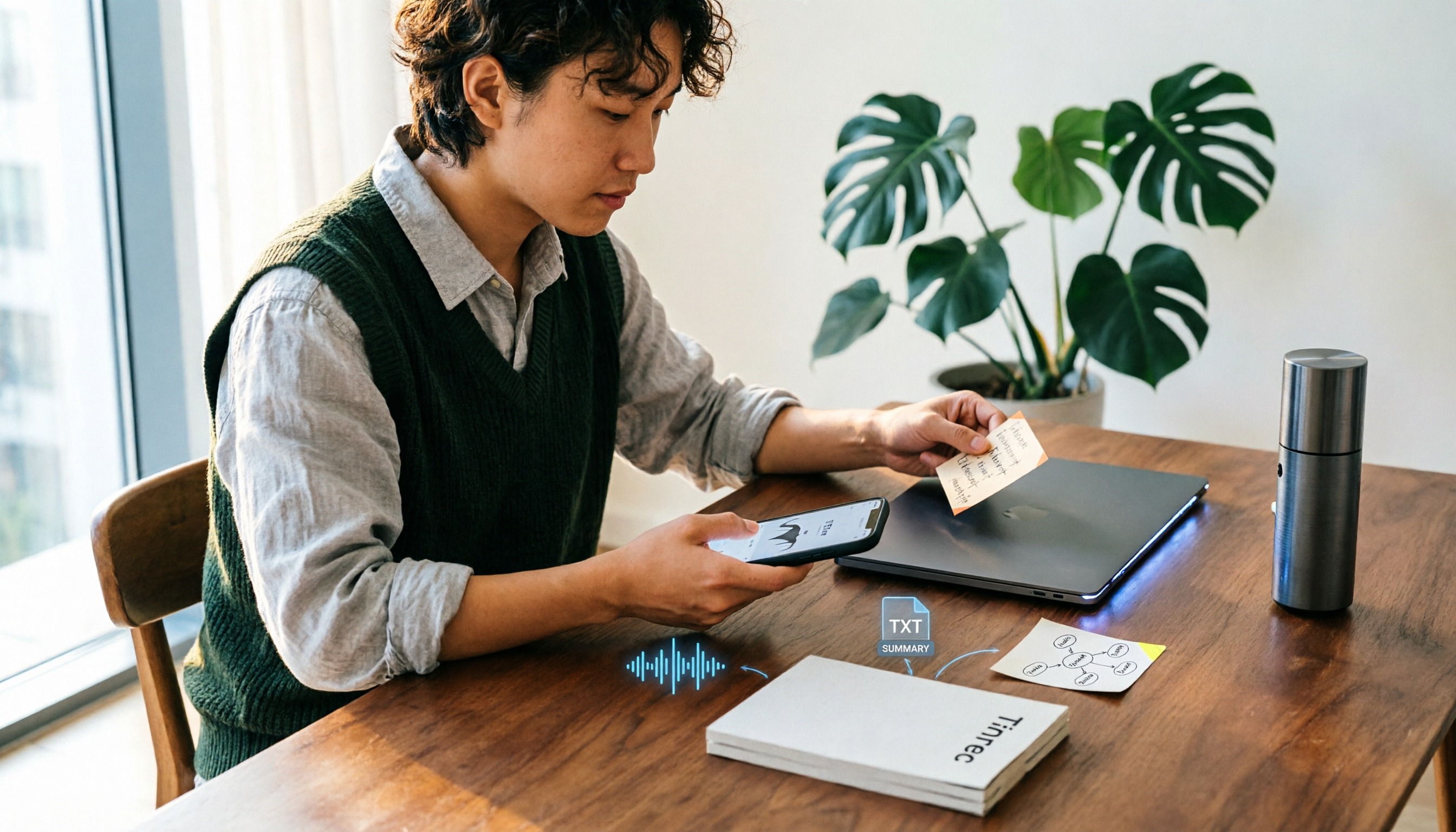
2026 Comparison of 3 Plaud Recording Export Methods: App, Web, or Desktop — Which Is Fastest?
PLAUD recordings don't automatically save to your phone's gallery or cloud drive—you have to export them yourself. This guide breaks down the differences, format limitations, and common pitfalls of three export methods (mobile App, Plaud Web, Plaud Desktop), explains how to export transcripts, summaries, and mind maps, and offers alternatives if you don't want to carry extra hardware.
4 Transcription Tools Tested for 2026: Yating Latest News and How to Choose an AI Meeting Recorder
Many people searching for "Yating transcription latest news" are really asking whether it's still worth using. This article first summarizes publicly available updates on Yating, then compares Yating, Notta, Otter.ai, and Tinrec across four key selection criteria, and lists four common pitfalls when choosing a tool.

Plaud vs Tinrec: 2026 AI Recording Tool Comparison — How to Choose Between Plaud's Sync and Tinrec's Post-Meeting Organization
How does Plaud sync recordings? Many assume files upload automatically after recording, but transfer only triggers when the app connects via Bluetooth. This article starts with the sync process and compares Plaud and Tinrec across five dimensions—file import, post-meeting organization, team collaboration, and cost—to help you decide between a portable hardware device and a workflow-integrated meeting notes solution.

3 Ways to Export Plaud Recordings in 2026: Download, Transcribe, or Team Workflow — Which Is Easiest?
How do you export Plaud recordings? This guide breaks down three methods — Plaud App, desktop/Plaud Web, and Plaud MCP — with step-by-step instructions and use cases. It also compares organizing files yourself versus importing into Tinrec to generate transcripts, summaries, and action items, so you can pick the most time-saving approach.