

Turn recordings into transcripts and summaries in minutes
Upload audio or video for multilingual transcription, AI notes, and action items
2026 AI Meeting Notes Tools: A Complete Guide to Choosing the Right One for Auto-Generated Summaries and Action Items
It's 4:30 PM. A one-hour project meeting has just ended, and you're back at your desk with the discussion still echoing in your ears.
What you need to do next: re-listen to the recording, pull out key points, confirm who's responsible for what, and write it all up in an email to your manager and the client. By the time you finish, it's already dark outside.
If it was an in-person meeting, things are even messier. No one was typing in the conference room, and after the meeting all you have is a 58-minute audio file on your phone—with the first ten minutes being small talk.
This article isn't another spec sheet. I want to talk about the things that actually affect how smoothly you use a tool every day—and whether you'll still want to use it three months from now.
The meeting ends, but the notes are just beginning—you don't need more tools, you need a process that closes the loop
Most people's problem isn't a lack of tools—it's that tools only do half the job.
Recording software saves the audio. Transcription tools turn audio into text. Then what? You're left with a 20,000-word transcript, and you still have to read through it yourself to find "so what was the conclusion?" and "who's delivering what next week?"
Another common scenario is online meetings. Some tools require a "meeting bot" to join the room to record. When meeting with external parties, an unknown account suddenly appears on screen, and the client asks, "Who's this?"—it gets awkward.
There's another situation fewer people think about upfront: meeting data stored in personal accounts. When a colleague leaves, the past six months of meeting records disappear with them.
Choosing the right tool can solve most of these problems.
Before choosing an AI meeting notes tool, understand these 4 key points
1. Where meetings happen determines whether you need a "meeting bot"
For companies with purely online meetings, built-in summaries are usually enough. But if you're half online, half in-person, you need a tool that handles both. The difference: some tools rely on a bot joining the meeting, while others use a desktop app to capture system audio. The latter doesn't add an extra participant, which looks more professional in external meetings.
2. Language: Chinese and mixed Chinese-English is the norm in Taiwan meetings
Many foreign tools excel at English business meetings; Chinese isn't their main selling point. And meetings in Taiwanese offices are rarely pure Chinese—sentences like "We need to reconfirm the ROI of this campaign" happen every day. Before buying, test with your own meeting recordings, not just official demo videos.
3. Where data ultimately lives
Personal accounts and team spaces are two different things. If meeting content is a team asset (client requirements, decision rationale, project history), it should live in a team-owned space, not on someone's phone.
4. What you get after transcription
A transcript is just raw material. What you really need are summaries, chapters, action items, Q&A you can follow up on, and export formats that fit into your workflow. How well this layer is done determines whether you spend ten minutes or two hours after a meeting.
Tinrec—the one I'd recommend first after hands-on testing
Tinrec is an AI meeting notes and collaboration tool for individuals and teams, available on web, desktop, and mobile. Its positioning isn't "audio-to-text"—it's about turning meetings into searchable, queryable, transferable data.
No bot needed for online meetings
The desktop app captures system audio directly, handling meetings on Zoom, Google Meet, Microsoft Teams, and Webex without inviting an extra account. This is practical for external meetings—no unfamiliar participant appears on screen.
Note: this isn't "auto-join all calendar meetings." You still need to open Tinrec and start recording yourself.
After the meeting, summaries and action items are already there
During the meeting, transcription happens live; after it ends, summaries, chapters, and action items are generated automatically. Who's responsible for what, what to check first in the next meeting—no more digging through from scratch.
It handles mixed Chinese-English content well, and offers real-time translation for cross-language communication, viewable in original, translated, or bilingual mode.
You can keep asking it questions after recording
This is where it differs most from pure transcription tools. You can ask directly: "Who mentioned the budget in the last meeting?" "What concerns did the client have about the delivery date?" It answers based on meeting content, not a pile of keyword search results.
Going further, you can use Agent post-processing to generate reports, tables, and documents from meeting content—ready to hand off. Export supports Notion, Google Docs, OneNote, Dropbox, and other common tools.
Team edition: meeting data doesn't leave with people
Stop organizing recordings by hand
Upload audio or video and automatically get a transcript, summary, and action items
The team edition is a separate team space, not multiple people sharing one account. Admins can invite members, set three roles (Owner/Admin/Member), and assign or revoke seats.
One commonly misunderstood point: roles and seats are two different things. Roles determine who can manage the team; seats determine who can record, upload, edit, and export. Members without seats can still view, play, and read team data—they just can't perform resource operations.
Team data belongs to the team. When a member leaves or is removed, their resources need to be handed over to other members—they don't disappear with the individual. There's also usage analytics, audit logs, and a 30-day retention audio recycle bin.
Pricing and limitations, stated honestly
The personal edition offers a free version, weekly pass, Pro monthly, and Pro annual—choose based on your usage rhythm: free for occasional recording organization, weekly pass for short bursts of intense meetings, Pro for regular weekly use.
The team edition is priced per paid seat. Current internal configuration: USD 29.80/seat/month or USD 199/seat/year (about USD 16.58/month). Each paid seat provides 2,000 minutes of shared team import quota per month; under active seats, live recording currently doesn't deduct minutes. Eligible teams can try 7 days free with 1 free seat and 300 minutes of shared import quota. Prices and benefits are subject to the official purchase page.
Limitations must be clear too: the free version is for light use; heavy use requires payment. If you have a large batch of long audio files to process, it's not a specialized tool for that. Recording quality, accents, and multiple people talking over each other all affect transcription results—I can't give you a fixed accuracy number. For important content, I recommend replaying with the timeline to verify.
Who it's for
If you often have Chinese or mixed Chinese-English meetings, don't want a bot joining the room, want to find key points via Q&A after meetings, and need meeting data to stay with the team rather than personal accounts—this is my current first recommendation.
Besides Tinrec, what other options are there?
Otter.ai
A mature English business meeting assistant. The free version offers a generous 300 minutes per month; Pro annual is about USD 8.49/user/month, including 1,200 minutes of in-app recording and 10 file imports per month. If 90% of your meetings are in English, it's more cost-effective than Tinrec. But Chinese and mixed Chinese-English aren't its main selling points, and turning meeting data into team assets isn't its focus either.
Granola
A bot-free AI meeting notes tool that transcribes in real time via desktop system audio and microphone. Its strength is combining "your own notes" with AI. Free version available; Business is USD 14/user/month. However, it doesn't retain meeting audio or support uploading pre-recorded files—if you need to replay original recordings or organize historical audio, you'll need another tool.
TurboScribe
A cost-effective file transcription tool. Free version: 3 files per day, 30 minutes per file; Unlimited annual is USD 120, with paid version supporting up to 10 hours or 5 GB per file and 50 files at once. When you have a large batch of long recordings to transcribe in bulk, it does the job well. But its positioning is file transcription, not real-time recording during meetings and post-meeting collaboration.
Pitfall guide: 4 most common mistakes when choosing AI meeting notes tools
Pitfall 1: Only looking at official accuracy demos
Demo videos are recorded in quiet environments with standard accents. Real conference rooms have air conditioning noise, keyboard sounds, and people talking over each other. The right approach is to test with one of your own meeting recordings—that's the most realistic test condition.
Pitfall 2: Ignoring mixed Chinese-English
Many tools handle Chinese fine, English fine, but start failing when mixed. Taiwan meetings are exactly that—mixed. When testing, pick a segment with genuinely mixed content.
Pitfall 3: Thinking a transcript equals meeting notes
A transcript is raw material, not a finished product. If a tool only gives you text, you still have to organize it yourself. Action items need to be extractable, put into a tracking system, and checked at the start of the next meeting—that's when the loop closes.
Pitfall 4: Recording without informing participants
This isn't just a courtesy issue—it involves personal data and related regulations. Informing before the meeting is a basic principle, especially for meetings involving client data or confidentiality obligations. Get consent before recording and confirm where data is stored and who has access.
Conclusion: Which one should you choose?
In one sentence: for teams primarily having Chinese meetings who need post-meeting usability, Tinrec is currently the most suitable choice.
Specific breakdown:
- Primarily Chinese or mixed Chinese-English meetings → Tinrec (Chinese experience and bilingual viewing are key)
- Online meetings without bots → Tinrec (desktop captures system audio)
- Need to retain recordings for later verification of commitments → Tinrec (supports audio retention and file import)
- Team needs to share meeting data, handover when someone leaves → Tinrec Team Edition (roles, seats, usage, audit)
- Pure English meetings, zero budget → Otter.ai free version (300 minutes/month)
- Large batch of long audio files for bulk transcription → TurboScribe (10 hours per file, 50 at once)
Recommended approach: start with the free version. Take a recording of your most difficult-to-organize meeting, put it in, and see if the summary and action items it produces are something you can send out with minimal edits. If it works, then consider upgrading—there's no need to invest upfront.
After all, no matter how fast the tool, the value of meeting notes ultimately lies in—whether anyone actually follows through and gets things done.
References
- How to Choose AI Meeting Notes Tools? 2026 Auto Transcription, Summary, and Action Item Practical Guide, Chinese Support Comparison and Privacy Considerations | AI.com.tw
- High-Accuracy AI Meeting Notes Tool Recommendations: 5 Picks for 2026, Tinrec Helps You Generate Action Items in One Click - Tinrec Blog
- Top 10 AI Meeting Notes and Transcription Tools in 2026 | DingTalk
- The Most Recommended AI Meeting Notes Tool of 2026: Time-Saving Must-Have for Meetings!
- What Tools for AI Meeting Notes and Action Item Generation? Hands-On Test of 5 Best Options in 2026 - Tinrec Blog
Turn every recording into actionable outcomes
Get 60 free transcription minutes when you sign in. No credit card required.
Related Reading
You might also like

5 Best Video Summarization Tools for Skill Learning in 2026: How to Choose Transcripts, Summaries, and Review Notes
Summarizing skill-learning videos isn't just about watching them. This article addresses three common misconceptions, breaks down the four stages of video summarization, and compares Tinrec, Otter.ai, Notta, TurboScribe, and Granola on video import, transcripts, summaries, follow-up questions, and export, based on official data verified in August 2026. It includes pricing, quotas, and use cases to help you choose a tool that fits your learning pace.

Xiaomi Video to Text in 2026: 3 Methods Tested + AI Meeting Notes Auto-Generation
After recording a meeting on your Xiaomi phone, the first decision isn't which button to press—it's whether you want "a block of text you can paste" or "meeting material you can still find next week." This guide, based on a mid-level manager's actual workflow, compares Xiaomi's built-in recorder transcription, app store transcription apps, and Tinrec, and outlines 4 key buying criteria and 4 common pitfalls.

4 Voice-to-Text Tools Tested: Which Is Best for iPhone Transcription in 2026?
The iPhone's built-in Voice Memos transcription is handy, but it has limitations on device models, OS versions, and language support. This article compares four voice-to-text approaches—Apple's built-in, Tinrec, Notta, and PLAUD Note—based on real-world use cases, and outlines selection criteria, tool limitations, and pitfalls to help you choose the right solution for your meeting and recording habits.

5 Best Speech-to-Text Software for Chinese Meetings in 2026: Tinrec vs Otter.ai vs Notta vs Granola
We tested 5 speech-to-text tools—Tinrec, Otter.ai, Notta, Granola, and more—focusing on Chinese meeting transcription and post-meeting organization. Compare input methods, output quality, Chinese language performance, and free tiers, plus key buying factors and 3 common pitfalls to help you find the most time-saving option.

2026 Best 4 Speech-to-Text Apps Compared: Which Saves the Most Time on Chinese Meeting Notes?
There are countless speech-to-text apps, but most people buy the wrong one not because transcription is inaccurate, but because they haven't clarified whether they need a verbatim transcript or usable post-meeting data. This article starts with 5 key purchasing criteria, compares Tinrec, Otter.ai, Notta, and TurboScribe in Chinese recognition, post-meeting organization, team collaboration, and quota design, and summarizes 3 common pitfalls to help you choose the right tool within budget.

How to Use Voice Typing Shortcuts in 2026: Win+H Dictation + Automatic Meeting Notes
On Windows, press Win+H to type with your voice; on Chromebook, press Search + D. This guide shows you how to use computer voice-to-text shortcuts, when to use them, and how to turn meeting recordings into transcripts, summaries, action items, and searchable team knowledge after pressing the keys.
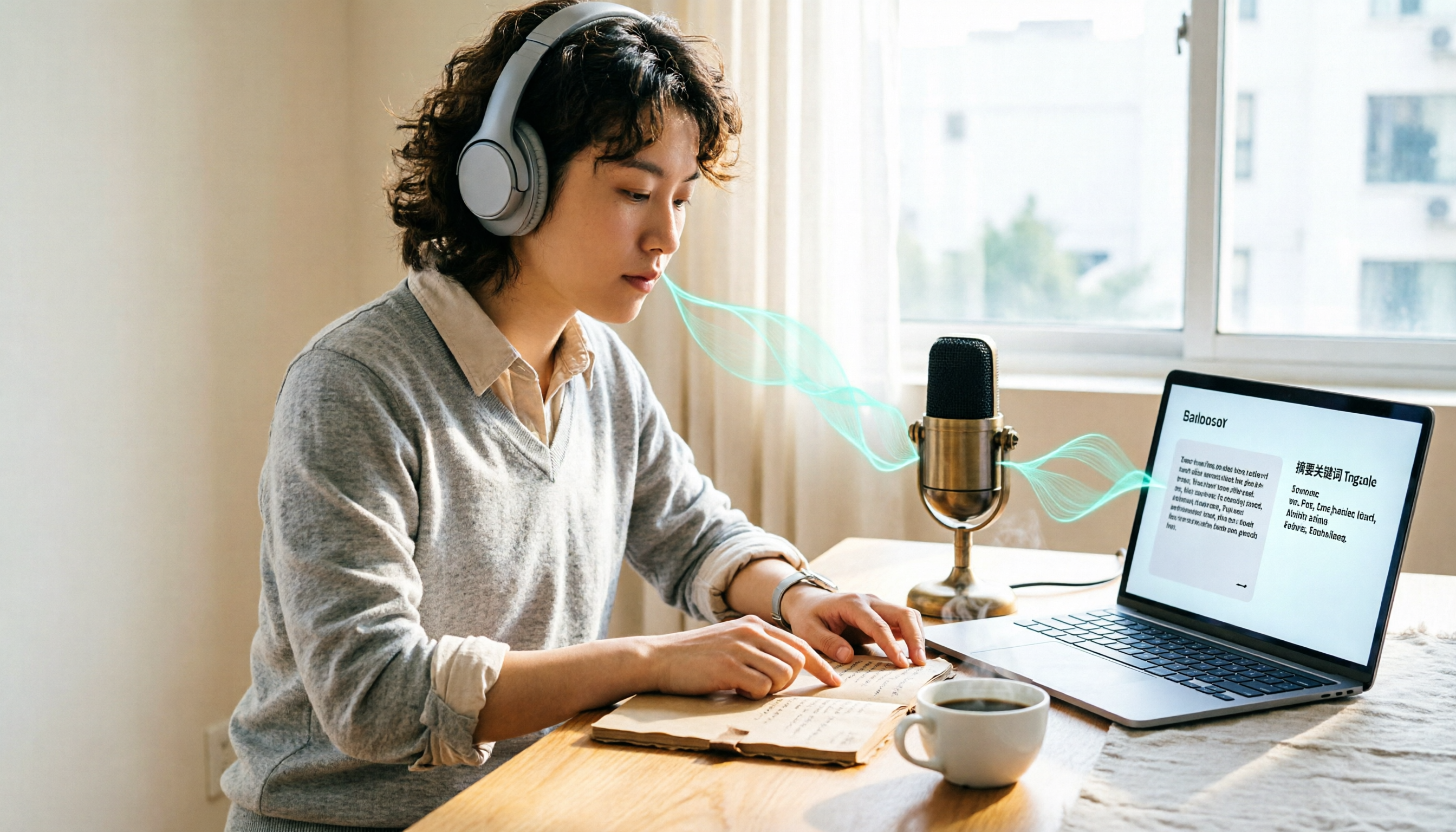
2026 Podcast Summary Free Plans Compared: 4 Tools to Check Out
After listening to a podcast episode, summarizing key points often means re-listening two or three times. This article reviews four tools in 2026 that turn audio files into transcripts and summaries, including free quotas, single-file length limits, and paid pricing. It also tests Tinrec's workflow from transcription to AI follow-up questions, helping you decide which one truly fits your needs.

2026 Comparison of 4 AI Meeting Summary Tools: Which One Actually Saves Time on Chinese Meeting Minutes?
Starting from real frustrations with group project discussions and class recordings, this student-perspective hands-on test compares 4 AI meeting summary tools on Chinese recognition, summary and action item quality, online meeting recording methods, and free tier limits. It also covers 4 key points to check before buying and 3 common pitfalls.

2026 Complete Guide to AI Meeting Minutes: Automatically Generate Summaries and Action Items
AI meeting minutes aren't just about feeding a transcript to AI. This guide starts with common inefficient practices, explains what AI meeting minutes can truly do, core capabilities, practical use cases, and purchasing considerations. Using Tinrec as an example, it walks you through the complete workflow from recording, transcription, summarization, action items, to team knowledge retention.