
Turn recordings into transcripts and summaries in minutes
Upload audio or video for multilingual transcription, AI notes, and action items
Why Do You Need a "Podcast to Text" Tool? Three Hidden Costs You Haven't Noticed
In the era of information overload, podcasts and online courses have become primary channels for acquiring knowledge. However, compared to reading text, listening to information often comes with a high time cost:

- Low Information Density: In a one-hour interview, the real meat may only be 10 minutes, with most time spent on rambling or small talk.
- Difficult to Retrieve: Want to find a specific point but can't remember if it was at 15:30 or 42:10, forcing you to drag the progress bar and listen again repeatedly.
- Lack of Actionability: It feels insightful in the moment, but without written notes, you forget everything in two days, unable to turn it into actual action.
Therefore, choosing a podcast to text tool with high real-time capability and AI summarization is not just about saving time on manual transcription—it's about converting "sound" into usable intellectual assets.
2026 Top 7 AI Audio-to-Text Tool Reviews: Which Is the Most Powerful?
With numerous transcription tools on the market, we reference the latest test data and combine user needs for "extracting highlights" to select the following tools for comparison:
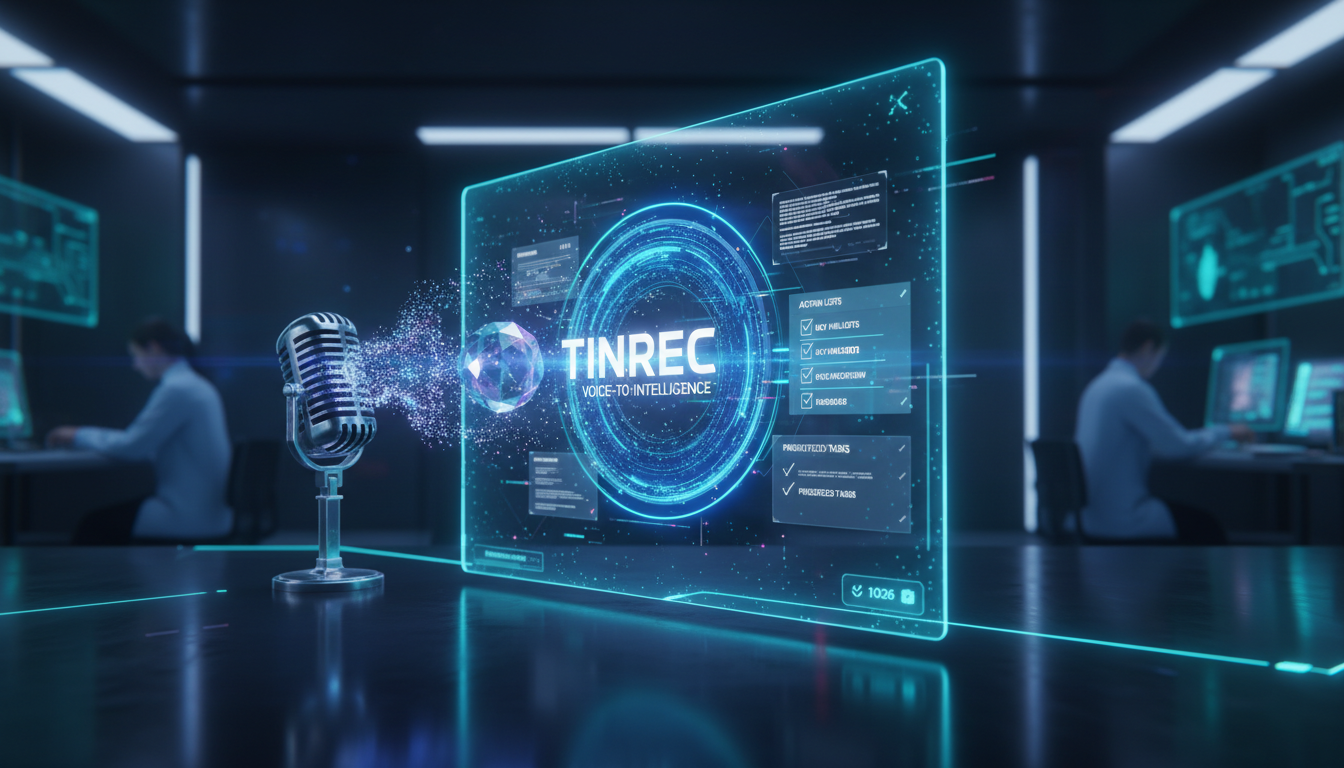
1. Tinrec (Instant Recording): An All-in-One Assistant Evolving from "Transcription" to "Understanding"
If you want more than just a transcript—you want an AI assistant that truly "understands" your audio—Tinrec (Instant Recording) is the best choice today.
Tinrec's biggest feature is that it unifies the entire workflow of recording → transcription → summary → conversation. Unlike traditional tools that just dump a large block of text, Tinrec supports AI chat queries, allowing you to ask questions about the recording and get precise answers (e.g., "What are the speaker's three conclusions about AI trends in this podcast?").
Additionally, it supports syncing across iOS, Android, and web versions, directly processes YouTube video links or uploaded podcast audio files, and automatically generates meeting minutes and action items—ideal for knowledge workers needing high efficiency.
2. MyEdit: Lightweight Online Editing Choice
MyEdit is a no-download online tool, especially suitable for occasional short audio files. Its strengths are an intuitive interface and rich audio editing features (like noise removal).
- Best for: Short audio to text, subtitle creation for videos.
- Limitations: Limited daily free trial (about 3 minutes) and cannot distinguish speakers, making it less effective for multi-person podcast editing.
3. Yating Transcription: Local Champion for Taiwanese Mandarin
For mixed Mandarin and Taiwanese dialect recognition, Yating Transcription still holds a strong position in the Taiwanese market, offering high accuracy for Taiwanese accents and mixed Chinese-English content.
- Best for: Podcasts or interviews heavy with Taiwanese local terms and Taiwanese dialect.
- Limitations: Relatively slow transcription (1 minute of audio takes about 10 minutes to transcribe), and the summary feature occasionally fails, which may not be ideal for urgent note-taking.
4. Good Tape: Cross-Language Tool for Media Professionals
Created by a Danish media company, Good Tape focuses on journalists and media professionals, supporting over 90 languages.
- Best for: Processing multi-language interview recordings.
- Limitations: Free version processing is very slow (queue waiting), and Chinese content lacks automatic punctuation, requiring extra cleanup.
5. Vocol.ai: Team Collaboration and Note-Taking Tool
Vocol.ai is positioned as a collaboration platform, suitable for internal meeting records and discussions within enterprises.
- Best for: Teams needing to annotate and comment on the same transcript.
- Limitations: Interface and pricing are relatively complex; for individuals simply wanting to organize podcast notes, it may be overly feature-heavy.
6. PowerDirector
Though primarily a video editing software, PowerDirector's built-in "AI Voice to Text" feature is very convenient for video creators, directly generating SRT subtitle files.
- Best for: Video creators simultaneously creating subtitles.
7. cSubtitle
A tool focused on the Chinese market, supporting Cantonese and Mandarin and providing an online editor. Although its features are simpler, it remains valuable for specific language needs.
Stop organizing recordings by hand
Upload audio or video and automatically get a transcript, summary, and action items
Side-by-Side Comparison: Specification Table of 7 Popular Transcription Tools
To help you understand the differences, we've compiled a core specification comparison table:
| Tool Name | Core Advantage | AI Chat Query | Languages Supported | Transcription Speed | Target Users |
|---|---|---|---|---|---|
| Tinrec (Instant Recording) | Real-time audio to text + AI Q&A summary | Supported | Chinese/English/Japanese/Korean/Taiwanese, etc. (10 languages) | Real-time/Very fast | Students, professionals, meeting minutes |
| MyEdit | Convenient online editing, noise removal | Not supported | Chinese/English/Japanese, etc. (9 languages) | Fast | Short video subtitle creation |
| Yating Transcription | Strong recognition of Taiwanese Mandarin/Taiwanese | Not supported | Chinese/English/Taiwanese | Slow | Local Taiwanese interview editing |
| Good Tape | Supports 90+ languages | Not supported | 90+ languages | Slow (free version requires queue) | International news journalists |
| Vocol.ai | Team collaboration and annotation | Not supported | Chinese/English/Japanese | Fast | Enterprise teams |
| PowerDirector | Video editing integration | Not supported | Chinese/English/Japanese, etc. (10 languages) | Fast | YouTubers / Editors |
In-Depth Review: How Tinrec Instant Recording Changes Your Listening Habits
During our tests, we found that the biggest difference between Tinrec and other tools lies in the "way information is accessed."
Most tools (like MyEdit or Yating) produce a "transcript" as the end result, leaving you to read through it to extract key points. But Tinrec's logic is to save you reading time.
1. Real-Time Audio to Text: What You Hear Is What You Get
Tinrec supports real-time audio to text, where text appears line by line as you record. This means while listening to a podcast or attending a class, you don't need to type frantically—just watch the screen and mark key points on the fly.

2. AI Smart Summary and Action Items
For knowledge-based podcasts lasting 1-2 hours, Tinrec can automatically analyze the context and generate "meeting minutes" and "to-do items." This solves the pain point of "listening without action," directly telling you the specific steps suggested by the speaker.
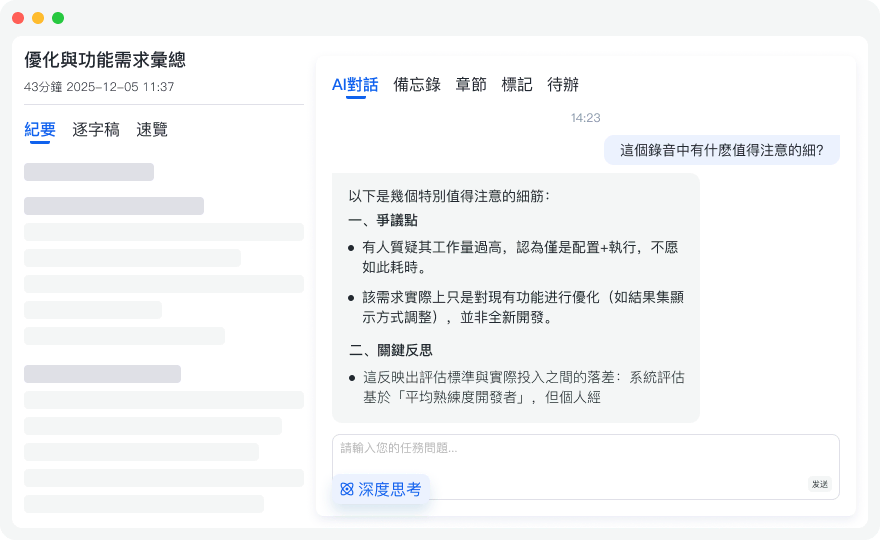
3. Chat with Your Recording (AI Chat)
This is the most impressive feature for our review team. You can use the AI chat query function to directly ask questions. For example: "What are the three SEO tips for 2026 mentioned by the speaker?" The AI searches the entire recording and summarizes the answer for you—far more powerful than traditional Ctrl+F keyword search.
Practical Tutorial: 4 Steps to Turn a Long Podcast into Highlight Notes
Below we use Tinrec as an example to show how to quickly organize a 60-minute YouTube interview or podcast:
Step 1: Import Audio Source
- Live Recording: For live lectures, open the Tinrec app and tap Start Recording.
- File Upload: If you have an MP3/M4A file, use the Audio File to Text feature to upload.
- Web Link: For a podcast on YouTube, simply paste the URL into the Podcast/Online Video to Text interface.
Step 2: Select Language and Start Transcription
Select the main language of the audio (supports Chinese, English, Japanese, etc.), and Tinrec will automatically perform speaker separation and generate a transcript.
Step 3: One-Click Generate AI Summary
After transcription, click the "AI Summary" button. The system will auto-generate structured notes including: full outline, key decision points, and to-do items.
Step 4: Use AI Chat to Dive into Details
After reading the summary, if you're interested in a particular point, switch to the "AI Chat" page and ask for details. For example: "Please list the tools mentioned by the speaker in detail," and the AI will extract relevant content from the transcript to answer you.
FAQ: Podcast to Text Common Questions
Q1: Are there completely free audio-to-text tools? Most tools offer "free trials" or "daily limits." For example, MyEdit provides 3 minutes free per day; Tinrec offers 100 minutes of free recording per month, which is sufficient for light users. For heavy usage, subscription plans are usually more cost-effective than pay-per-minute.
Q2: Can iPhone recordings be directly transcribed to text? While the iPhone's built-in Voice Memos is convenient, it's quite closed off for transcription and export. We recommend using a third-party app like Tinrec that supports iOS; after recording, it transcribes in the cloud and syncs to the web version for editing, making the process much smoother.
Q3: How accurate are the transcripts? Accuracy depends on recording quality and background noise. Generally, in a quiet environment, modern AI tools like Tinrec and MyEdit can achieve accuracy above 95%. Tinrec especially supports mixed Chinese-English recognition, performing better for podcasts with more professional terminology.
Q4: Can I directly convert a YouTube video into text notes? Yes. Tinrec and some tools (like Yating Transcription) support video-to-text. Tinrec's advantage is that you can directly paste a YouTube link for parsing without downloading the video file first, saving the trouble of format conversion.
Q5: How is AI transcription different from ChatGPT? ChatGPT (free version) usually has a single input length or file size limit (about 20-25MB) and lacks professional audio processing engines (like noise reduction, speaker separation). Professional tools like Tinrec are designed specifically for "long audio," capable of handling hours of recordings with timestamp features for easy backtracking.
Q6: How much do transcription tools typically cost? Pricing is mainly divided into "subscription" and "pay-per-minute."
- Subscription: For example, Tinrec Basic is about $4.9/month (600 minutes); MyEdit is about NT$120/month.
- Pay-per-minute: For example, Yating Transcription costs about NT$160 for 60 minutes. In the long run, if you have monthly podcast transcription needs, subscription plans usually have a much lower cost per minute than pay-per-minute.
Turn every recording into actionable outcomes
Get 60 free transcription minutes when you sign in. No credit card required.
Related Reading
You might also like

How to Write English Meeting Minutes in 2026: 6 Sections + AI Auto-Summary
English meeting minutes are not a verbatim transcript. This guide starts with the most common mistakes, then covers the 6 standard sections of meeting minutes, ready-to-use English phrases and tenses, and compares Tinrec, Otter.ai, Granola, and Notta for Chinese-language meetings and post-meeting organization—so you can deliver usable minutes in half an hour.

4 Free Meeting Notes Tools Tested: Which Free Tier Actually Works? (2026)
Many free meeting notes tools exist, but 'free' means very different things. This article cuts through common misconceptions and compares Tinrec, Otter.ai, Notta, and TurboScribe on free quotas, Chinese recognition, and post-meeting organization to help you find the one that truly saves time.

2026 Meeting Minutes Action Items: 4 Free Tools Compared
Your English meeting minutes look great, but no one takes action afterward? The problem usually isn't the English—it's the action items section. This guide covers practical English phrasing for action items, assigned tasks, deadlines, and resolutions, and compares four meeting-notes tools with free plans: Tinrec, Otter.ai, Notta, and Granola. Includes free-tier limits, key buying criteria, and common pitfalls to avoid.

How to Write Meeting Minutes in English: Standard Format & Key Phrases (2026 Guide)
Learn how to write English meeting minutes: correct terminology, a 12-item standard format, resolutions and past-tense action verbs, plus a hands-on tool test and comparison of 3 alternatives. Master English meeting minutes in one guide.

5 Meeting Transcription Tools Tested for 2026: Which Free Version Is Enough?
Spending two hours after a meeting organizing notes? This article compares Tinrec, Otter.ai, Notta, and Granola based on real-world usage, covering recording methods, transcript quality, post-meeting organization, and free tiers to help you find the one that fits your workflow.

5 Meeting Minutes Templates Tested for 2026: Which One Actually Tracks Action Items?
We break down 5 common meeting minutes templates (general meetings, board meetings, project stand-ups, client meetings, remote/asynchronous) and explain the required fields and best use cases for each. We also show how Tinrec's real-time transcription, AI summaries, action item extraction, and team spaces turn templates from manual forms into post-meeting outputs. Includes FAQs and selection tips.

Free AI Meeting Notes in 2026: How to Choose Free Tiers + Summaries & Action Items in One Go
How to choose a free AI meeting notes tool? Instead of comparing who offers the most minutes, look at the real limits of free tiers, Chinese and mixed Chinese-English recognition, how online meetings are captured, and whether summaries and action items can be generated afterward. This article uses 5 key criteria to help you pick the right tool, and demonstrates with Tinrec the complete workflow from recording to transcription to team knowledge retention.

How to Take Sales Meeting Notes in 2026: Tinrec Bot-Free Recording + Automatic Post-Meeting Organization
Sales meeting notes aren't just about transcribing every word. This article starts with common pitfalls and walks you through pre-meeting preparation, meeting recording, post-meeting summaries, and action items. It also compares Tinrec and Otter.ai on Chinese sales meetings, bot-free recording, post-meeting organization, and team knowledge retention.

3 Sales Meeting Notes Formats Tested for 2026: AI-Generated Minutes and Action Items Save the Most Time
Sales meeting notes aren't just about filling out a form—they capture customer needs, objections, commitments, and next steps. This article starts with the common mistake of "filling in the form after the fact," breaks down what should be recorded in sales meeting notes, compares three formats in real-world tests, and shows how Tinrec can generate transcripts, summaries, and action items in real time during the meeting. It ends with a buying checklist and FAQs.