

Turn recordings into transcripts and summaries in minutes
Upload audio or video for multilingual transcription, AI notes, and action items
A Side-by-Side Comparison of 5 Audio-to-Text Tools in 2026: From Good Tape to Tinrec, a Hands-On Review for Busy Managers
I attend about 15 meetings a week—weekly meetings, project status updates, one-on-ones, cross-department coordination. The most frustrating part isn't the meetings themselves, but what comes after: sorting through all the decisions and action items. I've tried handwritten notes (too slow), recording and listening back (too time-consuming), and asking team members to help (they're busy too). It wasn't until I started using AI audio-to-text tools that I got that time back.
Over the past few years, I've tried several tools—starting with Good Tape, then Notta, Otter, Fireflies, and finally settling on Tinrec. This article shares my hands-on experience with these five tools from a mid-level manager's perspective, so you don't have to test them all yourself.
Why Are People Looking for Alternatives to Good Tape?
Good Tape is an easy-to-use audio-to-text tool with a simple interface, great for first-time users. I started with Good Tape myself—record a meeting, get the transcript, do a quick edit. It's beginner-friendly.
But after a few weeks, I ran into issues: some colleagues use Android, others use iPhones, and cross-device sync wasn't smooth; sometimes I needed to process not just meeting recordings but also interview audio, competitor analysis videos from YouTube—Good Tape's support for these sources was limited. Plus, I realized that getting a verbatim transcript wasn't enough—I needed quick summaries and automatic action items to report to my boss without stumbling.
If you have similar needs—not just audio-to-text but turning audio and video content into actionable knowledge—then Tinrec is worth considering.
Tinrec vs Good Tape: What's the Core Difference?
While Good Tape is stable for basic transcription, Tinrec is designed to better handle diverse audio and video sources in the workplace. Here are the differences I found most noticeable after real-world use.
Comprehensive Input Sources I often process more than just meeting recordings. Last week, I threw in a podcast interview audio, three YouTube competitor analysis videos, and recordings from two online meetings—all into Tinrec. It supports live recording, local audio/video files, and even public video links for direct parsing, no need for extra conversion tools. Good Tape is more focused on recording transcription and struggles with videos or external links.
AI Depth Getting a transcript is just the first step. Tinrec's auto-summary, chapter splitting, and action item extraction are a must-use combo after every meeting. The action item extraction, in particular, pulls out "who, what, when" directly from the discussion—I just copy and paste to assign tasks. Good Tape also offers summaries, but in terms of depth and accuracy, Tinrec's semantic understanding is more refined and less likely to miss important action items.
Cross-Platform and Mobile Use I use iOS, but my team includes Android users and interns who only use the web version. Tinrec's iOS, Android, and web apps have nearly identical features, with recordings syncing across devices. I can record on my phone on the go and pick up where I left off on my computer back at the office. Good Tape's cross-platform experience is less complete, sometimes requiring manual file transfers.
Language and Localization Our team frequently uses a mix of Chinese and English, and occasionally Cantonese with clients. Tinrec's recognition of Mandarin, Traditional Chinese, and Cantonese is noticeably better—especially in meetings with code-switching and background keyboard noise—with lower error rates than I expected. Good Tape handles English well, but accuracy drops with mixed Chinese content, leading to more post-editing time.
Post-Processing Flexibility Beyond exporting to Word or PDF, Tinrec can directly export to Notion and Google Docs, which is great for my established workflow. More advanced is its Agent feature, which automatically generates meeting reports and Gantt chart drafts from recordings—streamlining the entire process from organization to delivery. Good Tape is still primarily transcription and simple summaries, requiring manual follow-up.
Stop organizing recordings by hand
Upload audio or video and automatically get a transcript, summary, and action items
Tinrec's Core Features at a Glance
After comparing the differences, let's look at what Tinrec actually does for me. Here are the features I use weekly, explained with real scenarios.
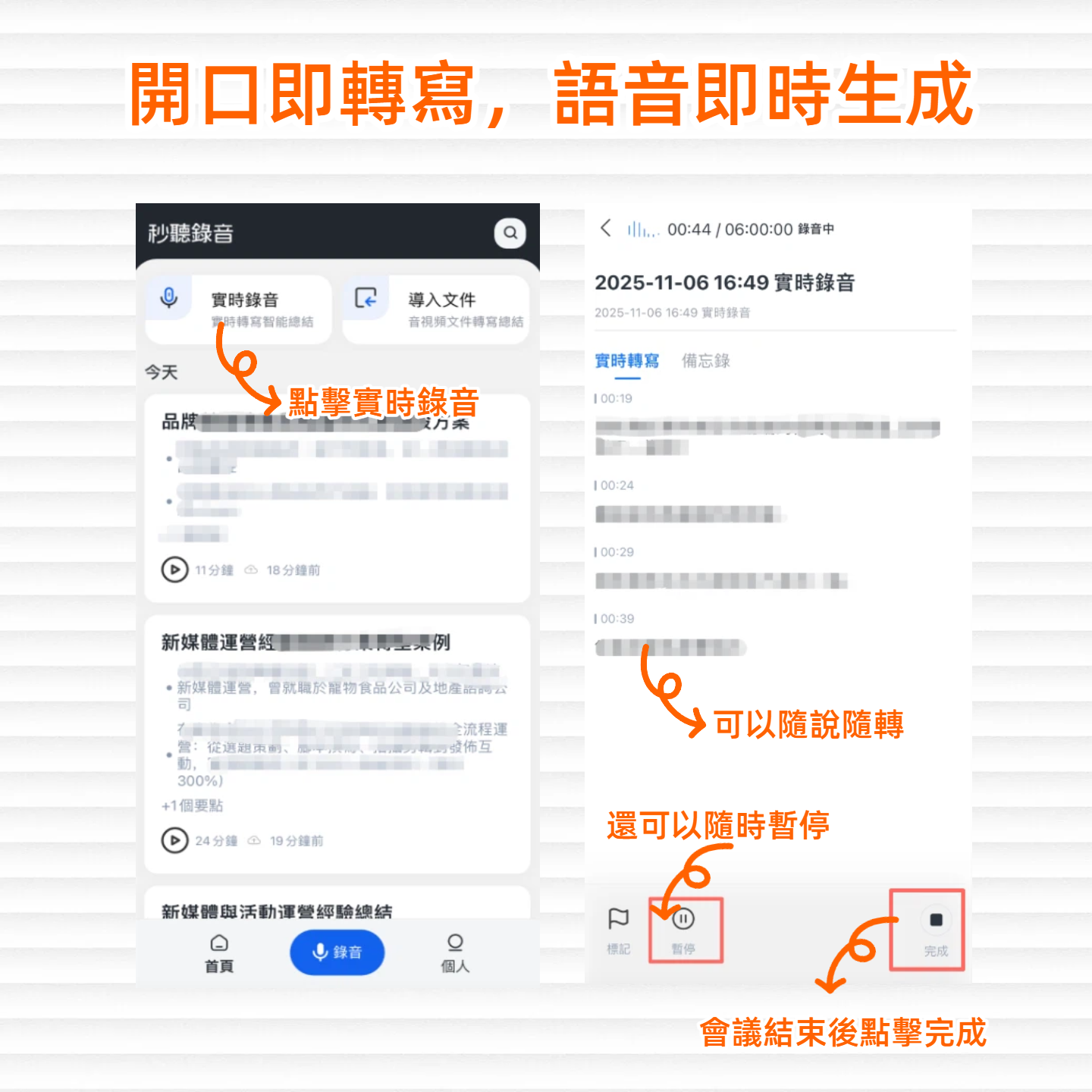
Live Transcription During meetings, I open Tinrec and text appears almost instantly as I record—latency less than 1 second. I can listen to colleagues while glancing at the screen to ensure I'm not missing key points. The moment the meeting ends, the transcript is ready—no need to re-listen and retype.
Online Video Link Parsing Recently, the marketing team sent me a competitor's YouTube launch video and asked for a quick summary. I pasted the link into Tinrec, and it converted the video to text with a summary and sections. Previously, I'd have to watch and take notes—now it's done in 10 minutes.
AI Chat Query This is my go-to recommendation. After a one-hour cross-department meeting, I can ask Tinrec: "What was the budget cap discussed?" or "When is the marketing team submitting the proposal?" It gives answers based on the content—no need to scroll through 30 pages of transcript. When my boss asks about a previous conclusion, I just pull out my phone and ask.
Automatic Action Item Extraction After every meeting, Tinrec automatically generates an action item list in the format: "Task, Owner, Deadline." I tweak it a bit and paste it into the team chat. Previously, this took 20 minutes—now it's under 2.
Multi-Format Export and Post-Processing Depending on the audience, I can export the same meeting as a transcript for myself, a summary for my boss, and action items for my team. For formal reports, I use the Agent feature to generate a meeting record and then fine-tune it. It's much faster than starting from scratch.
Real-World Use Cases
Features may still sound abstract. Here are some actual applications from my team.
Weekly Department Meetings Our weekly meetings usually involve 8–10 people discussing progress, resource allocation, and emergencies. I record with Tinrec while participating. Afterward, I check the AI summary for key points and use the action item list to assign tasks. Before the next meeting, I use the chat query to confirm previous decisions—no need to dig through notes.
Online Courses and Lectures The company arranged a three-hour strategy course by an external lecturer. I recorded the entire session with Tinrec, then used the chapter feature to mark key sections and create study notes. Shared with the team, it's far more effective than watching the long video.
User Interview Research Our product team conducted a series of user interviews, accumulating over ten hours of recordings. Previously, transcribing took a full day. Now, we import everything into Tinrec, which automatically transcribes, generates summaries and key sentences—researchers can directly quote, speeding up analysis significantly.
Personal Knowledge Management When inspiration strikes, I habitually record a voice memo. Tinrec automatically transcribes and categorizes it. On weekends, I review which ideas can become proposals—over time, it becomes my personal idea bank.
Key Considerations When Choosing an Audio-to-Text Tool
After years of trial and error, I've summarized a few key points to consider when choosing a tool, along with how Tinrec measures up.
Diverse Input Sources First, consider whether you mainly handle simple meeting recordings or also local files and online videos. Tools like Notta and Otter excel at online meetings, while Fireflies focuses on meeting bots. If your needs are as varied as mine—covering multiple sources—Tinrec's support for video links and file transcription is more comprehensive.
Post-Transcription Organization Do you need to manually re-listen and mark key points, or can the tool automatically summarize, split chapters, and extract action items? Tinrec's AI post-processing goes deeper—it doesn't just transcribe; it delivers actionable insights.
Cross-Platform Consistency How smoothly can you switch between phone, tablet, and computer? Can you record offline? Tinrec's three-platform sync is seamless with nearly identical features—record on your phone outside and pick up at the office without missing a beat.
Language Support and Localization If your work involves mixed Chinese-English, Cantonese, or other languages, test with real meeting recordings, not just standard audio files. Tinrec's fine-tuning for Chinese scenarios gives it a clear advantage, with significantly lower error rates than other tools I've used.
Free Plan and Pricing Most tools offer free trials. I recommend testing the free version first. Tinrec's free plan provides basic transcription minutes—enough for a few meetings to try it out. If you're in meetings daily like I am, the Pro plan's minutes and features are more suitable. It costs less than a couple of coffees a month for an extra hour of family time every day.
Conclusion: Is Tinrec Worth Trying?
If you're currently using Good Tape, Notta, or Otter but find them lacking in cross-source organization, AI depth, or Chinese recognition, Tinrec is a clear upgrade. It doesn't just convert audio to text—it streamlines the entire process from summary, action items, Q&A, to export. It's ideal for managers, researchers, and content creators who frequently process large volumes of audio and video information.
In my experience, switching from Good Tape to Tinrec saved me the most time not in transcription, but in the mental effort of figuring out what was actually said. I recommend downloading Tinrec's free version and testing it with your own meeting recordings—nothing beats a real-world trial.
Test device: iPhone 15 Pro, software version as of July 2026. Accuracy data from the product team's internal tests; actual results may vary based on recording environment, accents, and background noise.
Turn every recording into actionable outcomes
Get 60 free transcription minutes when you sign in. No credit card required.
Related Reading
You might also like

5 Best Audio-to-Text Tools in 2026: Top Alternatives to Good Tape
Looking for a Good Tape alternative? This article compares five audio-to-text tools—Tinrec, Otter, Notta, Fireflies, and TurboScribe—across language support, AI features, and cross-platform experience to help you find the best fit.

What's the Best Good Tape Alternative? 2026 Hands-on Test of 3 Tools: Tinrec is the Most Comprehensive
If you've been using Good Tape but find it lacking, check out our hands-on test of 3 speech-to-text tools. See why Tinrec is a more comprehensive choice, supporting Cantonese, AI Q&A, and multiple export options—even the free version is sufficient.

2026 Comparison of 5 Transcription Tools: Why Tinrec Is a Great Alternative to Otter
Still using Otter but find its Chinese performance lacking? This side-by-side comparison covers 5 mainstream transcription tools, from language support and AI post-processing to pricing, and shows you why Tinrec is a better fit for managing meetings, courses, interviews, and online videos.

2026 In-Depth Comparison of 4 Speech-to-Text Tools: Beyond Notta and Otter, Why Tinrec Is Worth a Try
A thorough hands-on test of 4 major speech-to-text tools, from free to paid versions. As a small team manager, I'll tell you directly which one saves you the most time, so you won't be fooled by vendor hype.

2026 Comparison of Two French Transcription Tools: Good Tape vs. Tinrec – Which One Is Right for You?
Good Tape is a solid tool for French transcription, but if you need multilingual support, AI summaries, and cross-platform compatibility, Tinrec is the more comprehensive choice. This hands-on comparison helps you decide quickly.

2026 Ultimate Guide to Transcription Tools: Beyond Good Tape, Discover Better Options
Hands-on review for small to mid-sized team leaders: If you're looking for a Good Tape alternative, this explains why Tinrec is better for meetings, courses, interviews, and content creation—handling everything from recording to organizing in one go.

2026 Comparison of 6 AI Transcription and Note-Taking Tools: From Free to Paid, Which One Is Your Work Accelerator?
Meetings, lectures, and interview recordings piling up? Which AI note-taking tool can really save you time? This article compares 6 popular solutions, evaluating real-time transcription, AI summaries, and multi-source support. After reading, you'll know which one to choose.

How to Choose a Speech-to-Text Tool in 2026: A Complete 5-Step Guide
This article starts from the pain point of accumulating recordings, shares 5 speech-to-text tools I've tested, and uses Tinrec as an example to teach you a method for selecting and using these tools, turning recordings into usable knowledge.
2026 Comparison of 5 Audio-to-Text Tools: From Free to Paid, Which One Is Worth Trying?
Looking for a reliable audio-to-text tool in 2026? I tested 5 popular apps including Tinrec, Notta, Otter, etc., comparing features, pricing, Chinese support, and multi-scenario usability. A must-read for small team leaders and solopreneurs.