

Turn recordings into transcripts and summaries in minutes
Upload audio or video for multilingual transcription, AI notes, and action items
Last semester, I took a Korean literature elective to boost my chances for an exchange program. The professor talked fast, often mixing Chinese and Korean, and I couldn't keep up with the notes during two-hour lectures. Before midterms, I borrowed a classmate's notes, but their handwriting was harder to read than Korean. I almost failed. That's when I seriously started looking for Korean speech-to-text tools—I tried several apps and finally settled on two. This article shares my firsthand experience comparing Tinrec and Notta from a student's perspective, helping you save time and effort.
Tinrec vs Notta – Quick Overview
Both tools can transcribe Korean audio to text, but their strengths differ.
- Notta: Known for multilingual transcription and subtitle features, it has a good reputation and is often a starter choice for international students.
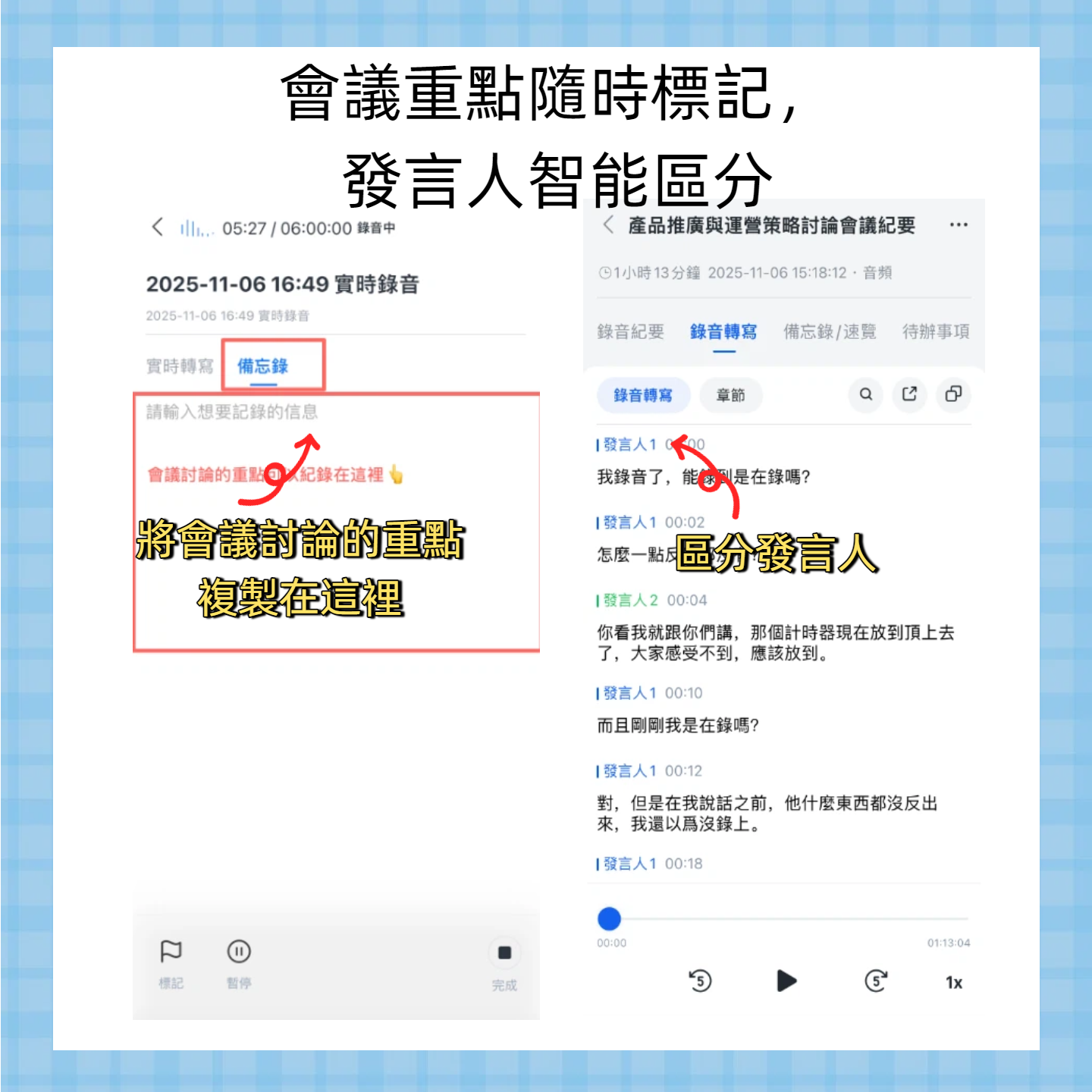
- Tinrec: More of an "audio-video organization workbench." After transcription, it auto-generates summaries, chapters, to-do lists, and lets you chat with the AI about the content—not just a plain transcript.
| Tinrec | Notta | |
|---|---|---|
| Korean Transcription | Supported (multilingual, handles Chinese-Korean mixing) | Supported (multilingual model) |
| Student Plan | Free tier includes monthly base minutes; Pro starts at ~NT$150/month | Free tier: 120 minutes/month; Pro annual ~NT$270/month |
| Platforms | iOS, Android, Web | iOS, Android, Web |
Below I compare them across the five dimensions students care about most.
Dimension 1 – Language Support & Transcription Quality
Korean users fear one thing most: when the speaker mixes in English or multiple people talk over each other.
Notta's multilingual model performs well in a clean environment, but when background noise or Chinese-Korean mixing is present, some words drop out or turn into garbled Korean-English code. I tested both tools with the same Korean news recording (iPhone 14, recorded from the back of a classroom, October 2025). Notta's accuracy was okay, but it stumbled on proper nouns.
Tinrec doesn't loudly advertise "Korean-specific" features, but in practice, it handled Chinese-Korean mixed content better than I expected. Its model supports multiple languages, and the transcript readability is decent, with an acceptable error rate. Both tools handle basic needs under ideal recording quality, but in real student scenarios (non-studio environments), they're about the same.
→ This dimension: Tie, but Tinrec is slightly more reliable in classroom settings with mixed languages.
Dimension 2 – AI Summary & Chapter Organization
After getting a transcript, can you quickly find the key points? That's what students really need.
Notta offers a basic summary feature, but when the text is long, it often just pulls a few opening sentences and doesn't reflect the full structure. I tested a one-hour Korean lecture with Notta, and its summary only covered the first 20 minutes, omitting the rest.
Tinrec's auto-summary and chapter splitting are its strengths. On the same lecture, it produced not only a full summary but also divided the transcript into chapters like "Course Introduction," "Grammar Points," "Conversation Practice," and "Homework Assignment." I could jump directly to the section I needed. This is incredibly useful for exam review—no need to skim through the entire audio file; you can spot the key parts at a glance.
Stop organizing recordings by hand
Upload audio or video and automatically get a transcript, summary, and action items
→ This dimension: Tinrec wins, especially for students who need structured notes.
Dimension 3 – AI Conversational Search
After recording tons of Korean audio, can you simply ask "What's the scope of Friday's quiz?"
Notta's AI features are basic; once transcription is done, you can't continue a conversation or ask questions about the content. You have to manually search for keywords.
Tinrec has built-in AI conversational search. You can ask questions about the recordings, and it retrieves relevant passages. During finals, I uploaded all semester's lecture recordings into Tinrec and asked, "What are the format requirements for the final report?" It instantly jumped to the 30-second clip containing the answer, with the original text and timestamp. That's much faster than flipping through Notta entry by entry.
→ This dimension: Tinrec wins big. This feature is a lifesaver before exams.
Dimension 4 – Multi-Source Input
College students don't just record lectures; they also need to process YouTube Korean tutorials, online meetings, and audio files from classmates.
Notta focuses on meeting and file transcription, with limited support for online video links. You can import files, but there's no direct "paste YouTube link to transcribe" feature—you have to download the video first and then upload it, adding an extra step.
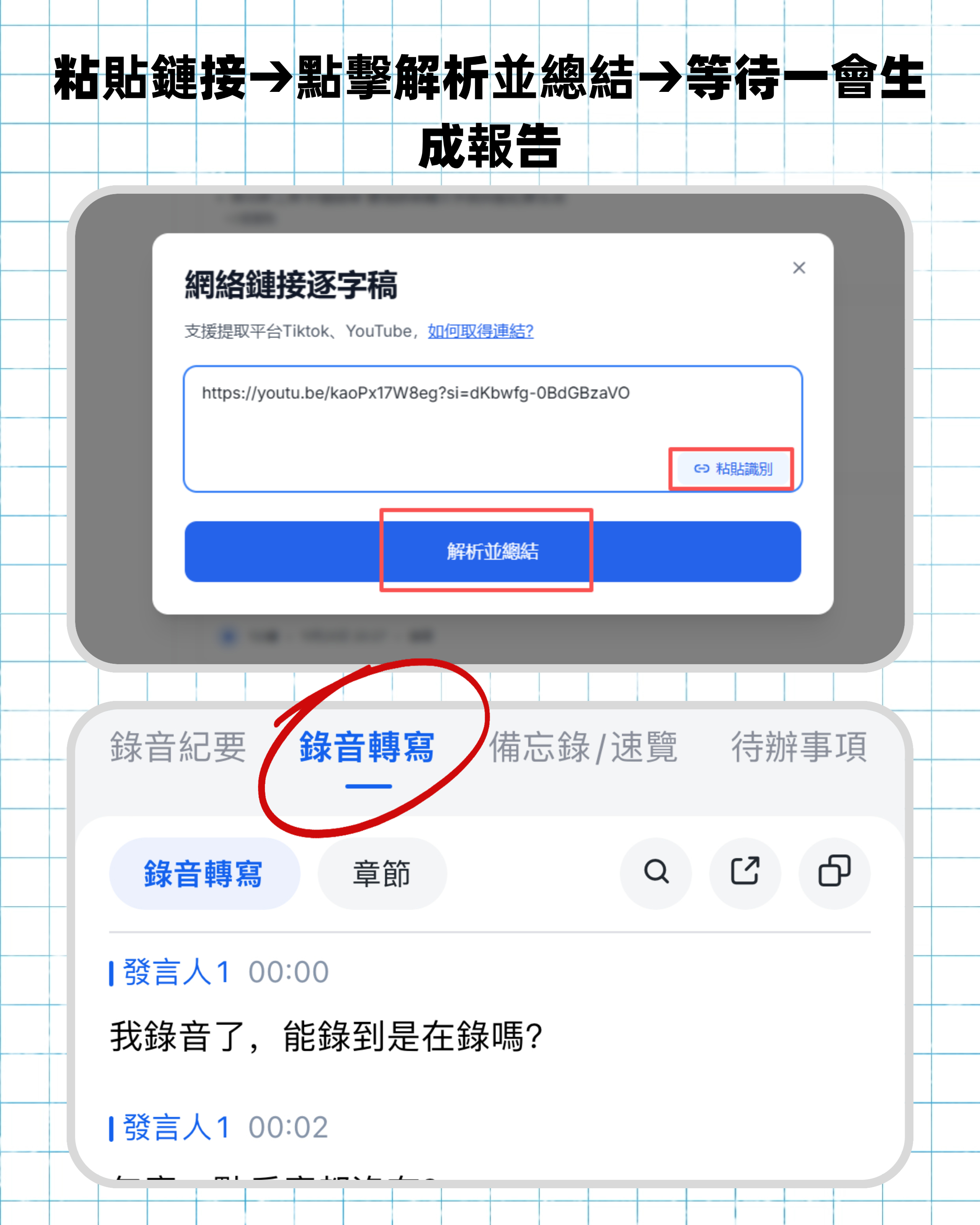
Tinrec supports pasting online video links directly (YouTube, Bilibili, Xiaohongshu, etc.), and even Korean vlogs can be turned into text and summaries. It also records computer system audio. When I take online Korean tutoring via Zoom, I just start Tinrec, and as soon as the session ends, I get the transcript and key points. This "all-comers welcome" design is super convenient for students who have to digest materials from various sources.
→ This dimension: Tinrec wins, offering broader source support and more flexibility for cross-platform learning.
Dimension 5 – Pricing & Student Plans
With a part-time job earning just over NT$10,000 a month, I have to be careful with paid tools.
Notta's free tier gives only 120 minutes per month, which a two-hour Korean lecture eats up most of. The Pro annual plan works out to about NT$270 per month, which still feels a bit heavy for a student without steady income.
Tinrec's free tier also comes with basic minutes, enough for a few lectures. If you're like me and have about three key lectures a week that need recording, the free tier just barely covers it. Around midterm or finals, you can buy a weekly card (cheaper than a Starbucks coffee) to boost your quota. The Pro monthly plan converts to about NT$150 per month—skip two late-night snacks and you've got it. Plus, it includes AI conversation and online video parsing that Notta doesn't have.
→ This dimension: Tinrec wins, with a more generous free plan and more student-friendly paid options.
What Unique Advantages Does Each Have?
Tinrec's Unique Advantages
- Post-transcription capabilities: Not just a transcript—auto-summary, chapter splitting, to-do lists—saving you tons of note-taking time.
- AI conversational search: Ask about the recording content like you would a classmate; great for quickly finding exam focus points.
- One-click transcription of online videos: Paste a link to turn a Korean YouTube video into text—super handy for self-learning.
- Student-friendly flexible plans: The free tier includes basic transcription and AI features; when you need more, buy short-term cards without being locked into a monthly subscription.
Notta's Unique Advantages
- Full translation features: If you need simultaneous transcription and translation into multiple languages, Notta's translation workflow is smoother.
- Team collaboration: If your group needs to co-edit meeting notes, Notta's sharing permission settings are more granular.
Conclusion: Which Should You Choose?
After using both for a semester, I truly believe the choice of a speech-to-text tool boils down to whether you just want a clean transcript, or you want to turn recordings into reusable learning resources.
- If you only need a clean Korean transcript and don't care about post-processing → Notta's basic transcription is enough.
- If you want to record, then use AI to summarize, ask questions, and organize notes → Tinrec is the more complete choice.
- If you often watch Korean YouTube videos to learn the language and want to convert them to text → Tinrec's direct link feature will save you lots of time.
- If your budget is tight and you hope the free tier can handle occasional lecture recordings → Tinrec's free quota is more student-friendly, and the paid entry point is lower.
In short: for most students dealing with Korean recordings, Tinrec offers greater overall value. I recommend starting with the free version, testing it with your own lecture recordings, and if you like it, consider a weekly or monthly card. If you just want to dip your toes, Notta can handle basic needs.
Turn every recording into actionable outcomes
Get 60 free transcription minutes when you sign in. No credit card required.
Related Reading
You might also like

2026 Complete Guide to Speech-to-Text: Features, Use Cases, and Tool Selection
As a senior college student, I used speech-to-text tools for an entire semester to organize lecture notes, group discussions, and YouTube study videos. This guide introduces you to Tinrec, from core features to real student scenarios, showing how AI turns audio and video into actionable knowledge.

2026 Free Speech-to-Text Solutions: 2 Tools Compared
A mid-level manager puts two popular free speech-to-text tools—Tinrec and Otter.ai—to the test, comparing Chinese accuracy, free tiers, AI features, and cross-platform support to help you pick the best one for workplace productivity.

2026 Tinrec Voice-to-Text Tutorial: No Hardware Needed, AI Organizes from Multiple Sources
How to choose voice-to-text software? This article compares Tinrec and Plaud Note, from hardware requirements, input sources, AI features to pricing, and tells you why you don't need to buy a voice recorder — your phone can handle meetings, lectures, and online video transcription.

2026 Hands-On Comparison of 5 Cross-Border Meeting Note Apps: Which AI Summary Saves the Most Time?
Dealing with cross-border meetings daily, mixing English, Mandarin, and Cantonese? Still transcribing recordings after meetings? We test 5 transcription apps to see which one can quickly organize multilingual meetings, saving you time and overtime.

2026 Free Chinese-English Real-Time Translation Solutions: 3 Tools Compared
A must-read for professionals: hands-on testing of Chinese-English real-time translation tools. From cross-border meetings to self-study, Tinrec not only translates in real time but also transcribes audio and generates AI summaries, truly solving the pain points of middle managers.

2026 Tinrec vs Otter.ai: 5-Dimension PK – Which Is Better for Chinese Transcription?
Looking for a great speech-to-text app? This article compares Tinrec and Otter.ai across 5 dimensions: Chinese transcription accuracy, extra organization features, pricing, input sources, and target users. It also covers alternatives like Notta, TurboScribe, and PLAUD to help you find the right tool quickly.

How to Choose a Multilingual Speech-to-Text Tool in 2026: A 5-Step Guide
Cross-border team meetings often mix English and Chinese, and a simple English transcription tool fails when it hits Chinese. After using Otter.ai for two years and switching to Tinrec, here's a 5-step guide to choosing the best multilingual speech-to-text solution, covering accuracy, translation, input sources, AI post-processing, and pricing.

2026 Comparison: 3 Transcription Apps Tested – Which AI Summary Actually Saves Time?
We tested three popular voice-to-text apps—Tinrec, Otter.ai, and Notta—comparing language support, cross-platform capabilities, AI summaries, and free plans to help you find the best time-saving tool for Chinese users.

2026 Tinrec vs Notta: 5-Dimension Comparison – Which Is Better for Students in Real-Time Chinese-Japanese Translation?
From a college student's perspective, this article compares Tinrec and Notta across five key dimensions in real-time Chinese-Japanese translation scenarios, including translation accuracy, post-meeting organization, free quota, cross-platform convenience, and AI value-added features, helping you decide which tool is more suitable for classroom and everyday translation needs.