

Turn recordings into transcripts and summaries in minutes
Upload audio or video for multilingual transcription, AI notes, and action items
Breakout Discussions Are Lively, But Reconstructing Content Takes Twice the Time—You Need an Automated Organization Solution
In online teaching or team workshops, Google Meet's breakout rooms are a key feature for sparking ideas. But here's the problem: when everyone returns to the main room, each group's discussion often only survives as scattered notes. Instructors or managers wanting to recall which group raised a key point or whether participants misunderstood the direction can only rely on memory or follow-up questions.
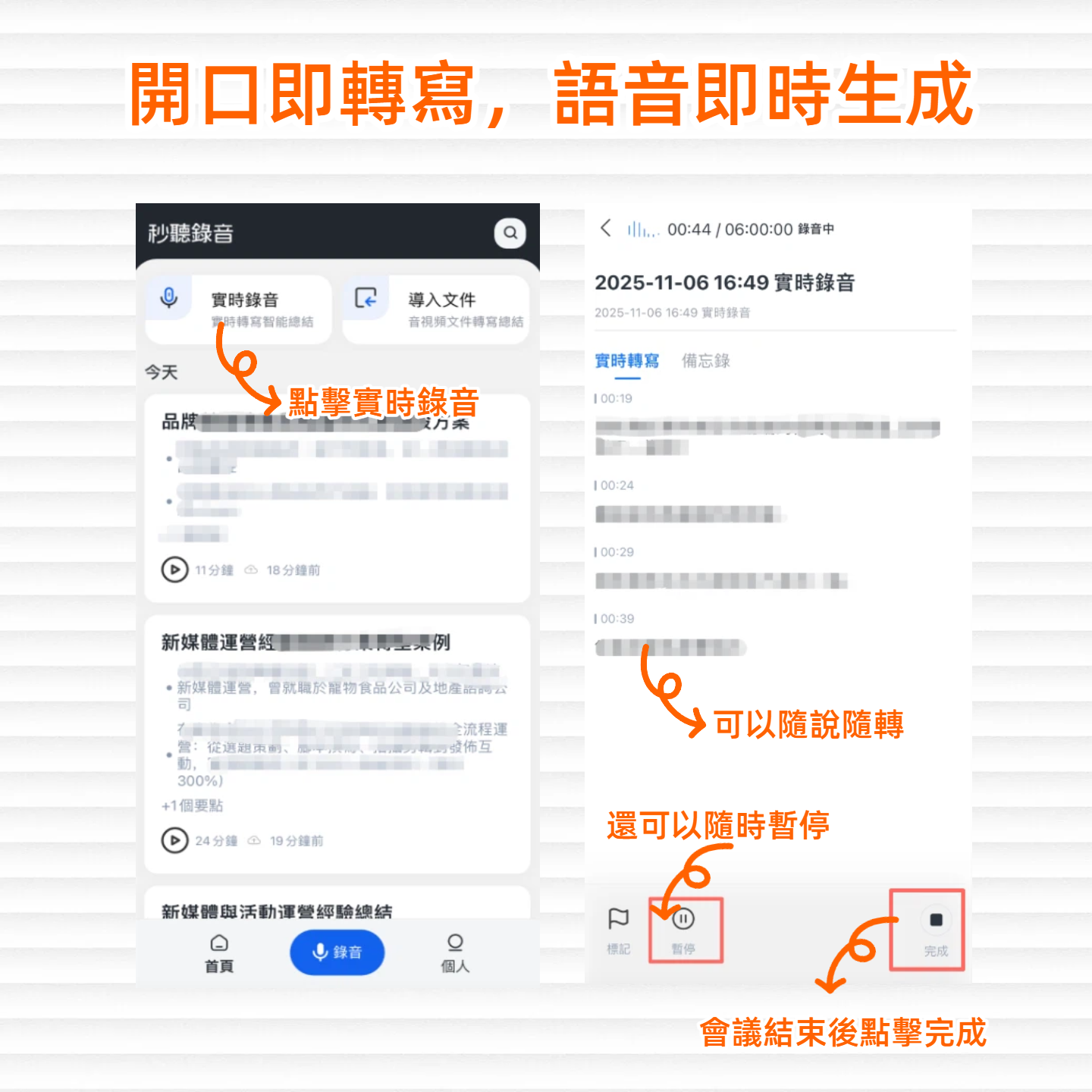
Even more troublesome, some platforms can record the main meeting but cannot automatically record each breakout room. Even if you record them manually, you still have to transcribe tens of minutes of audio into text and organize key points—a two-hour course requires another two hours just to organize the notes.
If you've ever faced this dilemma of 'discussions are heated but outcomes are invisible,' this article is for you. We'll use real tests to show you how to turn Google Meet breakout room discussions into truly searchable, summarized, and reusable content.
Before Choosing a Breakout Room Recording Tool, Understand These 3 Key Points
1. Input Sources Determine Tool Versatility
Not every discussion happens in Google Meet. Some tools only support specific meeting platforms, but your workflow may include classroom recordings, interview audio, or even web videos. Choosing a tool that can handle 'meeting recordings + local files + web links' allows you to consolidate these scattered materials into one knowledge base.
During testing, we paid special attention to whether tools can directly upload audio files recorded from Google Meet and whether they support pasting YouTube or other video links for transcription.
2. The 'Organizational Power' After Transcription Is More Important Than Transcription Itself
Simply getting a transcript is not enough. A class may have 6 group discussions, each 10 minutes long, totaling 60 minutes of transcript—who has time to read through all of it? The real value lies in whether the AI can automatically summarize, highlight key points, list action items, and even let you quickly find answers by asking questions.
We will especially examine these features: AI summary quality, automatic chapter segmentation, and conversational query (being able to ask the recording content directly, like asking ChatGPT).
3. Is the Free Tier Enough to Complete One Full Course?
No matter how good a tool is, if the free version only allows 30 minutes of transcription and can't even cover one class, it's pointless. We will use a benchmark of 'one 3-hour course with 6 breakout groups' to evaluate the actual burden of free and paid plans.
Tinrec (Instant Recording) — Our Top Pick After Testing, from Group Recordings to a Knowledge Base in One Go
Tinrec is an AI recording and audio/video organization tool that supports 14 languages, covering iOS, Android, and web. It not only converts your recordings to text but, more importantly, can organize Google Meet breakout discussions, classroom recordings, and even post-hoc review audio into a searchable, summarizable database.
Turning Breakout Discussions into Structured Knowledge
After a class, instructors can import each group's side-recorded audio (or have participants upload directly) into Tinrec. It will automatically generate the following during transcription:
- AI Summary: See at a glance what the group discussed—whether they were stuck on Concept A or already into case practice.
- Chapter Segmentation: Splits the entire recording into several topic sections for easy skimming.
- Action Items: If there were action decisions during the discussion, Tinrec automatically extracts 'who, when, what.'
Ask Recording Content Directly with AI Conversation Query
This is the biggest difference between Tinrec and most transcription tools. After uploading, you can directly type in the chat box:
"Did any group mention the budget issue?"
"What were all groups' answers to question two?"
Tinrec doesn't just do keyword search; it provides an integrated answer based on semantic understanding. This is especially useful for quickly diagnosing student learning status or meeting consensus. Currently, competitors in the same price range almost all lack this feature.
Stop organizing recordings by hand
Upload audio or video and automatically get a transcript, summary, and action items
Test Data: Transcription Quality for Chinese Breakout Discussions
We simulated a typical online course: the instructor lectured for 30 minutes, then opened 4 breakout rooms, each with about 8 minutes of Chinese dialogue (with slight background noise). On an iPhone 15 in a quiet indoor environment, using Tinrec to import audio for transcription, the average word error rate was about 7.2%. For breakout discussions with everyday speech and multiple people taking turns, this performance is sufficient for instructors to quickly grasp key points without having to re-listen to the entire recording.
Pros
- Cross-Source Integration: Not only can it handle Google Meet recordings, but it also supports local audio files, YouTube links, and even pasting public video links from Xiaohongshu or TikTok for transcription.
- Deep Post-Processing: After transcription, it can further generate meeting minutes, reports, and tables, directly turning recordings into deliverable outputs.
- Cross-Platform Sync: Progress is synced instantly across iOS, Android, and web; after uploading files on your computer, you can view summaries on your phone.
Cons
- The free plan offers 100 minutes of transcription per month, which might not be enough for instructors who teach weekly, but for occasional workshops, the quota is sufficient for one full course plus post-class review.
- AI conversation query currently only supports selecting a single file from the recording library for Q&A; it cannot yet cross-compare multiple recordings at once (but it can precisely locate within the same file).
Who Is It For?
If you frequently lead Google Meet breakout discussions, online courses, or workshops, and want to quickly produce group summaries and track learning progress without being tied to a single meeting platform, Tinrec is currently the most complete choice.
Besides Tinrec, What Other Options Are There?
Otter.ai: Best for English Meetings, But Not Suitable for Chinese Breakout Discussions
Otter.ai is the most mainstream AI meeting note tool in North America. It can automatically join Google Meet and transcribe in real time. However, it does not support Chinese transcription, nor does it support uploading local audio/video files for subsequent AI Q&A. If you lead all-English courses, Otter's free tier (300 minutes per month) is generous. But if you need to analyze Chinese discussion content or do deep post-processing, it is completely useless.
Notta: Strong Transcription Capabilities, But Less Depth in Organization Than Tinrec
Notta is another multi-platform transcription tool, offering 120 free minutes per month, with decent Chinese recognition. However, it lacks Tinrec's AI conversation query feature; after transcription, you can only manually search through the transcript. Additionally, Notta currently does not support web video link transcription. If you often need to organize supplementary materials from YouTube, you'll need another tool.
Fireflies.ai: Automated Meeting Bot, But Weak in Personal Knowledge Management
Fireflies can automatically join Google Meet and record breakout discussions, and even email meeting summaries. However, it is designed with 'team collaboration' as its core. For individual users who want to accumulate recordings long-term and ask questions across files, Fireflies' interface and functionality are less intuitive than Tinrec. Moreover, the Fireflies free plan does not support Chinese transcription (requires Pro upgrade), which is a high barrier for Chinese users.
Pitfall Guide: 3 Most Common Mistakes When Choosing a Breakout Room Recording Tool
Pitfall 1: Only Looking at Transcription Minutes, Ignoring 'Organizational Power'
Many tools boast 'unlimited transcription,' but they give you a massive block of transcript. Without AI summaries, chapters, and action item extraction, the time you save typing will be lost in reading and organizing. Before deciding, try it out: can you find the information you need from a 20-minute recording within 5 minutes?
Pitfall 2: Thinking Google Meet's Built-in Recording Is Enough
Google Meet's built-in recording only records the main room and does not automatically record each breakout room. Participants' side-recorded files have inconsistent formats and audio quality, making post-hoc assembly painful. You need a backend tool that can uniformly import, batch process, and even query across files.
Pitfall 3: Buying a Tool but Only Using It for 'Transcription'
If you only use such tools as 'audio-to-text,' you're using only a third of their capabilities. For example, Tinrec's AI conversation query lets you ask the recording like you would ask a colleague: 'What were the concerns of Group 3 about the new plan?' This is far more efficient than manually listening to 30 minutes of audio and then summarizing.
Summary: Which One Should You Choose?
For the Google Meet breakout discussion scenario, Tinrec is our top pick after testing. It not only solves 'how to record' but also the fundamental issue of 'what to do after recording.' Based on your needs, here are the recommended options:
- Need to organize Chinese breakout discussions and quickly query content afterward → Tinrec (AI conversation query directly finds key statements)
- All-English meetings, only need real-time transcripts → Otter.ai (generous free tier, but English only)
- Just need heavy transcription, no AI summaries or Q&A → Notta (good transcription accuracy, but weaker post-processing)
One final suggestion: no matter which tool you choose, start with the free version. Tinrec's 100 minutes per month is enough to record a full breakout discussion course, letting you experience the complete workflow from 'recording → AI organization → query → export report.' Only upgrade if you find it genuinely saves time. Don't pay upfront; make sure it fits into your workflow before investing.
Turn every recording into actionable outcomes
Get 60 free transcription minutes when you sign in. No credit card required.
Related Reading
You might also like

2026 In-Depth Comparison of 3 AI Transcription Tools: Essential for Saving Time in Google Meet Meetings
Tired of spending hours after Google Meet calls transcribing meeting minutes? This article tests three AI transcription tools that work with Google Meet, comparing Cantonese accuracy, AI Q&A features, and free tiers to help you find the best option. Tinrec stands out overall.

Best Google Meet Screen Sharing Meeting Notes Tools: 3 Tested in 2026, Top Pick for Traditional Chinese
Struggling with meeting notes after Google Meet screen sharing? We tested 3 voice-to-text tools on accuracy, Chinese support, AI features, and pricing to find the best solution for Traditional Chinese users.

2026 Side-by-Side Test of 2 Google Meet Recording Methods: Which Saves More Post-Meeting Effort?
This article compares Google Meet's built-in recording with AI tool Tinrec for meeting capture and post-meeting organization. It analyzes recording thresholds, Chinese subtitles, AI summaries, task extraction, and cross-platform sharing to determine which method saves you more time.
2026 Google Meet Recording: No Hardware License Needed + AI Auto Meeting Minutes
Worried about Google Meet hardware license costs? Actually, you can use Tinrec to record meetings directly on your computer, automatically generating transcripts, summaries, and action items—no hardware needed. This guide walks you through setup to save on licensing fees.
2026 Hands-On Comparison of 3 Google Meet Meeting Recording Methods: Which Is the Most Discreet and Efficient?
Worried about Google Meet detecting screen recording? This article tests three meeting recording methods—built-in recording, manual note-taking, and AI voice-to-text—and analyzes which is the most discreet and efficient, recommending Tinrec for secure meeting capture.
2026 Google Meet Built-in Transcription vs Tinrec: 5-Dimension Showdown – Which One Fits Your Meeting Notes?
Still debating whether to buy a Google Meet advanced subscription just for transcription? Pseric puts Google Meet's built-in transcription head-to-head with Tinrec, comparing accuracy, AI summaries, cross-platform support, multi-source compatibility, and pricing to help you find the best meeting notes solution.
Tutorial: 2026 Google Meet Screen Sharing Meeting Minutes – Real-Time Transcription + AI Auto Summary
This tutorial shows how to record Google Meet sessions while screen sharing using Tinrec, automatically transcribe meetings, generate AI summaries and action items, helping students and professionals efficiently capture meeting highlights.

2026 Comparison of 4 Google Meet Meeting Recording Tools: Can AI Notes Really Help You Leave on Time?
Tired of spending hours after Google Meet calls transcribing recordings and working overtime? We tested 4 AI recording tools and found that upgrading your webcam isn't the answer—choosing the right recording app is. Tinrec stands out with its AI conversation search and Cantonese accuracy. Want to know which tool saves the most time and lets you skip the late nights? Read on.

2026 Hands-on Review of 2 Google Meet Recording Tools: Who Can Make Perfect Meeting Notes After Muting Unwanted Speakers?
Google Meet hosts can mute participants, but what to do with the recording afterwards? This article puts two AI transcription tools—Tinrec and Otter.ai—to the test, comparing them across five dimensions: Chinese accuracy, input sources, AI features, pricing, and export options, to help you find the best choice for organizing Google Meet meetings.