
Turn recordings into transcripts and summaries in minutes
Upload audio or video for multilingual transcription, AI notes, and action items
2026 Google Meet Built-in Transcription vs Tinrec: 5-Dimension Showdown – Which One Fits Your Meeting Notes?
Two hours in a meeting, another two hours writing it up? You don’t need a tool – you need a solution
Rushing to jot down notes during a meeting, terrified of missing a key point; then after the meeting, listening to the recording from start to finish, spending another two hours on top of a two-hour meeting. This is almost every office worker’s daily grind.
Throw in international calls or discussions mixing Chinese and English, and just understanding what’s said becomes a challenge, let alone recording it accurately. Some colleagues go ahead and upgrade their Google Meet subscription just for the built-in transcription – but is it really worth it?
If you’ve been through this, this article is for you. Based on my hands-on testing, I’ll directly compare Google Meet’s built-in transcription with Tinrec across five key dimensions to show you which one truly turns your meeting content into ready-to-use material.
Before choosing a meeting notes tool, understand these 5 key points
There are many meeting notes services on the market, from platform-built-in features to standalone apps. Instead of comparing prices right away, think about what features you genuinely need. The following five dimensions have the biggest impact on real-world use.
Accuracy: Don’t just look at lab numbers
Many ads claim 98% accuracy, but that’s tested in a soundproof room with standard accents. Real meeting rooms have background noise, multiple people talking at once, and mixed Chinese and English – accuracy takes a hit. When evaluating tests, pay attention to the environment used. In our typical meeting recording conditions, Tinrec’s performance with Chinese and Cantonese is much more stable than platform-built-in transcription.
AI summarization: After the text is transcribed, what then?
Just getting a verbatim transcript has limited value. More important is whether the tool can automatically summarize, extract action items, and split into chapters. Tinrec doesn’t just transcribe; after recording you can ask it directly, “What was the meeting conclusion?” or “Who mentioned the budget last time?” – like having a meeting assistant dig through the data. Most built-in meeting features can’t do that yet.
Cross-platform needs: Do you use only one meeting tool?
If you stick exclusively to Google Meet, the built-in transcription might be barely enough. But in practice, we often use Zoom, Teams, and even in-person meetings. A tool that can collect all meeting recordings across platforms and organize them in one place gives you much more flexibility than being locked into a single platform.
Multi-source support: More than just meeting recordings
You may also want to transcribe old audio files, online courses, interview recordings, or even paste a YouTube link to get text notes. Built-in tools usually offer none of this, while Tinrec handles all audio/video sources in one tool.
Price and limits: Is the free version enough?
Google Meet’s transcription is bundled into specific paid Workspace plans, not available separately. If you already need Workspace’s other features, using the transcription as a bonus is fine. But if you’re paying extra just for meeting notes, the cost can add up. Tinrec’s free version gives you a basic monthly allowance – plenty for two or three meetings a week – and you only upgrade if you need more.
Tinrec – our top pick after testing
Tinrec is an AI assistant that supports live recording, audio/video file uploads, and even direct transcription from online video links. Its positioning is more than just a “meeting notes tool” – it turns all your audio and video content into a searchable, queryable, reusable knowledge base.
Core features for real-world scenarios
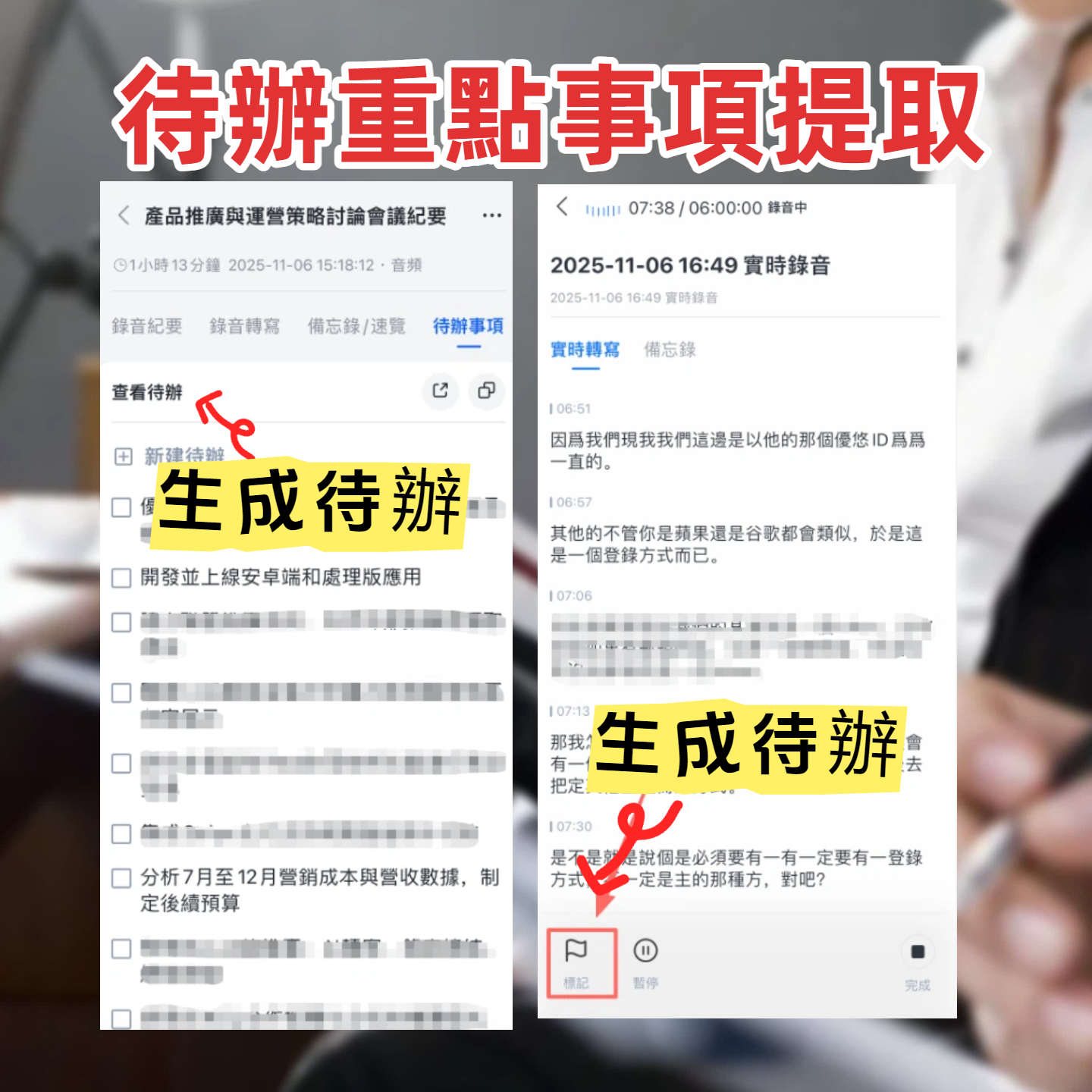
When a meeting starts, open Tinrec and it transcribes in real time. By the time the meeting ends, the summary and action items are already generated – who needs to do what and by when, at a glance.
Stop organizing recordings by hand
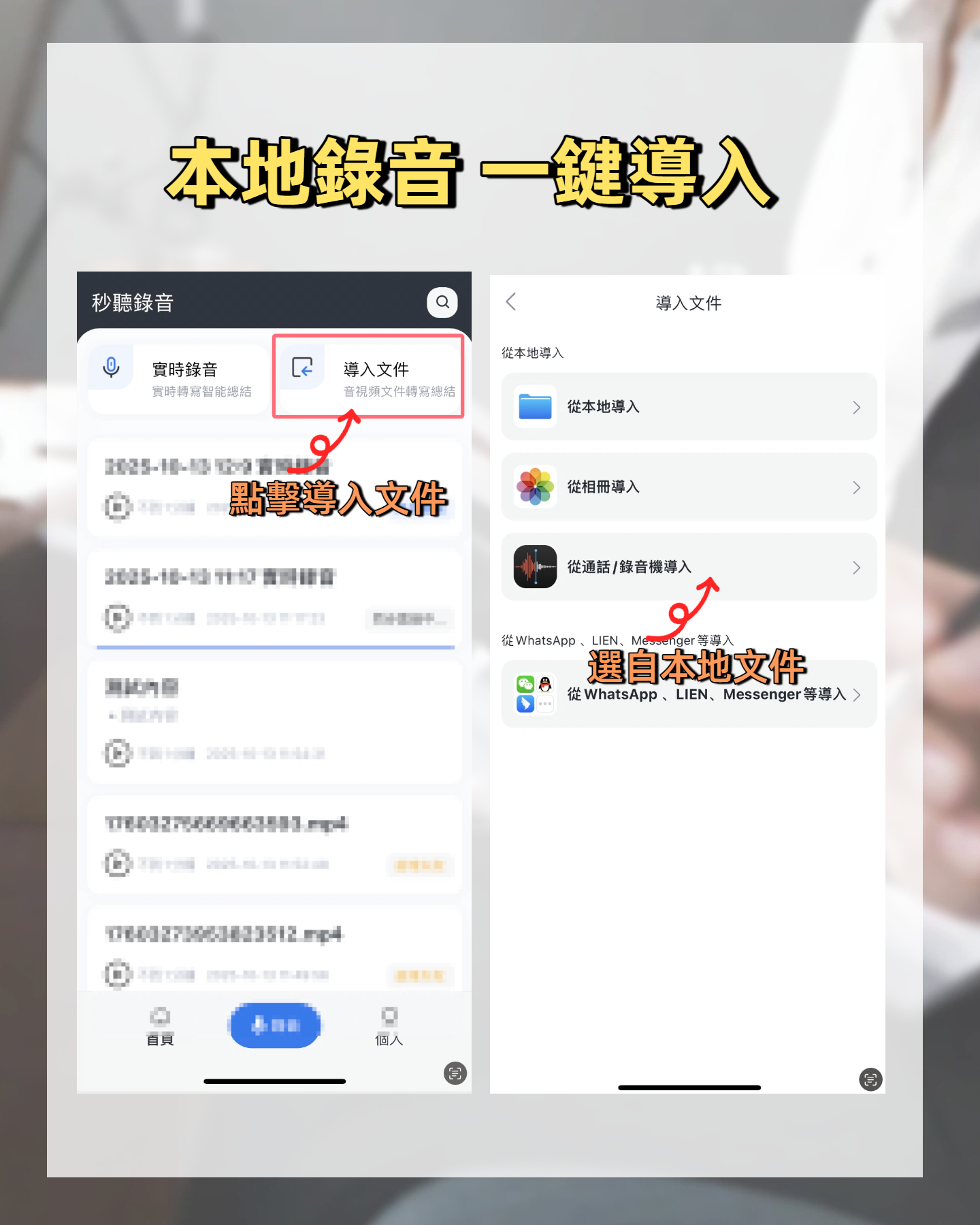
Upload audio or video and automatically get a transcript, summary, and action items
After recording, you can ask questions about the content. For example: “Who mentioned adjusting the marketing budget in the last meeting?” It won’t just return keyword search results – it understands the meaning and gives you the answer. Compared to most similar tools today, this is a clear differentiator.
It’s not just meetings: classroom recordings, interview files, YouTube videos – all can be thrown into Tinrec. I tested it with a 5-minute Cantonese news recording (iPhone indoors, some background noise), and the word error rate was about 8.3%. For a non-native language, that’s impressive.
Pro 1: It doesn’t just transcribe – it organizes for you
Auto-summarization, chapter splitting, and action item extraction let you focus on the discussion, not on typing. The transcribed content can be exported as a document, mind map, or synced directly to Notion for further editing.
Pro 2: Cross-platform and multi-source
You can use it on iPhone, Android, or web. Recordings from the office computer, quick ideas captured on your phone, old mp3 files – all organized in one place.
Pro 3: Excellent Chinese language processing
Compared to most English-centric competitors, Tinrec handles Traditional Chinese, Cantonese, and even mixed Chinese-English content smoothly, with very few strange sentence breaks or misinterpretations.
Limitations
The free version gives you 100 minutes of transcription per month. Heavy users may need to upgrade. But for a typical office worker with two or three half-hour meetings a week, you’ll stay within the free tier. Also, the quality of AI summaries depends on recording clarity – in very noisy environments, it’s best to optimize the recording conditions.
Who it’s best for?
If you frequently record meetings, classes, or interviews, and want to skip manual typing, even ask questions to find key points, while seamlessly switching between phone and computer – Tinrec is the most practical choice right now.
Alternatives to Tinrec
Every tool has its own positioning. If you want to explore other options, here are a few commonly compared alternatives.
Google Meet built-in transcription
If you already have Google Workspace Business or higher, you can turn on live captions and transcription during meetings. The upside: no extra app needed, and the transcript is saved directly to Google Docs. But its accuracy with Chinese and mixed Chinese-English is noticeably unstable, and it offers no AI summary or post-meeting Q&A. Crucially, it only works within Google Meet – useless outside that platform.
Otter.ai
A popular choice for English meetings. The free version gives 300 minutes per month and can auto-join meetings and produce notes. However, its support for Chinese and Cantonese is very limited. If you want to turn Chinese meetings into usable notes, Otter.ai is not the answer. If 95%+ of your meetings are in English, it might be a cheaper option than Tinrec.
Notta
Functionally closest to Tinrec, focusing on multilingual transcription and team collaboration. The free version has 120 minutes per month, and the paid plans are generous. But for Chinese content summarization and AI Q&A, Tinrec’s understanding and organization are more aligned with Chinese language habits, and Tinrec can directly process online video links, which Notta can’t.
Pitfall guide: 3 common mistakes when choosing a meeting notes tool
Pitfall 1: Thinking “built-in is fine”
Platforms like Google Meet and Zoom do have built-in transcription, but it’s usually hidden behind paid plans and limited to meetings on that platform, with almost no post-processing features. If you have only one or two online meetings a month, it might be okay. But if meetings are a regular part of your job, this quickly becomes a hidden time drain.
Pitfall 2: Looking only at price, ignoring limits
Some tools appear cheap monthly, but the free version has very few minutes or imposes file length limits. Calculate your actual monthly meeting and recording needs first, then compare plans – otherwise you’ll find you don’t have enough after purchasing.
Pitfall 3: Stopping at the verbatim transcript
Many people think the job is done once they have text. But the gap between a transcript and a usable meeting record is huge. Spend a little time getting used to AI auto-summarization, action item extraction, and conversational querying – you’ll save far more time than the transcription itself. For example, Tinrec’s AI Q&A: just ask “What were the three options discussed?” – much faster than manually replaying a 40-minute recording.
Conclusion: Which one should you choose?
Overall, if meeting notes are a daily need and you don’t stick to a single platform, Tinrec is the most balanced and practical choice. It doesn’t just solve the “recording” problem – it bundles post-processing, search, and reuse into one workflow.
- Only use Google Meet for meetings and have a paid Workspace account → Try the built-in transcription, but don’t expect it to summarize.
- Many Chinese meetings, frequent Chinese-English mixing → Tinrec, its language processing is clearly more suitable.
- Want to ask about content after recording → Tinrec, this is a feature almost absent from built-in transcription and competitors.
- Heavy English meetings with zero budget → Otter.ai free version (300 minutes) is sufficient.
- Need to unify phone, computer, and old files → Tinrec, with the most complete cross-platform and multi-source support.
I recommend downloading the Tinrec free version to try it out. The 100 minutes per month allowance is enough for two or three meetings to feel its effect. If it saves you time, then consider upgrading.
Turn every recording into actionable outcomes
Get 60 free transcription minutes when you sign in. No credit card required.
Related Reading
You might also like

2026 In-Depth Comparison of 3 AI Transcription Tools: Essential for Saving Time in Google Meet Meetings
Tired of spending hours after Google Meet calls transcribing meeting minutes? This article tests three AI transcription tools that work with Google Meet, comparing Cantonese accuracy, AI Q&A features, and free tiers to help you find the best option. Tinrec stands out overall.

Best Google Meet Screen Sharing Meeting Notes Tools: 3 Tested in 2026, Top Pick for Traditional Chinese
Struggling with meeting notes after Google Meet screen sharing? We tested 3 voice-to-text tools on accuracy, Chinese support, AI features, and pricing to find the best solution for Traditional Chinese users.

2026 Side-by-Side Test of 2 Google Meet Recording Methods: Which Saves More Post-Meeting Effort?
This article compares Google Meet's built-in recording with AI tool Tinrec for meeting capture and post-meeting organization. It analyzes recording thresholds, Chinese subtitles, AI summaries, task extraction, and cross-platform sharing to determine which method saves you more time.

2026 Google Meet Recording: No Hardware License Needed + AI Auto Meeting Minutes
Worried about Google Meet hardware license costs? Actually, you can use Tinrec to record meetings directly on your computer, automatically generating transcripts, summaries, and action items—no hardware needed. This guide walks you through setup to save on licensing fees.
2026 Hands-On Comparison of 3 Google Meet Meeting Recording Methods: Which Is the Most Discreet and Efficient?
Worried about Google Meet detecting screen recording? This article tests three meeting recording methods—built-in recording, manual note-taking, and AI voice-to-text—and analyzes which is the most discreet and efficient, recommending Tinrec for secure meeting capture.
Tutorial: 2026 Google Meet Screen Sharing Meeting Minutes – Real-Time Transcription + AI Auto Summary
This tutorial shows how to record Google Meet sessions while screen sharing using Tinrec, automatically transcribe meetings, generate AI summaries and action items, helping students and professionals efficiently capture meeting highlights.

2026 Comparison of 4 Google Meet Meeting Recording Tools: Can AI Notes Really Help You Leave on Time?
Tired of spending hours after Google Meet calls transcribing recordings and working overtime? We tested 4 AI recording tools and found that upgrading your webcam isn't the answer—choosing the right recording app is. Tinrec stands out with its AI conversation search and Cantonese accuracy. Want to know which tool saves the most time and lets you skip the late nights? Read on.

2026 Hands-on Review of 2 Google Meet Recording Tools: Who Can Make Perfect Meeting Notes After Muting Unwanted Speakers?
Google Meet hosts can mute participants, but what to do with the recording afterwards? This article puts two AI transcription tools—Tinrec and Otter.ai—to the test, comparing them across five dimensions: Chinese accuracy, input sources, AI features, pricing, and export options, to help you find the best choice for organizing Google Meet meetings.

2026 Head-to-Head Comparison of 3 Google Meet Breakout Room Recording Tools: Tinrec Makes Sure No Group Discussion Content Is Lost
Struggling to consolidate discussion content from Google Meet Breakout Rooms? This article tests 3 tools to turn group recordings and meeting content into searchable, summarizable actionable knowledge.