
Turn recordings into transcripts and summaries in minutes
Upload audio or video for multilingual transcription, AI notes, and action items
Ever struggle to take notes during meetings? Especially with Google Meet online meetings, the built-in recording feature leaves you with a video file that you still have to rewatch and manually transcribe to find key points.
AI tools like Tinrec claim to do it all—record, transcribe, and organize automatically—making meeting notes as easy as chatting.
In this article, I tested both solutions across five key dimensions to help you decide which one is better for office workers, freelancers, or anyone who needs to quickly organize meeting content.
Google Meet Built-in Recording vs Tinrec: Quick Overview
Google Meet's built-in recording is essentially a cloud-based "camcorder"—it saves the full audio and video to Google Drive, but if you need a text record, you have to manually listen back and take notes.
Tinrec is an AI audio/video organization tool that not only captures system audio from Google Meet but also automatically generates transcripts, summaries, and action items, and supports AI Q&A so you can directly "interrogate" specific parts of a recording.
Quick Facts:
- Price Barrier: Google Meet's built-in recording requires a paid Google Workspace plan (Business Standard or higher); Tinrec offers a free tier with basic monthly transcription minutes, while paid Pro monthly/yearly plans suit higher-volume users.
- Platform Support: Google Meet built-in recording works only on desktop Chrome; Tinrec has iOS, Android apps and a web version, usable on phone and computer.
- Core Difference: One gives you a video file; the other turns content into a searchable, organizable, and queryable text database.
Next, I compare them across the five most painful points of post-meeting organization.
Dimension 1: Post-Recording Organization
Google Meet's built-in recording produces an .mp4 file stored in your Google Drive. For a 60-minute meeting, finding a specific decision by a specific person means dragging the progress bar, listening, pausing, typing, and repeating.
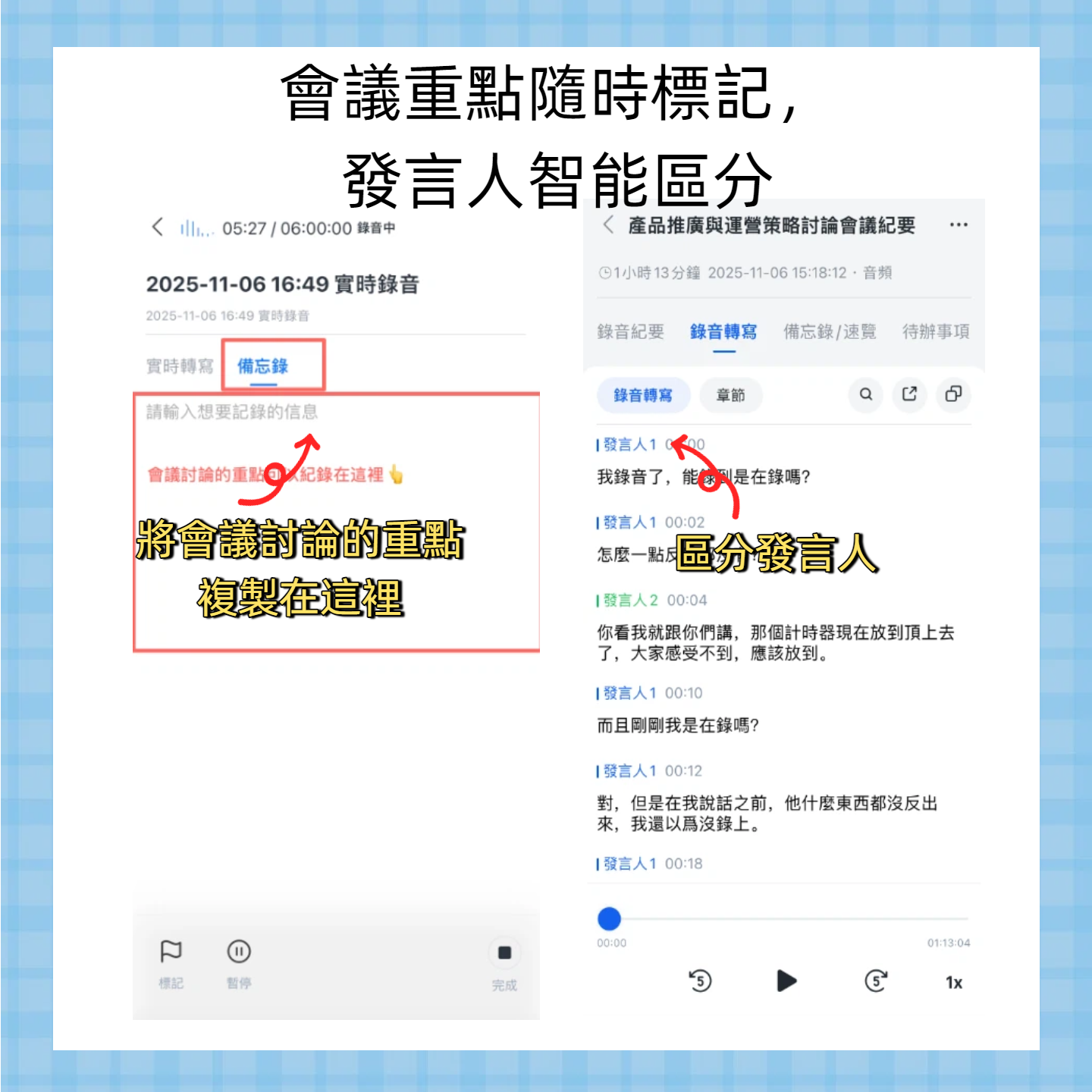
Tinrec transcribes text in real-time during recording and automatically generates AI summaries, speaker-segmented sections, and a list of action items. My common scenario: within 30 seconds after a meeting ends, I see three decisions and five action items, ready to copy to Slack.
→ This dimension: Tinrec clearly wins, especially for those who need quick meeting notes.
Dimension 2: Chinese Subtitles and Summaries
Google Meet's built-in recording supports live captions (English), but accuracy for Chinese meetings is mediocre and captions can't be exported. Recorded videos also can't automatically generate Chinese summaries.
Tinrec performs well in Traditional Chinese and mixed Chinese-English meetings. In my test of a product discussion mixing both languages, the transcript was clear and the AI summary captured key terms. It also supports extracting subtitles from videos, allowing standalone export of .srt subtitle files.
→ This dimension: Tinrec clearly wins; Chinese users will notice the difference.
Dimension 3: Cross-Platform Access and Sharing
Google Meet recordings are essentially only accessible via Google Drive; sharing involves links or permissions. For those who organize notes in Notion or OneNote, manual transfer is required.
Tinrec's transcripts, summaries, and action items can be exported as Word, PDF, or TXT with one click, and can sync directly to Notion, Google Docs, and Dropbox—tools I use daily. I keep all recordings in Tinrec and export to different note apps by project.
Stop organizing recordings by hand
Upload audio or video and automatically get a transcript, summary, and action items
→ This dimension: Tinrec clearly wins, with great cross-tool flexibility.
Dimension 4: AI Q&A and Smart Search
Google Meet recordings are just videos—you can only watch, not ask. To confirm a number or timestamp, you have to replay the entire segment.
Tinrec includes an AI chat query feature where you can type: "What was the marketing budget number from last Wednesday's meeting?" It retrieves the relevant segment from past recordings and marks the timestamp. For those attending five or six meetings a week, it's like having a personal meeting assistant.
→ This dimension: Tinrec clearly wins, making historical meeting data truly useful.
Dimension 5: Price Barrier and Flexibility
Google Meet's built-in recording is "free on the surface," but you actually need a paid Google Workspace account (the basic plan can't record), starting at around US$12/month. For individual users or small teams, that cost buys only recording functionality.
Tinrec has a completely free plan with basic monthly transcription minutes, enough for occasional meetings or classes. If usage grows, you can choose a weekly pass (for short-term intensive use) or Pro monthly/yearly plans with transparent pricing. You can try the free version first to see if it fits.
→ This dimension: For those just testing the waters, Tinrec's zero barrier is more advantageous.
What Are Their Unique Advantages?
Tinrec's Unique Advantages (3 Items)
- More than meetings: organize various audio/video: Besides recording Google Meet, you can also upload audio files or paste YouTube/TikTok video links to transcribe—great for learning notes or content creation.
- Automated meeting post-production: Summaries, chapters, action items, and mind maps generated in one go. AI can also help create formal reports or tables.
- Long-term knowledge base: All recordings become searchable and queryable, never turning into useless file clutter.
Google Meet Built-in Recording's Unique Advantages (2 Items)
- One-click start, no installation: If the meeting host has permission, just click to record—simple with almost no learning curve.
- Complete meeting visuals: Includes shared screens, slides, and participant expressions, ideal for situations needing full visual records (e.g., design discussions, training).
Summary: Which One Should You Choose?
- If you only need to record for documentation, with lots of screen sharing, and your company already pays for Google Workspace → Google Meet's built-in recording is sufficient.
- If you want instant meeting transcripts, automatic summaries, and action items without manual work → Tinrec is for you.
- If you're a student, freelancer, want to save money and efficiently organize online classes or interviews → Download Tinrec's free version first; within a week you'll know if it's right for you.
In a nutshell: Google Meet's built-in recording is a "recording tool," while Tinrec is an "organizing and understanding tool." For most people who need text records and track action items, Tinrec's time-saving effect is significant.
Frequently Asked Questions
Can the free version of Google Meet record?
No, personal free Google accounts don't have recording. Only Google Workspace Business Standard or higher users can start recording and save files to Google Drive.
Does Tinrec need special software to record Google Meet?
No. You can record via phone microphone near the computer speakers, or use the "System Audio Recording" feature on the Tinrec desktop app, similar to screen recording software—easy to learn in minutes.
How accurate is Tinrec's transcription?
In quiet environments with clear speech, Traditional Chinese transcription quality is quite good. However, if multiple people talk simultaneously or background noise is high, some segments may need manual review. It's recommended to re-listen for important decisions.
Will Tinrec leak company secrets after recording?
Tinrec uses encrypted transmission and storage and does not actively share your audio or text data. For confidential meetings, please read the official privacy policy or consult your company's IT staff.
How long can Tinrec's free version record?
The free version provides basic monthly transcription minutes (actual minutes per product page), enough for several short meetings under 30 minutes. For longer sessions, choose the weekly pass or Pro plan.
Can I upload Google Meet recordings to Tinrec for transcription?
Yes! Download the Google Meet recording, then upload it to Tinrec (supports common formats like .mp4). It will transcribe and summarize just like real-time recording.
Turn every recording into actionable outcomes
Get 60 free transcription minutes when you sign in. No credit card required.
Related Reading
You might also like

How to Take Meeting Minutes on Google Meet in 2026? 5 Steps with Tinrec for Free
Tired of being overwhelmed by post-meeting notes after Google Meet calls? A mid-level manager tested 5 steps using Tinrec for free to convert meeting recordings into summaries and action items, saving over an hour a day from manual work.

Tinrec vs Google Meet 2026: 4-Dimension Comparison, Which Is Better for Meeting Minutes?
This article compares Tinrec and Google Meet on meeting recording and organization across four dimensions—language support, AI capabilities, and cost—to help you choose the best post-meeting tool.

2026 Testing 5 Google Meet Alternatives: Which Captures Meetings Best?
Reddit users rave about Google Meet alternatives that not only improve meetings but also auto-transcribe, summarize, and create to-dos. A hands-on test of Tinrec and 4 other tools.

Tinrec vs Otter.ai 2026: A 5-Dimension Showdown – Which Is Better for Chinese Meeting Transcription?
With Google Meet background reversal and frequent online meetings, which recording tool should you use to organize meeting content? This article deeply compares Tinrec and Otter.ai from 5 dimensions: input sources, Chinese accuracy, AI organization features, cross-platform support, and price, to help you choose the best solution for Chinese users and cross-source audio/video data organization.

2026 Google Meet Meeting Notes Free Plan Roundup: Tinrec at a Glance
Thinking about buying a Google Meet account just to record meetings? There's a more cost-effective choice. This article covers Tinrec's free and paid plans, showing you how to automatically get meeting transcripts, summaries, and action items without spending extra on an account.

2026 In-Depth Comparison of 3 AI Transcription Tools: Essential for Saving Time in Google Meet Meetings
Tired of spending hours after Google Meet calls transcribing meeting minutes? This article tests three AI transcription tools that work with Google Meet, comparing Cantonese accuracy, AI Q&A features, and free tiers to help you find the best option. Tinrec stands out overall.

Best Google Meet Screen Sharing Meeting Notes Tools: 3 Tested in 2026, Top Pick for Traditional Chinese
Struggling with meeting notes after Google Meet screen sharing? We tested 3 voice-to-text tools on accuracy, Chinese support, AI features, and pricing to find the best solution for Traditional Chinese users.

2026 Google Meet Recording: No Hardware License Needed + AI Auto Meeting Minutes
Worried about Google Meet hardware license costs? Actually, you can use Tinrec to record meetings directly on your computer, automatically generating transcripts, summaries, and action items—no hardware needed. This guide walks you through setup to save on licensing fees.
2026 Hands-On Comparison of 3 Google Meet Meeting Recording Methods: Which Is the Most Discreet and Efficient?
Worried about Google Meet detecting screen recording? This article tests three meeting recording methods—built-in recording, manual note-taking, and AI voice-to-text—and analyzes which is the most discreet and efficient, recommending Tinrec for secure meeting capture.