
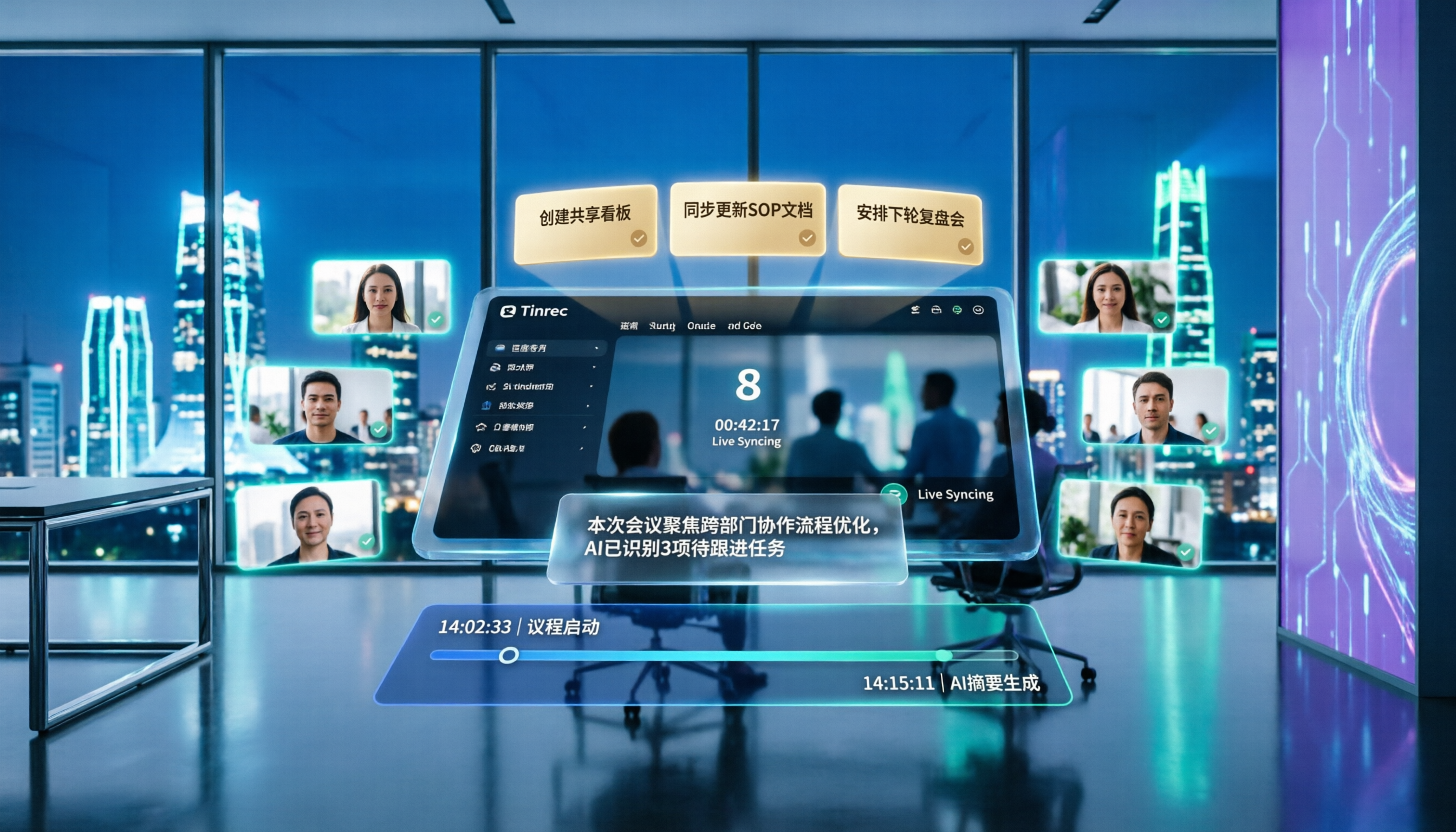
Turn recordings into transcripts and summaries in minutes
Upload audio or video for multilingual transcription, AI notes, and action items
5 Zoom and Google Meet Alternatives: Quick Overview
If you're looking for an alternative to Zoom or Google Meet, it's usually not because they don't work, but because you've hit specific pain points: free meeting time limits, messy meeting notes, or forgetting who said what after the call.
I tested 5 practical alternatives, focusing on whether the free tier is sufficient, and included Tinrec in the comparison because many people overlook the fact that video conferencing tools and meeting note-taking tools often need to be used together.
| Tool | Core Positioning | Free Tier Limits | Best For |
|---|---|---|---|
| Google Meet | Browser-based video conferencing | Free meetings up to 60 minutes | Teams already using Google Workspace |
| Microsoft Teams | Enterprise collaboration hub | Requires a Microsoft account | Organizations subscribed to Microsoft 365 |
| Cisco Webex | Enterprise video and webinars | Free meetings up to 40 minutes | Those hosting online webinars |
| Zoho Meeting | Budget-friendly video conferencing | Free plan available; advanced features require payment | Small teams with limited budgets |
| Jitsi Meet | Open-source, no-registration video conferencing | Basically free with no time limits | Privacy-conscious users who prefer not to sign up |
| Tinrec | AI meeting notes and team collaboration | Free tier includes basic quota | Those who want to turn meeting content into documents |
This comparison focuses not just on "can you hold a meeting," but also on "where does the meeting content go afterward."
Dimension 1: Ease of Getting Started
Google Meet has the lowest barrier to entry—just open a browser, no software installation needed. This is convenient for impromptu meetings, but the downside is that it degrades more noticeably than Zoom when the network is unstable.
Jitsi Meet goes a step further: you can start a meeting on multiple Jitsi servers without creating an account, making it ideal for users who don't want to leave personal data.
Microsoft Teams and Cisco Webex lean toward a "log in first, then use" model. Teams is deeply integrated with Microsoft 365, so if your company already uses it, activation is nearly zero-cost. Webex requires installing an app to access full features.
→ This dimension: Google Meet and Jitsi Meet win, ideal for those who want to jump into a meeting quickly.
Dimension 2: Free Plan Meeting Time Limits
This is the primary reason many people seek alternatives. Zoom's free plan has a 40-minute limit, Google Meet's free plan now allows 60 minutes, and Webex's free plan is also capped at 40 minutes.
If you need meetings longer than an hour without paying, Jitsi Meet is currently the most lenient option, with essentially no time limit.
Zoho Meeting's free plan also offers a certain quota, but its paid plans start at $1 per host per month, making it a viable option for budget-conscious users.
→ This dimension: Jitsi Meet wins; if you need formal business features, Zoho Meeting is a low-cost choice.
Dimension 3: Post-Meeting Content Organization
If you care about "whether meeting notes are preserved," the previous tools share a common limitation: they primarily handle the live meeting, leaving the follow-up organization to you.
Google Meet and Webex have built-in transcription, but usually only in higher-tier paid plans. Teams meeting recordings go to OneDrive or SharePoint, but turning them into summaries and action items still takes time.
Tinrec takes a different approach. It doesn't handle the meeting itself; instead, its desktop app captures system audio directly, working with Zoom, Google Meet, Teams, or Webex without needing a bot to join the meeting, and converts speech to text in real time.
For a 30-minute project meeting, Tinrec generates a live transcript, then organizes it into summaries, chapters, and key points, automatically extracting action items. You can search the transcript for a specific decision or ask the AI, "What concerns did the client raise?"
→ This dimension: Tinrec wins; the earlier tools handle "the meeting," while Tinrec handles "the work after the meeting."
Dimension 4: Chinese and Multilingual Meeting Experience
Google Meet's Chinese interface is well-designed, and live captions support Traditional Chinese, but quality drops noticeably when multiple people speak simultaneously or there's background noise.
Stop organizing recordings by hand
Upload audio or video and automatically get a transcript, summary, and action items
Teams and Webex primarily target Western markets; while their live transcription for Chinese meetings has improved, there's still a gap compared to tools built with Chinese in mind.
Tinrec offers more comprehensive support for Chinese, Traditional Chinese, and mixed Chinese-English content. In tests with mixed-language product meetings, summaries and action items accurately captured the key points. It also provides real-time translation and bilingual side-by-side views, so you can read translations while listening in cross-language meetings.
The team glossary feature is also worth mentioning. You can pre-set company product names and project codes to improve transcription stability and reduce misrecognition of proper nouns.
→ This dimension: Tinrec wins, especially for Chinese-speaking teams or those needing bilingual meeting notes.
Dimension 5: Team Collaboration and Knowledge Retention
Google Meet and Teams excel in ecosystem integration: Meet lets you schedule meetings directly from Google Calendar, while Teams is deeply tied to Microsoft 365.
However, both share a common issue: meeting content is scattered across different services. Meet recordings go to Drive, Teams recordings to OneDrive or SharePoint, and over time, finding a specific decision often means digging through multiple places.
Tinrec's team plan consolidates everything into a single team space. All meeting data—recordings, transcripts, summaries, action items—belongs to the team and doesn't disappear when a member leaves. Admins can allocate seats, monitor usage, and track audit logs. Members without a seat can still view data, but need a seat to upload, edit, or export.
→ This dimension: Tinrec wins, ideal for organizations that want to turn meetings into team assets.
What Are the Unique Strengths of Each?
Tinrec's Unique Strengths
- Bot-free meeting recording: The desktop app captures system audio directly, so no extra bot needs to join Zoom, Meet, or Teams meetings, avoiding disruption to participants.
- More than just transcripts: Automatically generates summaries, chapters, and action items, and lets you ask follow-up questions via AI.
- Team space and governance: Roles, seats, usage analytics, audit logs, and an audio recycle bin turn meeting data into manageable team assets.
- Chinese and multilingual experience: Supports real-time translation, bilingual transcripts, and team glossaries.
Unique Strengths of Other Tools
- Google Meet's browser convenience: No installation needed—just open a link to join, with the smoothest integration with Google's ecosystem.
- Microsoft Teams' enterprise integration depth: If you're already a Microsoft 365 user, Teams is nearly a zero-extra-cost choice.
- Jitsi Meet's open-source and no-registration model: Privacy-conscious users who don't want to tie an account can start meetings directly.
Summary: Who Should You Choose?
- Impromptu meetings without installing software → Google Meet or Jitsi Meet, just open a browser
- Company already uses Microsoft 365 → Teams is the easiest, no need to introduce new tools
- Need to host webinars or prioritize enterprise security → Cisco Webex
- Limited budget but need formal meeting features → Zoho Meeting
- Need to organize content, track action items, and build team knowledge after meetings → Tinrec, which fills the gap where the other tools are weakest
In a nutshell: video conferencing tools make meetings happen; Tinrec makes meetings valuable. If your pain point isn't the meeting itself but the recording, organization, and follow-up afterward, try Tinrec's free plan first.
Frequently Asked Questions
Can Google Meet's free plan record meetings?
No, Google Meet's free plan doesn't support recording. Recording and attendance tracking require upgrading to a paid Google Workspace plan.
Can I record online meetings without installing software?
Yes, but it depends on the tool. Tinrec's desktop app captures system audio directly, so no bot needs to join the meeting, and the meeting platform doesn't need to enable recording permissions.
Is Jitsi Meet really completely free?
Jitsi Meet's open-source version and public servers are basically free, but if you self-host, you'll need to handle server and maintenance costs yourself.
Is Tinrec's free plan sufficient?
The free plan provides a basic quota to experience recording, import, summarization, and transcription. For occasional meeting recordings, the free plan is a good start; if you have meetings to organize weekly, consider the Pro or team plans.
Can these tools be used together?
Yes. For example, you can use Google Meet for the meeting and Tinrec's desktop app to record the content simultaneously. They don't conflict; they complement each other.
Can meeting transcription accuracy be guaranteed 100%?
It's not advisable to expect that. Any AI transcription tool is affected by audio quality, background noise, accents, and overlapping speech. For critical content, cross-check the transcript against the original recording.
References
- The 8 best Zoom alternatives in 2026 | Zapier
- Top 10 Zoom Alternatives That Actually Work For Small Teams (2026)
- 8 Best Video Conferencing Alternatives to Google Meet | Noota
- r/degoogle on Reddit: Google Meet/Zoom Alternatives? (And thoughts on fairmeeting?)
- Top 7 of the Best Google Meet Alternatives
Turn every recording into actionable outcomes
Get 60 free transcription minutes when you sign in. No credit card required.
Related Reading
You might also like

for mac google meet: Audio Permissions, Recording, and Transcript Handoff for Google Meet on Mac
Recording Google Meet on a Mac usually gets stuck not because you cannot find the record button, but because macOS separates 'capture system audio' and 'use microphone' into two independent authorizations. This article proceeds in three parts—permission setup, recording, and post-meeting organization—explaining how to determine which layer is causing meeting audio not to be recorded, and how to organize the recording into a transcript, summary, and to-dos and hand it off to a colleague.

How to Change Your Google Meet Background on Mobile: Check Account and Version Requirements First, Then Follow the Pre-Meeting or In-Meeting Path
When you're told to join a client-facing meeting and only have your phone on hand, the last thing you want is to discover five minutes before the call that you can't find the background option. This article first explains what's required to use backgrounds on mobile (account type, app version, device permissions), then walks through two paths step by step—one before you join the meeting and one during it—and closes with a pre-meeting checklist and alternatives if you can't find the option.

Google Meet 2026 APK Installed: Choosing a Meeting Notes Tool on Android — First Look at the Mobile vs. Desktop Organization Gap
Installing the Google Meet 2026 APK is just the first step. This article uses four dimensions to narrow down meeting notes tools that claim to 'support Google Meet' to two or three options, focusing on the real-world gap between Android mobile and desktop post-meeting organization. Each dimension includes specific questions you should confirm with the product page or vendor.

Google Meet 2026 Meeting Notes Capability Review: Where Built-in Transcription Ends and How to Split Post-Meeting Action Items and Deliverables
A practical mid-level manager's review of Google Meet 2026 recording and transcription coverage, explaining the responsibility boundaries for post-meeting summaries, action items, and deliverables, with recommendations for Chinese and mixed Chinese-English meetings, data storage, and team handoffs.

Which Google Meet 2026 APK Should You Install? Android Install Source Guide, Meeting Prerequisites, and Backup Recording Handoff Order When Nothing Was Recorded
When you're assigned to join a Google Meet on an Android phone and handle post-meeting notes, first clarify whether you're attending, hosting, or responsible for organizing. Then decide whether to install from the official app store or a third-party APK source, what prerequisites are needed to sign in, and how to use audio recording and transcription in order to fill in the transcript and action items and hand them off when the meeting wasn't recorded.

Google Meet 2026 Meeting Notes Capabilities: Where Built-In Transcription Ends and How to Split Post-Meeting To-Dos and Deliverables
Google Meet 2026 recording and transcription are not automatically enabled by default, and post-meeting summaries, to-dos, and deliverables still have coverage boundaries. This article walks through the actual workflow to assess built-in platform capabilities, explains the differences in organizing Chinese and mixed Chinese-English meetings, the distinction between data storage and team spaces, and offers recommendations for dividing post-meeting to-dos, deliverables, and data storage.
How to Choose a Google Meet Note-Taking Tool for Windows: Four Dimensions to Narrow Down from Cross-Device Gaps to Two or Three Options
Meetings happen on Google Meet on a Windows PC, but organizing often gets picked up on a phone or another device. This article uses four dimensions (how audio gets in, how far post-meeting output goes, the organizing gap between Windows and phone, and whether data stays in a personal or team space) to narrow down candidate tools to two or three, with specific questions to ask product pages or vendors for each dimension.
How to Choose a Google Meet Meeting Notes Tool for PC: Narrow a Dozen Options to Two or Three with Four Dimensions, and What to Confirm with Vendors for Each
After a Google Meet call on a Windows PC, what you actually need to deliver is decisions, owners, deadlines, and an archivable record. This article uses four dimensions to help you narrow a dozen tools that claim Google Meet support down to two or three, with specific questions to confirm on product pages or with vendors for each dimension.

What You Need for Google Meet: Pre-Meeting Role Checklist and Post-Meeting Handoff
From the perspective of administrative assistants and project coordinators, this guide breaks down the prerequisites for joining or hosting a Google Meet by role, including account requirements, organizational settings, recording permissions, and extra conditions for external attendees. It also provides a pre-meeting checklist and a post-meeting handoff sequence for transcripts, decisions, and action items.