

Turn recordings into transcripts and summaries in minutes
Upload audio or video for multilingual transcription, AI notes, and action items
Meetings, research, client interviews—the hardest part isn't the conversation itself, but having to replay the recording and type up the transcript afterward. A one-hour recording can easily take three hours to transcribe, with constant pausing, rewinding, and window switching. What you need isn't a voice recorder, but a tool that turns your recordings into editable text directly. This article tests several interview transcription tools to help you save those overtime hours.
3 Key Points to Understand Before Choosing Transcription Software
First, Cantonese recognition capability. In Hong Kong, meetings and interviews rarely happen entirely in standard Mandarin. Many tools claim to support Chinese, but when you test them with a Cantonese recording, many will turn "佢話" into "西瓜" or "唔該" into "唔乖." Before choosing software, make sure it supports Cantonese or Traditional Chinese accents, and ideally test it with your own recordings.
Second, what you can do after transcription. A transcript is just the first step. You need to quickly find key points, generate summaries, and extract action items—not manually Ctrl+F through a 30-page document. AI organization features are what truly save time.
Third, cross-platform and collaboration needs. You might record on an iPhone today, edit on Windows at the office, and share with colleagues tomorrow. If the software only supports one platform or lacks team sharing features, it'll become a headache in the long run.
Tinrec (秒听录音)—An All-in-One Solution for Interview Transcription
Tinrec is an AI meeting notes tool designed for individuals and teams. It not only supports audio-to-text conversion but also helps you organize interview content into summaries, action items, and a searchable database. It supports iOS, Android, and web versions, so you can organize anytime, no matter where you record.
Hands-on experience: When you open Tinrec during an interview, it generates the transcript in real time—no need to wait until the recording ends. After the interview, AI automatically generates summaries and key points, and even extracts action items mentioned by the interviewee. The most useful feature is the AI Q&A—you can ask, "What did the interviewee think about the budget?" and it will give you a direct answer based on semantic understanding, not just keyword search. This feature is rare among competitors in the same price range.
Chinese and multilingual performance: Tinrec supports Chinese, Traditional Chinese, and multilingual meeting transcription, plus real-time translation, allowing you to view the original text, translation, or side-by-side bilingual view. This is a major advantage for users who frequently have interviews mixing Chinese and English. The team version also supports custom vocabulary, letting you add industry-specific terms to improve recognition accuracy.
Team collaboration: If you're doing research or market surveys with a team, Tinrec's team space lets you store all interview recordings, transcripts, and summaries in one place. Members can search and reuse historical data, while admins can manage seats, monitor usage, and review audit logs. Even if a colleague leaves, the interview data won't disappear, making handovers much easier.
Limitations: The free version has monthly usage limits, so heavy users will need to upgrade. Additionally, while AI transcription significantly reduces manual work, it's still advisable to cross-check important content against the recording in cases of heavy accents, background noise, or multiple people speaking at once.
Stop organizing recordings by hand
Upload audio or video and automatically get a transcript, summary, and action items
Who it's for: If you need to handle Cantonese or mixed Chinese-English interviews, want to use AI to find key points right after recording, or need to share interview data with your team, Tinrec is a comprehensive choice on the market today.
Other Interview Transcription Tool Options
Yating Transcriber: An AI speech-to-text service developed in Taiwan, designed for Taiwanese accents, supporting Mandarin, Taiwanese, and mixed Chinese-English. Accuracy is decent, but the interface and features focus mainly on individual recording organization, lacking team collaboration and AI Q&A. If you only do occasional personal interviews, it's worth a try.
oTranscribe: An open-source, free transcription tool that requires no installation—just open your browser and use it. It integrates a player and text editor on the same page, with keyboard shortcuts for pausing, rewinding, and inserting timestamps. You can export to Markdown or plain text when done. However, it doesn't have automatic speech-to-text; you still have to type manually, but it simplifies the workflow.
Speed Typing Transcriber: A free transcription software from Taiwan, featuring a text editor, timeline annotations, auto-save, and keyboard-controlled playback. The latest version adds speech recognition, but it's still primarily designed to assist manual transcription. Compared to Tinrec, it lacks AI summaries, Q&A, and team collaboration, making it suitable for users who prefer the traditional manual transcription process.
Notta: A multilingual transcription tool supporting over 50 languages, converting recordings into transcripts and generating summaries. It overlaps with Tinrec in many features, but Tinrec's bot-free desktop recording and team space management are better suited for users handling online meetings and team collaboration.
Avoidance Guide: 3 Common Mistakes When Choosing Interview Transcription Software
Mistake 1: Only looking at official accuracy claims. Many tools claim accuracy rates as high as 98%, but that number is usually measured in a quiet recording studio. Real interviews have background noise, accents, and tone variations, which significantly lower accuracy. We recommend testing with your own recordings for free to see real performance.
Mistake 2: Ignoring post-transcription organization features. If you only use the software as an "audio-to-text" tool, you're wasting its value. AI summaries, action item extraction, and Q&A are what save you the most time. Asking "What are the key points of this interview?" right after recording is much better than manually flipping through 30 minutes of transcript.
Mistake 3: Not considering team sharing needs. Doing interviews alone versus with a team are completely different needs. If you need to share recordings, transcripts, and analysis results with colleagues, you must choose a tool with team space features; otherwise, files will scatter across individual computers and quickly become a mess.
Summary: Which One Should You Choose?
If you need a tool that can handle Cantonese interviews, automatically generate summaries and action items, support AI Q&A, and allow team data sharing, Tinrec is the most comprehensive choice.
- Need Cantonese and mixed Chinese-English transcription → Tinrec (multilingual support, strong Chinese performance)
- Want to use AI to find key points right after recording → Tinrec (AI Q&A feature is rare at this price)
- Doing interviews or research as a team → Tinrec (team space, seat management, usage analytics)
- Only occasionally transcribe manually and don't want to install software → oTranscribe (free, browser-based)
- Mainly handling English content with a limited budget → Consider other English transcription tools
We recommend trying Tinrec's free version first, testing it with your own interview recordings, and upgrading if it works well. The most important thing is to choose a tool that fits your needs, not just follow the crowd.
References
- Yating Transcriber
- oTranscribe Recommendation! Cloud Transcription Service, No Download or Installation Needed – Free Resource Network
- Speed Typing Transcriber Download for Transcripts/Subtitles, Thesis Speech Recognition – FUNTOP Info Site
- Yating Transcriber App – App Store
- Notta – Accurate Transcript, Speech to Text, Meeting Recording, AI Summary – App Store
Turn every recording into actionable outcomes
Get 60 free transcription minutes when you sign in. No credit card required.
Related Reading
You might also like

for mac google meet: Audio Permissions, Recording, and Transcript Handoff for Google Meet on Mac
Recording Google Meet on a Mac usually gets stuck not because you cannot find the record button, but because macOS separates 'capture system audio' and 'use microphone' into two independent authorizations. This article proceeds in three parts—permission setup, recording, and post-meeting organization—explaining how to determine which layer is causing meeting audio not to be recorded, and how to organize the recording into a transcript, summary, and to-dos and hand it off to a colleague.

How to Change Your Google Meet Background on Mobile: Check Account and Version Requirements First, Then Follow the Pre-Meeting or In-Meeting Path
When you're told to join a client-facing meeting and only have your phone on hand, the last thing you want is to discover five minutes before the call that you can't find the background option. This article first explains what's required to use backgrounds on mobile (account type, app version, device permissions), then walks through two paths step by step—one before you join the meeting and one during it—and closes with a pre-meeting checklist and alternatives if you can't find the option.

Google Meet 2026 APK Installed: Choosing a Meeting Notes Tool on Android — First Look at the Mobile vs. Desktop Organization Gap
Installing the Google Meet 2026 APK is just the first step. This article uses four dimensions to narrow down meeting notes tools that claim to 'support Google Meet' to two or three options, focusing on the real-world gap between Android mobile and desktop post-meeting organization. Each dimension includes specific questions you should confirm with the product page or vendor.

Google Meet 2026 Meeting Notes Capability Review: Where Built-in Transcription Ends and How to Split Post-Meeting Action Items and Deliverables
A practical mid-level manager's review of Google Meet 2026 recording and transcription coverage, explaining the responsibility boundaries for post-meeting summaries, action items, and deliverables, with recommendations for Chinese and mixed Chinese-English meetings, data storage, and team handoffs.

Which Google Meet 2026 APK Should You Install? Android Install Source Guide, Meeting Prerequisites, and Backup Recording Handoff Order When Nothing Was Recorded
When you're assigned to join a Google Meet on an Android phone and handle post-meeting notes, first clarify whether you're attending, hosting, or responsible for organizing. Then decide whether to install from the official app store or a third-party APK source, what prerequisites are needed to sign in, and how to use audio recording and transcription in order to fill in the transcript and action items and hand them off when the meeting wasn't recorded.

Google Meet 2026 Meeting Notes Capabilities: Where Built-In Transcription Ends and How to Split Post-Meeting To-Dos and Deliverables
Google Meet 2026 recording and transcription are not automatically enabled by default, and post-meeting summaries, to-dos, and deliverables still have coverage boundaries. This article walks through the actual workflow to assess built-in platform capabilities, explains the differences in organizing Chinese and mixed Chinese-English meetings, the distinction between data storage and team spaces, and offers recommendations for dividing post-meeting to-dos, deliverables, and data storage.

How to Choose a Google Meet Note-Taking Tool for Windows: Four Dimensions to Narrow Down from Cross-Device Gaps to Two or Three Options
Meetings happen on Google Meet on a Windows PC, but organizing often gets picked up on a phone or another device. This article uses four dimensions (how audio gets in, how far post-meeting output goes, the organizing gap between Windows and phone, and whether data stays in a personal or team space) to narrow down candidate tools to two or three, with specific questions to ask product pages or vendors for each dimension.
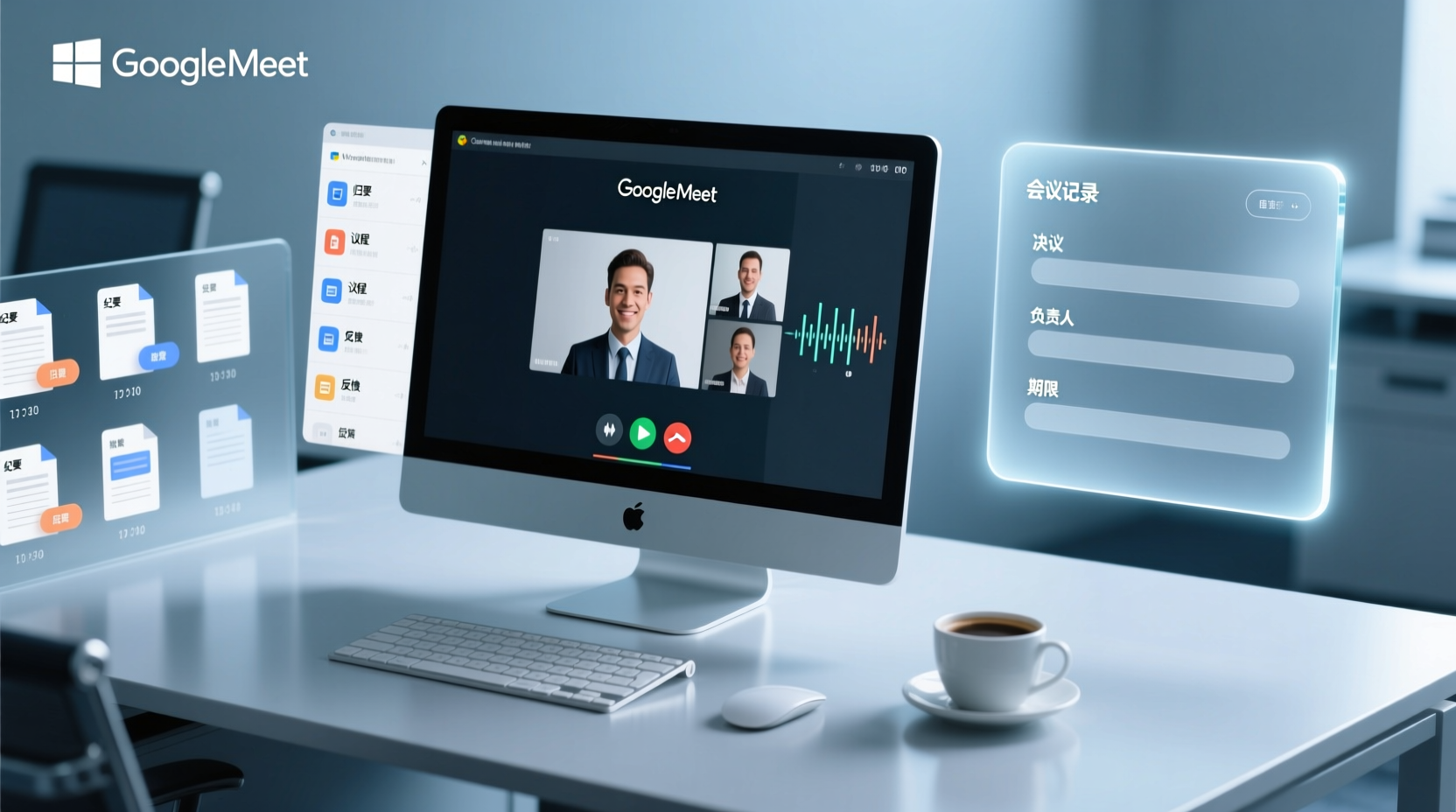
How to Choose a Google Meet Meeting Notes Tool for PC: Narrow a Dozen Options to Two or Three with Four Dimensions, and What to Confirm with Vendors for Each
After a Google Meet call on a Windows PC, what you actually need to deliver is decisions, owners, deadlines, and an archivable record. This article uses four dimensions to help you narrow a dozen tools that claim Google Meet support down to two or three, with specific questions to confirm on product pages or with vendors for each dimension.

What You Need for Google Meet: Pre-Meeting Role Checklist and Post-Meeting Handoff
From the perspective of administrative assistants and project coordinators, this guide breaks down the prerequisites for joining or hosting a Google Meet by role, including account requirements, organizational settings, recording permissions, and extra conditions for external attendees. It also provides a pre-meeting checklist and a post-meeting handoff sequence for transcripts, decisions, and action items.